Rūḥ of Allah and Paraclete of Jesus: One Divine Personality Explaining the Resurrection
Christianity calls the promised revealer the Paraclete, Comforter, Holy Spirit, and Spirit of Truth; the Qur’an speaks of the Rūḥ al-Qudus and of divine agency that collects, recites, guides, and explains revelation. This paper argues that these are not rival missions but one divine mission—and, within the Adishakti.org theological thesis, one and the same divine personality revealed in Shri Mataji Nirmala Devi.
- Summary: One Spirit, One Mission
- Thesis and Method: From Text to Proposed Fulfillment
- The Johannine Paraclete: A Divine Person Who Speaks
- Stevick Verbatim and Al-Qiyāmah 75:16–19
- The Comforter Makes Humanity Holy
- The Qur’anic Rūḥ: Revelation, Truth, Guidance
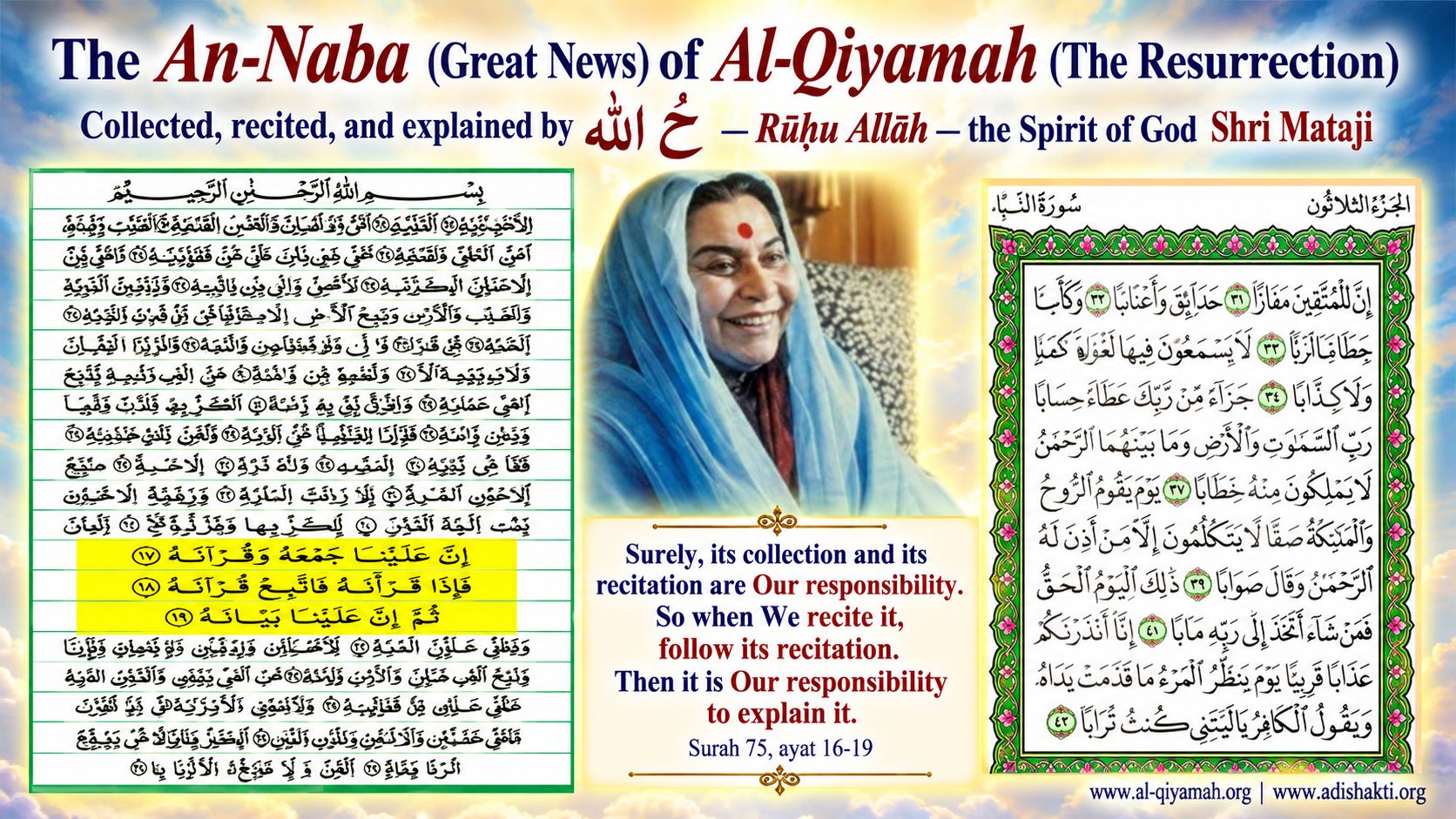
- Al-Qiyāmah 75:16–19: God Explains the Resurrection
- The Common Prediction: The Spirit Unknown, Resurrection Disputed
- Correspondence Table: Paraclete and Rūḥ
- From Functional Unity to One Divine Personality
- Shri Mataji: The Rūḥ and Paraclete in Historical Mission
- Resurrection as Transformation and Restoration
- Academic Qualification and Alternative Readings
- Conclusion: The Rūḥ and Paraclete Are One
- References
Summary: One Spirit, One Mission
This paper advances a direct comparative-theological thesis: the Rūḥ of Allah in the Qur’anic economy of revelation and the Paraclete or Comforter promised by Jesus in John 14–16 disclose one divine agency, one revelatory purpose, and—within the Adishakti.org interpretation—one divine personality. The vocabulary differs because the scriptures arise within different linguistic and theological worlds; the mission does not. In John, the Paraclete comes from God, teaches, reminds, testifies, convicts, guides into truth, speaks what is heard, declares what is to come, and communicates what belongs to Christ. In the Qur’an, the Holy Spirit brings revelation from the Lord in truth for confirmation and guidance, while Surah al-Qiyāmah places the collection, recitation, and explanation of revelation under divine agency precisely within the proclamation of Resurrection.
The argument is therefore not merely that Christianity and Islam happen to contain similar ideas about Spirit. The stronger thesis is that their revelatory grammars converge upon the same divine function: God personally engages humanity through Spirit in order to communicate truth, clarify revelation, guide the receptive, expose error, and prepare humanity for salvation and Resurrection. Adishakti.org identifies this unified eschatological mission with Shri Mataji Nirmala Devi, whose public teaching explicitly invoked Jesus’ promised Comforter and whose Self-Realization ministry interpreted resurrection as an inwardly verifiable transformation of human consciousness.
Central thesis: The Rūḥ of Allah and the Paraclete/Comforter of Jesus are one and the same divine personality. Their shared mission is to communicate, clarify, guide, sanctify, restore, and explain the Resurrection.
Introduction: The Question of Identity
The central question of this study is not whether Christianity and Islam use identical terminology for divine Spirit. They do not. It asks whether the Johannine Paraclete and the Qur’anic Rūḥ participate in a sufficiently coherent revelatory and eschatological pattern to justify the stronger Adishakti.org thesis that they disclose one divine personality and one mission. To prevent the conclusion from being assumed in advance, the argument proceeds in stages.
John 14–16 attributes teaching, remembrance, testimony, conviction, guidance, speech, and declaration to the Paraclete. Qur’an 16:102 explicitly attributes revelation from the Lord “in truth” to Rūḥ al-Qudus, while Al-Qiyāmah 75:16–19 attributes collection, recitation, following, and clarification or explanation to divine agency.
The paper then compares these actions without initially asserting identity. The question is whether both corpora describe divine communication moving from source, through revelatory agency, toward understanding, guidance, and human response.
John predicts that the world will neither receive nor know the Spirit of Truth. An-Naba 78:1–5 opens with dispute over the Great News and warns that the disputants will come to know. Yusuf Ali understands the Great News as the message of Resurrection. The paper therefore distinguishes a crisis of recognition of the Revealer from a crisis of reception of the Revelation.
Before identifying the figures, the study considers the dominant Christian identification of the Paraclete with the Holy Spirit given to the Church and the classical Islamic identification of Rūḥ al-Qudus in Qur’an 16:102 with Jibrīl/Gabriel.
Only after those steps does the paper advance its stronger theological thesis: the Rūḥ and the Paraclete are one divine personality whose single mission is to communicate, clarify, sanctify, restore, and disclose Resurrection.
Finally, the paper asks whether Shri Mataji’s documented teaching, claim concerning the promised Comforter, cross-scriptural explanation, and Self-Realization mission fit the profile constructed from the preceding textual comparison.
Philological note: feminine Spirit language
The feminine English pronouns used for the Paraclete in this paper are an interpretive convention, not a claim about the grammatical form of the surviving Greek Gospel. Greek pneuma (“spirit”) is neuter and paraklētos (“paraclete/advocate”) is masculine. By contrast, Syriac rūḥā was historically feminine and early Syriac Christian literature could employ feminine language and imagery for the Holy Spirit. Grammatical gender does not by itself establish the ontological or biological sex of God. The relevance is narrower but significant: feminine Spirit language belongs to an authentic early Semitic-Christian linguistic environment and is therefore not intrinsically alien to Christian pneumatology.
1. The Johannine Paraclete: A Divine Person Who Speaks
John’s farewell discourses describe the Paraclete through sustained personal and verbal agency. The Paraclete will come; the world cannot receive this Spirit of Truth because it neither sees nor knows the Spirit; the Paraclete will abide with and in the disciples; will teach and remind; will testify concerning Jesus; will convict the world; will guide into all truth; will speak what is heard; will declare what is to come; and will take what belongs to Christ and declare it. The accumulated verbs resist any reduction of the Paraclete to an impersonal religious mood. The Johannine portrait is of divine self-communication actively addressing humanity.
“And I will pray the Father, and he shall give you another Comforter, that she may abide with you for ever; even the Spirit of truth; whom the world cannot receive, because it seeth her not, neither knoweth her: but ye know her; for she dwelleth with you, and shall be in you.”
John 14:16–17 — feminine theological rendering; grammatical qualification stated above
“But the Comforter, which is the Holy Ghost, whom the Father will send in my name, she shall teach you all things, and bring all things to your remembrance, whatsoever I have said unto you.”
John 14:26 — feminine theological rendering; grammatical qualification stated above
“But when the Comforter is come, whom I will send unto you from the Father, even the Spirit of truth, which proceedeth from the Father, she shall testify of me.”
John 15:26 — feminine theological rendering; grammatical qualification stated above
“Howbeit when she, the Spirit of truth, is come, she will guide you into all truth: for she shall not speak of herself; but whatsoever she shall hear, that shall she speak: and she will shew you things to come. She shall glorify me: for she shall receive of mine, and shall shew it unto you.”
John 16:13–14 — feminine theological rendering; grammatical qualification stated above
But the Comforter, which is the Holy Ghost … she shall teach you all things, and bring all things to your remembrance, whatsoever I have said unto you.
John 14:26 — feminine English rendering used in this paper; see the Aramaic/Syriac pronoun note above
When she, the Spirit of truth, is come, she will guide you into all truth … whatsoever she shall hear, that shall she speak: and she will shew you things to come.
John 16:13 — feminine English rendering used in this paper; see the Aramaic/Syriac pronoun note above
The Paraclete therefore continues rather than competes with Jesus’ revelatory mission. The Spirit communicates Christ, interprets Christ, recalls Christ, and extends divine instruction beyond the temporal limits of Jesus’ earthly ministry. The crucial theological category is continuity of divine speech.
2. Stevick’s Paraclete: Verbatim Primary Source and Qur’anic Comparison
Daniel B. Stevick’s analysis is reproduced below verbatim as the principal Christian scholarly passage for the comparison. Its importance is cumulative: he presents the Paraclete as coming as Jesus came, encountering the world’s non-reception, abiding with and in believers, acting through a dense sequence of speech-verbs, eliciting human reception and knowledge, and finally restoring alienated humanity through divine self-expression.
The Paraclete will come (15:26; 16:7, 8, 13) as Jesus has come into the world (5:43; 16:28; 18:37) ... The Paraclete cannot be received by the world (14:17), as Jesus himself was rejected (5:43; 12:48; 15:18-20). The world which does not know the Paraclete (14:17) did not know Jesus (16:3)....
The Paraclete will take the things of Christ (the things that are mine, ek tou emou) and declare them (16:14-15)... The Spirit is God-in-relations. The Paraclete is the divine self-expression which will be and abide with you, and be in you (14:16-17). The Spirit's work is described in terms of utterance: teach you, didasko (14:26); remind you, hypomimnesko (15:26), testify, martyro (15:26), prove wrong, elancho (16:8), guide into truth, hodego (16:13), speak, laleo (16:13, twice), declare, anangello (16:13, 14, 15). The johannine terms describe verbal actions which intend a response in others who will receive (lambano), see (theoreo), or know (ginosko) the Spirit… The Spirit's initiatives imply God's personal engagement with humanity. The final Paraclete passage closes with a threefold repetition of the verb she will declare (anangello), 16:13-15… The things of Christ are a message that must be heralded. The intention of the Spirit of truth is the restoration of an alienated, deceived humanity.”
Stevick 2011, 292
Coming and rejection
Stevick first places the Paraclete’s coming in deliberate analogy with Jesus’ coming and then places the world’s inability to receive or know the Paraclete beside its rejection of Jesus. In the present comparison, Al-Qiyāmah supplies the corresponding crisis of reception: revelation is given, yet humanity disputes Resurrection, turns toward the immediate world, offers excuses, and may deny and turn away. Qur’an 75 therefore supplies the eschatological audience to whom divine explanation is addressed. The Rūḥ/Paraclete mission is not information offered to a neutral world; it confronts resistance.
Divine self-expression and abiding presence
Stevick’s phrase “divine self-expression” describes the Paraclete as God personally entering relation—being with and in the receptive community. Al-Qiyāmah 75:16–19 likewise refuses to portray revelation as autonomous human speech: the divine voice assumes responsibility for gathering it, reciting it, and explaining it. In the paper’s synthesis, John stresses the personal presence of the explaining Spirit, while the Qur’anic passage stresses God as the source and guarantor of the revelatory process. The two descriptions converge upon divine, not merely human, interpretation.
Teach, remind, testify, prove wrong, guide, speak, declare
Stevick’s sevenfold sequence is the strongest functional bridge. Teaching and reminding preserve and interpret what has already been given; testimony and conviction distinguish truth from error; guidance moves the hearer toward truth; speaking and declaring communicate what must become known. Surah 75:16–19 presents a compressed Qur’anic sequence with the same pedagogical direction: revelation is collected, recited, followed, and then explained or clarified. The Christian vocabulary is more elaborately personal; the Qur’anic vocabulary is more explicitly revelatory. Both depict divine truth becoming intelligible through divine initiative.
Receive, see, and know
Stevick emphasizes that the Spirit’s speech intends a human response: people are to receive, see, and know. Al-Qiyāmah similarly moves continually from revelation to human response—the self-reproaching soul, the one who questions the Hour, the human being who is a witness against himself, and the one who either confronts or rejects the Hereafter. Explanation therefore has an existential purpose. Divine speech seeks recognition and transformation, not merely textual comprehension.
Threefold anangellō — “she will declare”
Stevick highlights the threefold repetition of anangellō in John 16:13–15 and renders the climactic activity as “she will declare.” This repeated declaration closely illuminates the logic of Qur’an 75:19: after collection and recitation comes explanation. Declaration and explanation are not identical lexical acts, but they occupy the same revelatory trajectory—what belongs to God must be communicated so that its meaning and consequence become manifest. Within the paper’s thesis, the one Spirit declares in Johannine idiom and explains in the Qur’anic Resurrection idiom.
Restoration of alienated, deceived humanity
Stevick’s conclusion identifies restoration as the telos of the Spirit’s speech. That makes the comparison with Al-Qiyāmah theological rather than merely verbal. Surah 75 exposes denial, self-deception, mortality, accountability, and the certainty of return to the Lord. Its divine explanation serves the same restorative horizon: humanity must be brought out of deception into recognition of Resurrection. The paper therefore reads the Paraclete’s restoration and the Rūḥ’s Qur’anic guidance as one eschatological mission.
3. The Comforter Makes Humanity Holy
The soteriological dimension is equally important. Jack Wilson Stallings and Robert E. Picirilli interpret John 14 as reassurance that Jesus’ departure does not terminate the disciples’ ministry. Through the Holy Spirit, the work of salvation continues, and the Comforter enables understanding of Jesus’ teaching while expanding the disciples’ apprehension of divine truth.
The Comforter will recall to their minds Jesus’ teachings, will enable them to understand truly and completely, and will develop and expand them into new and wonderful truths.
Jack Wilson Stallings and Robert E. Picirilli, The Randall House Bible Commentary: The Gospel of John (1989), p. 205
Their formulation that the Spirit’s primary function is making human beings holy—sanctification—adds a transformative criterion to revelation. The Comforter does not merely transmit information. Divine explanation is ordered toward changed persons. Teaching, truth, remembrance, salvation, and holiness belong to one movement of divine action.
4. The Qur’anic Rūḥ: Revelation, Truth, and Guidance
The Qur’an gives the Rūḥ an equally consequential place in divine communication. Qur’an 16:102 commands Muhammad to say that the Rūḥ al-Qudus—the Holy or Pure Spirit—has brought the revelation down from the Lord in truth, in order to strengthen believers and as guidance and good news for those who submit. The structural resemblance to John is striking: the Spirit proceeds under divine authority; the Spirit mediates truth; and the result is confirmation, guidance, and salvific good news.
The terminology should not be flattened. Qur’anic Rūḥ occurs in several contexts and Islamic exegetical traditions do not simply reproduce Johannine pneumatology. Yet the comparative question concerns mission before later systematization. At that level, the Rūḥ who communicates truth from the Lord and the Paraclete who hears, speaks, teaches, and guides into truth occupy the same revelatory field.
5. Al-Qiyāmah 75:16–19: God Explains the Resurrection
The most consequential Qur’anic correspondence appears inside Surah al-Qiyāmah itself. Verses 16–19 interrupt the Resurrection discourse to address the reception of revelation: Muhammad is told not to move his tongue hastily; the divine voice assumes responsibility for collecting the revelation and its recitation; the Prophet is commanded to follow that recitation; and finally the text declares that its explanation or clarification belongs to God. The sequence is remarkable because divine explanation is embedded in the very surah whose governing subject is al-Qiyāmah—the Resurrection.
Indeed, upon Us is its collection and its recitation … Then upon Us is its clarification.
Qur’an 75:17–19, following the sense represented in major English translations
This creates the central bridge of the paper. John’s Spirit of Truth comes to teach, remind, guide, speak, and declare. Al-Qiyāmah declares that God undertakes collection, recitation, and explanation. Qur’an 16:102 identifies the Holy Spirit as the bearer of revelation from the Lord in truth and for guidance. Read together within the present theological framework, the functions form a coherent chain: God sends the Spirit; the Spirit communicates divine truth; divine revelation is collected and recited; its meaning is explained; humanity is guided; and the entire process is oriented toward salvation and Resurrection.
Literarily, verses 16–19 are striking because they occur within a surah named for Resurrection. The surrounding discourse moves through denial of bodily reconstitution, questioning of the Hour, cosmic disturbance, personal accountability, death, judgment, and God’s ability to raise the dead. Into that eschatological sequence comes a concentrated statement about how revelation itself is received and made clear. The paper therefore treats the placement—not merely the vocabulary—as significant: the Resurrection proclamation contains an internal theology of divine communication.
The four-stage movement may be represented as collection → recitation → following → explanation. Collection protects the integrity of what is given; recitation makes it communicable; following establishes the proper human response to the communicated revelation; explanation or clarification makes its significance intelligible. John’s Paraclete discourse has a comparable pedagogical movement: remembrance preserves, testimony communicates, guidance directs, and declaration discloses. The correspondence is structural rather than dependent on translating different verbs as though they were lexical equivalents.
A necessary qualification is that Rūḥ is not named in 75:16–19. The argument therefore does not claim that the verses explicitly say “the Rūḥ will explain Al-Qiyāmah.” Its reasoning is intertextual: Qur’an 16:102 names Rūḥ al-Qudus as the bearer of revelation from the Lord in truth and for guidance; 75:16–19 identifies collection, recitation, and explanation as divine responsibilities. The Adishakti.org synthesis connects those revelatory functions. That connection is theological inference, not the surface grammar of 75:16–19.
6. The Common Prediction: The Spirit Unknown, the Resurrection Disputed
At this point the Christian and Qur’anic trajectories converge in a striking eschatological pattern. John does not predict universal recognition of the Paraclete. On the contrary, Jesus says that the world cannot receive the Spirit of Truth because it neither sees nor knows Her (John 14:17). Stevick strengthens the parallel by placing the world’s non-reception of the Paraclete beside its rejection of Jesus. The promised divine revealer therefore enters history under a prediction of non-recognition.
The Qur’an, meanwhile, opens Surah al-Naba not with universal agreement about Resurrection but with dispute: humanity questions one another concerning the Great News, the matter over which they disagree. In Abdullah Yusuf Ali’s note 5889, the “Great News” is identified as “the News or Message of the Resurrection.” The Qur’anic eschatological announcement is thus presented in an atmosphere of disagreement before the repeated warning that they will come to know.
عَمَّ يَتَسَاءَلُونَ - عَنِ النَّبَإِ الْعَظِيمِ - الَّذِي هُمْ فِيهِ مُخْتَلِفُونَ - كَلَّا سَيَعْلَمُونَ - ثُمَّ كَلَّا سَيَعْلَمُونَ
Concerning what are they disputing? Concerning the Great News. About which they cannot agree. Verily, they shall soon (come to) know! Verily, verily they shall soon (come to) know!
Surah 78:1–5, An-Naba (The Great News)
Yusuf Ali, note 5889: “Great News: usually understood to mean the News or Message of the Resurrection.”
Abdullah Yusuf Ali, The Holy Qur’an, Amana Corporation, 1989.
The synthesis advanced here is therefore more precise than simply saying that both scriptures expect opposition. The Bible predicts that the divine Spirit who comes to disclose truth will remain unknown and unreceived by the world; the Qur’an predicts that the Great News identified with Resurrection will be disputed. If the Rūḥ and the Paraclete are one divine personality, and if Her mission includes explaining al-Qiyāmah, then the two predictions interlock: the divine Messenger is not recognized, and the Resurrection message She explains is contested.
This also creates a difficult implication for Muslim reception within the paper’s theology. The Qur’an does not state that “Muslims will reject the Rūḥ,” and such a sentence should not be placed in the mouth of the text. Rather, the argument is that Muslims, like Christians and all other human communities, remain capable of participating in the very dispute the Qur’an predicts if a claimed fulfillment is rejected because its form does not conform to inherited expectation. On the Adishakti.org reading, recognition of the Qur’an as scripture does not automatically guarantee recognition of the Rūḥ when Her Resurrection mission is encountered historically.
The Bible predicts that the Paraclete will remain unknown to the world; the Qur’an predicts that humanity will dispute the Great News of Resurrection.
Within this paper’s identification of the Paraclete with the Rūḥ of Allah, these are not unrelated warnings. They form a common prediction: humanity will fail to recognize the divine personality sent to communicate and explain truth, while simultaneously disputing the Resurrection that She proclaims and explains. The rejection of the revealer and the dispute over Her message are the two sides of the same eschatological crisis.
Thus Christians may fail to recognize the Comforter they were told to expect, while Muslims may fail to recognize the Rūḥ whose revelatory mission they affirm in scripture. The theological irony is severe: communities may preserve the prophecies while resisting the claimed fulfillment. In the Adishakti.org thesis, Shri Mataji’s rejection or non-recognition is therefore not treated as evidence against the mission; it is interpreted within the very pattern of non-recognition and dispute that John and the Qur’an describe.
This synthesis is presented as a constructive comparative-theological argument, not as an established consensus of biblical or Qur’anic scholarship. Historically, John 14:17 speaks of “the world,” not specifically Muslims, and Surah 78:1–5 speaks of those disputing the Great News without identifying a later religious community. The unprecedented claim made by this paper lies in reading those two textual patterns together under the prior thesis that the Johannine Paraclete and Qur’anic Rūḥ are one divine personality.
An-Naba itself develops the eschatological context beyond verses 1–5. Verse 17 calls the Day of Decision or Sorting Out an appointed time, and verse 38 places “the Spirit and the angels” standing in ranks on that Day. The surah therefore contains, within one literary unit, dispute over the Great News, the appointed eschatological Day, and the presence of the Spirit. The text does not identify that Spirit with John’s Paraclete; the significance for this paper is the convergence of motifs that makes the comparative question possible.
The distinction between person and message should remain explicit: John 14:17 concerns non-recognition of the Revealer—“the world” does not receive or know the Spirit of Truth—whereas An-Naba 78:1–5 concerns disagreement over the eschatological Revelation, the Great News. In compressed form: John predicts a crisis of recognition; An-Naba depicts a crisis of reception. Under the paper’s identity thesis, these become complementary rather than identical predictions.
7. The Same Functional Signature
The cumulative comparison is clearest when the textual functions are displayed before the theological identity claim is made. The following table distinguishes the textual observations from the comparative inference drawn from them.
| Johannine Paraclete | Qur’anic evidence | Comparative significance |
|---|---|---|
| “She shall teach you” — John 14:26 | “Upon Us is its clarification/explanation” — 75:19 | Divine interpretation makes revelation intelligible. |
| “Bring all things to your remembrance” — John 14:26 | Collection and recitation — 75:17–18 | Revelation is preserved, recalled, and transmitted. |
| “Guide you into all truth” — John 16:13 | Rūḥ al-Qudus brings revelation from the Lord “in truth,” for guidance — 16:102 | Truth and guidance are explicit purposes of Spirit-mediated revelation. |
| “Whatsoever she shall hear, that shall she speak” — John 16:13 | “When We recite it, follow its recitation” — 75:18 | Divine communication precedes human reception and response. |
| Threefold “declare” (anangellō) — John 16:13–15 | “Then upon Us is its clarification” — 75:19 | Disclosure culminates in communicated meaning. |
| The world cannot receive or know Her — John 14:17 | Dispute over the Great News — 78:1–5 | Crisis of recognition of the Revealer corresponds to crisis of reception of the eschatological message. |
| Restoration of alienated humanity — Stevick | Resurrection, accountability, return to the Lord — Surah 75 | Revelation is ordered toward eschatological restoration rather than information alone. |
The correspondence is not dependent on one isolated word. It is cumulative. The Johannine Paraclete is sent; the Qur’anic Holy Spirit brings revelation from the Lord. The Paraclete speaks what is heard; Qur’anic revelation is recited through divine agency. The Paraclete teaches and guides into truth; the Qur’anic Spirit brings truth as guidance. The Paraclete declares and makes Christ’s message intelligible; Al-Qiyāmah assigns clarification and explanation to God. The Paraclete convicts an alienated world; Al-Qiyāmah confronts the self-reproaching soul, denial, accountability, death, and Resurrection. The Comforter sanctifies; Qur’anic guidance calls humanity from denial toward submission to divine truth.
On this reading, Christianity and Islam are not describing two unrelated divine educational programs. They preserve complementary descriptions of one eschatological pedagogy. The Christian text emphasizes the promised divine personality who will perform the teaching; the Qur’anic Resurrection text emphasizes divine responsibility for preserving, reciting, and explaining the revelation. One describes the agent through the language of Paraclete and Spirit of Truth; the other describes the Rūḥ and the divine acts of revelation and explanation.
One source, one Spirit, one revelatory function, one explanatory mission, one Resurrection message, one crisis of recognition, one proposed fulfillment.
The paper’s case is cumulative rather than deductive. No single lexical parallel proves that the Rūḥ and Paraclete are personally identical. The proposed identity emerges from the combined pattern of divine sending, truth-bearing revelation, teaching and clarification, guidance, human response, eschatological dispute, and restoration. The stronger the functional and literary convergence becomes, the more the paper asks whether two separate divine missions are necessary to explain it.
The Christian objection: the Paraclete as the Holy Spirit already given to the Church
Mainstream Christian interpretation likewise presents a substantial objection. John itself identifies the Paraclete as the Holy Spirit, and Christian tradition normally understands the promise as fulfilled in the Spirit’s presence among Jesus’ disciples and, paradigmatically, at Pentecost. On this reading, the Paraclete is not a later human teacher and need not be sought as a new historical incarnation or individual personality.
The Adishakti.org interpretation responds by emphasizing the continuing future-oriented functions in John’s farewell discourse: teaching, reminding, testifying, convicting, guiding into all truth, speaking what is heard, declaring what is to come, and communicating the things of Christ. Its argument is that Pentecost need not exhaust the historical scope of those promises. That remains a theological argument rather than a conclusion demanded by the Greek text, but stating the traditional alternative in full makes clear exactly where the interpretive disagreement lies.
The Islamic objection: Rūḥ al-Qudus as Jibrīl/Gabriel
Classical Islamic exegesis presents an immediate challenge to the proposed identity. Major tafsīr traditions, including al-Ṭabarī, al-Jalālayn, and Ibn Kathīr, identify Rūḥ al-Qudus in Qur’an 16:102 with Jibrīl/Gabriel, the angelic bearer of revelation. On that reading, the verse does not introduce a later feminine eschatological personality; it describes Gabriel bringing the Qur’an to Muhammad. Any academic argument for a wider Rūḥ–Paraclete synthesis must therefore acknowledge that it departs from this dominant exegetical identification.
The comparative argument does not overturn the Gabriel interpretation merely by pointing to functional similarity. Instead, it asks a different theological question: whether the Qur’anic language of Rūḥ, truth-bearing revelation, guidance, and divine clarification can participate in a broader theology of divine Spirit across scriptures. The textual fact that 16:102 attributes truth-bearing revelation and guidance to Rūḥ al-Qudus remains relevant even when classical tafsīr identifies that figure with Gabriel. The claim of identity with the Paraclete is therefore a constructive reinterpretation, not a recovered consensus of classical Islam.
8. From Functional Unity to One Divine Personality
The thesis of this paper can therefore be stated without equivocation within its comparative-theological framework: the Rūḥ of Allah and the Paraclete of Jesus are one and the same divine personality. Their mission is not merely similar. It is one mission expressed through two revelatory traditions: to communicate what comes from God, explain divine truth, restore what humanity has misunderstood or forgotten, guide human beings beyond deception, make them holy, and disclose the meaning and reality of Resurrection.
This identity claim is theological rather than a conclusion compelled by historical-critical method. Functional equivalence alone does not logically prove personal identity. But comparative theology may ask whether the convergence is best understood as coincidence, analogy, or continuity of divine self-disclosure. Adishakti.org chooses the third: one God, one Spirit, one restorative purpose, progressively named and described in different scriptural vocabularies.
9. Shri Mataji: The Rūḥ and Paraclete in Historical Mission
Only at this stage does the paper introduce Shri Mataji as the proposed historical fulfillment. This ordering is methodological: her identity is not used to generate the scriptural profile; instead, the profile is first constructed from John, the Qur’an, Stevick, and the competing interpretive traditions, and is then applied to her documented mission.
Within Adishakti.org’s interpretation, Shri Mataji Nirmala Devi supplies the historical focus of this unified mission. Her significance is not asserted merely because she taught spirituality. The proposed correspondence rests on the form of her ministry: she repeatedly interpreted Jesus, the Holy Spirit, Islam, the Qur’an, Hindu traditions, and other scriptures; presented spiritual truth as capable of direct verification; offered Self-Realization as an inward awakening; and explicitly told Christian audiences that Jesus had promised the Holy Ghost, Counselor, Redeemer, and Comforter and that disciples should have been waiting for the promised time.
He has predicted that ‘I’ll send you the Holy Ghost’; ‘I’ll send you the Counselor’; ‘I will send you the Redeemer’; ‘I’ll send you the Comforter.’
Shri Mataji Nirmala Devi, Rome, 1983, as preserved in the supplied source
The Adishakti.org claim is consequently stronger than saying that Shri Mataji resembles the Paraclete or resembles the Islamic Rūḥ. It identifies her revelatory mission as the historical manifestation through which the one divine Spirit performs the work described across both traditions. In Christian terms, she teaches, reminds, guides, declares, and calls humanity to sanctification. In the paper’s Qur’anic reading, the same mission illuminates the divine explanation of al-Qiyāmah: Resurrection is proclaimed, interpreted, and made spiritually intelligible.
10. Resurrection as Transformation and Restoration
The convergence becomes clearest when Resurrection is understood not only as a proposition about the future but as divine restoration beginning within human beings. Stevick’s description of the Spirit’s purpose as the restoration of alienated and deceived humanity and Stallings and Picirilli’s emphasis on sanctification converge with the Adishakti.org understanding of Self-Realization: revelation must culminate in transformation. Explanation is complete only when what is explained becomes spiritually operative.
This does not erase bodily or final eschatology from either Christianity or Islam. Rather, it proposes an inaugurated dimension: the same divine Spirit who announces and explains Resurrection begins its restorative logic in living persons. The seeker moves from ignorance toward knowledge, alienation toward divine relation, moral fragmentation toward sanctification, and inherited belief toward claimed direct spiritual awareness. In this framework, the Comforter’s teaching and the Rūḥ’s revelatory guidance are two descriptions of one resurrection-making work.
11. Academic Qualification and Alternative Readings
A rigorous paper must identify the point at which textual evidence ends and constructive theology begins. John explicitly identifies the Paraclete with the Holy Spirit and attributes teaching, remembrance, testimony, conviction, guidance, speech, and declaration to that Spirit. Qur’an 16:102 explicitly speaks of the Holy Spirit bringing revelation from the Lord in truth for confirmation and guidance. Qur’an 75:16–19 explicitly assigns collection, recitation, and clarification of revelation to the divine ‘We.’ These are textual data. The further proposition that the Johannine Paraclete and Qur’anic Rūḥ are one divine personality manifested in Shri Mataji is the interpretive synthesis advanced by this paper.
Christian theologians may object that the Paraclete is the eternally divine Holy Spirit already given to the apostolic community and cannot be identified with a later human teacher. Muslim exegetes may identify Rūḥ al-Qudus in revelatory passages with Gabriel and reject any identification with a later personality. Those objections must be recorded because they represent major interpretive traditions. They do not, however, dissolve the comparative observation on which this paper is built: both corpora associate divine Spirit with truth-bearing revelation and guidance, and Surah al-Qiyāmah itself makes divine clarification integral to the discourse of Resurrection.
Conclusion: The Rūḥ and Paraclete Are One
The common prediction now becomes central to the conclusion. John anticipates a Spirit of Truth whom the world does not receive or know; An-Naba opens with humanity disputing the Great News of Resurrection. Under the paper’s identification of the Rūḥ with the Paraclete, the predicted non-recognition of Her person and the predicted dispute over Her Resurrection message become one coherent eschatological pattern. The revealer is unknown; the revelation is contested; and eventual knowledge follows the period of dispute.
The argument has reached a deliberately strong conclusion. The Paraclete of John and the Rūḥ of the Qur’anic revelatory economy perform the same essential divine work: they mediate what comes from God, communicate truth, guide humanity, clarify revelation, overcome deception, and direct human beings toward salvation and restoration. Surah al-Qiyāmah adds the decisive eschatological setting by declaring divine responsibility for the collection, recitation, and explanation of revelation within the very proclamation of Resurrection.
Accordingly, within the Adishakti.org comparative theology developed here, there is no division of ultimate mission between an Islamic Rūḥ and a Christian Comforter. They are one and the same divine personality spoken of through different sacred vocabularies. The Paraclete explains what humanity could not yet bear; the Rūḥ communicates truth from the Lord; Allah undertakes to explain the revelation of al-Qiyāmah. The unified purpose is the restoration of humanity through truth, holiness, guidance, and Resurrection.
The paper identifies Shri Mataji Nirmala Devi as the historical revelatory personality in whom this unified mission becomes explicit: the promised Comforter who teaches and restores, and the Rūḥ through whom the Great News of Resurrection is explained. That identification remains a confessional and comparative-theological conclusion rather than an established consensus of Christian or Islamic scholarship. But the paper’s central claim is unambiguous: the scriptural functions are not two missions. They constitute one divine work of explanation and restoration, and Adishakti.org names the divine personality accomplishing that work as Shri Mataji.
References
- The Gospel according to John 14–16, especially John 14:16–17, 14:26, 15:26, and 16:7–15.
- The Qur’an 16:102 and Surah al-Qiyāmah 75:1–40, especially 75:16–19.
- Stevick, Daniel B. Jesus and His Own. 2011, p. 292, as quoted in the supplied research material.
- Stallings, Jack Wilson, and Robert E. Picirilli. The Randall House Bible Commentary: The Gospel of John. Randall House Publications, 1989, p. 205.
- Shri Mataji Nirmala Devi. Rome discourse, 1983, as reproduced in the supplied Adishakti.org source.
- Adishakti.org. Al-Qiyāmah research series and the supplied paper, “The Second Coming of Jesus in the Paraclete.”
- Al-Ṭabarī, Tafsīr on Qur’an 16:102: Rūḥ al-Qudus identified with Jibrīl/Gabriel.
- Al-Jalālayn, Tafsīr on Qur’an 16:102: Rūḥ al-Qudus identified with Gabriel.
- Ibn Kathīr, Tafsīr on Qur’an 16:102: Rūḥ al-Qudus interpreted as Jibrīl.
- Brock, Sebastian. “The Holy Spirit as Feminine in Early Syriac Literature,” discussed in scholarship on early Syriac Christianity.
- Abdullah Yusuf Ali, The Holy Qur’an, Surahs 75 and 78; An-Naba 78:1–5 and 78:38.
Search
💬 Interactive Chat
Continue exploring this paper and related Adishakti.org research through the Interactive Chat.