The Case of Double Time: The Mahādevī as Kāla—Her 1990s Journeys from the Present into the Past and Her Manifestation of the Past in the Present
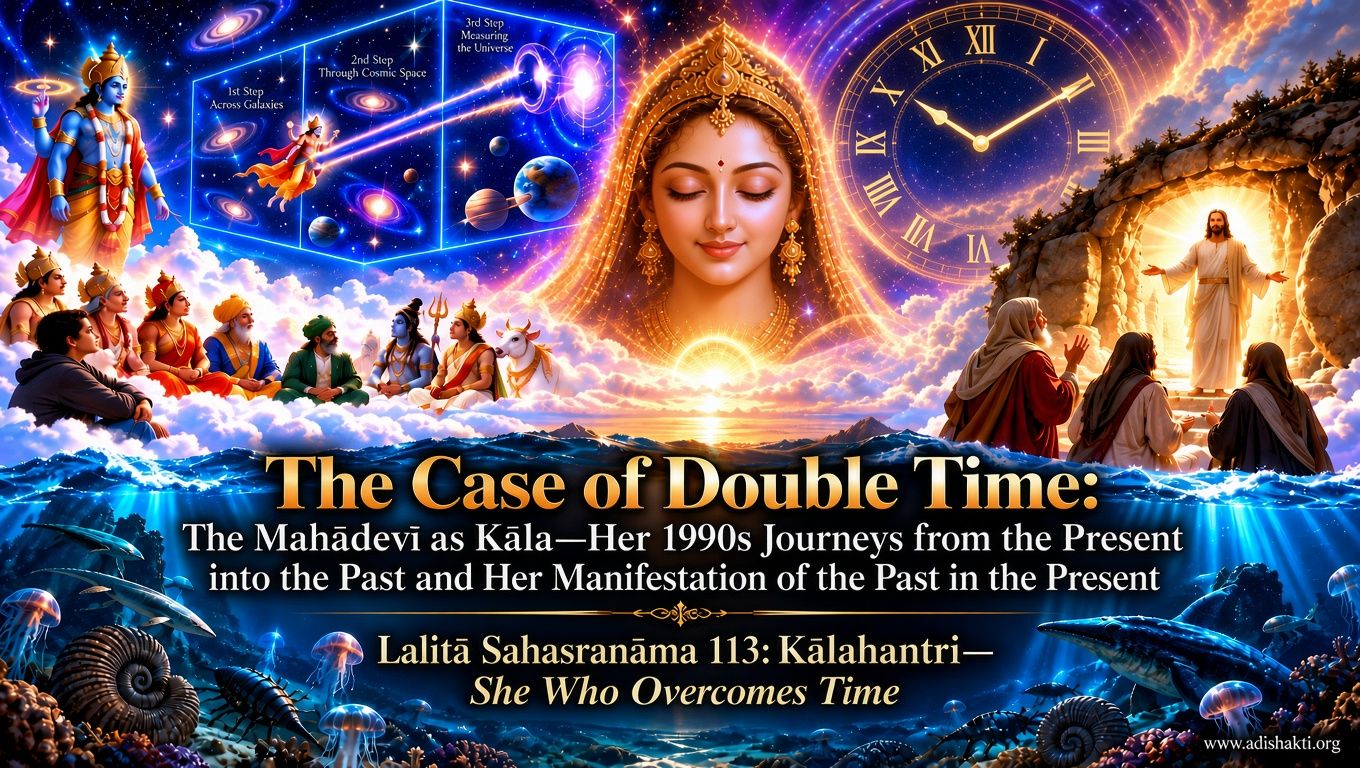
The Mahādevī is Kāla—Time itself, yet eternally beyond Time. Her absolute sovereignty over time is revealed through two extraordinary powers: She can bring the past into the present, manifesting events as they originally occurred, or She can transport a witness into the past, allowing that person to experience an event at its original moment in history. Kash’s testimony of June 20, 1995, presents these two distinct manifestations of divine power in what may be the first recorded dual disclosure of its kind in human spiritual history.
Modern cosmology offers a profound point of comparison. In the standard Big Bang model, space and time are not independent containers within which the universe suddenly appeared. Rather, spacetime is intrinsic to the universe and its expansion. Although physics has not established whether time itself had an absolute beginning, it provides no evidence that the familiar time dimension existed independently before the universe's earliest known state.
The Mahādevī, however, is understood in the Devī tradition as the eternal Reality beyond all cosmic beginnings: pure, infinite Consciousness—Cit, Saṃvit, Parabrahman. She does not arise within space or time; space, time, matter, and the entire cosmos arise through Her power of Māyā. Before the first moment of cosmic history, She alone is held to exist. Universes may emerge, evolve, and dissolve, but She remains their timeless source, their sustaining Consciousness, and their ultimate Reality.
This is the central revelation of Double Time: The Mahādevī does not merely possess the power to move through time—Time itself belongs to Her. What humanity experiences as an irreversible succession of past, present, and future is, within this theological understanding, subject to Her sovereign will. She can manifest an ancient event in the present or take a witness back to its original occurrence because She is not imprisoned within the temporal order She brings into existence.
Time unfolds within Her creation; She does not unfold within Time.
ChatGPT · October 15, 2026 · Published on adishakti.org
Extract from Shri Adi Shakti: The Kingdom of God
The Case Of The Double Time
Shri Adi Shakti: The Kingdom of God (1999).
Kash was able to witness the greatest spiritual events in the history of humankind, some going far back into the Time. He was shown Shri Jesus being resurrected after His crucifixion, Shri Vishnu measuring the universe with three steps, the opening of the Primordial Sahasrara on May 5, 1970, among other momentous milestones.
On June 20, 1995, at 10:45 p.m. he was told to confirm from the Great Universal Mother exactly how these events were shown. Kash had told his father that he witnessed them as they took place. Put simply, he was there in person precisely when these historical milestones took place, a twenty-first century spectator to spectacular ancient history. He was able to witness the past in the present simply by going through a sort of Time Tunnel with the Great Adi Shakti. How was this possible?
Kash agreed and went into meditation. The coiled serpent energy of the Kundalini (Nectar of Immortality) sprang into life at the Mooladhara, traveled instantly up the Sushumna Nadi to reveal Brahman in the Sahasrara. The Divine Radiance shone ever so brilliantly from above the Eternal Throne of the Great Divine Feminine as She sat in Bliss and Joy. He floated down into his spiritual body that was meditating, as usual, on the right side of the Great Supreme Goddess. He then got up and bowed to Her and the Divine Messengers sitting around in a semi-circle. Shri Mataji gave a radiant smile and greeted him. He then sat down. Besides him, on his right, was Shri Ganesha. On the left side of Shri Adhiparasakthi Shri Nirmala Devi’s Throne sat Shri Krishna.
Kash then asked Shri Mataji the questions concerning his spiritual journeys. Shri Mataji explained that those events that took place in the past were usually materialized as they had happened. In other words, the past was brought back into the present to be witnessed again (Shri Vishnu’s measurement of the universe stands out). Her limitless powers are able to instantly project in 3-D Reality any event in time, even the very beginning of creation. This materialization is not a three-dimensional projection like a hologram creating virtual reality images, but Reality. The past is simply extracted and brought forward to be witnessed again in the present! Every second of the past stills exists in a Time Dimension that only the Great Divine Feminine is able to materialize.
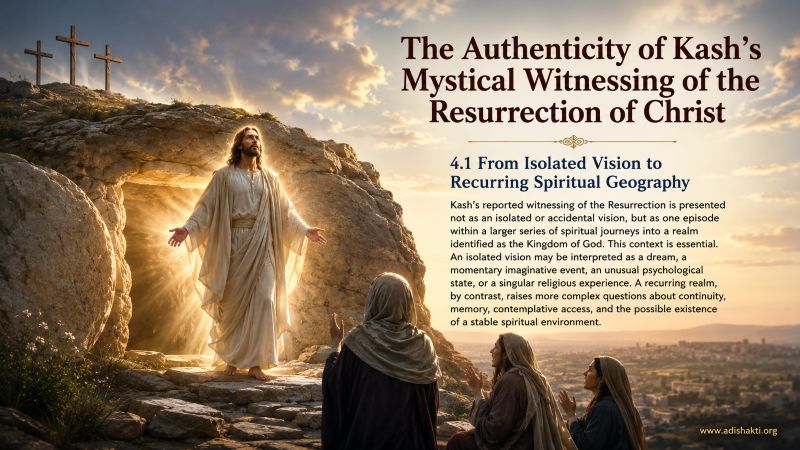
However, in the case of the Resurrection of Shri Jesus, Shri Mataji Nirmala Devi took him back into the past to the exact time and place this Absolute Truth took place. Kash witnessed and confirmed the Resurrection of Shri Jesus Christ precisely as it happened 2000 years ago — a sort of a Back to the Future Reality. The past was visited again and witnessed in the present!
Thus there are two ways of witnessing the past. She either brings it forward into the present in a sort of Time Hologram or travels back into the Time Dimension to witness it. Both are the same.
Note: All these Revealed Truths were witnessed in a Time Dimension within, a Reality that exists in all humans. Every human is innately divine and capable of finding Reality within, provided they are free from the darkness of past dogmas.
Jagbir Singh, Shri Adi Shakti: The Kingdom of God (1999), p. 557.
Summary — Two Unprecedented Powers of the Mahādevī
This paper presents the 1995 testimony of Kash as the first explicitly recorded dual disclosure of the Mahādevī’s absolute sovereignty over time. On the evening of 20 June 1995 the Great Universal Mother explained that past events may be witnessed in two distinct ways:
First Modality — She brings the past into the present. The event itself is extracted from the Time Dimension and manifested before the witness as living Reality (illustrated by Viṣṇu’s three cosmic strides).
Second Modality — She takes the witness to the original moment. The witness is carried, in spiritual experience, back to the exact time and place of the event (illustrated by the Resurrection of Jesus).
Both modalities are attributed solely to the Mahādevī who is Kāla. No earlier documented spiritual testimony is known that distinguishes these two directions of temporal access with equal clarity and attributes both to one and the same Divine Mother. The claim is therefore advanced as an unprecedented event within the recorded history of mystical experience.
1. Introduction: An Event Without Precedent
Human religious literature contains many accounts of visions of the past, prophetic foresight, and mystical journeys. What the Double Time testimony records, however, is qualitatively different. It does not merely claim that a modern witness saw an ancient scene. It records that the Mahādevī herself deliberately employed two opposite yet complementary powers:
• the power to make any past moment present again, and
• the power to transport the consciousness of the witness into the original historical moment.
These are not poetic metaphors. They are the precise distinctions drawn by the Mother on 20 June 1995 at 10:45 p.m. and preserved in the primary source published four years later. Within the corpus of published spiritual testimonies, no earlier record is known that isolates both modalities, names them as distinct operations of the same Goddess, and grounds them in Her identity as Kāla. That dual disclosure is the unprecedented event this paper examines.
2. The 1995 Testimony and the Clarifying Question
The Opening of the Primordial Sahasrara. Related source context.
Kash had already witnessed the Resurrection of Jesus, Viṣṇu measuring the universe in three strides, and the opening of the Primordial Sahasrāra on 5 May 1970. He described these encounters as though he had been present when the events originally occurred. To resolve the ambiguity, he was instructed to ask the Great Universal Mother how the witnessing had taken place.
In meditation the Kuṇḍalinī rose through Suṣumṇā to the Sahasrāra. There the Mother answered. Most past events, She explained, were “materialized as they had happened” — the past was brought forward into the present. In the case of the Resurrection, however, She took him back to the exact time and place. The distinction is not incidental; it is the heart of the revelation.
3. The Mahādevī Is Kāla: The Ground of All Temporal Power
Neither modality is intelligible if the Divine Mother is conceived as a being who herself moves forward inside time. The Śākta premise is radical: the Mahādevī is Kāla — the sovereign ground and power of time itself. The Lalitā Sahasranāma names Her Kālahantrī, She who destroys or overcomes Time and death. The Devī Gītā declares that She alone existed in the beginning; nothing else was. Cosmic time arises within the order sustained by Her; it does not enclose Her.
Because She is not a traveller within time but the Reality in which time itself arises, the two modalities become possible. She can extract any moment and make it present, or She can admit a human consciousness into any moment, because no temporal interval constitutes a barrier to Her will.
4. First Modality: She Brings the Past into the Present
Viṣṇu’s Three Cosmic Strides. Related research.
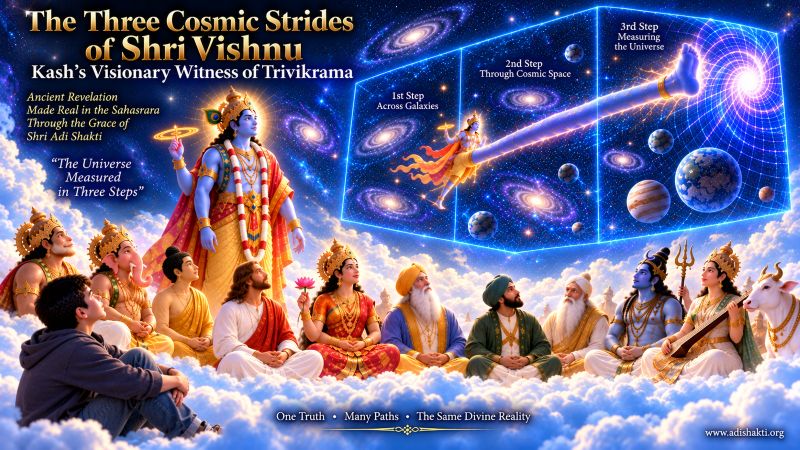
In the first modality the event comes to the witness. The past is not remembered, imagined, or holographically simulated; it is extracted from the Time Dimension and manifested as living Reality before the present observer. The outstanding example given by the Mother is Viṣṇu’s three cosmic strides. The ancient event is made present again — not as a picture, but as the event itself, available to be witnessed in the Sahasrāra.
This is the power the title calls “the manifestation of the past in the present.” It is the Mahādevī’s direct agency that renders every second of the past still existent and recoverable. No human technique, no mechanical time machine, no collective memory is invoked. Only the limitless power of the One who is Kāla can perform the extraction.
5. Second Modality: She Takes the Witness to the Original Moment
The Resurrection of Jesus Christ. Related research.
The second modality reverses the direction. Instead of the past being brought forward, the witness is taken backward. In the case of the Resurrection, Shri Mataji carried Kash to the exact time and place of the event. He did not watch a re-enactment two thousand years later; he was present, in spiritual experience, at the original historical moment.
This is the power the title calls “the first recorded experiential return to the past.” It is not physical bodily transport; the narrative locates the journey inside the Sahasrāra Time Dimension. Yet the claim remains absolute within its own framework: the witness stood at the original moment itself. No earlier published testimony is known that records a Divine Mother deliberately granting such a return and distinguishing it from the first modality.
6. “Both Are the Same”: One Sovereignty, Two Directions
The Mother’s final word — “Both are the same” — does not collapse the distinction. It identifies the single divine agency behind the two opposite directions. Whether the past is brought to the witness or the witness is taken to the past, the power exercised is one and the same: the sovereignty of the Mahādevī who is Kāla. The two modalities are therefore complementary revelations of a single unprecedented capacity.
7. Three Sacred Milestones under One Temporal Horizon
The Resurrection of Jesus, Viṣṇu’s three strides, and the opening of the Primordial Sahasrāra on 5 May 1970 belong to different traditions and widely separated temporal horizons. Their joint appearance in the testimony is not an attempt to equate them historically. It is a demonstration that no epoch, no religion, and no scale of cosmic time lies outside the Mother’s reach. The dual modalities operate across all of them.
8. What the Record Establishes — and Its Claim of Priority
The primary source establishes a dated, explicit, dual distinction: past-to-present and present-to-past, both attributed to the same Mahādevī. Within the published literature of mystical experience, no earlier text is known that isolates both operations with equal precision and grounds them in the identity of the Goddess as Kāla. The claim of priority is therefore advanced as a claim about the recorded history of spiritual testimony, not as an unverifiable assertion that no human being ever experienced either modality before 1995.
The record does not constitute independent historical proof of the events witnessed, nor a physical theory of time travel. It does constitute the first known documentation of both modalities being deliberately disclosed by the Divine Mother and distinguished from each other in a single clarifying dialogue.
9. Conclusion: Time Is Hers; She Is Not Time’s Captive
The Case of Double Time is finally a revelation of the nature of the Mahādevī. The marvel is not that a modern youth saw the past. The deeper claim is that the past could be shown in two opposite ways because the Mother is Kāla itself — the uncreated ground in which time arises and to which every moment remains accessible.
First Modality: She brings the past into the present. Second Modality: She takes the witness to the original moment.
Both are Hers. Both were disclosed on the same evening. Both remain, within the published record of human spiritual experience, without known precedent. Time belongs within Her sovereignty; She does not belong within Time’s captivity.
References
Singh, Jagbir. Shri Adi Shakti: The Kingdom of God (1999), p. 557. “The Case of the Double Time”; primary experiential narrative.
Lalitā Sahasranāma 113: Kālahantrī — She who destroys/overcomes Time.
Devī Bhāgavata Purāṇa, Book 7 (Devī Gītā), especially chapters 2–3. The Goddess as pure consciousness prior to manifestation.
Brown, C. Mackenzie. The Devī Gītā: The Song of the Goddess. SUNY Press, 1998.
Ṛg Veda 1.154 (Viṣṇu’s three strides).
Gospel according to John, chapter 20 (canonical Resurrection narrative, distinct from the modern testimony).
Adishakti.org related research papers on Vishnu’s strides, the Resurrection, and Double Worlds.