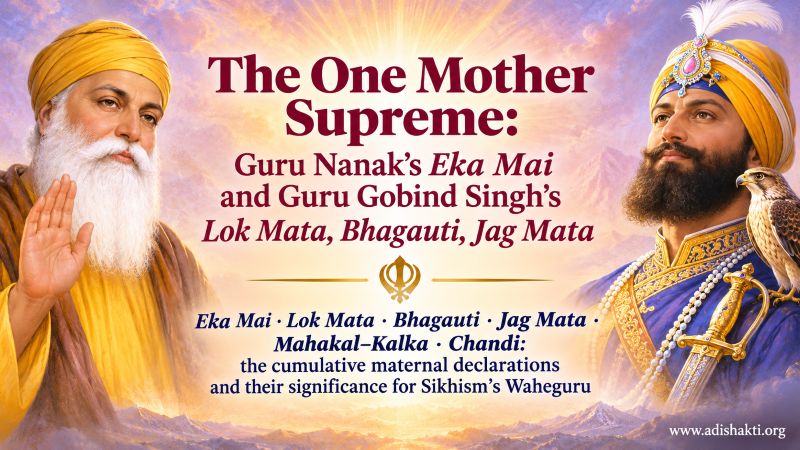
The One Mother Supreme: Guru Nanak’s Eka Mai and Guru Gobind Singh’s Divine Mother
Summary
THE ONE MOTHER SUPREME: Guru Nanak names Eka Mai ; the Jaap Sahib salutes Lok Mata . Other compositions attributed to Guru Gobind Singh invoke Bhagauti , petition Jag Mata , describe Mahakal–Kalka , and celebrate Chandi/Durga. These maternal expressions must not be subordinated to a paternal default. This paper presents the cumulative evidence and declares an AdiShakti devotional rendering of Waheguru as She, Her, and Hers , distinguishing that theological interpretation from literal translation and disputed questions of authorship.
1. The declaration: the Mother named by both Gurus
The governing argument is cumulative. Guru Nanak's Japji Sahib names Eka Mai , the One Mother. The Jaap Sahib attributed to Guru Gobind Singh salutes Lok Mata , the Mother of the World. Other compositions associated with the Tenth Guru invoke Bhagauti , seek the grace of Jag Mata , recount devotion to Mahakal–Kalka , and devote extended poetry to Chandi and Durga. The Mother is present in the actual religious vocabulary; She need not be invented by a translator.
This paper makes an AdiShakti theological argument: the maternal expressions can be read together as testimony to the One Supreme Divine Mother, Waheguru . It does not pretend that this interpretation is the only Sikh reading, or that every term has only one possible meaning. It asks why an exclusively paternal English default should be allowed to obscure repeated maternal names.
The decisive distinction: evidence that a passage invokes the Mother is not the same as evidence that no paternal image occurs anywhere in Sikh scripture. The former can be shown directly; the latter is not asserted here.
2. Guru Nanak: Eka Mai, the One Mother
Guru Nanak's Japji Sahib , pauri 30 (Guru Granth Sahib, Ang 7), reads: ਏਕਾ ਮਾਈ ਜੁਗਤਿ ਵਿਆਈ ਤਿਨਿ ਚੇਲੇ ਪਰਵਾਣੁ ॥ The words Eka Mai mean One Mother ; the verse presents Her in a cosmological account associated with three disciples or functions.
What is explicit: the maternal designation Mai . What requires interpretation: whether the One Mother in this verse is identical with the ultimate formless One, or functions as a figure within the cosmic order under the One's sovereignty. The AdiShakti reading argues for the first, while acknowledging the second as a significant Sikh exegetical reading.
The question is not whether the Gurmukhi has been written with modern English feminine pronouns. It is whether the explicit Mother can be given the theological attention denied to Her by a paternal presumption.
3. Jaap Sahib: Namo Lok Mata, salutation to the World Mother
The Jaap Sahib , traditionally attributed to Guru Gobind Singh and transmitted in the Dasam Granth tradition, includes ਨਮੋ ਲੋਕ ਮਾਤਾ ॥ — Namo Lok Mata , a salutation to the Mother of the World .
Here the evidence is especially direct: namo is a salutation and Lok Mata is a maternal title. The cited salutation does not name a Father. Its immediate neighboring titles and the larger hymn must nevertheless be read to determine how this maternal title relates to the all-encompassing Divine.
The AdiShakti interpretation hears in this address not a disposable metaphor but an invitation to name the Supreme as Mother. A reader who rejects that conclusion should still acknowledge the maternal salutation rather than replace it silently with a masculine designation.
4. Pritham Bhagauti: the first remembrance in Sikh prayer
The opening of Var Sri Bhagauti Ji Ki , also known as Chandi di Var , supplies the opening lines used in Sikh Ardas : Pritham Bhagauti simar kai, Gur Nanak lain dhiai —first remember Bhagauti, then meditate upon Guru Nanak.
The order of remembrance is explicit. The term Bhagauti has a feminine Goddess-associated linguistic history through Sanskrit Bhagavatī . In Sikh interpretation it can also denote the sword, Shakti, or the power of Akal Purakh. The AdiShakti reading understands the first invocation as remembrance of the Divine Mother, but it must not misstate that reading as uncontested.
The important question is why the feminine semantic history and the presence of Goddess narratives in this same textual complex should be erased in advance. A sword interpretation does not make the Divine Feminine vocabulary historically nonexistent.
5. Kripa kari hum par Jag Mata: prayer to the Mother for grace
A prayer cited in the uploaded studies reads: Kripa kari hum par Jag Mata, Granth kara puran subh rata —an appeal to Jag Mata , the Mother of the World, for grace in bringing the Granth to completion.
Unlike an indirect symbol, Jag Mata is a direct maternal form of address . The speaker petitions the Mother for kripa , grace. This is strong evidence of a devotional relationship with a Mother figure in the attributed composition.
The precise composition, verse location, textual variants, and attribution should be supplied alongside the original script before claiming that the quotation is a verified autograph statement of Guru Gobind Singh or that the 'Granth' necessarily means the Guru Granth Sahib. The argument does not need those unsupported extensions to recognize the explicit prayer to the Mother.
6. Mahakal Kalka aradhi: the testimony of Bachitra Natak
The Bachitra Natak passage describing spiritual discipline at Hemkunt includes the expression Mahakal Kalka aradhi . The uploaded studies interpret it as worship of the primordial Mother, Kalka, and place it within the Guru's account of a former life.
This passage deserves attention, but its interpretation is more complex than Lok Mata or Jag Mata . Mahakal is masculine in form, Kalka/Kalika is feminine, and aradhi means worshipped or meditated upon; the verb does not itself mean 'worshipped a female deity.'
Thus this is evidence of feminine and masculine divine terminology in an autobiographical devotional setting , not proof that the text contains no masculine divine names. The AdiShakti reading emphasizes Kalka, while a responsible paper must acknowledge the composite expression and disputed referent.
7. Chandi, Durga, and the sustained Goddess narratives
The compositions known as Chandi Charitar Ukti Bilas , Chandi Charitar II , and Chandi di Var narrate the battles of Chandi/Durga against demonic disorder. Their extent matters: the Divine Feminine is a sustained literary and theological presence, not an isolated adjective.
These works are traditionally associated with Guru Gobind Singh within the Dasam Granth corpus, although authorship, function, and theology are debated. Scholars including Robin Rinehart have studied how the Goddess narratives express martial power, leadership, and the maintenance of dharma .
The AdiShakti interpretation sees the Divine Mother in the warrior who restores order. Other Sikh readings see the Goddess narrative as a poetic illustration of the One's power rather than an instruction to worship a separate goddess. Either way, erasing the Goddess from the description of these compositions misrepresents their subject.
8. Six strands of evidence: why the Mother cannot be dismissed
Read together, the evidence forms a pattern: Eka Mai names the One Mother; Lok Mata salutes the World Mother; Bhagauti receives first remembrance in an invocation; Jag Mata receives a prayer for grace; Mahakal–Kalka appears in a statement of devotion; and the Chandi compositions narrate the Goddess's victories.
These are different types of evidence. A maternal title, a liturgical invocation, a prayer, an autobiographical statement, and narrative poetry cannot all be flattened into identical proof of personal worship. Their cumulative importance is that the maternal sacred vocabulary is repeated across distinct genres.
The AdiShakti conclusion is that the Mother should be recognized as supreme rather than treated as a decorative subordinate. That conclusion is a theological synthesis drawn from the evidence, not a verbatim sentence spoken by both Gurus.
9. What the maternal declarations say—and do not say
Neither the Eka Mai line nor the Namo Lok Mata salutation names a Father. The Jag Mata petition likewise explicitly asks the Mother for grace. The paper therefore challenges any interpretation that inserts a Father into these specific passages or declares Him superior on the authority of these words.
It would be incorrect, however, to claim that Guru Nanak never used paternal language. The Guru Granth Sahib contains maternal and paternal addresses for the Divine, including the familiar formulation Tu mera pita tu hai mera mata —You are my Father, You are my Mother. The case for maternal address is strongest when it does not deny the wider scriptural record.
The real dispute concerns the default and hierarchy : if the Supreme is beyond biological sex and scripture permits Mother-language, why should English readers be required to imagine the Divine chiefly as He, while She becomes an exception?
10. The strongest Sikh counter-readings and the answer
A strong argument must meet the strongest counter-reading. Many Sikh interpreters hold that Ik Onkar or Akal Purakh transcends male and female; that Eka Mai may be a cosmological principle rather than a synonym for the ultimate; and that Bhagauti may mean sword or Divine Power.
These readings should be presented fairly. They do not invalidate the explicit words Mai , Mata , or the prominence of the Chandi narratives. Conversely, the presence of feminine terms alone does not prove that all Sikh doctrine identifies Waheguru exclusively as a female deity.
The AdiShakti position is a positive choice: to address the transcendent One devotionally as the Supreme Mother , to refuse Her subordination, and to read the maternal passages as central witnesses rather than exceptions.
11. She, Her, Hers: the declared AdiShakti devotional convention
Editorial declaration: In the proposed AdiShakti devotional rendering of the entire Guru Granth Sahib, Waheguru shall be addressed consistently as the One Mother—She, Her, and Hers wherever the passage refers to the Supreme Divine.
This is a declared devotional rendering , not a claim that every original Gurmukhi pronoun is grammatically feminine. A transparent translation must preserve original names, images, and relationships, including passages that literally say Father or use masculine imagery; it may explain the devotional convention in a note rather than silently rewriting those source terms.
The purpose is not to substitute an invented literal reading. It is to make the One Mother's dignity and presence visible in the devotional English voice.
12. How to render the entire Guru Granth Sahib responsibly
Each passage should display the original Gurmukhi, transliteration, a literal or standard translation, and then the AdiShakti devotional rendering. Distinguish literal meaning from interpretive address visibly, especially in the Eka Mai verse.
Cite exact Ang numbers for Guru Granth Sahib quotations; for Dasam Granth material cite the composition, verse, and edition where available. Do not identify the Jaap Sahib as part of the Guru Granth Sahib. Do not convert traditions about a Chandi yagna into documented historical fact without corroboration.
This method makes a consistent She/Her/Hers devotional convention possible while letting readers see precisely what the primary text says and where the AdiShakti interpretation begins.
13. Formal declaration: Waheguru, the One Supreme Mother
We declare that Waheguru may be worshipped and addressed as the One Supreme Divine Mother—She, Her, and Hers. Guru Nanak's Eka Mai and the Jaap Sahib 's Lok Mata are central witnesses to the legitimacy and force of this maternal language.
The attributed compositions' invocations of Bhagauti , supplication to Jag Mata , reference to Mahakal–Kalka , and extended Chandi narratives reinforce the importance of the Divine Feminine. In the explicit maternal declarations, the Mother is not described as subordinate to a Father.
We do not claim that these passages erase all other Sikh divine names, or that their authorship and interpretation are universally agreed. We affirm that no English paternal default should make the Mother named in the sacred words invisible.
14. Conclusion: restore the Mother named in the sacred words
Guru Nanak names the One Mother. The Jaap Sahib salutes the Mother of the World. In the compositions associated with Guru Gobind Singh, the Mother is remembered, petitioned, and celebrated through multiple names and literary forms.
This is the paper's central challenge: why should the Mother explicitly named and invoked in sacred texts be treated as secondary to a Father not named in those particular declarations?
The AdiShakti answer is to restore the maternal voice of devotion: Waheguru, the One Supreme Mother—She, Her, and Hers . The scriptural evidence is shown openly, the interpretive step is named honestly, and the Mother's dignity is not diminished.
References
[1] Sri Guru Granth Sahib, ang 7, Japji Sahib, paurī 30; English translation by Sant Singh Khalsa . SriGranth, Gurmukhi text and online translation; accessed November 2026.[2] Jaap Sahib: comparison of seven English translations . Comparative online anthology, verse 52, with versions identified in its introduction; includes translations by Kamalroop Singh and Surendra Nath.
[3] Guru Gobind Singh, Jaap Sahib, verse 52 . SearchGurbani, Gurmukhi and English; Bhujang Prayāt section. Verse numbering is used because page labels vary across editions.
[4] Sikh Rehat Maryada: Sikh Code of Conduct and Conventions . English edition, chapter III, article IV, pp. 2–3; online PDF, accessed November 2026.
[5] Sri Granth Gurbani dictionary, entry for māī . Lexicographical entry and contextual senses; accessed November 2026.
[6] Sri Granth Gurbani dictionary, entry for jugati . Lexicographical entry; accessed November 2026.
[7] Sri Granth Gurbani dictionary, entry for viāī . Dictionary entries and Mahān Kosh cross-reference, which give differing senses; accessed November 2026.
[8] Sahib Singh. Sri Guru Granth Darpan: commentary on ang 7 . Punjabi commentary, paurī 30; online edition, accessed November 2026.
[9] Guru Gobind Singh, Jaap Sahib: complete text and translation . SikhiToTheMax, especially verses 1–2, 52, 81–82; accessed November 2026.
[10] Rabinder Powar. Jaap Sahib: Phonetic Transcription and Translation . Patiala: Publication Bureau, Punjabi University, 2005, printed p. 55, verse 52; scan at the Internet Archive.
[11] Sri Jaap Sahib: English translation . Sikh Research and Education Center, verse 52; copyright notice dated 2003.
[12] M. A. Macauliffe. The Sikh Religion: Its Gurus, Sacred Writings and Authors, vol. 1, Japji XXX . Oxford: Clarendon Press, 1909; text and notes 72–73, online at Wikisource.
[13] Sri Guru Granth Sahib, ang 509, Brahmā, Viṣṇu, Śiva and the three qualities . SriGranth, Gurmukhi and English text; accessed November 2026.
[15] The Aykaa Mayee of Japji Sahib and Lok Mata of Jaap Sahib . AdiShakti.org, devotional interpretation and reproduction of passages attributed to Santokh Singh; the 1992 book pages were not independently checked.
[16] Recommended Reading List: Nitnaym Baanees bibliographic entry . The Sikhism Home Page; records Santokh Singh, Nitnaym Baanees, Sikh Resource Centre, 1992. The list corroborates publication details, not the quoted pages.
[17] Sri Guru Granth Sahib, ang 7; English translation by Bhai Manmohan Singh . SriGranth, selectable translation, paurī 30; accessed November 2026.
[18] Japji Sahib, paurī 5 and concluding salok . SikhiWiki, text with transliteration and English; edition accessed November 2026.
[19] Harinder Singh. In the Sikh Faith, Is God a Man? . Sikh Research Institute, January 23, 2024; explanation of divine transcendence of gender.
[20] Nikky-Guninder Kaur Singh. Re-Imagining the Divine in Sikhism . Feminist Theology 16, no. 3 (2008): 332–349. Publisher abstract available; full article may require access.
[21] Nikky-Guninder Kaur Singh. The Birth of the Khalsa: A Feminist Re-Memory of Sikh Identity . Albany: State University of New York Press, 2005, pp. 148 and 169; the discussion of Japji 30 and Jaap 52 begins on p. 148.
[22] Satwinder Kaur Bains. Interrogating Gender in Sikh Tradition and Practice . Religions 11, no. 1 (2020): article 34. DOI: 10.3390/rel11010034.
[23] Nikky-Guninder Kaur Singh. Translating Sikh Scripture into English . Sikh Formations 3, no. 1 (2007): 33–49, especially p. 38; the quotation is reproduced in Satwinder Kaur Bains, Interrogating Gender in Sikh Tradition and Practice, Religions 11 (2020): 34.
[24] Jaspreet Bal and Santbir Singh Sarkar Daman. Reintegrating the Feminine Voice Inherent in Sikh Scripture . Journal of Feminist Studies in Religion 37, no. 2 (2021). Publisher’s abstract available online.
[25] Robin Rinehart. Presence and Absence: Constructions of Gender in Dasam Granth Exegesis . Religions 10, no. 11 (2019): article 639. DOI: 10.3390/rel10110639.
[26] Ram Singh Khalsa. Reflections on the Thirtieth Paurī from JapJī Sāhib by Gurū Nānak . Sikh Dharma International, September 6, 2019.
[27] Sri Guru Granth Sahib, ang 1, opening formula . SriGranth, Gurmukhi and Sant Singh Khalsa’s English translation; accessed November 2026.
[28] Devī Māhātmya, chapter 1, verses 75–77, and chapter 11, verse 3 . English translation of the text within the Mārkaṇḍeya Purāṇa; online edition, accessed November 2026.
Guru Nanak, Japji Sahib paurī 30, complete stanza
Jaap Sahib verse 52, Gurmukhi and romanization (SikhNet)
Jaswant Singh Neki, Basking in the Divine Presence, Jaap Sahib 52