Walter Mercado’s Beyond the Horizon and the Manifestation of the Age of Aquarius
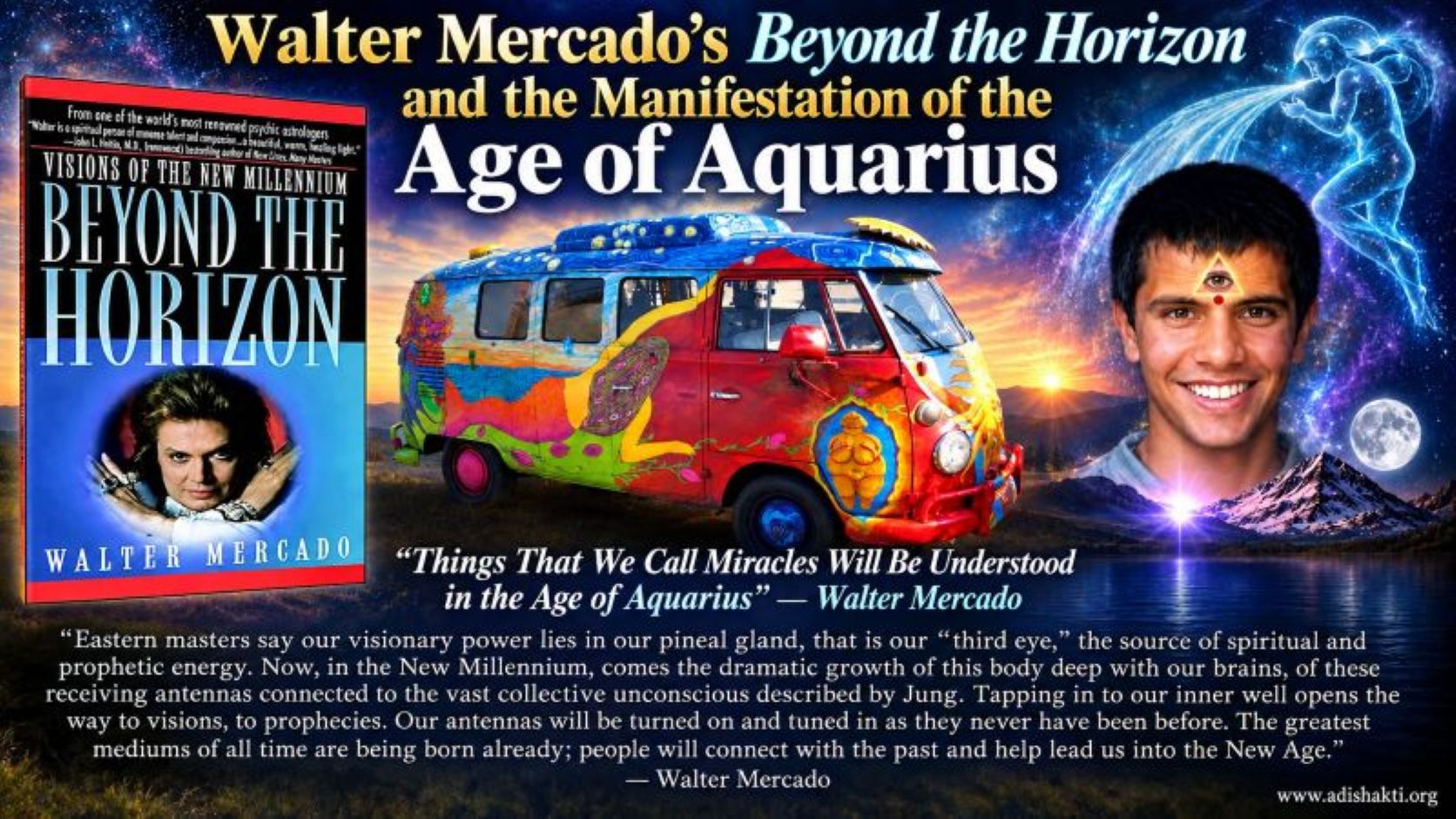
The “Be Your Own Goddess” art bus evokes the counterculture’s search for liberation, inwardness, peace, and the recovery of the feminine sacred.
An Academic Comparative Study of Walter Mercado’s Aquarian Forecast, Shri Mataji Nirmala Devi’s 1972 Message to the Flower Children, Her Identification of Aquarius with Kundalini, and the Mystical Testimony Examined by the Adishakti.org Authenticity Series
“Things That We Call Miracles Will Be Understood in the Age of Aquarius”
“Eastern masters say our visionary power lies in our pineal gland, that is our “third eye,” the source of spiritual and prophetic energy. Now, in the New Millennium, comes the dramatic growth of this body deep with our brains, of these receiving antennas connected to the vast collective unconscious described by Jung. Tapping in to our inner well opens the way to visions, to prophecies. Our antennas will be turned on and tuned in as they never have been before. The greatest mediums of all time are being born already; people will connect with the past and help lead us into the New Age.
Humanity returns to the simple and natural on this plane, but our spirits, as our bodies sleep, can come into contact with other realities, can receive knowledge through our astral voyages. We can develop our ability to reach out with this power and gain revelations. Charged with the energy of the coming age and opening ourselves to it, we increase our capacity to abandon our bodies, to leave our bodies, to send our spirits through space to see and know distant places through time to know the future and the past, and to connect to other spirits, other consciousness...
Mystics speak of powers of levitation, of raising the physical body with the power of the mind. Researchers have confirmed the existence of out-of-body experiences, of sending the spirit to explore outside of the spiritual body. The spiritual awakening that comes with the New Age brings not just the integration of science and spirituality, but a balance of spiritual and physical energy.
We will see that our bodies are but the space suit our souls wear on this terrestrial plane. Once our mission here is completed, we discard it and move on as our true selves, our spirits and selves intact, to the next plane.
Things that we call miracles will be understood in the Age of Aquarius. We will know the law of nature that makes our miracles happen, we will know why they happen, and we won’t think of them as miracles, but as blessings.”
Walter Mercado, Beyond The Horizon, A Time Warner Company, 1997 p. 128.
Warner Books, 1997, p. 128. The longer passage supplied for this study is treated as the primary textual basis for the analysis below.
Central Thesis
Walter Mercado’s Aquarian forecast acquires unusual comparative significance when read beside Shri Mataji Nirmala Devi’s explicit identification of Aquarius with Kundalini and the experiential claims preserved in the Adishakti.org Authenticity Series. Mercado anticipated heightened inner perception, a renewed investigation of the “third eye,” nonordinary states of consciousness, reconciliation between scientific inquiry and spirituality, and a gradual reinterpretation of phenomena formerly categorized as miracles. Shri Mataji supplied a much more precise spiritual mechanism: she identified the Age of Aquarius as the age of Kundalini, in which the latent spiritual power within human beings awakens and Self-realization becomes collectively accessible.
This paper therefore argues that, within a comparative theological and historical framework, the Age of Aquarius can reasonably be described as already manifesting. This conclusion does not require treating astrological ages as experimentally demonstrated astronomical periods, nor does it require declaring every paranormal interpretation scientifically proven. It rests instead upon the striking convergence between the characteristics attributed to Aquarius, Shri Mataji’s collective Kundalini mission, the worldwide movement toward experiential spirituality, and the type of visionary testimony subjected to documentary examination in the Authenticity Series.
Table of Contents
- Introduction — From Prediction to Manifestation
- 1. Mercado’s Aquarian Anthropology
- 2. Shri Mataji: “The Age of Aquarius” as the Age of Kundalini
- 3. Aquarius, Blossom Time, Resurrection and Qiyamah
- 4. The Flower Children as the Human Prelude to the Age of Aquarius
- 5. The Third Eye and the Authenticity Series
- 6. From Ancient Revelation to Contemporary Experience
- 7. From Exceptional Mystics to Collective Self-Realization
- 8. Science, Spirituality and the Limits of the Claim
- 9. From Miracle to Investigable Event
- 10. Jung, Mercado and Collective Consciousness
- 11. The Advent of Shri Mataji as the Decisive Aquarian Claim
- 12. Is the Age of Aquarius Clearly Manifesting?
- Conclusion — Beyond the Horizon Has Come Within
- References
Introduction — From Prediction to Manifestation
Walter Mercado’s Beyond the Horizon: Visions of the New Millennium, published in 1997, belongs to a late twentieth-century literature that interpreted the approaching millennium not simply as a chronological transition but as a transformation in human consciousness. Mercado’s vision of the Age of Aquarius is expansive. He anticipates heightened spiritual perception, renewed attention to the “third eye,” increasingly direct exploration of consciousness, greater receptivity to visionary experience, and an eventual reconciliation—at least in aspiration—between scientific understanding and spiritual reality. The Aquarian human being, in this account, does not merely inherit religious propositions. He or she increasingly seeks to experience consciousness directly.
This distinction between inherited belief and direct experience provides the most important bridge to Shri Mataji Nirmala Devi. Her teaching does not treat Aquarius primarily as an astrological curiosity. In public discussions she explicitly associated Aquarius, or Kumbha, with Kundalini and described the contemporary transformation as the period in which this latent spiritual energy could awaken on a collective scale. The convergence with Mercado is consequently more exact than the observation that both figures spoke about a “New Age.” Mercado describes the anticipated phenomenology of an awakening civilization; Shri Mataji identifies Kundalini awakening and Self-realization as the interior mechanism by which a transformation of consciousness occurs.
The Adishakti.org Authenticity Series introduces a third component. Its subject is not Aquarian astrology as such, but a corpus of testimony concerning reported inner visions, encounters with sacred personalities, perception of subtle realms, and instances in which visionary information is subsequently compared with scriptures, iconography, chronology and external sources. The academic significance of the Series lies not in presuming every metaphysical interpretation to be proven, but in asking whether extraordinary reports can be subjected to ordinary historical questions: What was said? When was it said? Was it recorded before later confirmation? What information was available to the witness? What independent correspondences exist? Those questions turn the rhetoric of a “New Age” into an evidentiary program.
1. Mercado’s Aquarian Anthropology
Mercado’s Aquarian vision is fundamentally anthropological: it concerns what the human being is becoming. In the supplied passage from page 128 of Beyond the Horizon, he begins with the traditional association between visionary perception and the “third eye,” connecting it with the pineal gland and prophetic receptivity. He then moves outward from individual perception toward a collective field of consciousness, invoking Jung’s collective unconscious and imagining human beings becoming increasingly receptive to information that exceeds the normal boundaries of waking sensory life.
Mercado’s argument should not be reduced to a literal physiological claim about the pineal gland. The more consequential proposition is that modern humanity is entering a period in which interior perception will again be taken seriously. Visions, prophetic impressions, altered states and experiences interpreted as contact with realities beyond ordinary consciousness are not presented as relics of a premodern worldview. They are presented as phenomena that will become increasingly relevant to the civilization of the future.
His discussion of the body reinforces this anthropology. Mercado treats physical embodiment as one dimension of a larger spiritual identity and anticipates increased interest in experiences interpreted as consciousness operating beyond ordinary bodily limitations. Whether those interpretations are accepted metaphysically or approached phenomenologically, the conceptual shift is unmistakable: consciousness is not treated as a trivial by-product of ordinary material life but as a frontier whose capacities remain incompletely understood.
2. Shri Mataji: “The Age of Aquarius” as the Age of Kundalini
The strongest bridge between Mercado and Shri Mataji is Shri Mataji’s own identification of Aquarius with Kundalini. In discussions of the Aquarian age, she connected the symbolism of Aquarius or Kumbha with the subtle human system and described the period as one in which Kundalini awakening becomes central. This interpretation transforms Aquarius from a vague prediction of cultural novelty into an interior event: a latent spiritual power rises within the human being and makes Self-realization possible.
The resulting sequence is conceptually precise. Human consciousness begins in an ordinary condition in which spiritual reality is largely mediated through tradition, doctrine and inherited religious authority. Kundalini awakening is then understood as the transition into direct spiritual perception. Self-realization becomes the threshold through which the seeker can test claims experientially rather than accepting them merely because a scripture, institution or teacher asserts them. In this framework, the Age of Aquarius is not primarily something happening to the calendar. It is something happening to human consciousness.
3. Aquarius, Blossom Time, Resurrection and Qiyamah
Shri Mataji’s interpretation also places Aquarius within a much larger eschatological vocabulary. Her public teachings repeatedly connect the contemporary spiritual transformation with concepts such as Blossom Time, Resurrection and the Last Judgment, while also drawing parallels with Islamic expectations surrounding Qiyamah. These traditions are not identical, and responsible comparative theology should not erase their doctrinal differences. Yet Shri Mataji’s framework proposes that different civilizations may have preserved distinct symbolic languages for a transformation that ultimately concerns the awakening, judgment and spiritual maturation of human consciousness.
This comparative approach is particularly important for Adishakti.org because the Authenticity Series ranges across Hindu, Christian, Islamic, Sikh and other religious materials. Aquarius can therefore be treated not as a replacement for these traditions but as one interpretive vocabulary among several. Within the Adishakti thesis, the common center is the possibility that humanity has entered an eschatological period in which what was previously promised through prophetic symbolism becomes available as direct spiritual experience.
Such an interpretation also clarifies why the advent of Shri Mataji is central rather than incidental. If the age is defined by collective awakening, then a teacher whose defining mission is the collective awakening of Kundalini is not merely another spiritual personality appearing during the transition. Within the theology itself, her mission embodies the mechanism attributed to the transition.
4. The Flower Children as the Human Prelude to the Age of Aquarius
The connection between the Age of Aquarius and Shri Mataji’s mission becomes considerably stronger when her 1972 address to the Western counterculture is placed between Mercado’s later Aquarian forecast and her explicit identification of Aquarius with Kundalini. The flower children were already attempting to live many of the values later associated with an Aquarian transformation: rejection of excessive materialism, opposition to war, experimentation with communal life, fascination with Eastern spirituality, ecological sensitivity, expanded consciousness, universal love and a refusal to accept inherited religious authority merely because it was inherited. Shri Mataji did not dismiss this generation as spiritually empty. Her opening question—“My dear children, what are you searching?”—interpreted their rebellion as evidence of a genuine spiritual hunger whose direction had not yet been discovered.
My Dear [Flower] Children, What Are You Searching?
“My dear children, what are you searching?
Why are you aimlessly and listlessly running about?
The joy that you have searched in material gains,
the joy that you are looking for in power,
the joy that disappeared in the words of books
—the so-called knowledge—is all lost in yourself,
and you are still searching and seeking!
You can pay attention to everything outside yourself.
You are lost in your thoughts, like babes in the wood.
But there is great hope that you can rise into the Heaven of thoughtless awareness,
which we call Self-realization.
I invite you to this feast of Divine Bliss,
which is pouring around you, even in this Kali Yuga,
in these God-forsaken modern times.
I hope you will come and enjoy the spiritual experience of the life eternal.”
— Shri Mataji Nirmala Devi, 1972
This makes the flower children historically important to the Aquarian thesis. They can be read as a transitional generation: the cultural desire for an Age of Aquarius appeared before the spiritual mechanism of that age had been understood. Their flowers, anti-war ideals, journeys to India, psychedelic experiments, interest in yoga and meditation, and search for cosmic consciousness were outward expressions of an inward pressure toward transformation. Shri Mataji’s response was therefore neither a return to conventional material society nor a simple endorsement of countercultural methods. She accepted the depth of the search while reversing its direction. What the seekers were pursuing through drugs, travel, political revolt, books and altered states, she said, had to be discovered within through Self-Realization.
From “Flower Power” to the Flowering of Consciousness
The accompanying 1972 poem provides the missing symbolic bridge between the historical flower children and the Aquarian age of Kundalini. Shri Mataji addresses the seekers maternally as children who are exhausted at the end of a fruitless journey. The poem then transforms their own emblem—the flower—into a spiritual anthropology. The flower is no longer merely worn in the hair or offered as a symbol of peace; it becomes the lotus of awakened consciousness. The culmination is the invitation to “rest in the petals of the lotus flower,” in the lap of the gracious Mother, where life is adorned with blossoms and the head is anointed with Divine Love.
This imagery is especially significant within Sahaja Yoga because the thousand-petalled lotus is the traditional image of the Sahasrara, the crown center through which Kundalini is said to complete its ascent. The poem therefore performs a remarkable symbolic conversion. Flower power becomes the flowering of consciousness; the external flower becomes the Sahasrara; rebellion against social conditioning becomes liberation from ego and compulsive thought; the longing for universal love becomes collective consciousness; and the search for chemically induced expansion becomes an endogenous awakening of Kundalini. The counterculture is not rejected at the level of its deepest aspiration. It is interpreted as an incomplete anticipation of Self-Realization.
The poem’s maternal imagery adds a second Aquarian dimension. The children are portrayed as having lost their Mother “in darkness.” Within the wider Adishakti theological framework, this can be read as more than psychological consolation: modern humanity has lost awareness of the Divine Mother, and the recovery of the feminine sacred is inseparable from the recovery of spiritual wholeness. The hippie fascination with nature, earth, flowers, peace and non-hierarchical community can consequently be interpreted as an intuitive cultural movement toward values that Shri Mataji would later integrate into a theology of the Adi Shakti and collective awakening.
The final movement of the poem is even closer to Mercado’s later Aquarian language. Shri Mataji speaks of the individual self opening into a “Greater One,” of divine reality vibrating through the human being with bliss, and of the whole universe becoming filled with light. Mercado, twenty-five years later, would describe an Aquarian humanity whose spiritual “antennas” become increasingly receptive to a collective field of consciousness. The vocabularies differ, but the structural movement is strikingly similar: the isolated individual becomes receptive to a larger consciousness, interior perception expands, and spiritual transformation becomes simultaneously personal and collective.
The chronology is therefore illuminating. The flower children of the 1960s and early 1970s publicly announced the desire for an Age of Aquarius. Shri Mataji addressed that generation directly in 1972 and interpreted its dissatisfaction as a search for Self-Realization. Her poem transformed the flower-child symbol into the lotus of awakened consciousness. Her subsequent teaching explicitly identified Aquarius with Kundalini and collective spiritual awakening. Mercado’s 1997 Beyond the Horizon then described the mature Aquarian expectation in terms of heightened inner perception, expanded consciousness, collective receptivity and a future understanding of phenomena previously called miracles. Read together, these are not isolated fragments but stages in a coherent comparative narrative.
This sequence also clarifies what it means to say that the Age of Aquarius is “clearly manifesting.” The claim is not based solely upon a zodiacal date. Its evidence, within this comparative framework, is historical and phenomenological: a generation begins demanding peace, direct experience, expanded consciousness and liberation from materialist assumptions; a spiritual teacher addresses that generation and identifies the object of its search as Self-Realization; the same teacher later identifies Aquarius as the age of Kundalini; and subsequent testimony claims the emergence of precisely the forms of interior perception that Mercado associated with the Aquarian future. The Age of Aquarius thus appears not as a single event but as a progressive flowering of consciousness whose cultural buds were visible in the flower children and whose spiritual fulfillment, within Shri Mataji’s teaching, is the awakening of the Sahasrara through Kundalini.
5. The Third Eye and the Authenticity Series
Mercado’s attention to the “third eye” provides a particularly direct connection with the Authenticity Series. A substantial portion of the Kash testimony concerns experiences interpreted as inner vision: the witness enters meditation and reports perceiving persons, places, symbols or events that are not available through ordinary sensory observation. The academically useful question is not initially whether such perception proves a transcendent world. The first question is whether the testimony has a structure that permits historical investigation.
That structure requires distinctions. Documentary authenticity asks whether the report belongs to the historical corpus and can be dated or traced. Testimonial authenticity asks whether the witness appears to be sincerely reporting an experience rather than deliberately fabricating one. Informational authenticity asks whether details within the experience correspond to information the witness was not ordinarily expected to possess. Chronological priority asks whether those details were recorded before the alleged confirming information became available. Metaphysical interpretation comes last: what kind of reality, if any, ultimately caused the experience?
This hierarchy is essential because it allows the Series to investigate extraordinary testimony without confusing evidence with interpretation. A report may be demonstrably early and sincerely remembered while its metaphysical cause remains uncertain. Conversely, a spiritually attractive interpretation cannot compensate for poor chronology or undocumented retrospective reconstruction. In this sense, the Authenticity method itself expresses one of the more intellectually defensible aspects of Mercado’s Aquarian expectation: spiritual claims become subjects of investigation rather than objects of unquestioning credulity.
6. From Ancient Revelation to Contemporary Experience
One of the most consequential implications of Mercado’s forecast is the democratization of visionary experience. Traditional religions frequently locate their foundational revelations in a sacred past. Prophets, apostles, rishis, saints and seers encountered extraordinary realities; later generations received their testimony through scripture and tradition. Mercado’s Aquarian vision reverses this temporal distance by anticipating a period in which unusual spiritual perception becomes increasingly relevant to contemporary human beings.
The Kash corpus makes precisely this kind of claim. Its narratives describe reported encounters with Hindu divine figures, Christian sacred personalities, Sikh Gurus, Buddhist figures and subtle or cosmic environments. The significance of these reports for the Aquarian thesis is not that their metaphysical interpretation must be accepted in advance. Their significance is that they exemplify the transition from religion remembered to religion experienced. Ancient iconography, scripture and theology become comparative materials against which contemporary visionary testimony can be examined.
The “Floating Serpent” case illustrates this method especially well. The evidentiary interest lies not simply in the familiar image of Vishnu and Lakshmi with Shesha, but in the reported sequence by which a child described an unusual sensation of swaying or floating, encountered adult skepticism, lacked visual confirmation of water, and only later saw the disputed sensation placed within a recognizable Vaishnava cosmological setting. If that chronology can be independently secured, the case becomes more than an example of generic religious imagination; it becomes a testable question about prior knowledge and later correspondence.
7. From Exceptional Mystics to Collective Self-Realization
At this point Shri Mataji’s teaching becomes more radical than Mercado’s. Mercado often writes in the language of especially receptive visionaries, mediums and spiritually sensitive individuals. Shri Mataji’s Sahaja Yoga presents Self-realization as an innate human potential that need not remain restricted to an esoteric elite. Kundalini awakening is therefore framed as collective: ordinary seekers are invited to experience a transformation that older religious cultures often associated with rare saints and ascetics.
This changes the architecture of religious authority. The older model can be summarized as prophet, revelation, scripture, institution and believer. The Sahaja model proposes seeker, Kundalini awakening, Self-realization, direct perception and verification. Scripture and tradition remain important, but they are no longer intended to function solely as substitutes for experience. They become maps against which experience can be understood and tested.
That democratization is arguably one of the clearest features of an Aquarian spiritual paradigm. The central claim is not that every person becomes omniscient or visionary. It is that access to spiritual transformation is no longer conceived as the monopoly of priesthoods, secret initiatory orders or exceptional ascetics. The locus of verification moves inward while simultaneously becoming collective.
8. Science, Spirituality and the Limits of the Claim
Mercado anticipated an integration of science and spirituality, but an academic treatment must define this carefully. Contemporary science has not established a consensus that astral travel, prophecy, levitation, communication with spirits or other disputed paranormal phenomena occur according to the metaphysical explanations advanced by spiritual traditions. To claim otherwise would weaken rather than strengthen the paper because it would substitute aspiration for evidence.
What has changed is the intellectual status of consciousness itself. Meditation, contemplative practice, altered states, neuroplasticity, psychedelic experience, near-death reports and the neural correlates of mystical states have all become legitimate areas of interdisciplinary inquiry. This does not amount to scientific ratification of New Age metaphysics. It does demonstrate that experiences once dismissed simply because they were subjective can be investigated through psychology, neuroscience, phenomenology, anthropology, history and comparative religion.
The strongest Aquarian argument therefore does not say that science has finally proven ancient mysticism. It says that the modern division in which objective science investigates matter while religion alone speaks about consciousness has become increasingly inadequate. Conscious experience itself has become a serious field of inquiry, creating precisely the intellectual meeting ground that Mercado anticipated, even though the ultimate metaphysical conclusions remain contested.
9. From Miracle to Investigable Event
Mercado’s statement that phenomena called miracles will eventually be understood is philosophically more important than it first appears. A miracle is often treated as an interruption of natural law, but Mercado imagines a future in which at least some extraordinary phenomena might instead reveal laws or dimensions of reality not yet understood. The implication is methodological: wonder should lead to investigation rather than terminate it.
The strongest Authenticity papers operate in exactly this manner. Instead of stopping with the declaration that a miracle occurred, they ask what was reported, when the report was made, what the witness could ordinarily have known, whether independent witnesses or documents exist, whether later sources correspond with earlier testimony, and whether normal routes of information can explain the result. This approach does not trivialize the sacred character attributed to the experience. It creates an evidentiary discipline capable of distinguishing stronger cases from weaker ones.
In that sense, the movement from “miracle” to “investigable event” is itself Aquarian. Extraordinary spiritual claims enter a space between credulity and dismissal. They are neither accepted merely because they inspire devotion nor rejected merely because they challenge prevailing assumptions. They are subjected to the same chronological, documentary and comparative pressures applied to other historical claims.
10. Jung, Mercado and Collective Consciousness
Mercado’s invocation of Carl Jung adds another dimension to the comparison. Jung’s collective unconscious and Shri Mataji’s collective consciousness should not be treated as interchangeable concepts. Jung’s theory concerns inherited archetypal structures of the psyche, whereas Shri Mataji’s account of collective consciousness is explicitly spiritual and is connected to the state said to follow Self-realization. Nevertheless, both frameworks challenge an understanding of the human mind as an entirely sealed and isolated phenomenon.
Mercado uses Jung to imagine human consciousness becoming increasingly receptive to a larger psychic field. Shri Mataji describes Kundalini awakening as enabling awareness that transcends the ordinary ego-bound condition and develops a collective dimension. The theories differ in ontology and method, but their convergence lies in the proposition that human consciousness participates in structures or realities larger than the individual autobiographical self.
This convergence helps explain why the Age of Aquarius has so often been associated with networks, collectivity, interconnection and the dissolution of rigid boundaries. Within the present paper, however, its most important expression is spiritual rather than technological. The individual does not disappear into the collective; rather, Self-realization is understood as revealing a deeper level at which individuality and universality coexist.
11. The Advent of Shri Mataji as the Decisive Aquarian Claim
The Adishakti interpretation reaches its strongest theological conclusion at this point. If Aquarius is fundamentally the age of Kundalini, and if Shri Mataji’s defining historical mission was to establish a method of collective Kundalini awakening, then her advent becomes inseparable from the meaning of the Aquarian transition. She is not significant merely because she happened to teach during an era in which New Age ideas were culturally popular. Within her own theological framework, the work she inaugurated is the process by which the new age becomes experiential.
The argument can therefore be expressed without rhetorical exaggeration. Mercado anticipates an age of expanded spiritual perception. Shri Mataji identifies that age as the age of Kundalini. Sahaja Yoga claims to provide collective Kundalini awakening and Self-realization. The Authenticity Series documents a corpus of testimony in which individuals report precisely the kinds of expanded spiritual perception that an age of awakened consciousness would predict. Each proposition requires its own evidentiary evaluation, but together they form a coherent historical-theological pattern.
The chronology strengthens the comparison. Shri Mataji’s public identification of Aquarius with Kundalini predates Mercado’s 1997 publication. The parallel therefore need not be explained as Shri Mataji responding to Mercado. Instead, the two bodies of teaching can be examined as partly independent expressions of a broader late twentieth-century expectation that humanity was approaching a decisive transformation in consciousness.
12. Is the Age of Aquarius Clearly Manifesting?
The answer depends upon what is meant by “Age of Aquarius.” If the term is restricted to a precisely calculable astronomical epoch with a universally accepted beginning, the claim cannot be made with comparable certainty. Astrological ages do not possess universally agreed boundaries, and astrology itself does not have the empirical standing of astronomy. An academic argument should acknowledge that limitation rather than conceal it.
If, however, Aquarius is defined by the transformation of consciousness attributed to it by Mercado and Shri Mataji, the case for manifestation becomes considerably stronger. Eastern contemplative practices have become global; meditation and yoga have moved far beyond their original cultural settings; interreligious spirituality has expanded; consciousness and mystical states are legitimate subjects of scholarly and scientific investigation; the Divine Feminine has re-entered major theological and cultural conversations; and large numbers of seekers increasingly demand experiential rather than merely institutional forms of religion.
Within the Sahaja framework there is an additional and more specific claim: collective Kundalini awakening has already been inaugurated. That claim is precisely what Shri Mataji’s identification of Aquarius predicts. The Authenticity Series then occupies the experiential frontier of this proposition by preserving and critically examining testimony attributed to individuals whose spiritual perception allegedly expanded within this historical period.
Academic Judgment
Cultural manifestation — Strong: many characteristics historically associated with Aquarian spirituality—globalized contemplative practice, interreligious exchange, consciousness research and experiential spirituality—are visibly present in contemporary culture.
Correspondence with Mercado — Strong: the broad transformation Mercado anticipated is recognizable in the growing cultural and intellectual attention given to consciousness and direct spiritual experience.
Correspondence with Shri Mataji — Exceptionally specific within her theological system: her equation of Aquarius with Kundalini supplies a defined spiritual mechanism rather than a merely atmospheric prediction of change.
Authenticity Series correspondence — Significant but case-dependent: the Series documents exactly the category of visionary and nonordinary experience relevant to the Aquarian thesis, while the evidential strength of individual cases depends upon chronology, documentation, prior knowledge and independent corroboration.
Scientific proof of an astrological age — Not established: the argument is strongest as comparative theology, intellectual history and phenomenology of contemporary spirituality rather than as a claim that astronomy has demonstrated an Aquarian spiritual epoch.
Conclusion — Beyond the Horizon Has Come Within
The deepest point of contact between Walter Mercado and Shri Mataji Nirmala Devi is not astrology. It is their shared conviction that a decisive transformation of human consciousness belongs to the contemporary age. Mercado looked toward a millennium in which the “third eye,” visionary perception, nonordinary consciousness and the investigation of phenomena called miracles would move closer to the center of human concern. Shri Mataji gave this transition a specific spiritual name and mechanism: Aquarius is the age of Kundalini, and Kundalini awakening makes Self-realization and direct spiritual perception collectively accessible.
The Authenticity Series gives this comparative thesis an evidentiary dimension. Its importance does not require declaring every mystical narrative objectively proven. Its more durable contribution is the attempt to preserve extraordinary testimony in a form that permits questions of chronology, prior knowledge, documentary provenance, independent correspondence and alternative explanation. The resulting method is itself consistent with Mercado’s expectation that what earlier ages called miraculous would increasingly become something humanity attempts to understand.
Accordingly, the statement that the Age of Aquarius is clearly manifesting is most defensible when “manifesting” refers to a recognizable transformation in spiritual culture and consciousness rather than to an uncontested astronomical boundary. Under that definition, the convergence is substantial. Mercado forecast an age of expanded interior perception; Shri Mataji declared the arrival of an age of collective Kundalini awakening; Sahaja Yoga placed direct Self-realization at the center of spiritual life; and the Authenticity Series records claims that the visionary capacities associated with such an awakening are not confined to remote antiquity.
The 1972 flower-child address now supplies an indispensable historical bridge in this argument. Long before Mercado’s 1997 forecast, Shri Mataji had already encountered a Western generation consciously seeking peace, expanded awareness, Eastern spirituality and a new human order. She interpreted their search sympathetically but redirected it from external experimentation toward Self-Realization. In the accompanying poem, the central emblem of the counterculture itself is transfigured: the flower becomes the lotus, the lost children return to the Mother, the head is anointed with Divine Love, the individual opens into the Greater One, and the universe is perceived as filled with light. The later equation of Aquarius with Kundalini gives that earlier poetic transformation an unmistakable theological context. What the flower children called a new age becomes, in Shri Mataji’s teaching, the collective flowering of the Sahasrara.
The historical significance of Shri Mataji is therefore decisive within the Adishakti interpretation. If her identification of Aquarius with Kundalini is taken seriously, then her advent and the emergence of collective Self-realization are not merely events occurring during the Age of Aquarius; they constitute its defining spiritual manifestation. Mercado’s horizon is consequently transformed from a distant prediction into a present question. The frontier toward which he pointed is not principally somewhere in the heavens. It is the unexplored depth of human consciousness, and the central Aquarian proposition is that humanity has already begun to cross it.
References
- Mercado, Walter. Beyond the Horizon: Visions of the New Millennium. Warner Books, 1997, especially p. 128.
- Shri Mataji Nirmala Devi. “My Dear [Flower] Children, What Are You Searching?” Letter and accompanying poem, 1972; reproduced and examined by Adishakti.org.
- Shri Mataji Nirmala Devi. Public programs, interviews and discourses concerning Aquarius/Kumbha, Kundalini, collective Self-realization, Resurrection and contemporary spiritual transformation.
- Jung, C. G. Works concerning the collective unconscious and archetypal structures of the psyche, used here comparatively rather than as equivalent to Sahaja Yoga’s concept of collective consciousness.
- Adishakti.org. Authenticity Series. Documentary and comparative studies concerning the Kash testimony, visionary experience, chronology, prior knowledge and scriptural or iconographic correspondence.
💬 Interactive Chat
Explore Walter Mercado’s Aquarian forecast, Shri Mataji’s identification of Aquarius with Kundalini, and the evidentiary claims of the Authenticity Series.
Open chat →