Going Within and Going Beyond: Shirley MacLaine and Inner Transformation
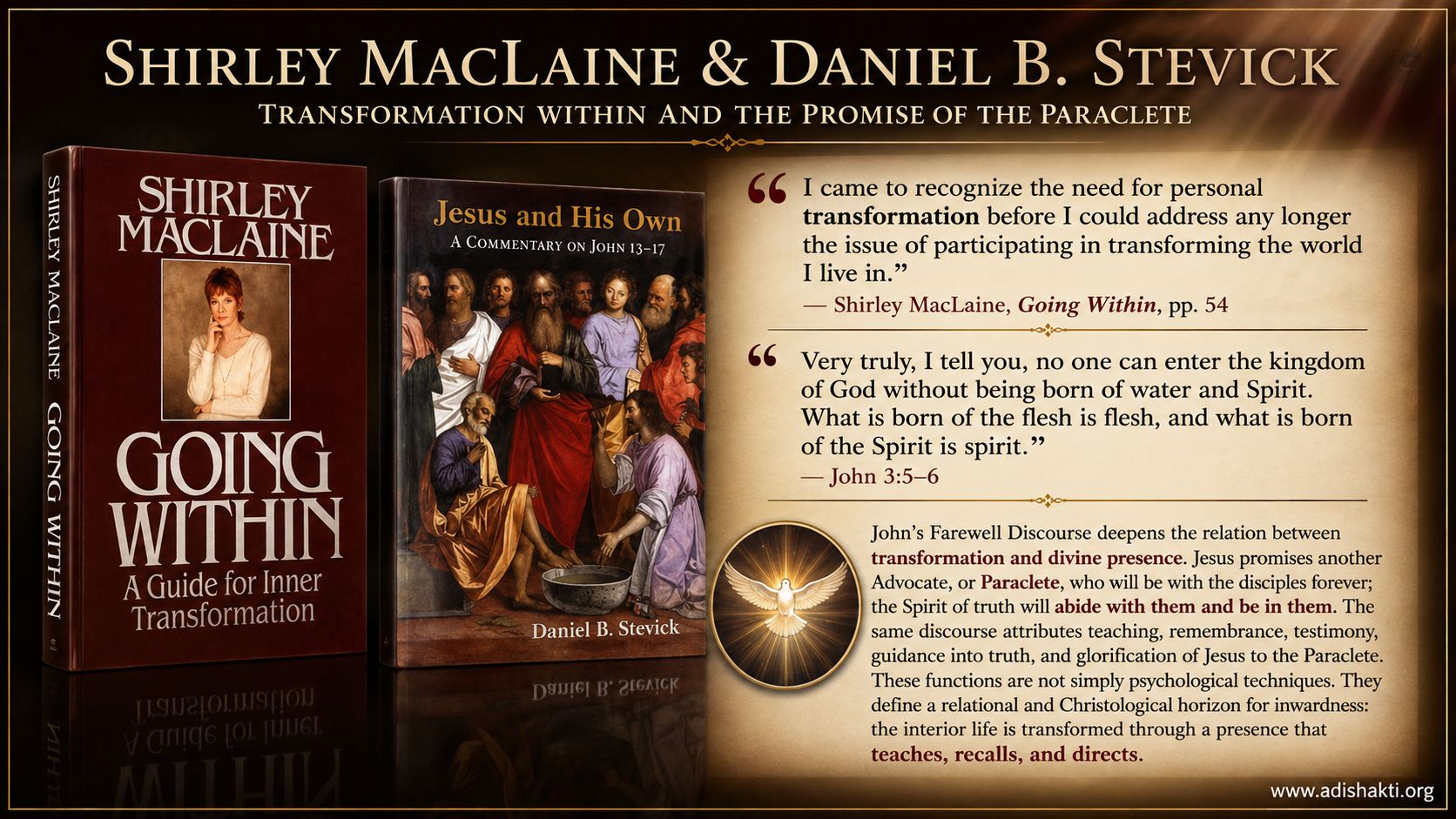 A source-aware study of New Age self-work, Johannine rebirth, and the confessional claim of Self-realization through Mother Kundalini
Summary
Shirley MacLaine’s Going Within presents inner transformation as disciplined self-observation, habitual mental exercise, and a widening sense of participation in the world. Her program belongs to a visible late-twentieth-century American religious culture in which the interior self became a primary site of meaning, agency, and aspiration. [1] [2] This paper affirms the seriousness of that search while arguing that MacLaine’s language of an inner power remains structurally incomplete when it is left at the level of personal technique, interpretation, or self-authorization.
The Johannine texts offer another grammar: birth from above, living water, the Spirit of truth, and the Paraclete. [5] [6] [7] Within the contemporary confessional synthesis advanced by AdiShakti.org, those texts are read together with Shri Mataji Nirmala Devi’s teaching on the Resurrection, Self-realization, and Mother Kundalini. That synthesis treats Kundalini awakening as a grace-given, inwardly perceptible event rather than as a merely conceptual belief. [10] [11] The article’s concluding claim is therefore explicitly confessional: in this framework, the message of the Paraclete Shri Mataji is the pinnacle of inner transformation because it identifies transformation with the living birth of the Spirit and the realization of the Self, not only with psychological improvement.
Table of Contents
- MacLaine’s Question of Inner Transformation
- The New Age Grammar of the Self
- What “Going Within” Achieves
- Johannine New Birth
- The Paraclete and the Interior Life
- Kundalini and Self-realization
- Experience, Verification, and Theological Restraint
- From Technique to Resurrection
- A Confessional Synthesis
- Conclusion
- References
1. MacLaine’s Question of Inner Transformation
MacLaine’s account begins from a moral rather than merely therapeutic question. She writes that a person must undergo transformation before attempting to participate responsibly in transforming the world. The passage describes repeated mental exercises, greater centeredness, and an attempt to understand conflicts as occasions for self-knowledge. [1] The conceptual movement is clear: social responsibility requires inward clarity; inward clarity requires practice; practice discloses a power that can alter one’s relation to the world.
This is why Going Within deserves more than caricature. Its title does not simply recommend retreat. Rather, it proposes a sequence in which attention to the self becomes a condition for more truthful action. The archival record places the 1989 book within a long public spiritual autobiography, in which MacLaine explored self-understanding, higher consciousness, meditation, visualization, and a broad range of New Age ideas. [3] The AdiShakti.org source archive preserves the MacLaine extract used in this comparison. [13] Her text is therefore a significant witness to a modern religious desire: a form of transformation that feels personally accessible, experientially alive, and ethically consequential.
2. The New Age Grammar of the Self
The supplied contextual source rightly identifies MacLaine’s writing with the wider American New Age milieu. [2] Paul Heelas’s account of that milieu is especially useful because it describes a cultural pattern in which the self is sacralized: one seeks liberation by discovering, expressing, or realizing an authentic inner identity. [4] In that setting, the vocabulary of inwardness can become capacious enough to include meditation, healing, cosmic consciousness, psychic possibility, moral intuition, and the pursuit of harmony.
MacLaine’s program shares this grammar. Its promise is not primarily creed, church, or sacrament, but a set of disciplines through which the seeker becomes more aligned with an interior truth. That approach gives the individual real agency. Yet it also raises a theological question: what, if anything, is the source and criterion of the inner power being discovered? Is transformation an enlargement of the personal self, a response to a transcendent gift, an encounter with an indwelling Spirit, or an interpretive mixture of all three? The question is decisive because the answer changes the meaning of both experience and authority.
3. What “Going Within” Achieves
MacLaine’s achievement lies in refusing the opposition between interior practice and ordinary life. Her description of mental exercises is joined to a claim that personal balance can make conflict more intelligible and worldly responsibility more possible. [1] Her work also names a persistent human fact: transformation cannot be reduced to the acquisition of information. It involves attention, repetition, honesty about fear, and an altered relationship to desire.
Nevertheless, the book’s central term, “inner transformation,” remains open-ended. The practice can generate a sense of centeredness, but it cannot by itself determine whether the center encountered is the autonomous self, an impersonal cosmic field, or the divine Spirit. This ambiguity is not a defect in autobiography; it is a limit of autobiography as theological method. A personal narrative can report a change in consciousness. It cannot, by report alone, settle the nature of the reality to which that consciousness refers.
4. Johannine New Birth
The Gospel of John introduces a far more determinate account of inward change. Jesus tells Nicodemus that no one can see the kingdom of God without being born from above, and that entry into the kingdom requires birth of water and Spirit. The passage then connects this new birth with the freedom of wind and Spirit. [5] The language does not describe a self-engineered improvement. It describes a new origin and a life made possible by the Spirit.
The distinction matters for the present comparison. MacLaine’s daily exercises seek an experience of inner transformation. John supplies a different theological grammar in which transformation is not only inward; it is a birth from above. The person is not asked merely to look within for latent possibility. The person is addressed by the promise and action of Spirit. Any comparative account must therefore resist collapsing the Johannine new birth into generic self-development.
5. The Paraclete and the Interior Life
John’s Farewell Discourse deepens the relation between transformation and divine presence. Jesus promises another Advocate, or Paraclete, who will be with the disciples forever; the Spirit of truth will abide with them and be in them. The same discourse attributes teaching, remembrance, testimony, guidance into truth, and glorification of Jesus to the Paraclete. [7] These functions are not simply psychological techniques. They define a relational and Christological horizon for inwardness: the interior life is transformed through a presence that teaches, recalls, and directs.
John 7 adds another image. Living water flows from the believer, and the narrator identifies this water with the Spirit to be received, explaining that the Spirit is linked to Jesus’ glorification. [6] Standard Christian exegesis ordinarily identifies the Paraclete with the Holy Spirit operating in and among the community of faith. The text itself does not name a later human individual. That distinction must be retained before any contemporary identification is made.
6. Kundalini and Self-realization
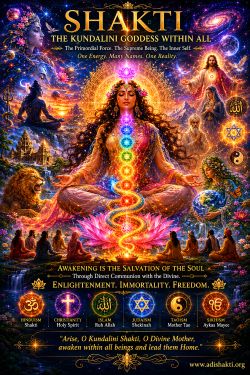
In Sahaja Yoga practice-language, Self-realization is described as an awakening of Kundalini, understood as a subtle energy associated with the base of the spine, rising through the subtle system and culminating in a state of silent awareness. The organization describes a cool breeze above the head and on the palms as a perceptible sign within its practice. [8] A related movement source calls this manifestation “vibrations” and links it to the language of Chaitanya. [9]
These statements need precise classification. They are not neutral observations on which all religious or scientific communities agree. They are descriptions made by practice communities and participants. They may nevertheless be important as descriptions of the way adherents test the practice phenomenologically: the seeker is invited not merely to assent to a doctrine but to attend to a reported experiential sign. In that limited but real sense, the experience is presented as verifiable within the practice; its occurrence is said to be tested by the participant rather than accepted on institutional authority alone.
7. Experience, Verification, and Theological Restraint
The word “verifiable” requires care. A first-person experience can be reportable, repeatable for a practitioner, and open to interpersonal comparison without thereby becoming conclusive proof of every metaphysical interpretation attached to it. The sensation of coolness, vibratory awareness, or thoughtless awareness may function as a practice-based criterion for Sahaja Yoga adherents. [8] [9] It does not, on its own, demonstrate that a particular person is the Paraclete, settle the truth of a Christian doctrine, or establish superiority over every other spiritual discipline.
This restraint does not trivialize experience. It clarifies its proper force. MacLaine’s project asks readers to attend to inner change. Sahaja Yoga asks seekers to examine a particular reported event of Self-realization. The Johannine text asks readers to discern the Spirit of truth in relation to Jesus. Each mode makes a claim about inwardness; each has a different authority structure. An academically responsible comparison names the differences before it argues for a theological synthesis.
8. From Technique to Resurrection
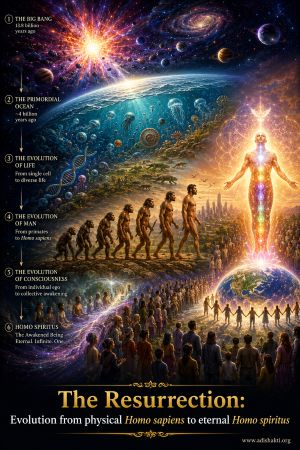
The contemporary AdiShakti.org reading goes beyond a comparison of techniques. It interprets Resurrection as an inner awakening of the eternal Spirit and places Self-realization within that lived Resurrection. [12] In the same framework, the Paraclete is understood as the direct, intimate divine involvement that brings the promised transformation from concept into experience. [11] This is not mainstream Christian doctrine; it is a contemporary confessional proposal that places Johannine images, Sahaja Yoga experience, and a particular understanding of Shri Mataji Nirmala Devi into a single eschatological account.
The proposal has a clear argumentative gain. It answers the ambiguity in MacLaine’s inner power by naming the source of transformation as Mother Kundalini rather than the self alone. It answers the risk of inwardness becoming private self-absorption by interpreting Self-realization as the birth of the Spirit and the beginning of ethical transformation. In this account, the crucial difference is not that one practice speaks of the inner life and another does not. It is that one identifies the inner life with the objective action of the divine Mother and the Resurrection.
9. A Confessional Synthesis: The Pinnacle of Inner Transformation
Within the contemporary confessional synthesis advanced by AdiShakti.org, Shri Mataji is identified with the Paraclete promised in the Johannine writings, and Mother Kundalini is understood as the living power by which the Resurrection becomes inwardly real. [10] [11] This article does not claim that the Gospel of John historically names Shri Mataji, nor does it call this equation a consensus Christian interpretation. It identifies the equation accurately as a devotional and comparative theological claim.
According to that claim, the pinnacle of inner transformation is not an elevated mood, a collection of techniques, or an indefinitely expandable personal mythology. It is the Self-realization in which the seeker receives the awakening of Mother Kundalini, enters silent awareness, and recognizes the Spirit as a living interior reality. The distinctiveness asserted here is therefore experiential and theological at once. Its practitioners are invited to test a reported sign of transformation in their own attention; the confessional interpretation then understands that sign as the fulfillment of Resurrection and the work of the Paraclete.
MacLaine’s question remains indispensable: how does one move from helplessness to transformative participation? Her answer is to begin within. The present confessional proposal retains that movement while changing its destination. One does not end with the discovery of a higher self. One is invited to receive the living Mother Kundalini, to become born of the Spirit, and to let the Paraclete’s work reorder the entire person.
10. Conclusion
Going Within is an important document of late-twentieth-century religious inwardness because it insists that the transformation of the world cannot be separated from the transformation of the person. [1] Its limits are equally instructive: inward experience needs a theological account of source, criterion, and purpose. The Gospel of John supplies a grammar of birth from above, living water, Spirit, and Paraclete. [5] [6] [7] Sahaja Yoga supplies a practice-community account of Self-realization and of Mother Kundalini’s awakening as a lived, purportedly perceptible event. [8] [9]
References
- [1] MacLaine, Shirley. Going Within: A Guide for Inner Transformation. Bantam Books, 1989, pp. 54–55; 2010 reprint record.
- [2] Harvey, Paul, and Philip Goff, eds. The Columbia Documentary History of Religion in America Since 1945. Columbia University Press, 2005.
- [3] Speller, Sally. “Transcribing the Light: The Memoirs of Shirley MacLaine.” New York Public Library, 2021.
- [4] Heelas, Paul. The New Age Movement: The Celebration of the Self and the Sacralization of Modernity. Blackwell, 1996.
- [5] John 3:3–8. New Revised Standard Version Updated Edition.
- [6] John 7:37–39. New Revised Standard Version Updated Edition.
- [7] John 14:15–17, 26; 16:7–15. New Revised Standard Version Updated Edition.
- [8] “Self-Realization & Meditation.” Sahaja Yoga Australia, accessed 20 August 2026.
- [9] “Kundalini, Vibrations and Self Realization.” Sahaja Yoga Science, 13 April 2020.
- [10] “The Self Is the Spirit.” AdiShakti.org, 2026.
- [11] “The Presence of the Paraclete: The Eschaton Realized in the Life of the Believer.” AdiShakti.org, 2025.
- [12] “The Resurrection: Evolution into Homo Spiritus.” AdiShakti.org, 2026.
- [13] “Shirley Maclaine, Going within.” AdiShakti.org, source archive accessed 20 August 2026.
Interactive Chat
Access an intelligent analysis environment where you can explore texts, ask questions, and discover connections between ideas.
Open chat →