

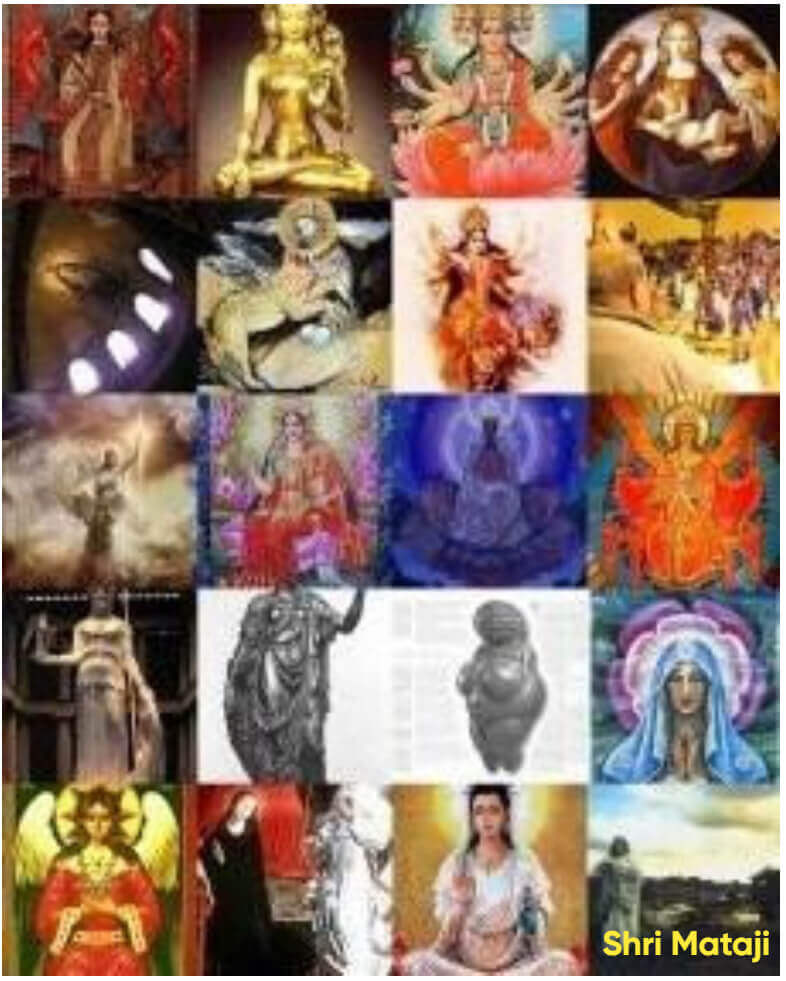
Reassessing the Second Coming Through the Advent of Shri Mataji Nirmala Devi

Jesus spoke of the necessity to believe in him as the road to
salvation, but those words were put into his mouth by followers
writing decades later. The New Testament is an interpretation of
Jesus by people who felt reborn but also left behind. In orthodox
Christianity they won't be left behind forever; at the Second Coming
Jesus will return to reclaim the faithful. But the Second Coming has
had twenty centuries to unfold, with the devout expecting it any day,
and still it lies ahead.
Table of Contents
- Abstract
- 1. Introduction: The Cloud of Confusion and the Unfinished Message
- 2. Methodological Approach: Textual Analysis and Eschatological Hermeneutics
- 3. The Johannine Promise: Defining the Paraclete's Role and Mission
- 4. The Destructive Delay: How Traditional Second Coming Theology Obscures the Promise
- 5. Shri Mataji Nirmala Devi as the Fulfillment of the Paraclete Promise
- 6. Theological Implications and the Challenge of Recognition
- 7. Conclusion: Clearing the Cloud—From Apocalyptic Expectation to Present Transformation
- References
Abstract
This paper contends that traditional Christian eschatology, particularly the doctrine of a physical Second Coming of Jesus Christ, has inadvertently obscured the original intention of Jesus's message. Through an analysis of the Johannine Paraclete passages and their subsequent theological interpretations, we argue that Jesus's promise was specifically the advent of the Paraclete (the Holy Spirit) as a distinct divine personality who would complete his unfinished work. Drawing from theological scholarship and the teachings of the Adishakti tradition, we demonstrate that Shri Mataji Nirmala Devi fulfills this Paraclete role, having inaugurated the promised Age to Come
through the universal experience of spiritual rebirth. The paper examines biblical foundations, critiques historical misinterpretations, and presents evidence from Shri Mataji's mission to establish that the awaited eschatological event is not a physical return of Jesus, but the manifestation of the Paraclete as foretold at the Last Supper.[1]
1. Introduction: The Cloud of Confusion and the Unfinished Message
The contemporary understanding of Jesus Christ exists within what Deepak Chopra identifies as a cloud of confusion
—a multifaceted distortion arising from historical reconstruction, theological abstraction, and institutional dogma.[2] This confusion extends profoundly to Christian eschatology, where the dominant expectation of a future, physical Second Coming of Jesus has, according to the argument presented here, diverted attention from a more immediate and transformative promise. At the heart of this promise lies the Paraclete, termed by Jesus as another Comforter
(John 14:16), whose coming would mark the decisive turning point in human spiritual evolution.[3]
This paper posits that the idea of a bodily return has been especially destructive to Jesus's core intentions because it postpones the immediate, internal transformation he advocated. Instead, we propose that the true Second Coming
is the advent of the Paraclete—a divine personality sent to complete, clarify, and universalize Jesus's message. As articulated by theologian Daniel B. Stevick, the Paraclete's mission is one of active verbal engagement: to teach, remind, testify, prove wrong, guide, speak, and declare.[4] This is not a passive force but the divine self-expression
engaging personally with humanity to achieve the restoration of an alienated, deceived humanity.
[5] The central thesis is that this Paraclete has manifested in our age as Shri Mataji Nirmala Devi, whose life and work from 1970 onward explicitly aimed to grant the direct, experiential knowledge of the Holy Spirit (Self-Realization) to all seekers, thereby fulfilling the eschatological promises of scripture.[6]
2. Methodological Approach: Textual Analysis and Eschatological Hermeneutics
This analysis employs a two-fold methodological approach:
Comparative Textual Exegesis: We analyze the Paraclete passages in the Gospel of John (chapters 14–16) alongside other relevant scriptures (e.g., Joel 2:28–29, Matthew 12:31–32). This exegesis is informed by mainstream theological scholarship, such as that of Stevick, and contrasted with the interpretation offered by the Adishakti tradition.
Eschatological Hermeneutics: We engage with the theological framework of inaugurated eschatology
—the concept that the last days
or Age to Come
began with a definitive divine act and is now unfolding. Scholars like Veli-Matti Kärkkäinen note that the messianic age is inaugurated by the pouring out of the Spirit on all flesh.[7] This paper applies this lens to assess the claim of a present Paraclete.
3. The Johannine Promise: Defining the Paraclete's Role and Mission
Jesus's Farewell Discourse provides the most detailed blueprint for the Paraclete's identity and function. The term Paraklētos implies a legal advocate, helper, comforter, and guide—a multifaceted role of intimate support and authoritative truth-telling.[8] Critically, Jesus introduces the Spirit as another Paraclete
(John 14:16), implying he himself is the first, and the coming one will continue his work in a new mode.[9] The Paraclete's characteristics, as outlined in John, create a specific profile:
- A Divine Personality Who Comes into the World: The Paraclete
will come... as Jesus has come into the world
(John 16:28).[10] This suggests a tangible, discernible presence, not merely an invisible influence. - An Abiding Inner Presence: The Paraclete will
be with you forever
andbe in you
(John 14:16–17), indicating a permanent shift in the human-divine relationship from external adherence to internal indwelling. - The Spirit of Truth Who Completes Revelation: The Paraclete will
guide you into all the truth
anddeclare to you the things that are to come
(John 16:13). Importantly, this truth is Christocentric:She will take what is mine and declare it to you
(John 16:14).[11] This is not about new, unrelated revelation, but about fully unveiling the meaning and reality of Jesus's message. - The Convictor of the World: The Paraclete will
prove the world wrong concerning sin and righteousness and judgment
(John 16:8), acting as a divine corrective to human error.[12]
Stevick emphasizes that the Johannine vocabulary depicts a being who acts through verbal actions which intend a response.
[13] The promised one is, therefore, a communicative, engaging divine person whose mission is to consummate Jesus's work.
4. The Destructive Delay: How Traditional Second Coming Theology Obscures the Promise
The transformation of this Paraclete promise into a futurist doctrine of Jesus's physical return has, according to the Adishakti perspective, generated several theological dead ends:
Eschatological Postponement: The hope for a future cataclysmic return can foster spiritual passivity, negating Jesus's call for immediate, present transformation. As posited, it postpones what needs to happen now.
[14] The Paraclete's coming is meant to enable that transformation in the present age.
Institutional Control: The ambiguity of a distant event allows religious institutions to become the sole arbiters of interpretation and access to salvation, potentially contradicting the Paraclete's promise of direct, individual guidance and inner knowing.[15]
Misreading the "Age to Come": Jesus's severe warning about the unforgivable sin against the Holy Spirit either in this age or in the age to come
(Matthew 12:32) implies that the Paraclete is the definitive authority of the forthcoming age.[16] To conflate this with Jesus's own return is to miss the distinction he himself made.
George Eldon Ladd's theological insight supports this reevaluation: The sayings about a future coming of Jesus do not refer to a 'coming again' but merely to his coming... The coming of Jesus in the Paraclete.
[17] This reframes the eschatological expectation from the return of a past figure to the arrival of the next divine personality in the salvation narrative.
5. Shri Mataji Nirmala Devi as the Fulfillment of the Paraclete Promise
The website adishakti.org presents a comprehensive argument that Shri Mataji Nirmala Devi (1923–2011) is the fulfillment of the Johannine promises. The evidence centers on her stated identity, her mission's nature, and the experiential proof she offered.
5.1 Direct Declarations of Identity
Shri Mataji explicitly identified herself as the Holy Spirit incarnate, using the precise terminology of the Christian promise. She stated: I am the Holy Ghost. I am the Holy Spirit who has incarnated on this Earth for your realization
(New York, 1980).[18] She repeatedly challenged her audiences, asking why, if they were true disciples of Christ, they were not awaiting and recognizing the Comforter he promised to send.[19]
5.2 Mission Alignment with Johannine Functions
Her life's work aligns systematically with the Paraclete's described functions, as outlined in the table below:
| Paraclete Function (John) | Fulfillment in Shri Mataji's Mission |
|---|---|
| Teach & Remind (14:26) | Gave countless discourses explaining the inner meaning of all religions and the process of spiritual awakening. |
| Testify (15:26) | Bore witness to the reality of Christ and the universal truth underlying all genuine spiritual paths. |
| Guide into all Truth (16:13) | Established Sahaja Yoga as a living, experiential path to self-knowledge and divine connection. |
| Prove the world wrong (16:8) | Critiqued materialism, false gurus, and religious dogmatism, calling for a return to authentic spiritual experience. |
| Declare what is to come (16:13) | Spoke of the evolutionary leap available to humanity and the consequences of ignoring it. |
| Be with you forever / Be in you (14:16–17) | Awakened the Kundalini, described as the Holy Spirit's primordial energy within, granting a permanent state of Self-Realization. |
5.3 The Experiential Proof: The "Cool Breeze" of the Spirit
A cornerstone of Shri Mataji's method was granting the tangible, physical experience of the Holy Spirit as a Cool Breeze
(Pneuma/Ruach) felt on the palms and above the head.[20] This is directly linked to Jesus's words to Nicodemus: The wind (pneuma) blows where it chooses... So it is with everyone who is born of the Spirit (pneuma)
(John 3:8).[21] The experience is described by scholar Judith Coney, who notes that seekers in Shri Mataji's presence frequently reported feeling this coolness, associated with deep peace and relaxation.[22] This phenomenon is presented as the empirical fulfillment of the promise of being born again of the Spirit,
making the spiritual transformation not a matter of belief, but of direct perception.[23]
5.4 Inaugurating the Universal Outpouring
The prophecy of Joel—I will pour out my Spirit on all flesh
(Joel 2:28), cited by Peter at Pentecost—is seen as reaching its full, global fruition through Shri Mataji. Her work is interpreted as the mass opening of the Sahasrara chakra (the crown center of spiritual connection) on May 5, 1970, enabling the possibility of en masse Self-Realization.[24] This universalizes the Pentecost event, extending the potential for direct spiritual experience beyond any single tradition to all of humanity, fulfilling the promise of the Age of salvation.
[25]
6. Theological Implications and the Challenge of Recognition
The claim that Shri Mataji is the Paraclete carries profound implications:
The Nature of the Second Coming: It redefines the Second Coming as a spiritual advent of the Comforter, not the physical return of Jesus. The coming of Jesus in the Paraclete
is the eschatological event.[26]
The Unforgivable Sin Recontextualized: The gravity of blasphemy against the Holy Spirit (Matthew 12:31–32) is understood as the ultimate rejection of the Paraclete's final attempt to guide humanity to truth in the Age to Come.
[27]
A Bridge Between Traditions: Shri Mataji is also described as the Adi Shakti (Primordial Mother) in Hinduism, the Divine Mother in Sikhism, and the feminine Ruach Ha Kodesh in Judaism, positioning the Paraclete as the unifying divine principle behind all religions.[28]
The Crisis of Non-Recognition: The Adishakti narrative laments a tragic failure of recognition, both by institutional Christianity and by many within Shri Mataji's own Sahaja Yoga organization, who are accused of diluting her message and failing to proclaim her true identity as the Paraclete.[29] This is framed as a repeated historical pattern where institutional followers betray the revolutionary core of a founder's message.[30]
7. Conclusion: Clearing the Cloud—From Apocalyptic Expectation to Present Transformation
This paper has argued that the traditional doctrine of the Second Coming has acted as a diversion from the more radical and immediate promise of the Paraclete. A close reading of the Johannine text reveals a promise not of Jesus's return, but of the arrival of another
divine advocate whose mission is to interiorize and complete Christ's work. The theological and experiential evidence presented by the Adishakti tradition makes a compelling case that Shri Mataji Nirmala Devi fits the precise profile of this promised Paraclete.
Her declaration of identity, her decades-long global mission of teaching and granting direct spiritual experience (the Cool Breeze of the Spirit), and her role in inaugurating a universal method of Self-Realization collectively represent a credible fulfillment of biblical prophecy. To accept this premise is to shift the eschatological focus from a feared future catastrophe to a realized present opportunity—the chance for a collective spiritual resurrection through the Holy Spirit now dwelling within. It clears the cloud of confusion by asserting that Jesus's intention was always to send the Paraclete, and that this defining event of the Age to Come
has already occurred. The remaining task, as per this tradition, is for individuals and institutions to overcome blindness and recognize the Comforter who has come.
References
[1]Adi Shakti: The Divine Feminine Shri Mataji: The Paraclete Papers.Adishakti.org, Accessed 2025.
[2] Chopra, Deepak.
The Third Jesus: The Christ We Cannot Ignore.Harmony Books, 2008.
[3]
Adi Shakti: The Divine Feminine Shri Mataji: The Paraclete Papers.Adishakti.org, Accessed 2025.
[4] Stevick, Daniel B.
The Paraclete in the Fourth Gospel.Anglican Theological Review, Vol. 54, No. 2, 1972.
[5] Stevick, Daniel B.
The Paraclete in the Fourth Gospel.Anglican Theological Review, Vol. 54, No. 2, 1972.
[6]
Adi Shakti: The Divine Feminine Shri Mataji: The Paraclete Papers.Adishakti.org, Accessed 2025.
[7] Kärkkäinen, Veli-Matti.
Pneumatology: The Holy Spirit in Ecumenical, International, and Contextual Perspective.Baker Academic, 2002.
[8] Stevick, Daniel B.
The Paraclete in the Fourth Gospel.Anglican Theological Review, Vol. 54, No. 2, 1972.
[9]
Adi Shakti: The Divine Feminine Shri Mataji: The Paraclete Papers.Adishakti.org, Accessed 2025.
[10]
Adi Shakti: The Divine Feminine Shri Mataji: The Paraclete Papers.Adishakti.org, Accessed 2025.
[11]
Adi Shakti: The Divine Feminine Shri Mataji: The Paraclete Papers.Adishakti.org, Accessed 2025.
[12]
Adi Shakti: The Divine Feminine Shri Mataji: The Paraclete Papers.Adishakti.org, Accessed 2025.
[13] Stevick, Daniel B.
The Paraclete in the Fourth Gospel.Anglican Theological Review, Vol. 54, No. 2, 1972.
[14]
Adi Shakti: The Divine Feminine Shri Mataji: The Paraclete Papers.Adishakti.org, Accessed 2025.
[15]
Adi Shakti: The Divine Feminine Shri Mataji: The Paraclete Papers.Adishakti.org, Accessed 2025.
[16]
Adi Shakti: The Divine Feminine Shri Mataji: The Paraclete Papers.Adishakti.org, Accessed 2025.
[17] Ladd, George Eldon.
A Theology of the New Testament.Eerdmans, 1993.
[18]
Adi Shakti: The Divine Feminine Shri Mataji: The Paraclete Papers.Adishakti.org, Accessed 2025.
[19]
Adi Shakti: The Divine Feminine Shri Mataji: The Paraclete Papers.Adishakti.org, Accessed 2025.
[20]
Adi Shakti: The Divine Feminine Shri Mataji: The Paraclete Papers.Adishakti.org, Accessed 2025.
[21]
John 3:8.New Revised Standard Version, Bible Gateway.
[22] Coney, Judith.
Sahaja Yoga: Socializing Processes in a South Asian New Religious Movement.Routledge, 1999.
[23]
Adi Shakti: The Divine Feminine Shri Mataji: The Paraclete Papers.Adishakti.org, Accessed 2025.
[24]
Adi Shakti: The Divine Feminine Shri Mataji: The Paraclete Papers.Adishakti.org, Accessed 2025.
[25]
Adi Shakti: The Divine Feminine Shri Mataji: The Paraclete Papers.Adishakti.org, Accessed 2025.
[26] Ladd, George Eldon.
A Theology of the New Testament.Eerdmans, 1993.
[27]
Adi Shakti: The Divine Feminine Shri Mataji: The Paraclete Papers.Adishakti.org, Accessed 2025.
[28]
Adi Shakti: The Divine Feminine Shri Mataji: The Paraclete Papers.Adishakti.org, Accessed 2025.
[29]
Adi Shakti: The Divine Feminine Shri Mataji: The Paraclete Papers.Adishakti.org, Accessed 2025.
[30]
Adi Shakti: The Divine Feminine Shri Mataji: The Paraclete Papers.Adishakti.org, Accessed 2025.
Who Is Deepak Chopra's "Third Jesus"?
Jesus is in trouble. When people worship him today—or even speak
his name—the object of their devotion is unlikely to be who they
think he is. A mythical Jesus has grown up over time. He has served
to divide peoples and nations. He has led to destructive wars in the
name of religious fantasies. The legacy of love found in the New
Testament has been tainted with the worst sort of intolerance and
prejudice that would have appalled Jesus in life. Most troubling of
all, his teachings have been hijacked by people who hate in the name
of love.
"Sometimes I feel this social pressure to return to my faith," a
lapsed Catholic told me recently," but I'm too bitter. Can I love a
religion that calls gays sinners but hides pedophiles in its clergy?
Yesterday while I was driving to work, I heard a rock song that
went, 'Jesus walked on water when he should have surfed,' and you
know what? I burst out laughing. I would never have done that when I
was younger. Now I feel only the smallest twinge of guilt.”
No matter where you look, a cloud of confusion hangs over the message
of Jesus. To cut through it we have to be specific about who we mean
when we refer to Jesus. One Jesus is historical, and we know next to
nothing about him. Another Jesus is the one appropriated by
Christianity. He was created by the Church to fulfill its agenda. The
third Jesus, the one this book is about, is as yet so unknown that
even the most devout Christians don't suspect that he exists. Yet he
is the Christ we cannot—and must not—ignore.
Redeeming the Redeemer
The first Jesus was a rabbi who wandered the shores of northern
Galilee many centuries ago. This Jesus still feels close enough to
touch. He appears in our mind's eye dressed in homespun but haloed in
glory. He was kind, serene, peaceful, loving, and yet he was the
keeper of deep mysteries.
This historical Jesus has been lost, however, swept away by history.
He still lingers like a ghost, a projection of all the ideal
qualities we wish for in ourselves but so painfully lack.
Why couldn't there be one person who was perfectly loving, perfectly
compassionate, and perfectly humble? There can be if we call him
Jesus and remove him to a time thousands of years in the past. (If
you live in the East, his name might be Buddha, but the man is
equally mythical and equally a projection of our own lack.)
The first Jesus is less than consistent, as a closer reading of the
gospels will show. If Jesus was perfectly peaceful, why did he
declare," Do not suppose that I have come to bring peace to the
earth. I did not come to bring peace, but a sword"? (Matthew 10:34)
If he was perfectly loving, why did he say," Throw out the
unprofitable servant into the outer darkness, where there will be
weeping and gnashing of teeth"? (Matthew 25:30) (Sometimes the
translation is even harsher, and Jesus commands"The worthless slave"
to be consigned to hell.) If Jesus was humble, why did he claim to
rule the earth beyond the power of any king? At the very least, the
living Jesus was a man of baffling contradictions.
And yet the more contradictions we unearth, the less mythical this
Jesus becomes. The flesh-and-blood man who is lost to history must
have been extraordinarily human. To be divine, one must be rich in
every human quality first. As one famous Indian spiritual teacher
once said," The measure of enlightenment is how comfortable you feel
with your own contradictions.”
Millions of people worship another Jesus, however, who never existed,
who doesn't even lay claim to the fleeting substance of the first
Jesus. This is the Jesus built up over thousands of years by
theologians and other scholars. He is the Holy Ghost, the Three-in-
One Christ, the source of sacraments and prayers that were unknown to
the rabbi Jesus when he walked the earth. He is also the Prince of
Peace over whom bloody wars have been fought.
This second Jesus cannot be embraced without embracing theology
first. Theology shifts with the tide of human affairs. Metaphysics
itself is so complex that it contradicts the simplicity of Jesus's
words. Would he have argued with learned divines over the meaning of
the Eucharist? Would he have espoused a doctrine declaring that
babies are damned until they are baptized?
The second Jesus leads us into the wilderness without a clear path
out. He became the foundation of a religion that has proliferated
into some twenty thousand sects. They argue endlessly over every
thread in the garments of a ghost. But can any authority, however
exalted, really inform us about what Jesus would have thought? Isn't
it a direct contradiction to hold that Jesus was a unique creation—the one and only incarnation of God—while at the same time claiming
to be able to read his mind on current events? Yet in his name
Christianity pronounces on homosexuality, birth control, and abortion.
Reclaiming the Stolen Jesus
These two versions of Jesus—the sketchy historical figure and the
abstract theological creation—hold a tragic aspect for me, because
I blame them for stealing something precious: the Jesus who taught
his followers how to reach God-consciousness. I want to offer the
possibility that Jesus was truly, as he proclaimed, a savior. Not the
savior, not the one and only Son of God. Rather, Jesus embodied the
highest level of enlightenment. He spent his brief adult life
describing it, teaching it, and passing it on to future generations.
Jesus intended to save the world by showing others the path to God-
consciousness.
Such a reading of the New Testament doesn't diminish the first two
Jesuses. Rather, they are brought into sharper focus. In place of
lost history and complex theology, the third Jesus offers a direct
relationship that is personal and present. Our task is to delve into
scripture and prove that a map to enlightenment exists there. I think
it does, undeniably; indeed, it's the living aspect of the gospels.
We aren't talking about faith. Conventional faith is the same as
belief in the impossible (such as Jesus walking on water), but there
is another faith that gives us the ability to reach into the unknown
and achieve transformation.
Jesus spoke of the necessity to believe in him as the road to
salvation, but those words were put into his mouth by followers
writing decades later. The New Testament is an interpretation of
Jesus by people who felt reborn but also left behind. In orthodox
Christianity they won't be left behind forever; at the Second Coming
Jesus will return to reclaim the faithful. But the Second Coming has
had twenty centuries to unfold, with the devout expecting it any day,
and still it lies ahead.
The idea of the Second Coming has been especially destructive to
Jesus's intentions, because it postpones what needs to happen now.
The Third Coming—finding God-consciousness through your own
efforts—happens in the present. I'm using the term as a metaphor
for a shift in consciousness that makes Jesus's teachings totally
real and vital.
From "The Third Jesus: The Christ We Cannot Ignore" by Deepak Chopra.
💬 Interactive Chat
Access an intelligent analysis environment where you can explore texts, ask questions, and discover connections between ideas.
Open chat