If the Kingdom of God is within, then the MahaDevi is the God within that Kingdom!
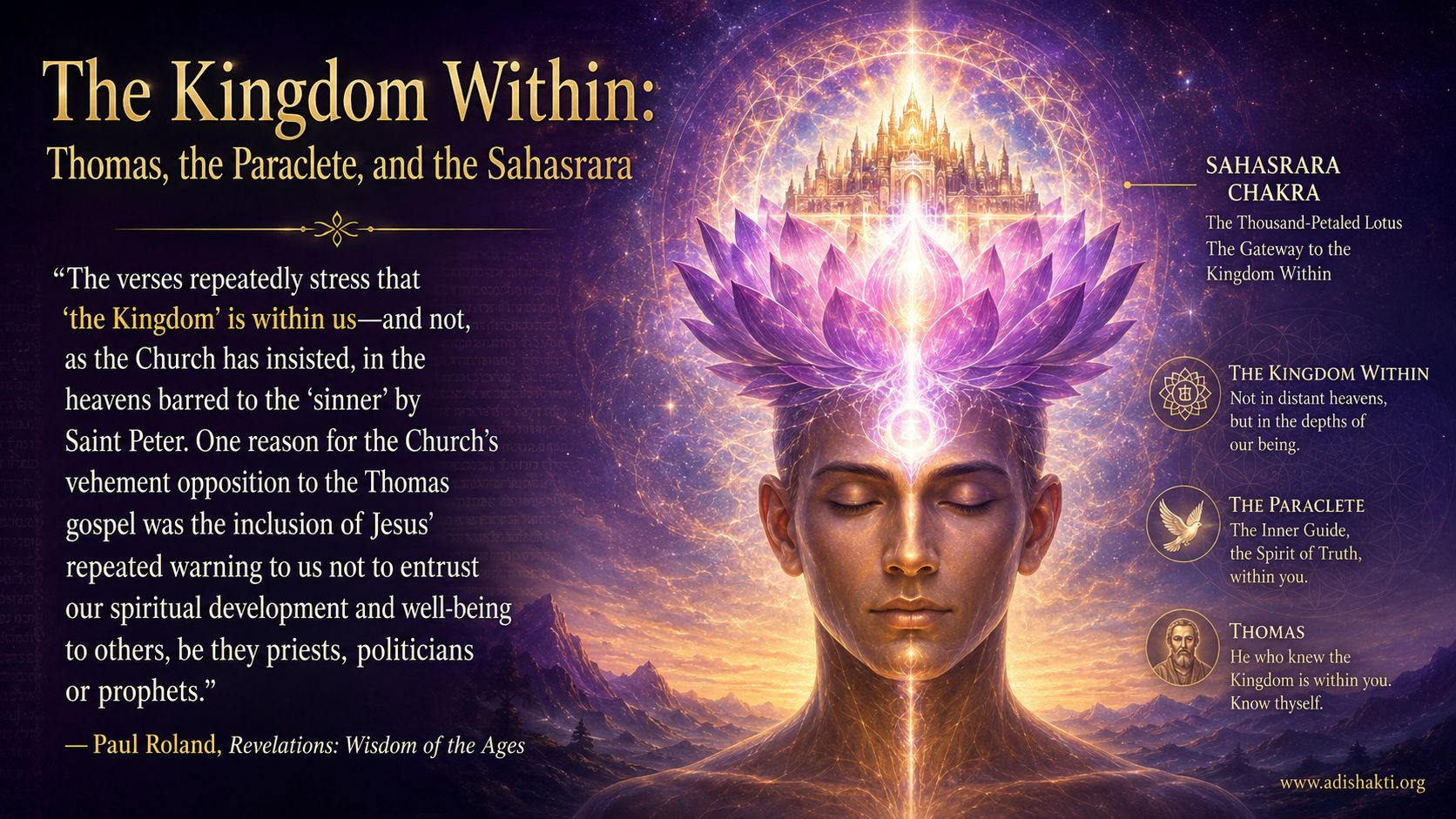 Why the MahaDevi Encountered in the Sahasrara Must Be the God Within the Kingdom of God
Summary: The Conclusion Is Not Optional Once the Premises Are Granted
This paper advances one governing thesis and refuses to blur it: “If the Kingdom of God is within, then the MahaDevi is the God within that Sahasrara!” AdiShakti.org names the Sahasrara as the interior Kingdom. A Kingdom of God within cannot be severed from the divine reality that makes it God’s Kingdom. It is not an empty spiritual chamber into which a lesser being merely enters; it is the inward realm of God.
AdiShakti.org identifies the MahaDevi as the Great Divine Mother and reports that Kash encountered Her within the Sahasrara, the precise interior site the source identifies as the Kingdom of God. The conclusion therefore follows with theological necessity inside the source’s stated premises: the MahaDevi is the God within that Sahasrara—the Divine Mother, the divine reality of the Kingdom within, and the indwelling Presence by whom the seeker is awakened, taught, and transformed.
Premise 1: AdiShakti.org identifies the Sahasrara as the Kingdom of God within; therefore this Kingdom is not a merely external location.
Premise 2: God cannot be absent from God’s own Kingdom; therefore, if the Kingdom is within that Sahasrara, God is within that Sahasrara.
Premise 3: Kash encounters the MahaDevi within that Sahasrara/Kingdom.
Premise 4: The MahaDevi is the Great Divine Mother, not a lesser creature, guide, or decorative symbol.
Conclusion: “If the Kingdom of God is within, then the MahaDevi is the God within that Sahasrara!”
The argument is forceful because it does not depend on a single phrase or a single experience. It draws together the non-localizable Kingdom in Luke, the explicit inward Kingdom of Thomas, the indwelling Spirit of John, the Śākta confession of the MahaDevi as the Great Goddess, and the reported location of Kash’s encounter. Historical method cannot turn a mystical testimony into a laboratory instrument. It can, however, make the sources clear; and once their confessional premises are understood, the conclusion is direct rather than evasive.
Table of Contents
1. The Argument Before All Evasion
The decisive question is not whether one likes the conclusion; it is whether one accepts the premises. The homepage supplied by the user presents the Kingdom as an inner reality, says that it is entered through the Sahasrara, and places Kash’s testimony within a record of the “inner Kingdom.”[1] From that point onward, it is not coherent to speak as though God remains entirely outside the seeker while God’s own Kingdom is within the seeker. The claim “the Kingdom is within” necessarily carries the claim of divine immanence.
To deny this would make the Kingdom a shell without its divine content. But a kingdom is not a vacant room. It is the living actuality of the ruler’s presence, authority, and order. To say “God’s Kingdom is within” while saying “God is not within” is to detach God from God’s own Kingdom. The paper rejects that incoherence. The Kingdom within means God within.
2. The Sahasrara as the Kingdom within Necessarily Means God within That Sahasrara
The AdiShakti.org synthesis makes the point concrete rather than abstract. Its study of Thomas, the Paraclete, and the Sahasrara proposes that the seventh chakra is the interior threshold of the Kingdom and that direct spiritual awakening is not an escape to a remote location but an encounter with divine reality within.[2] The paper does not hide the source’s mode: this is a contemporary confessional synthesis. But naming its mode does not make its reasoning weak. It makes the reasoning accountable.
Once the Kingdom is inwardly present, the search for God is no longer properly conceived as a journey to a distant external object. The question becomes: Who is encountered in the Kingdom that is within? The answer matters because presence identifies relation. If the MahaDevi is met in the Kingdom, and if the Kingdom is God’s own inward reality, then the MahaDevi’s identity cannot be reduced to a non-divine visitor who happens to stand inside God’s realm. The logic moves toward the conclusion before any rhetorical flourish is added: the One encountered in that Sahasrara is the God within that Sahasrara.
3. Jesus Rejects a Distant, Pointable Kingdom
Luke 17:20–21 supplies the canonical boundary against a merely external Kingdom. Jesus says that the Kingdom does not arrive with observable signs and that people will not say, “Look, here it is!” or “There it is!” The NRSVUE renders the final phrase “the kingdom of God is among you,” while preserving “within” as an alternative in its note.[3] The translation debate must be faced without fear: “among” and “within” are not mechanically identical. Yet both readings refuse a God-realm that can be found by geographical pointing or public spectacle.
The inward translation is more than a devotional preference. Ilaria Ramelli argues that the Greek entos hymōn in this verse is best understood as “inside you,” citing Greek usage, Latin tradition, and early Syriac versions. This is a substantive scholarly case, even though many contemporary translations choose “among you.”[4] The point required for this paper is therefore secure at two levels: Luke rejects a distant, pointable Kingdom; and a serious philological argument supports the stronger “within” reading.
4. The Explicit Inward Kingdom in Thomas
The Gospel of Thomas speaks with even less ambiguity. Saying 3 rejects locating the Kingdom in the sky or sea and says, “the kingdom is inside of you, and it is outside of you.” Saying 113 likewise says that the Kingdom will not come by waiting or by someone indicating “here” or “there.”[5] This is not an isolated mystical metaphor. It is a coherent refusal to make divine reality a remote object while the seeker remains spiritually empty.
Thomas is non-canonical and may not be used to erase the distinction between canonical and non-canonical Christian texts. Its date and literary relationship to the Synoptic Gospels remain debated; one scholarly synthesis places it cautiously in the range of about 135–200 C.E.[12] But that caution changes neither the wording of Thomas nor its relevance. Thomas strengthens a convergent pattern: the Kingdom is already present, unrecognized by those who seek it only as an external event.
5. The Paraclete Is the Indwelling Divine Presence
John makes the divine content of inwardness explicit. Jesus promises another Advocate, the Spirit of truth, who abides with the disciples and “will be in you.” John further assigns the Paraclete the acts of teaching, reminding, bearing witness, guiding into truth, and glorifying Jesus.[6] This is not the language of a mere human interpreter. It is the language of God’s active Presence entering the believer’s interior life.
Therefore the question “If the Kingdom is within, who is within?” has a Johannine answer before the AdiShakti.org synthesis adds its own naming: the Spirit of truth is within. The Spirit is not a distant doctrine, an institutional possession, or a verbal formula. The Spirit is the indwelling Divine Presence who awakens, teaches, corrects, and transforms. The source’s identification of the MahaDevi with the Divine Mother and Paraclete must be described as confessional theology; but the prior principle of divine indwelling belongs to the text of John itself.
6. The MahaDevi Is the Great Divine Mother, Not a Lesser Being
The third premise excludes a superficial escape route. The MahaDevi is not introduced in Śākta theology as a lesser angel, a saintly guide, or a symbolic feminine ornament added to an otherwise male God. C. Mackenzie Brown’s study of the Devī Gītā describes a Goddess tradition in which the Great Goddess is envisioned as a compassionate female deity and bestower of salvific wisdom.[7] The word MahaDevi therefore bears ontological weight: it speaks of the Great Divine Mother.
AdiShakti.org makes the same point in its own theological language. Its discussion of Devī Gītā 7.31–45 presents true knowledge as direct experiential knowledge of God Almighty and connects this knowledge to the inward realization of pure consciousness.[8] The traditions’ vocabularies must not be collapsed into a false historical sameness. But inside the specific source tradition, the conclusion is explicit: the MahaDevi is not less than God. She is the Divine Mother—the divine reality of whom the seeker receives knowledge and transformation.
7. Kash Met the MahaDevi Within the Kingdom
Now the central testimonial premise can be stated without dilution. The “Double Worlds” record reports that Kash believed he was travelling outside his physical body, but that the Great Adi Shakti disclosed that his spiritual journeys had taken place within his own Sahasrara. The account identifies this as an interior Kingdom rather than a realm reached by physical travel.[9] The reported location is therefore not incidental. It is the exact theological fact on which the conclusion turns.
A related AdiShakti.org study identifies the Sahasrara as the Kingdom of God and distinguishes documentary, phenomenological, and metaphysical authenticity. It acknowledges that historical investigation can study the report’s date, transmission, and coherence without independently verifying a transcendent referent.[10] That is an evidentiary boundary, not a retreat. The paper does not need to pretend that a document can test the divine as though it were a laboratory object. It needs to report accurately what this testimony claims: Kash meets the MahaDevi within the realm the source calls God’s Kingdom.
The source does not portray the MahaDevi as an outsider passing through a divine space owned by someone else. It portrays Her as the Great Divine Mother encountered at the very heart of the inner Kingdom. That location, joined to Her divine status, completes the inference.
8. The Deduction: Why the MahaDevi Is God
| Logical step | Established proposition | Necessary implication |
|---|---|---|
| 1 | The Kingdom of God is inward rather than a distant, pointable territory. | Divine reality is present at the interior locus called the Kingdom. |
| 2 | God’s Spirit abides in and is in the seeker. | The Kingdom within is filled by God’s own indwelling Presence, not left vacant. |
| 3 | The MahaDevi is the Great Divine Mother in the source’s Śākta theology. | She cannot be reduced to a lesser being who merely represents God. |
| 4 | Kash encounters the MahaDevi within the Sahasrara/Kingdom. | The MahaDevi is encountered precisely at the Sahasrara the source identifies as the location of divine Presence. |
| Conclusion | The premises stand together. | The MahaDevi is the God within that Sahasrara—the Divine Mother, divine reality of the Kingdom within, and indwelling Presence. |
There is no remaining logical space for the weaker claim that the MahaDevi is only a teacher about God. A teacher about God may stand outside the Kingdom and point inward. But the MahaDevi in this account is encountered within the Kingdom, is named the Great Divine Mother, and is understood as the One who discloses, awakens, and transforms. The conclusion is not an ornamental leap. It is the conclusion demanded by the premises: the MahaDevi is the God within that Sahasrara.
9. A Cumulative Case of Text, Theology, and Testimony
The conclusion grows stronger because the evidence is cumulative. Luke removes the image of a distant, publicly observable Kingdom. Thomas makes the inward language explicit. John identifies the divine content of inwardness as the Spirit who abides and is in the seeker. Śākta theology supplies the meaning of MahaDevi as the Great Divine Mother. Kash’s testimony then supplies the reported encounter within the Kingdom. None of these sources should be falsely described as saying exactly what the others say. But together, in the AdiShakti.org synthesis, they form a single line of theological recognition.
The final AdiShakti.org testimony about liberated souls in the realm of the MahaDevi reinforces the source’s own identification of Her as sovereign within the spiritual Kingdom. The paper reports this as contemporary confessional testimony, not as independent empirical verification; within that testimony, the MahaDevi is the One who discloses Her spiritual Paradise and the souls within it.[11] That is why the title does not say merely “the MahaDevi and God.” It says: the God within is the MahaDevi.
10. What Responsible Source-Awareness Does—and Does Not—Change
Source-awareness does not require weakening the conclusion. It requires assigning each piece of evidence to its proper level. Scripture establishes the texts’ language about non-localizable Kingdom and indwelling Spirit. Scholarship clarifies translation debates and historical contexts. Śākta theology explains the status of the MahaDevi. AdiShakti.org supplies the contemporary testimony and its own interpretation. The article’s conclusion then names the result of their integration.
What responsible source-awareness does not permit is the false claim that every Christian, every Hindu, or every scholar already accepts this identification, or that a historical document can compel assent to metaphysical truth. But those limitations do not alter the result within the stated theological premises. They clarify the kind of certainty at stake: not experimental coercion, but confessional entailment. If the premises are granted, the conclusion follows. The MahaDevi is God within.
11. Conclusion: The MahaDevi Is the God within the Sahasrara
The argument now stands in full view. The Kingdom of God is within; therefore God is within. Jesus excludes the distant and pointable Kingdom. John names the Spirit who abides and is in the seeker. The MahaDevi is the Great Divine Mother, not a lesser being. Kash encounters Her within the Kingdom. Each statement has its own source and its own level of evidence; together they issue in one conclusion.
This is the explicit confession of the source-aware AdiShakti.org synthesis. The MahaDevi is not merely associated with God, not merely sent by God, and not merely a metaphor for spiritual power. She is the God within that Sahasrara: the Divine Mother present within the Kingdom, the indwelling divine reality by whom the seeker is awakened, taught, and transformed.
References
- [1] Adi Shakti. “Adi Shakti: The Divine Feminine.” AdiShakti.org, accessed August 24, 2026.
- [2] Manus AI. “The Kingdom Within: Thomas, the Paraclete, and the Sahasrara.” AdiShakti.org, August 11, 2026.
- [3] “Luke 17:20–21.” New Revised Standard Version Updated Edition, Bible Gateway, accessed August 24, 2026.
- [4] Ramelli, Ilaria. “Luke 17:21: ‘The Kingdom of God Is Inside You’: The Ancient Syriac Versions in Support of the Correct Translation.” Hugoye: Journal of Syriac Studies, vol. 12, no. 2, 2009, pp. 259–276.
- [5] Lambdin, Thomas O., trans. “The Gospel of Thomas.” The Nag Hammadi Library, Sayings 3 and 113, accessed August 24, 2026.
- [6] “John 14:16–17, 26; 15:26; 16:7–15.” New Revised Standard Version Updated Edition, Bible Gateway, accessed August 24, 2026.
- [7] Brown, C. Mackenzie. “The Devī Gītā: The Song of the Goddess: A Translation, Annotation, and Commentary.” SUNY Press, 1998.
- [8] Manus AI. “The Supremacy of Knowledge and the Realization of the Goddess.” AdiShakti.org, June 14, 2026.
- [9] Manus AI. “The Authenticity of Kash Witnessing the Double Worlds.” AdiShakti.org, August 23, 2026.
- [10] ChatGPT AI. “The Authenticity of Kash’s Mystical Witnessing Shri Mataji’s Opening of the Kingdom of God (Sahasrara).” AdiShakti.org, June 3, 2026.
- [11] Manus AI. “The Eternal Kingdom: Liberated Souls in the Realm of the MahaDevi.” AdiShakti.org, July 4, 2026.
- [12] Burke, Simeon. “When Was the Gospel of Thomas Written?” Bible Odyssey, Society of Biblical Literature, December 14, 2022.