The Primordial Mother’s Promise Fulfilled: Shri Mataji Nirmala Devi, the Devī Gītā, and the Mother Within
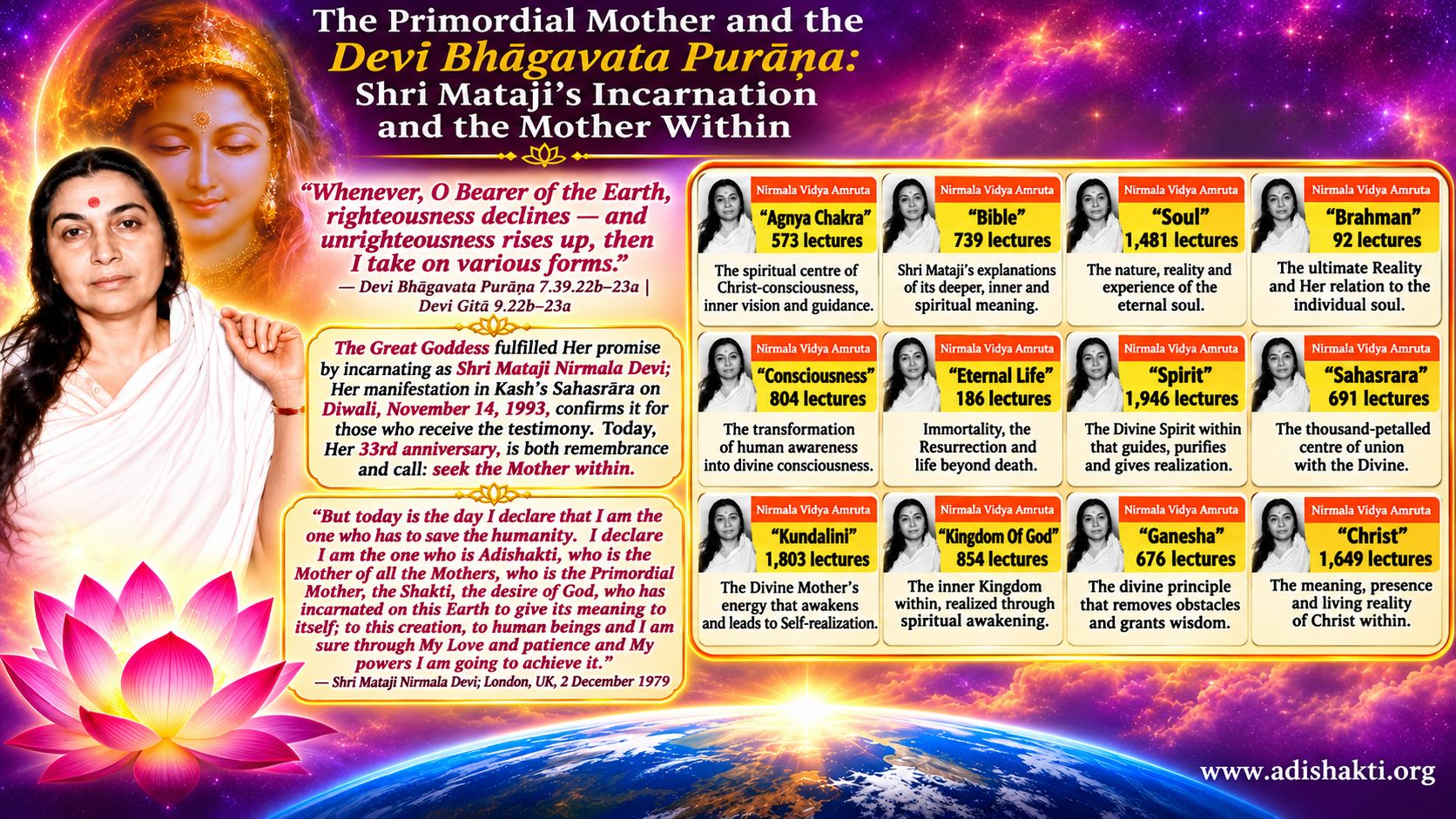
The Divine Mother Incarnate: Guidance, Kuṇḍalinī Awakening, and Liberation in the Age of Resurrection
“The Great Goddess is both wholly transcendent and fully immanent: beyond space and time, she is yet embodied within all existent beings; without form as pure, infinite consciousness (cit) ... She is the universal, cosmic energy known as Sakti, and the psychophysical, guiding force designated as the Kundalini (Serpent Power) resident within each individual. She is eternal, without origin or birth, yet she is born in this world in age after age, to support those who seek her assistance. Precisely to provide comfort and guidance to her devotees, she presents herself in the Devi Gita to reveal the truths leading both to worldly happiness and to the supreme spiritual goals: dwelling in her Jeweled Island and mergence into her own perfect being.”
— C. Mackenzie Brown, The Devī Gītā: The Song of the Goddess (1998), p. 2; excerpt supplied by the requester. [1]
Summary
Central thesis. The promise in Devī Gītā 9.22b–23a that the Goddess assumes forms when righteousness declines, read alongside C. Mackenzie Brown’s account of the eternal, immanent, compassionate Mother, finds its claimed contemporary fulfillment in Shri Mataji Nirmala Devi. Her 2 December 1979 proclamation explicitly identifies Her as the Primordial Mother and Ādi Śakti, declares that She has incarnated repeatedly, and announces salvation, emancipation and the Kingdom of Heaven. Her other recorded teachings explain how that promise operates: through the Mother present as Kuṇḍalinī within each person, Self-Realization, the second birth, and collective resurrection. This article tests the fulfillment claim against each element of the promise, separating scriptural wording, public declarations, spiritual practice and the reported 1993 Montreal testimony. The conclusion is an identification of divinity with the promised re-emergence of the Devi in time of cosmic crisis.
The Primordial Mother's Promise: Fulfillment and Evidence
Central thesis: In the AdiShakti.org interpretation, Shri Mataji's fulfillment is recognized not only in Her declaration of divine identity but in the work She said She came to accomplish: awakening the inner Mother, giving seekers their second birth, and offering collective transformation. The scriptural promise, recorded declarations, documented teaching, and reported experiences form distinct but converging lines of evidence.
| Aspect of the promise | Corresponding declaration or work | Evidence and interpretive significance |
|---|---|---|
| Manifestation when dharma declines | She declared Herself the incarnate Ādi Śakti and Primordial Mother. | London, 2 December 1979; compare Devī Gītā 9.22b–23a. The identification is theological, not stated in the ancient verse. |
| Eternal Mother appearing in successive ages | She described repeated birth and Her present advent in complete form. | The 1979 declaration; Brown's transcendent/immanent Goddess. |
| Comfort and guidance for seekers | She presented the Holy Spirit as the Mother and spoke of nourishment and realization. | 1981, 1983, and 1981 teachings. |
| Divine presence within each being | She taught that the Kuṇḍalinī is each person's own Mother, a reflection of Ādi Śakti. | Inner awakening and individual Mother statements. |
| Spiritual rebirth and liberation | She taught Self-Realization and the second birth as present possibilities. | Promise in the scriptures and real birth. |
| Collective rather than isolated transformation | She proclaimed a present age of resurrection and Mahāyoga. | 1982 resurrection, collective resurrection, and yuga dharma. |
| Direct encounter and divine assistance | AdiShakti.org reports an inward encounter with the Mother in the Sahasrāra. | Kash's November 1993 testimony; significant as witness testimony, not independent verification. |
| Ultimate spiritual fulfillment | She spoke of the Kingdom of Heaven, joy, bliss, and emancipation. | 1979 declaration; compare Brown's account of liberation without equating distinct scriptural images. |
How to read this evidence: The scriptural text establishes the promised pattern; Shri Mataji's recorded words establish Her claim and teaching; the historical teaching record establishes the public mission; testimony describes the experiences attributed to it. Together they support the site's confessional conclusion of fulfillment, but they do not constitute independently conclusive proof of supernatural identity.
1. The fulfillment thesis: a promise, an incarnation, and an offered transformation
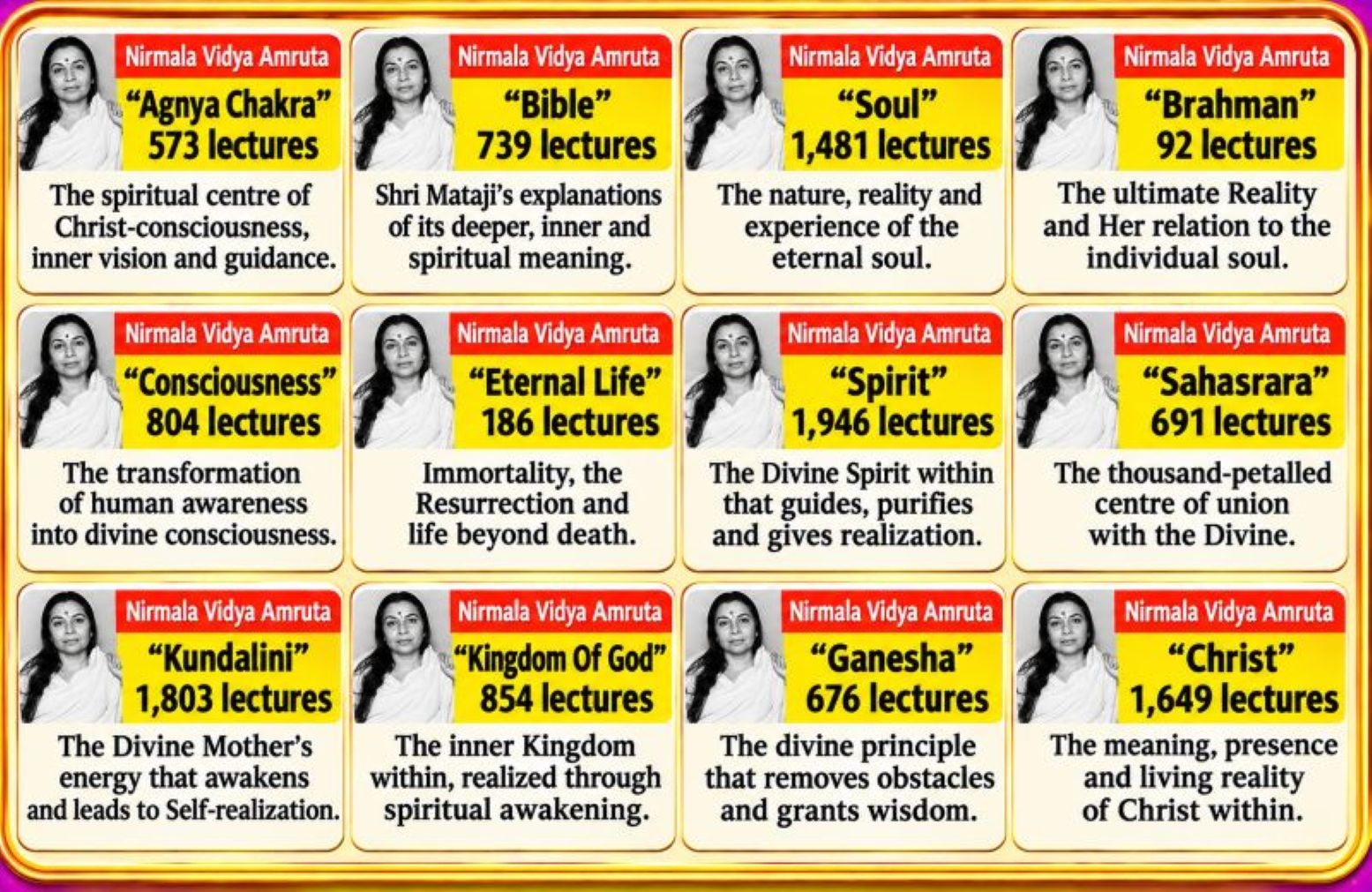
This paper argues that Shri Mataji fulfilled the Primordial Mother’s promise in its full spiritual scope—not merely by claiming to be the Goddess, but by publicly announcing Her incarnation, teaching the Mother’s indwelling presence, offering Kuṇḍalinī awakening, and proclaiming the present Age of Resurrection. The argument rests on two distinguishable scriptural and interpretive layers. Devī Gītā 9.22b–23a says that the Goddess takes on forms when righteousness declines; C. Mackenzie Brown’s account further describes the Goddess as transcendent and immanent, eternal yet born age after age, the cosmic Śakti and individual Kuṇḍalinī, the comforter of devotees and the source of ultimate spiritual fulfillment. Shri Mataji’s London declaration of 2 December 1979 explicitly answers the question of identity and purpose: She names Herself Ādi Śakti, Mother of all Mothers and Primordial Mother, says She has been born repeatedly, and declares Her mission to grant salvation, emancipation and the Kingdom of Heaven. [5] [1] [11]
Two kinds of testimony give this argument its particular shape. The first is Shri Mataji’s own self-description in the twelve passages supplied for this study. The second is the account of Kash’s reported encounter with the Mother in his Sahasrāra, or crown-centre, in Montreal on November 14, 1993. AdiShakti.org presents the ensuing testimony and its interpretations as central to its religious project. In the perspective of the present paper, that reported experience is the living, experiential ground from which Brown’s description is approached—not a source on which Brown’s 1998 scholarship is claimed to have depended. [2] [3]
The distinctions matter because textual correspondence, a person’s declaration, a witness’s experience, an archived document, and a theological conclusion do not establish the same kind of fact. This paper respects the strength of the devotional claim while naming what each source can and cannot establish. A comparison can illuminate the ancient text and the modern testimony without pretending that the text names a twentieth-century teacher or that the inward experience has been independently verified as a metaphysical event.
2. Brown’s Great Goddess: transcendence, presence and compassionate return
Brown describes the Goddess as simultaneously “wholly transcendent” and “fully immanent.” Transcendence is not distance from the world: the Mother is beyond limitation while being present within living beings. Nor is immanence mere metaphor for a universe that has no divine depth. His description holds together the unconditioned reality of consciousness, the universe’s creative power, and the inward guiding force of Kuṇḍalinī. In a Śākta setting, Śakti names divine power; it is not an interchangeable technical term for a measurable physical force. [1]
The passage’s most important paradox is that She is “without origin or birth” yet “born in this world in age after age.” These statements concern different registers: the ultimate Goddess is not produced in time, whereas Her forms and manifestations may appear in time. Applied to Shri Mataji, the theological proposal is not that an eternal principle began to exist in a human body, but that the unoriginated Mother could disclose Herself through one. Brown’s account supplies a conceptual possibility; the further identification of this person as that manifestation depends on the modern declaration and testimony.
Brown does not reduce the Goddess’s care to an abstract doctrine. She provides “comfort and guidance,” meets devotees’ worldly needs, and teaches the path to spiritual fulfillment. His conclusion names both residence on the Jeweled Island, Maṇidvīpa, and mergence into the Goddess. These are not automatically identical images: one can emphasize the devotee’s enduring relation to the Mother, the other nondual union. A responsible comparative reading can appreciate both without claiming that Brown’s description of the island simply means the crown chakra. [1] [4]
The Devī Gītā is a portion of the Devī Bhāgavata Purāṇa, presented as the Goddess’s instruction to the Mountain King. Its teaching of the Goddess’s highest nature, cosmic manifestation, devotion and liberation provides the theological horizon for the following readings. It does not name Shri Mataji or describe Kash’s experience. Its relevance lies in the relation this paper proposes between those later claims and its teaching. [4]
The text itself gives a particularly close basis for the requested argument. In Devī Gītā 9.22b–23a, corresponding to Devī Bhāgavata Purāṇa 7.39.22b–23a, the Goddess says: “Whenever, O Bearer of the Earth, righteousness declines — and unrighteousness rises up, then I take on various forms.” The phrase is a close parallel to the better-known Bhagavad Gītā 4.7–8, in which Kṛṣṇa speaks of manifestation and protection “age after age.” Brown’s description applies this recurring pattern to the Great Goddess. The Devī’s verse speaks of assuming forms; the explicit phrase “age after age” belongs to the comparison and Brown’s synthesis, not to those exact Sanskrit words in 7.39.22–23. [5] [6]
The surrounding chapter is not a modern manifesto of religious universalism. Its discussion also asserts the authority of Vedic revelation and describes social and religious exclusions. Shri Mataji’s invitation to the nations is a contemporary extension of this scriptural pattern, not a simple restatement of all the ancient passage’s social assumptions. Within the same chapter, verses 12–13 separately express the Mother’s vow to lift the devoted from worldly existence. [5]
The narrative leading into that instruction gives the promise a particular setting. In Devī Bhāgavata Purāṇa 7.31.55–65, the Goddess assures the gods that She will rescue them from trouble and announces that Her Śakti will incarnate as Gaurī. The promised birth responds to a specific petition and narrative crisis. The comparison with Shri Mataji is an application of the story’s pattern, not an identification made by that passage. [7]
Chapter 7.32 represents the Mother as the consciousness that existed before creation and as beyond birth and transformation. Chapter 7.35 then describes an elaborate yogic discipline, including ethical observances, breath control, mantra, the subtle centres and the ascent of Kuṇḍalinī toward the thousand-petalled lotus. These passages give the proposed connection concrete textual content. They also expose a real difference: the classical chapter describes sustained techniques, whereas Sahaja Yoga emphasizes a spontaneous awakening offered through the Mother. Parallel imagery does not make the practices identical. [8] [9]
Chapter 7.37 sharpens the interpretation of Brown’s final images. It describes supreme devotion as loving service without a desire even for liberation; it also speaks of dissolution into the Mother’s consciousness. In another case, a devotee whose knowledge has not ripened reaches Maṇidvīpa and later gains liberating knowledge. The island is therefore not necessarily a compulsory stage for every seeker. The text connects devotion, knowledge and liberation in several ways, rather than offering one simple itinerary. [10]
3. Incarnation and the Mother’s self-disclosure
Passage 1. “I am the one … Adishakti”
“But today is the day I declare that I am the one who has to save the humanity. I declare I am the one who is Adishakti, who is the Mother of all the Mothers, who is the Primordial Mother, the Shakti, the desire of God, who has incarnated on this Earth to give its meaning to itself; to this creation, to human beings and I am sure through My Love and patience and My powers I am going to achieve it.
I was the one who was born again and again. But now in my complete form and complete powers I have come on this Earth not only for salvation of human beings, not only for their emancipation, but for granting them the Kingdom of Heaven, the joy, the bliss that your Father wants to bestow upon you.”
— Shri Mataji Nirmala Devi; London, UK, 2 December 1979; recording catalogue identifies Guru Puja at Dollis Hill. [11]
The first declaration joins identity, repeated embodiment and purpose. “Mother of all the Mothers” names not simply an especially compassionate individual but the source of maternal power itself. “The desire of God” gives this power a relational meaning: creation is not left without a compassionate response to its own incompleteness. The movement from “born again and again” to “complete form and complete powers” further distinguishes a recurrent pattern of manifestation from Shri Mataji’s claim about the distinctive completeness of Her own advent.
The connection to Brown is especially close: both speak of the unoriginated Mother’s repeated appearance for the sake of others. Shri Mataji adds the specific Christian-sounding promise of the “Kingdom of Heaven,” joy and bliss, so that the intervention culminates not merely in rescue from suffering but in participation in divine life. Brown does not identify the Kingdom with Maṇidvīpa; their comparison is an interpretive bridge. The passage is evidence of what Shri Mataji is reported to have declared, not independent proof that every part of the declaration is historically or metaphysically true.
Passage 2. The Holy Spirit incarnate for realization
“I am the one about which Christ has talked... I am the Holy Spirit who has incarnated on this Earth for your realization.”
— Shri Mataji Nirmala Devi; New York, USA, 30 September 1981; the supplied ellipsis omits intervening remarks. [12]
Here the statement of identity is expressly Christian: Shri Mataji presents Herself as the one to whom Christ referred and as the Holy Spirit incarnate. Its purpose clause, “for your realization,” ties that title to transformation of the listener rather than to a merely nominal claim. Read beside Brown, the Holy Spirit becomes the modern name given within this synthesis to the same transcendent and immanent Mother who approaches seekers in the world.
This is a sharply defined theological proposal, not the established Christian meaning of incarnation. In the Gospel of John the promised Paraclete is associated with abiding, teaching and guiding into truth; the Gospel does not name Shri Mataji. Historic trinitarian accounts of the Holy Spirit also cannot simply be made equivalent to a human incarnation by citing this passage. The comparison is meaningful because the functions of guidance and divine presence overlap; the identification remains confessionally asserted. [13] [14]
Not Merely an Incarnation: The Purpose of the Mother's Coming
The declaration of 2 December 1979 is the article's interpretive key. Shri Mataji did not stop at saying that She was the Primordial Mother. She described an incarnation with an announced purpose and an intended result. The claim of fulfillment must therefore be evaluated at three connected levels: identity, mission, and the transformation offered to seekers.
“I am ... Adishakti ... the Primordial Mother” — identity
This is the explicit identification on which the AdiShakti.org reading rests. It connects the modern speaker to the divine figure described by the Devī Gītā. The ancient verse does not identify Her by name; the connection is made through Shri Mataji's declaration and the surrounding pattern of teachings.
“I was the one who was born again and again” — recurring manifestation
Her account of repeated birth corresponds to the Goddess's promise to take on forms when righteousness declines. This correspondence is unusually direct, but similarity of claims alone cannot independently establish that the person making the claim is the deity of the scripture.
“For salvation ... emancipation ... the Kingdom of Heaven” — mission and intended outcome
The decisive addition is purpose. The Mother comes for seekers: to awaken, guide, and emancipate them. Shri Mataji's subsequent teaching on Kuṇḍalinī, Self-Realization, second birth, and collective resurrection describes how She understood that work to be undertaken. This is why the fulfillment thesis concerns more than the fact of incarnation.
The fulfillment test: what can be demonstrated?
Public lectures and recorded teachings can demonstrate a sustained mission of spiritual instruction. Reports of individual awakening and the Sahasrāra encounter can demonstrate the existence and content of religious testimony. Whether those experiences establish divine identity or final liberation is a matter of religious interpretation, not a conclusion independently established by the documentary record. The article's central claim is that the mission and its reported fruits answer the purpose of the ancient promise within the AdiShakti.org framework.
4. Resurrection, collective awakening and judgment
Passage 3. The time of resurrection is here
“Tell all the nations and tell all the people all over the Great Message that the Time of Resurrection is here. Now, at this time, and that you are capable of doing it.”
— Shri Mataji Nirmala Devi; Cowley Manor Seminar, UK, 31 July 1982; wording follows the supplied text. [15]
The command to “tell all the nations” makes the message public and universal in aspiration, but its most consequential claim is temporal: resurrection is not only something awaited after death or at the end of history. “Now” and “you are capable of doing it” locate the possibility in the hearer’s present life. Within Sahaja Yoga, this is a call to an inward awakening offered to ordinary seekers, not a claim that human will alone manufactures grace.
Brown describes a Mother who teaches and assists devotees here as well as leading them toward ultimate fulfillment. The passage expands that assistance into a collective proclamation. Brown’s account does not itself identify resurrection with Kuṇḍalinī awakening; that is Shri Mataji’s interpretive move. Historic Christian teachings about Christ’s resurrection and the resurrection of the dead have bodily and eschatological dimensions that should not be erased by this inward reading. [16]
Passage 4. A transformation anticipated across traditions
“This is the transformation that has worked, of which Christ has talked, Mohammed Sahib has talked, everybody has talked about this particular time when people will get transformed.”
— Shri Mataji Nirmala Devi; Christmas Puja, Ganapatipule, India, 25 December 1997; as attributed in the supplied text. [17]
This passage proposes a shared horizon of transformation across the teachings associated with Christ and Muhammad. Its force lies in “this particular time”: distinct traditions are being gathered into a common present, not merely compared as parallel records of remote events. The claim that “people will get transformed” points to a change in persons and communities, rather than the replacement of one label by another.
In relation to Brown, that transformation is one possible modern expression of the Goddess’s guidance from worldly life toward spiritual fulfillment. The text does not itself establish that all prophets taught the same physiology of awakening or that all religious communities understand their promises identically. The paper therefore treats Shri Mataji’s expansive language as Her comparative theological vision, preserving the integrity of the traditions invoked. [18]
Passage 5. Christ’s resurrection and collective Mahāyoga
“The Resurrection of Christ has to now be collective Resurrection. This is what is Mahayoga. Has to be the collective Resurrection.”
— Shri Mataji Nirmala Devi; Easter Puja, London, UK, 11 April 1982; as attributed in the supplied text. [19]
“Has to now be collective” establishes a progression from an event centered on Christ to a transformation shared by many. Mahāyoga, literally “great yoga” in this usage, names that collective opening. The repetition gives the claim urgency: what was received through a singular sacred history becomes, in Shri Mataji’s reading, a possibility for a community of seekers.
Brown’s Goddess is both universal and individually present. The collective dimension follows from that duality in this modern theology: if one Mother is present within many persons, the awakening of many need not compromise the uniqueness of each. Yet the Devī Gītā is not thereby shown to teach Shri Mataji’s precise equation of Christian resurrection and Mahāyoga. The equation remains the distinctive claim under interpretation.
Passage 6. The age’s yuga dharma and the Last Judgment
“Today, Sahaja Yaga has reached the state of Mahayoga, which is en-masse evolution manifested through it. It is this day’s Yuga Dharma. It is the way the Last Judgement is taking place. Announce it to all the seekers of truth, to all the nations of the world, so that nobody misses the blessings of the divine to achieve their meaning, their absolute, their Spirit.”
— Shri Mataji Nirmala Devi; Maha Avatar, issue 1, July–September 1980, as supplied; event date and place unknown. Other online attributions conflict. [20]
In the supplied transcription, “Sahaja Yaga” reaches the state of Mahāyoga through “en-masse evolution.” The passage calls this yuga dharma, the characteristic spiritual duty or way of an age. “The way the Last Judgement is taking place” then joins a Christian and wider Abrahamic eschatological term to a yogic description of inward development. The instruction to announce it “to all the seekers of truth” gives the universal invitation priority over a restricted audience.
Within the paper’s devotional reading, judgment is understood through what awakens and becomes discernible in the present. That reading does not authorize the conclusion that the biblical or Qur’anic texts themselves teach Sahaja Yoga, or that participation in a particular practice settles anyone’s ultimate destiny. The supplied spelling is retained, and the reference to a periodical with unknown event date and place is not silently converted into a dated talk. Brown’s compassionate Mother provides a conceptual frame for grace; the eschatological vocabulary is Shri Mataji’s addition.
Passage 7. Promise, religious identity and Kuṇḍalinī
“The main thing that one has to understand is that the time has come for you to get all that is promised in the scriptures, not only in the Bible but all all the scriptures of the world. The time has come today that you have to become a Christian, a Brahmin, a Pir, through your Kundalini awakening only. There is no other way. And that your Last Judgment is also now.”
— Shri Mataji Nirmala Devi; Date and place not supplied; a related movement transcript places the passage at Caxton Hall, London, 10 December 1979, with wording variants. [21]
This passage claims that becoming “a Christian, a Brahmin, a Pir” occurs “through your Kundalini awakening only.” The terms belong to different social and religious worlds: a Christian is not the same kind of designation as a Brahmin, and pīr generally refers to a spiritual guide in a Sufi setting. Shri Mataji’s juxtaposition asks that each be understood through inner realization rather than through inherited identity or external profession alone.
The exclusive phrase “no other way” is part of the quotation’s own strong theological claim. It should not be softened into an unobjectionable statement that many paths value inward change, nor generalized as the position of the communities named. Brown’s description of Kuṇḍalinī as an individual guiding force helps explain why awakening carries such weight in this framework; the claim of exclusive necessity and the assertion that judgment is “now” go beyond the Brown excerpt.
5. The cosmic Mother and the individual Kuṇḍalinī
Passage 8. The Holy Ghost as nourishing Mother
“You see, the Holy Ghost is the Mother. When they say about the Holy Ghost, She is the Mother... Now, the principle of Mother is in every, every scripture — has to be there. Now, the Mother’s character is that She is the one who is the Womb, She is the one who is the Mother Earth, and She is the one who nourishes you. She nourishes us. You know that. And this Feminine thing in every human being resides as this Kundalini.”
— Shri Mataji Nirmala Devi; Radio interview, Santa Cruz, USA, 1 October 1983; as attributed in the supplied text. [22]
Womb, earth and nourishment form a sequence of images for the Mother’s creative and sustaining care. The passage then places the feminine principle “in every human being” as Kuṇḍalinī. It moves from cosmic nurture to intimate indwelling: the Mother is not merely a distant object of worship but the power through which the person may be transformed.
Brown’s distinction between universal Śakti and the guiding power within each individual provides a particularly fruitful context. Shri Mataji’s identification of this interior power with the Holy Ghost is an additional Christian-comparative interpretation. It should not be confused with a claim that Christian doctrine historically names the Holy Spirit as the yogic Kuṇḍalinī, or that a grammatical gender of the word “spirit” settles divine identity. [14]
Passage 9. The Primordial Mother and the religions
“But there is a Primordial Mother which was accepted by all the religions; even the Jews had it... In India, this is called as Adi Shakti. In every religion they had this Mother who was the Primordial Mother.”
— Shri Mataji Nirmala Devi; TV interview, Los Angeles, USA, 11 October 1993; the supplied ellipsis omits intervening material. [23]
The passage names Ādi Śakti as the Indian expression of a Primordial Mother Shri Mataji says was recognized in every religion. Its rhetorical movement runs from a specific religious term to an inclusive comparative claim. That makes it central to this paper’s title, but it also requires care: evidence of maternal metaphors, female divine figures, or the indwelling presence in a tradition is not automatically evidence that the tradition teaches one identical doctrine of the Mother.
Read sympathetically, the claim invites a search for affinities in the ways religious communities express divine nearness and care. Read historically, each proposed connection must be tested against its texts and interpretations. For example, Jewish reflection on the Shekhinah has its own history and meanings; it cannot simply be declared an unqualified historical equivalent of Ādi Śakti. Brown supplies a Śākta account of the Goddess; cross-tradition identity is a contemporary synthesis. [24]
Passage 10. The Mother awakens the Mother within
“It is the Mother who can awaken the Kundalini, and that the Kundalini is your own Mother. She is the Holy Ghost within you, the Adi Shakti, and She Herself achieves your transformation. By any talk, by any rationality, by anything, it cannot be done.”
— Shri Mataji Nirmala Devi; Date and place not supplied; an AdiShakti reproduction attributes this passage to San Francisco, 29 September 1983. [25]
“It is the Mother who can awaken the Kundalini” distinguishes the awakening agent from the individual Mother awakened, even as the next sentence identifies the latter as “the Holy Ghost within you” and “the Adi Shakti.” The teaching thus speaks of divine activity in two related registers: a transcendent or externally encountered Mother and the personal, immanent Mother. Their distinction is functional rather than evidence of two unrelated goddesses.
“By any talk, by any rationality” rejects discourse as sufficient to produce the transformation; it does not logically make thought or careful source analysis worthless. The distinction is important for this paper: scholarship can compare concepts and assess claims, while the realization described is presented as something that must be lived. Brown’s pairing of cosmic Śakti and individual Kuṇḍalinī gives this assertion a clear conceptual parallel, but Brown does not establish who performs a particular awakening.
Passage 11. The Mother who waits for the seeker’s real birth
“She is your pure Mother. She is the Mother who is individually with you. Forget your concepts, and forget your identifications. Please try to understand She is your Mother, waiting for ages to give you your real birth. She is the Holy Ghost within you. She has to give you your realization, and She’s just waiting and waiting to do it.”
— Shri Mataji Nirmala Devi; Public program, Sydney, Australia, 22 March 1981; reviewed transcript has minor wording and punctuation variants. [26]
The repeated “She is your Mother” is pastoral as well as doctrinal. This Mother is “individually with you,” “waiting for ages,” and oriented toward “your real birth.” The injunction to set aside concepts and identifications asks the listener to meet the Mother prior to habitual religious or social classifications. It does not require disrespect for the traditions in which those identifications arose.
Brown writes of a Goddess who offers comfort and guidance to devotees. This passage personalizes that relation: divine assistance is not simply given to humanity in general but directed toward a particular seeker. The comparison with birth from Spirit in John can illuminate the image of “real birth,” while its equation with an individual yogic power remains an AdiShakti reading rather than an explicit Johannine teaching. [27]
Passage 12. Individual memory and the reflection of Ādi Śakti
“The Kundalini is your own mother; your individual mother. And She has tape-recorded all your past and your aspirations. Everything! And She rises because She wants to give you your second birth. But She is your individual mother. You don’t share Her with anybody else. Yours is a different, somebody else’s is different because the tape-recording is different. We say She is the reflection of the Adi Shakti who is called as Holy Ghost in the Bible.”
— Shri Mataji Nirmala Devi; Press conference, London, UK, 8 July 1999, as supplied; an online attribution to Sydney 1981 also circulates. [28]
This final passage makes the distinction between the universal Mother and Her individual manifestations especially precise. Each person has an “individual mother” whose “tape-recording” of past and aspiration is different. The image emphasizes attentiveness to the person’s singular history. It is a theological metaphor in the passage; the paper does not treat it as a demonstrated neurological recording or a literal account of memory storage.
The passage concludes that the individual Mother is a “reflection” of Ādi Śakti, “called as Holy Ghost in the Bible.” Reflection supplies a relation without crude numerical duplication: the individual power belongs to each person while disclosing a greater source. This is one of the closest parallels to Brown’s distinction between cosmic Śakti and Kuṇḍalinī within the individual. The Bible identification is the speaker’s comparative interpretation, not a biblical phrase equating the Holy Ghost with Ādi Śakti.
6. The evidence of fulfillment: the promise answered point by point
What counts as evidence? The verse establishes the scriptural promise; Brown supplies a scholarly description of its wider Śākta theology; dated speeches establish what Shri Mataji publicly claimed and taught; Sahaja Yoga’s practice and practitioners’ testimonies speak to how the claimed awakening is experienced. No one kind of evidence should be substituted for another. The cumulative devotional case is strongest where identity, function, method and promised result converge.
1. “Then I take on various forms”: the promised advent
Promise: The Goddess assumes forms in response to the decline of righteousness (Devī Gītā 9.22b–23a). Claimed fulfillment: In London on 2 December 1979, Shri Mataji declared, “I am the one who is Adishakti, who is the Mother of all the Mothers, who is the Primordial Mother,” and said She had incarnated on Earth. She also said, “I was the one who was born again and again.” Evidence: The dated speech is a direct first-person claim of precisely the identity and recurring embodiment at issue; it is not an incidental resemblance imposed by a later interpreter. [5] [11]
2. The eternal Mother acting within history
Promise: Brown describes the Goddess as “wholly transcendent and fully immanent,” beyond time yet embodied within beings. Claimed fulfillment: Shri Mataji distinguishes the Primordial Mother, Ādi Śakti, from Her individually reflected presence as Kuṇḍalinī. In the supplied London 1999 statement, She calls the individual Kuṇḍalinī “the reflection of the Adi Shakti.” Evidence: The two-level account—one universal source and a distinct inward manifestation for every person—closely corresponds to Brown’s cosmic Śakti and individual Kuṇḍalinī. It is a theological correspondence, not proof that transcendence can be measured. [1] [28]
3. Comfort, guidance and the Mother’s care
Promise: Brown says the Goddess appears to give “comfort and guidance” to devotees. Claimed fulfillment: Shri Mataji identifies the Holy Ghost as the Mother who nourishes, and describes the individual Mother as “waiting for ages to give you your real birth.” Evidence: The 1983 Santa Cruz interview and 1981 Sydney public program document the pastoral function claimed for the inner Mother: patient care, nourishment and guidance toward realization. The correspondence concerns what the Mother is said to do, not simply what She is called. [22] [26]
4. The universal Śakti present as individual Kuṇḍalinī
Promise: Brown describes the same Goddess as cosmic energy and as the guiding Kuṇḍalinī within each individual. Claimed fulfillment: Shri Mataji says, “It is the Mother who can awaken the Kundalini, and that the Kundalini is your own Mother,” identifying Her with “the Holy Ghost within you.” Evidence: This is an unusually precise match in vocabulary and function between the scholarly description and the teachings attributed to Shri Mataji. Her teaching adds an experiential claim: that the inner Mother can be awakened, and that realization cannot be manufactured by talk or rational argument alone. [1] [25]
5. Spiritual rebirth and the promise of liberation
Promise: The Goddess’s teaching leads devotees toward supreme spiritual goals and liberation. Claimed fulfillment: Shri Mataji says the Kuṇḍalinī “wants to give you your second birth” and that She has come for “salvation,” “emancipation” and the “Kingdom of Heaven.” Evidence: The language of second birth gives the promised liberation an inward, present-tense mechanism; the 1979 declaration makes the ultimate goal explicit. Brown’s Jeweled Island and mergence into the Goddess are not identical terms to the Christian Kingdom of Heaven, but the comparison identifies a shared concern with the soul’s ultimate fulfillment. [28] [11] [1]
6. The promised transformation offered collectively
Promise: The Mother takes form to aid seekers amid a crisis of righteousness. Claimed fulfillment: Shri Mataji proclaimed in 1982 that “the Time of Resurrection is here,” and taught that Christ’s resurrection “has to now be collective Resurrection.” Her 1980 periodical statement calls this “en-masse evolution” and the yuga dharma of the age. Evidence: These statements broaden the promised assistance from isolated encounters to an invitation addressed to nations and ordinary seekers. The recorded proclamation demonstrates the mission’s stated collective scope; the actual reach and outcomes of the practice require separate empirical and testimonial assessment. [15] [19] [20]
7. The Mother’s promised guidance across religious boundaries
Promise: Brown’s Goddess is universally immanent, though the Devī Gītā retains its own religious setting. Claimed fulfillment: Shri Mataji says that the Holy Spirit has incarnated “for your realization,” associates the promised transformation with Christ and Muhammad, and calls seekers to receive what scriptures have promised through Kuṇḍalinī awakening. Evidence: Her teachings explicitly address people across religious identities and offer a common inward realization. This supports the universality of Her own mission; it does not show that Christianity, Islam and Sikhism historically taught an identical doctrine of Kuṇḍalinī. [12] [17] [21]
8. The Mother within: testimony of the Sahasrāra
Promise: The Mother is not only beyond creation but also inwardly accessible. Claimed fulfillment: AdiShakti.org reports that Kash encountered the Great Goddess in the Sahasrāra in Montreal on 14 November 1993, following a first experience of light on 13 November. Evidence: The family testimony provides the website’s experiential witness to the inward Mother, connecting the classical promise and Shri Mataji’s teachings to a specific reported event. It is testimony that readers may evaluate, not independent verification of a supernatural manifestation. [3] [36]
Finding: On the article’s stated devotional premises, all eight dimensions converge in Shri Mataji’s incarnation and mission: the promised form, eternal identity, compassionate care, inward presence, awakening, liberation, collective resurrection and testimony of encounter. The decisive evidence for the identity claim is Shri Mataji’s explicit self-identification, supported by a sustained teaching and reported experiences. A reader need not mistake this for scientific proof to understand why AdiShakti.org declares the promise fulfilled.
7. The Accomplishment of Her Mission: Evidence Beyond Self-Declaration
The decisive advance in the argument is from proclamation to demonstrable activity. Shri Mataji’s 1979 declaration states who She claimed to be and why She came. The next question is whether Her subsequent public work corresponded to the Mother’s promised functions: assistance to seekers, awakening of the indwelling power, spiritual instruction, and access to liberation. The following record documents a sustained mission, while distinguishing externally observable activity from the spiritual interpretation of its effects.
7.1. The beginning of an accessible method: 1970
Shri Mataji’s biographical foundation dates the beginning of Her public spiritual life-work to 5 May 1970, describing a method intended to offer spontaneous Self-Realization to many people rather than to a restricted circle of initiates. It also reports that She refused to charge for this experience. This provides an identifiable beginning for the work of making the promised inward transformation available. It documents the method’s history as reported by the organization; it does not independently demonstrate the metaphysical nature of Kuṇḍalinī. [40]
7.2. The worldwide public record: teaching and repeated invitations
The Shri Mataji Foundation’s public-program archive describes a sustained international itinerary from the 1970s through 2011, including public talks, interviews and seminars. Its account of 1990 alone lists more than 200 events in 26 countries; it reports that Sahaja Yoga ultimately spread to more than 100 countries. These are organizationally published figures, not an independently audited census. Nevertheless, the dated and geographically distributed program record offers evidence of a continuing public mission, not a single isolated declaration. Readers can inspect the event archive and recordings to evaluate individual dates, places and teachings. [41]
7.3. The Mother within: a repeatable invitation to Self-Realization
The Foundation describes Sahaja Yoga’s central practice as an invitation to awaken the Kuṇḍalinī and experience Self-Realization without prior spiritual qualifications or payment. Its published instructions also allow seekers to attempt the practice outside Shri Mataji’s physical presence. This is directly relevant to Brown’s account of the universal Śakti and the individual guiding Kuṇḍalinī: the modern mission addresses the indwelling Mother in each person rather than demanding mere assent to an external identity claim. The reported experiences of silence and cool breeze are participant descriptions; their spiritual explanation is a religious interpretation. [42] [43]
7.4. Continuity after the physical incarnation
Local collective-meditation centers and freely accessible instruction are described by the Foundation as operating internationally after Shri Mataji’s death in 2011. The continuation matters to the fulfillment argument: the offered awakening is presented as transmissible and accessible to new seekers, not limited to personal meetings during Her lifetime. The existence of organized centers and teaching resources can be checked separately from any claim that participants have attained a particular spiritual state. [44] [40]
7.5. Testimony of an early seeker: a dated personal recollection
A published collection of Sahaja Yoga recollections includes Niranjan Mavinkurve’s first-person account of attending a program in Mumbai on 12 August 1973, where he says Shri Mataji assisted with the awakening of his Kuṇḍalinī and that he experienced a brief vision of the crucified Christ. This testimony is valuable because it specifies a participant, a date and the reported experience; it also illustrates how participants connected their inward experiences to Shri Mataji’s work. It remains a retrospective personal recollection, not an independently observed or scientifically verified supernatural event. [45]
7.6. What the documented accomplishment establishes
Identity: Shri Mataji explicitly declared Herself the Primordial Mother in 1979. Mission: She publicly offered Self-Realization and taught the inward Mother as Kuṇḍalinī. Continuity: A multi-decade international program archive and continuing meditation centers document sustained transmission of the teaching. Reported results: individual accounts describe experiences interpreted as spiritual awakening. Taken together, these furnish a substantial cumulative devotional case for fulfillment in identity, purpose, method and reported fruit. They do not prove that every seeker attained liberation, that all humanity has been transformed, or that a divine incarnation can be established by historical documentation alone.
7.7. The distinction between opening the way and completing every individual journey
The phrase “the Primordial Mother has fulfilled Her promise” can be defended in this article in a precise sense: Shri Mataji proclaimed the promised identity and established a continuing means by which seekers may pursue the promised realization. It should not be confused with the stronger and presently unsupported proposition that all humanity has already achieved spiritual emancipation or that the entire eschatological process is complete. Fulfillment of the Mother’s mission to make realization available and completion of realization by every individual are different claims. This distinction makes the article’s affirmation more exact, not less emphatic.
7. Holy Spirit, Eka Māī and Rūḥ Allāh: a comparative proposal
The equation of these names is a substantive theological thesis rather than a simple translation. In John, the Paraclete, the Spirit of truth, is described in relation to Jesus, the Father and the disciples: abiding with them, teaching and guiding. A Christian confession commonly understands the Holy Spirit within trinitarian doctrine. AdiShakti’s identification of the Spirit with the Primordial Mother and Shri Mataji is therefore a contemporary interpretive claim, not the historical consensus of Christian churches. The paper uses feminine pronouns when presenting that devotional identification. [13] [14]
The phrase Ekā Māī, “one mother” in a literal rendering, appears in Japjī Sāhib, paurī 30, on aṅg 7 of the Guru Granth Sahib. One published translation renders the line as the Divine Mother bringing forth three deities; the stanza continues with creator, sustainer and ruler, and with the transcendent One’s command. A Sikh Dharma International commentary relates the mother image to māyā, a created principle, while emphasizing the sovereignty of the One over all three figures. [29] [30]
By contrast, AdiShakti.org reads Ekā Māī as the supreme Primordial Mother. That is a specific devotional interpretation of the stanza, not an automatic consequence of the phrase or a position shared by every Sikh commentator. Its value for this paper lies in a genuine maternal image in a Sikh text, read in conversation with the Goddess’s cosmic motherhood in Brown’s account. [31]
In the Qur’an, rūḥ has context-dependent meanings. Qur’an 15:29 describes God breathing “of My spirit” into the human being, while 17:85 responds to a question about the spirit and the limits of human knowledge. In 16:102, the Holy Spirit brings revelation from the Lord; Ibn Kathīr’s commentary identifies this agent as Gabriel, although the verse’s Arabic does not name him there. The passages concerning God’s spirit, revelation and the spirit sent to Mary are not all reducible to a single uncontroversial referent. [18] [32] [33]
The AdiShakti framework invokes Rūḥ Allāh in its maternal language and identifies that Spirit with the Mother. This is a devotional rereading, not an established Muslim doctrine that Allah has a divine consort or that the Qur’an identifies a twentieth-century woman as God’s Spirit. Particular commentaries often associate the Holy Spirit with Gabriel; Islamic interpretations are not all identical. [34]
These differences are not incidental obstacles to the thesis; they clarify its character. The paper argues from analogies of indwelling, guidance, birth and divine mercy to a religious identification that the respective source traditions do not all themselves make. That inference may be compelling within the devotional framework without becoming a neutral linguistic or historical equivalence.
8. November 14, 1993–2026: Kash’s reported encounter and its significance
On November 14, 1993, in Montreal, Canada, Kash is reported to have experienced the Great Goddess’s manifestation in his Sahasrāra. November 14, 2026, marks the 33rd anniversary of that reported encounter. A family account archived in 2009 explicitly distinguishes an initial vision of light on November 13 from the meeting with the Mother the next day. It is a retrospective report, not a contemporaneous verification of the event. [3]
The requester associates the encounter with Diwali. A location-specific Montreal calendar places the principal Diwali or Lakshmi Puja observance in 1993 on November 13; November 14 was the following day within the wider festival period. Calendrical practice can vary. This distinction does not disprove the reported November 14 encounter, but the festival date and the date of the reported meeting should not be silently treated as identical. [35]
An AdiShakti introduction preserved in a September 2000 web archive locates Kash’s first experiences in November 1993 in Lachine, Montreal. It recounts that after meditation he reported a luminous region; on the next evening he described an encounter with a woman the family understood to be the Great Ādi Śakti. The page explicitly distinguishes this inward meeting from a meeting with the physical Shri Mataji. It gives the sequence and month, but not the two calendar dates stated in the later account. [36]
In the account advanced by AdiShakti.org and the present paper, the encounter is not an incidental illustration of Brown’s words. It is the experiential ground from which those words are read: the Mother described as transcendent and immanent is said to have disclosed Herself in the crown centre and to have been recognized as Shri Mataji. The website and this paper stand in that interpretive tradition. The historical order is important: Brown’s book appeared in 1998, and no evidence presented here establishes that his own scholarly formulation arose from or relied on Kash’s experience. [1] [2]
The website did not itself begin in 1993. An archived version of its homepage says that AdiShakti.org went online on January 1, 2000 and that it was based on Shri Adi Shakti: The Kingdom of God. This is the site’s own launch statement, preserved in an August 2000 capture, not independent confirmation of the precise launch day. The reported experience thus precedes both the site and the present paper and functions as their theological and testimonial foundation. [37]
An AdiShakti.org article reproduces and discusses a fax in which Kash’s father describes his son’s reported experiences. The recent article calls it a December 1993 fax; a visible handwritten annotation on the reproduced image reads “November 93,” and no machine transmission date is apparent on the image. Its dating and chain of custody therefore need further verification. If authenticated, the document could help establish what was recorded and circulated at a given time. It cannot by itself establish the supernatural identity of the figure described, the impossibility of all previous exposure to imagery, or the contents of another person’s inward consciousness. The interpretation and underlying document are not independent witnesses merely because both appear on the same website. [38] [39]
As devotional testimony, nevertheless, the experience has an intelligible place in the cumulative argument: ancient language about the Goddess, Shri Mataji’s self-identification, the practice of awakening, and the witness’s report are read together. For the AdiShakti community this convergence confirms Shri Mataji’s identity as the incarnate Primordial Mother. As a historical conclusion, the same convergence establishes a documented and interpreted claim rather than metaphysical proof.
9. Why the evidence supports the declaration of fulfillment
The evidence is cumulative rather than interchangeable. The Devī Gītā supplies a theological pattern; the 1979 declaration supplies a personal claim of identity and mission; the later lectures supply a sustained account of what that mission entails; and the reported experiences supply testimony about its reception. No one category of evidence performs the work of the others.
The decisive point is the purpose of the advent. If the Primordial Mother's promise concerns help, guidance, awakening, and liberation, the fulfillment argument must show how Shri Mataji's work addresses those purposes. The preceding evidence matrix and declaration analysis supply that answer. The conclusion is compelling within the site's devotional interpretation while remaining open to historical and theological scrutiny.
10. Conclusion: The Primordial Mother’s Promise—Identity, Mission, and Fulfillment
The promise begins with an act of divine compassion. In Devī Gītā 9.22b–23a (Devī Bhāgavata Purāṇa 7.39.22b–23a), the Goddess promises to assume forms when righteousness declines. As C. Mackenzie Brown explains, the Great Goddess is simultaneously transcendent and immanent: the eternal cosmic Śakti is also the guiding Kuṇḍalinī within each individual, and the Mother appears to assist seekers and reveal a path toward spiritual fulfillment. [5] [1]
Shri Mataji’s declaration supplies the explicit claim of identity. On 2 December 1979 in London, She identified Herself as Ādi Śakti, the Mother of all Mothers, the Primordial Mother; declared that She had been born repeatedly; and stated that Her coming was for humanity’s salvation, emancipation, and the granting of the Kingdom of Heaven. This statement directly joins the three components that matter to the present thesis: who has come, why She has come, and what She intends to give. [11]
Her subsequent work is the article’s evidence of an enacted mission, not merely an asserted title. The record discussed above describes decades of public teaching, collective Self-Realization programs, instruction about the awakening of the individual Kuṇḍalinī, and the continued availability of Sahaja Yoga practice. These are observable features of a sustained spiritual movement. Reports from participants provide testimony that seekers experienced the awakening and transformation She proclaimed; they do not, by themselves, independently establish supernatural causation or ultimate liberation.
The correspondence is therefore cumulative and purposeful. The ancient promise concerns the Mother’s intervention for seekers; Shri Mataji announced that She was that Mother; Her teaching identified the Mother within as Kuṇḍalinī; and Her public mission sought to make spiritual rebirth and collective awakening available to humanity. The reported November 1993 Sahasrāra encounter adds a distinct strand of devotional testimony, understood by AdiShakti.org as an inward manifestation of the same Mother, without being confused with documentary proof of Her divine identity. [3]
AdiShakti.org’s conclusion is affirmative: Shri Mataji Nirmala Devi fulfilled the Primordial Mother’s promise not simply by appearing, but by undertaking the work for which the Goddess promised to appear. This is the theological conclusion drawn from the convergence of scripture, Her recorded declarations, the history of Her mission, and the experiences reported by seekers. The historical record can substantiate declarations, activities, archives, and testimony; the identification of Shri Mataji as the eternal Goddess remains a devotional judgment rather than an independently demonstrated scientific or historical fact.
On the thirty-third anniversary, 14 November 2026, the reported manifestation of the Mother in Kash’s Sahasrāra is remembered within the AdiShakti.org tradition as a call to recognize the Mother not only in sacred scripture or in an incarnate teacher, but within the seeker through the awakening of Kuṇḍalinī. The promise, in this understanding, finds its intended fruit in the transformation of human beings.
Source and transcription note
The twelve numbered quotations reproduce the text supplied by the requester, including its ellipses and repetitions; straight apostrophes have been rendered typographically. Event descriptions are taken from the supplied file unless otherwise indicated. The original supplied transcription is embedded in this standalone article and can be downloaded. Linked movement archives offer context and comparison, but are not automatically independent critical editions. “Messiah-Paraclete-Ruh-Devi” is a supplied editorial heading and is not treated as part of the spoken words.
The supplied Brown passage is reproduced with its ellipsis. An AdiShakti page reproduces it and attributes it to Brown’s 1998 book, pp. 1–2; this paper does not imply that Brown endorsed the present identification. For passage 6, online sources give conflicting event attributions and the supplied “Sahaja Yaga” is retained. For passage 7, the related 1979 transcript differs in several words. For passage 12, the London 1999 and Sydney 1981 attributions should not be conflated without further archival work.
References
[1] C. Mackenzie Brown. “The Devī Gītā: The Song of the Goddess: A Translation, Annotation, and Commentary.” Albany: State University of New York Press, 1998, p. 2; the printed page was consulted in the Google Books preview. The excerpt and ellipsis were supplied by the requester.
[2] AdiShakti.org. “AdiShakti.org home and research-article index.” Devotional website and article index, accessed 14 November 2026.
[3] Jagbir Singh. “A most important realization before the inaugural celebration of Divine Feminine Day.” AdiShakti.org forum account, 2008; captured by the Internet Archive in 2009. Retrospectively distinguishes the reported experiences of 13 and 14 November 1993.
[4] The Devī Bhāgavata Purāṇa. “Book 7, chapter 32: Self-realization, spoken by the World Mother.” Translated by Swami Vijñānānanda. Sacred Texts online edition; passage-level primary-text translation.
[5] The Devī Bhāgavata Purāṇa. “Book 7, chapter 39: The Goddess takes on various forms.” Sanskrit and English translation at Eternal Raga, vv. 12–13 and 22b–23a; equivalent to Devī Gītā 9.12–13 and 9.22b–23a.
[6] Bhagavad Gītā. “Chapter 4, verses 7–8: Manifestation from age to age.” Sanskrit and English translation, including the 1905 translation of Annie Besant and Bhagavan Das, as reproduced by VivekaVani.
[7] The Devī Bhāgavata Purāṇa. “Book 7, chapter 31: The birth of Pārvatī.” Translated by Swami Vijñānānanda. Sacred Texts online edition, especially vv. 55–65.
[8] The Devī Bhāgavata Purāṇa. “Book 7, chapter 32: The Goddess and the nature of consciousness.” Translated by Swami Vijñānānanda. Sacred Texts online edition.
[9] The Devī Bhāgavata Purāṇa. “Book 7, chapter 35: Yoga and mantra.” Translated by Swami Vijñānānanda. Sacred Texts online edition, especially vv. 31–53.
[10] The Devī Bhāgavata Purāṇa. “Book 7, chapter 37: The glory of devotion.” Sanskrit and English translation at Eternal Raga, especially vv. 11–18 and 26–32; equivalent to Devī Gītā chapter 7.
[11] Shri Mataji Nirmala Devi. “Guru Puja, Advent Sunday, declaration.” Sahaja Library audio catalogue, London, 2 December 1979. The reproduced text is the requester’s supplied transcription; punctuation and capitalization differ among transcriptions.
[12] Shri Mataji Nirmala Devi. “I am the Holy Ghost.” LearnSahajaYoga transcript and event record, Christ Church, New York, 30 September 1981. The supplied ellipsis compresses material in the longer transcript.
[13] Gospel of John. “John 14:16–17, 14:26, 15:26 and 16:13.” New Revised Standard Version Updated Edition, Bible Gateway.
[14] Catholic Church. “Catechism of the Catholic Church, the Holy Spirit.” Libreria Editrice Vaticana, online edition, paragraphs 683–686; a representative Christian doctrinal source, not every Christian view.
[15] Shri Mataji Nirmala Devi. “The Time of Resurrection.” AdiShakti.org reproduction, attributed to the Cowley Manor Seminar, UK, 31 July 1982. Another transcription reads “you all are”; the supplied version is retained.
[16] Paul the Apostle. “1 Corinthians 15:12–23: Resurrection.” New Revised Standard Version Updated Edition, Bible Gateway.
[17] Shri Mataji Nirmala Devi. “The Time of Resurrection.” AdiShakti.org reproduction, attributed to Christmas Puja, Ganapatipule, India, 25 December 1997; audio catalogue metadata also exists.
[18] The Qur’an. “Surah al-Isrāʾ 17:85.” Quran.com, translation and Arabic text; see also 15:29, 16:102, 19:17 and 21:91.
[19] Shri Mataji Nirmala Devi. “The Time of Resurrection.” AdiShakti.org reproduction, attributed to Easter Puja, London, 11 April 1982; capitalization and punctuation vary between versions.
[20] Shri Mataji Nirmala Devi. “Sahaja Yoga and the Last Judgment.” Attributed quotation reproduced by Sahaja Yoga; the supplied text cites Maha Avatar, issue 1, July–September 1980. Event date and place are not independently established, and online dates conflict.
[21] Shri Mataji Nirmala Devi. “Christmas and Its Relationship to Lord Jesus.” LearnSahajaYoga transcript, Caxton Hall, London, 10 December 1979. The supplied text has “all all,” “Pir” and “no other way”; the transcript reads “all,” “Peer” and “no other way out.”
[22] Shri Mataji Nirmala Devi. “Radio interview with Barbara Schuler.” Sahaja Yoga transcript of KAZU interview, Santa Cruz, 1 October 1983. The supplied excerpt omits additional surrounding words.
[23] Shri Mataji Nirmala Devi. “TV Interview, Reel Women, Part 1 and 2.” LearnSahajaYoga draft transcript, Los Angeles, 11 October 1993. Intervening material about Athena is omitted in the supplied excerpt.
[24] Encyclopaedia Britannica. “Shekhina.” Encyclopaedia Britannica, online reference entry; Jewish concept and history.
[25] Shri Mataji Nirmala Devi. “The Mother Kundalini as the Holy Spirit.” AdiShakti.org reproduction, attributed there to San Francisco, 29 September 1983; exact wording has not been independently checked against the recording.
[26] Shri Mataji Nirmala Devi. “Sahaja Yoga: a spontaneous happening within us, of union with God.” LearnSahajaYoga reviewed transcript, Maccabean Hall, Sydney, 22 March 1981; spelling and punctuation vary slightly from the supplied excerpt.
[27] Gospel of John. “John 3:1–8: Birth of water and Spirit.” New Revised Standard Version Updated Edition, Bible Gateway.
[28] Shri Mataji Nirmala Devi. “Which God is for the Kundalini?.” Sahaja Yoga transcript under a London 1999 press-conference heading; the supplied date is 8 July 1999. Another AdiShakti index attributes the passage to Sydney in 1981; its original provenance is not resolved.
[29] Guru Nānak. “Japjī Sāhib, paurī 30.” Guru Granth Sahib, aṅg 7, text and translation at SriGranth.org.
[30] Sikh Dharma International. “Japjī Sāhib: Thirtieth Paurī.” Sikh Dharma International, 30 January 2019; a particular Sikh interpretation of the stanza.
[31] AdiShakti.org. “Awakening to Guru Nanak’s Vision of the Ekaa Maaee.” AdiShakti.org, 2025; a contemporary devotional interpretation of Japjī Sāhib.
[32] The Qur’an. “Surah al-Ḥijr 15:29.” Quran.com, translation and Arabic text.
[33] The Qur’an and classical commentary. “Surah al-Naḥl 16:102, the Holy Spirit.” Quran.com, Ibn Kathīr commentary; one influential tafsīr, not the sole Islamic interpretation.
[34] AdiShakti.org. “Self-realization and the baptism of Allah.” AdiShakti.org, comparative devotional exposition. Its cross-religious identifications are presented here as the website’s theological interpretation.
[35] Drik Panchang. “Lakshmi Puja in Montreal, 1993.” Location-specific Hindu calendar calculation, Montreal, Canada; principal observance listed as 13 November 1993.
[36] AdiShakti.org. “Introduction: The Seed of Human Evolution.” Internet Archive capture, 18 September 2000. Family-derived account of the November 1993 experiences and the distinction between inward and physical encounters.
[37] AdiShakti.org. “Archived AdiShakti.org homepage.” Internet Archive capture, 21 August 2000. The homepage states that the website went online on 1 January 2000; this is the site’s own retrospective statement.
[38] AdiShakti.org. “Authenticity of Kash’s Mystical Witnessing of the Contents of the First Fax.” AdiShakti.org, 2026; analyzes a letter it dates to December 1993. The reproduction and its chain of custody require independent verification.
[39] Jagbir Singh, attributed. “Reproduction of the first fax.” AdiShakti.org image of a letter attributed to Jagbir Singh. A handwritten annotation reads “November 93”; no machine transmission date is apparent in the visible reproduction.
[40] Shri Mataji Nirmala Devi Foundation. “Shri Mataji: The Biography of a Lifelong Engagement.” Organizational biography; identifies 5 May 1970, free public Self-Realization, and continuing worldwide work.
[41] Shri Mataji Nirmala Devi Foundation. “Public Programs: A Global Itinerary.” Organizational program archive with itinerary, geographic scope and links to recorded events.
[42] Shri Mataji Nirmala Devi Foundation. “Self Realization.” Description of the practice, claimed experience, and spontaneous collective awakening.
[43] Shri Mataji Nirmala Devi Foundation. “Experience Your Self-realization.” Participant-facing practice instructions and organizational claims about public programs.
[44] Shri Mataji Nirmala Devi Foundation. “Collective Meditation.” Information on continuing voluntary, free meditation centers.
[45] Linda J. Williams, ed.. “Eternally Inspiring Recollections, vol. 1 (to 1980).” Collection of participant recollections; includes Niranjan Mavinkurve’s account of 12 August 1973.
Search Adishakti.org
Search articles and research across Adishakti.org.
Interactive Chat
Explore texts, ask questions and discover connections between ideas.
Open Interactive Chat