Mātā Dharat Mahat | Mātā Bhūmiḥ: Mother Earth Is Alive — Kash’s Extraordinary Experience of the Breathing Earth
Summary
Kash’s November 1993 testimony is presented here as an extraordinary spiritual encounter with Mother Earth as a living presence, not merely as an unusual tactile sensation. The two ancient declarations—Mātā Dharat Mahat (Ang 8) and Mātā Bhūmiḥ (Atharva Veda 12.1.12)—provide its scriptural heart. The account deserves serious, affirmative theological consideration as a possibly unprecedented published report of experiencing the Earth breathing through the palm after Kundalini awakening. It also calls humanity to awaken its conscience against global warming, ecological destruction and the degradation of our planetary Mother. Within Adishakti.org’s interpretation, this is one sign of an emerging age of expanded spiritual consciousness.
1. Introduction: Ancient scripture and contemporary spiritual experience
What if the sacred declaration that Earth is our Mother were no longer merely a verse to recite, but a living reality to experience? That is the question raised by Kash’s extraordinary testimony from November 1993. Following Self-Realization and a mantra invoking Shri Ganesha and Shri Adi Shakti, Kash placed his right palm on the ground and reported that Mother Earth gently inhaled and exhaled beneath it. The significance of this account lies in its combination of a specific meditative act, an immediate bodily perception and a spiritual recognition of Earth as a conscious Mother.
This paper receives Kash’s testimony with openness, seriousness and affirmative theological interest. It is not necessary to begin by reducing an extraordinary religious experience to a misunderstanding of ordinary sensation. Religious history contains many accounts that were initially unintelligible within prevailing assumptions. Kash’s report deserves to be heard in its own terms before its implications are evaluated.
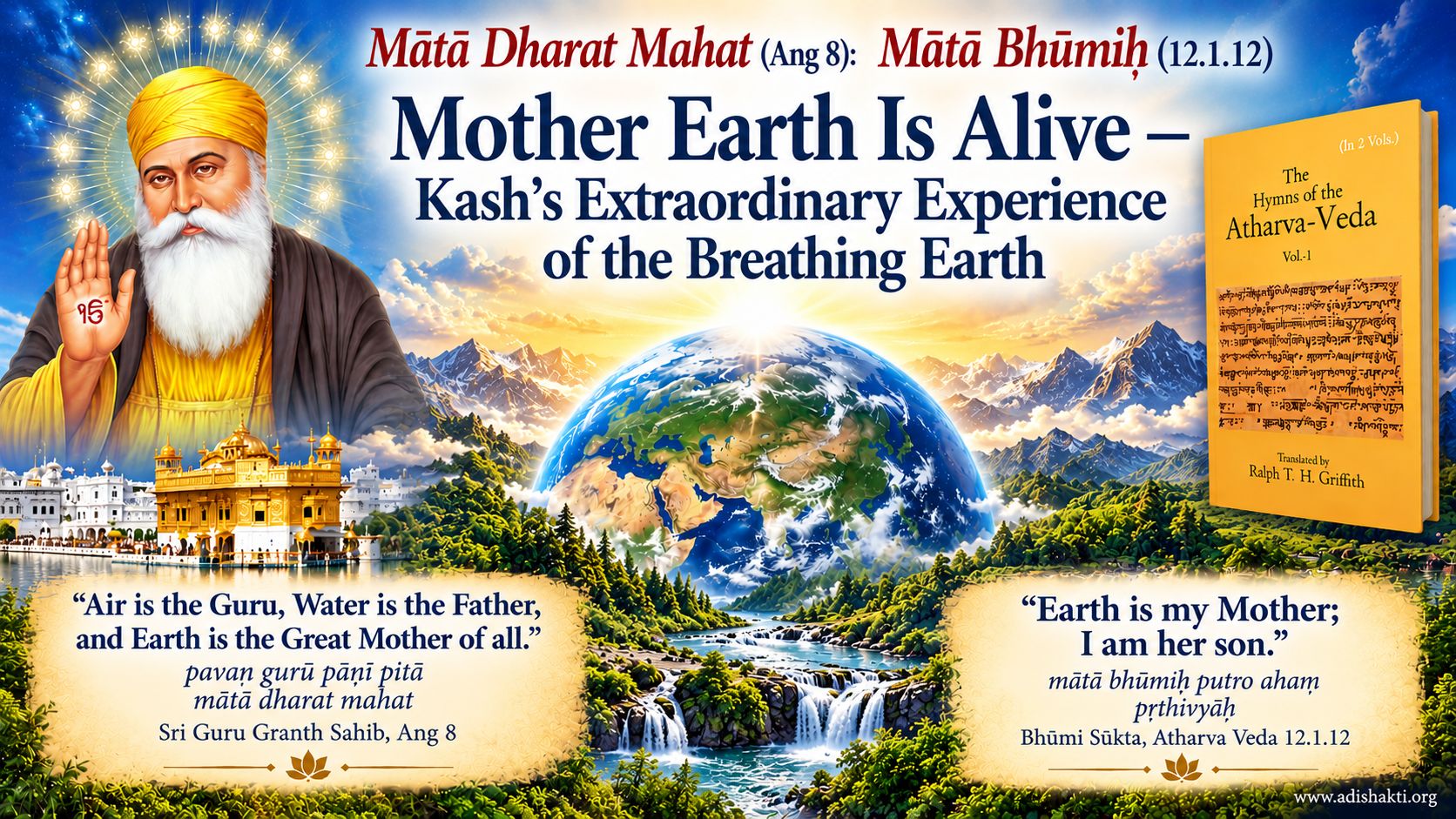
Two independent scriptural traditions speak with striking clarity. Guru Nanak declares mātā dharat mahat—Earth is the Great Mother (Sri Guru Granth Sahib, Ang 8). The Bhūmi Sūkta declares mātā bhūmiḥ putro ahaṃ pṛthivyāḥ—Earth is my Mother; I am her son (Atharva Veda 12.1.12). The Lalita Sahasranama further names the Divine Mother Śrī Mahī (718). These declarations are the theological foundation of the present investigation.
As far as the documentary material examined for this paper shows, Kash’s report is a remarkably distinctive—and potentially first-of-its-kind—published testimony of directly sensing Mother Earth breathe through the palm in the context of Kundalini awakening. A claim that no comparable experience has ever been reported anywhere in human history would require a comprehensive global historical survey that has not been completed. The account's importance does not depend on overstating that point.
The wider argument is ethical as well as spiritual: if Mother Earth is alive, humanity must awaken not only its consciousness but its conscience. The planetary crises of global warming, habitat loss, pollution and ecological devastation demand more than technical adjustments. They demand a profound change in the human relationship with the Earth that sustains us.
2. The complete primary testimony
The Spiritual Monsoon Begins
It was in early November 1993, that the drizzle of Divine Consciousness began. A Sahaja Yogi friend, Bhupinder, asked permission from the father if he could teach his sons Kash (13 year-old) and Shah (11 year-old) how to meditate. To allay any fears he explained that it was a simple, extremely harmless, newly discovered method of spiritual awakening.
Both children were given Self-Realization after which all three of them meditated. When they finished Kash went straight to his father and exclaimed that he had reached a beautiful land far away. The father skeptically listened, occasionally glancing at his friend to see if it made any sense to him.
Kash told that the very instant he closed his eyes and went into meditation, he found himself standing on a soft carpet of clouds — hues of blue and white not seen on Earth — spreading in all directions as far as the eye could see. Some distance away there was a very bright Light of Great Beauty shining above and illuminating the entire vastness. In spite of its dazzling brilliance he could gaze at it without hurting his eyes. He just stood and looked around in amazement and awe at the tranquillity and stunning beauty of the surroundings. For a long time he continued gazing around this strange serene land, wondering where he really was. Kash did not even take one step in any direction. The sheer splendor of this awesome scene illumined by a single dazzling Light and his inability to comprehend where he was kept him mesmerized and rooted to one spot.
After gazing around for about twenty minutes Kash closed his eyes again, and descended back to Earth.
His ignorant father just took it as a figment of a child's imagination. Unknown to him his Sahaja Yogi friend had just awakened his son’s Kundalini, the potential divine energy of the Holy Spirit residing within humans. (This is nothing short of a stupendous revolutionary spiritual breakthrough achieved by Shri Mataji Nirmala Devi, who bestows such priceless powers to any human desiring a Higher Consciousness.)
Note: On February 16, 1997, at 6:45 p.m. Kash was asked if he was aware on this first day of meditation that only a few minutes earlier he was on Earth. He replied that he knew that he lived on Earth, but could not comprehend what actually transpired. He himself was wondering how he came there, fully aware that he was not dreaming or hallucinating! But where was this Heavenly Paradise? He had absolutely no idea.
Earth Is A Conscious, Living Mother
The next evening Bhupinder gave Kash specific instructions and a mantra to recite before going into meditation. As directed, he put his right palm on the ground and uttered the mantra four times:
“Om Twameva Sakshat Shri Ganesha Sakshat Shri Adi Shakti Mataji Shri Nirmala Devi Namoh Namah.”
The dormant Kundalini energy inside his sacrum bone sprang into life, coursed through the central nervous system, and pierced the Sahasrara. At that very instant, for the first time, he felt the Mother Earth breathing. She was breathing very gently and every heave of Her breath felt on his palm, going slowly up, and then down again. As he continued repeating the Mighty Mantra of Shri Ganesha the sacred Shri Bhumidevi (Mother Earth) continued inhaling and exhaling to reveal Her true nature. Her superconscious child was sure beyond all doubts that Earth was breathing. This is truly the Dawn of Aquarius and human awareness will never be the same again. Mother Earth is alive — This Revealed Truth is Absolute.
The Earth Mother is alive: We have to feel Her, sense Her, hear Her, talk to Her and, most important, protect Her. We must defend Her for She is our Mother. She is a Conscious Being, a living cell of the infinite Universe. We have to transcend our debilitating ignorance, our destructive lifestyles, our cold selfishness, and transform ourselves into Higher Beings. It is time to begin the Great Journey that all Holy Scriptures, all Messengers, and all Divine Prophecies promised.
Awaken, humans, awaken! We are indeed at the crossroads of spiritual Eternity! Awaken and become masters of your spiritual Destiny! Awaken to bask in the first rays of the Millennium of Light! Let there be Love! Let there be Healing! Let there be Freedom! Let there be Justice! Let there be Transformation! Let there be Spiritual Evolution! Let there be Universal Truth! Let there be Collective Consciousness! Let there be Cosmic Bliss! Let there be Light! Let there be Light! Let there be ...
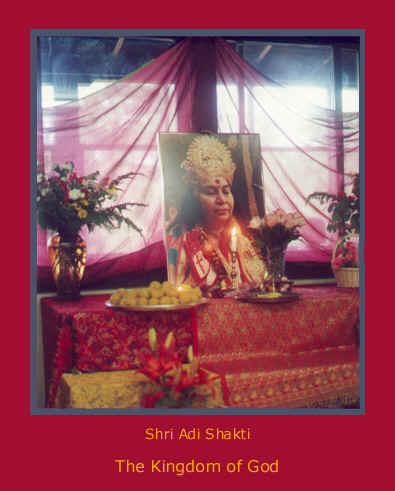
Shri Adi Shakti: The Kingdom of GodJagbir Singh, 1999, p. 78
3. Śrī Mahī (718): The Divine Mother identified with Earth
Within the Śrī Lalitā Sahasranāma, Mahī (718) is a name of the Divine Mother associated with Earth. This is more than an affectionate metaphor in the devotional reading advanced here: Earth is understood as a manifestation of the living Divine Feminine. The Mother who sustains the physical world is not divorced from the supreme reality celebrated as MahaDevi.
Read in this light, Kash’s experience becomes a remarkable convergence of scripture and spiritual encounter. The ancient name Mahī speaks of Earth’s sacred identity; Kash’s account describes a child becoming aware of that identity in an immediate, intimate way. What was proclaimed in a sacred name was, according to his testimony, felt in the palm of his hand.
This theological interpretation does not require the infinite MahaDevi to be limited to the planet. Rather, it understands the Earth as one vast living expression of Her presence. It is precisely this combination of divine transcendence and divine immanence that gives Kash’s testimony its distinctive meaning.
4. Atharva Veda: Earth as Mother and the language of breath
The Bhūmi Sūkta of the Atharva Veda (12.1) is one of the great ancient hymns to Earth. Its declaration is direct and personal: “Earth is my Mother; I am her son” (mātā bhūmiḥ putro ahaṃ pṛthivyāḥ; 12.1.12). This is not the language of possession. It is the language of kinship, dependence and reverence.
Kash’s account gives this verse an extraordinary contemporary immediacy. He did not merely repeat that Earth is Mother; he reported experiencing her as breathing. In the Adishakti.org theological reading, the encounter is a modern witness to the ancient intuition that the ground beneath humanity is not spiritually dead or alien to us.
Some English renderings of the same hymn employ language suggestive of Earth breathing upon humanity; the Sanskrit admits differing translations and should not be presented as a technical prediction of Kash’s particular sensation. The stronger connection is the hymn’s unmistakable portrayal of Earth as a sacred maternal presence to whom human beings owe care.
Thus Mātā Bhūmiḥ is also a moral summons. The child of Earth cannot rationally celebrate his Mother in worship while poisoning her waters, destroying her forests, destabilizing her climate and treating her living systems as expendable.
5. Devi Gita: MahaDevi and divine immanence
The Devi Gita, within Book Seven of the Devi Bhagavata Purana, presents MahaDevi as the supreme reality underlying the manifested cosmos. Her power gives rise to the universe while she remains more than any individual manifestation.
This theology explains why the Earth can be revered as divine without equating the infinite Goddess exclusively with the planet. Earth as Mahī is an expression of divine immanence, not a limitation upon transcendence.
Within this framework, Kash’s report may be interpreted as an unusual moment in which apparently inert ground was perceived as a living maternal presence. The scripture makes that interpretation theologically intelligible; it does not independently verify the reported event.
6. Guru Nanak: Earth as the Great Mother
Guru Nanak’s concluding salok of Japji Sahib declares: “Air is the Guru, Water is the Father, and Earth is the Great Mother of all” (pavaṇ gurū pāṇī pitā mātā dharat mahat; Sri Guru Granth Sahib, Ang 8). This magnificent declaration locates every human life within a sacred family of air, water and Earth.
Placed beside the Atharva Veda, it creates an extraordinary interreligious convergence: the Vedic seer calls Earth “my Mother,” while Guru Nanak calls her “the Great Mother.” The traditions are not identical in doctrine, but they meet in a profound affirmation of human dependence upon the Earth.
In this paper’s interpretation, Kash’s testimony is a powerful contemporary reminder of that forgotten relationship. He reported not an abstract concept of Mother Earth, but a direct encounter with her apparent living rhythm. The experience therefore speaks across religious boundaries and invites people of all traditions to reexamine how they treat the planet.
These verses must be heard as an urgent demand upon human conscience. To injure the air, poison the water and devastate the Earth is to violate the very relationships that Guru Nanak presents as sacred. Whether one understands Earth’s motherhood theologically, poetically or ecologically, the obligation to protect her is real.
7. Kundalini, Mooladhara, Shri Ganesha, and the Earth element
The distinctive details of Kash’s experience matter. The testimony records the right palm placed upon the ground, four repetitions of a mantra invoking Shri Ganesha and Shri Adi Shakti, and a gentle rising and falling that Kash understood as Mother Earth breathing. These details make the account more specific than a general feeling of unity with nature.
In Sahaja Yoga, Shri Ganesha is associated with the Mooladhara Chakra and the Earth element; Kundalini awakening is understood to transform awareness through the subtle system and Sahasrara. The spiritual interpretation offered by the testimony is therefore internally coherent: an awakened child, invoking the deity associated with the Earth element, becomes aware of the Earth as living Mother.
Rather than treating this coherence as incidental, the paper recognizes it as central to the testimony’s meaning. Kash’s experience is extraordinary precisely because the ritual setting, the felt event and the ancient scriptural language converge in a single narrative. Such coherence is not the same as an instrumentally measured planetary breath, but it gives the report profound spiritual and theological relevance.
8. Worldwide intellectual traditions of the living Earth
The living-Earth idea appears across religious, philosophical, scientific, and ecological literature. These sources should be read comparatively, not treated as interchangeable proofs. Their differing conceptions of life—spiritual, metaphorical, systemic, and biological—are precisely what makes the comparison illuminating.
8.1. V. S. Agrawala and Klaus K. Klostermaier
The supplied research quotes V. S. Agrawala, as cited by Klaus K. Klostermaier in Hinduism: A Short History, pp. 217–218: “Mother Earth is the deity of the new age.” This modern interpretation connects Shakta sacred cosmology with renewed ecological reverence. It supports the theological importance of Earth, not an empirical demonstration of consciousness.
8.2. James Lovelock and Lynn Margulis
The Gaia hypothesis studies the relationships between biological life and the atmosphere, oceans, and planetary environment. James Lovelock described life and environment as “a single, tightly coupled process” (Geophysiology, the Science of Gaia, 1989). This supports planetary integration and feedback, but does not establish a single conscious planetary mind.
8.3. David Spangler and the world soul
David Spangler’s The Meaning of Gaia (1990) asks what is intended “when we talk about the spirit of Gaia”. His exploration of the anima mundi distinguishes spiritual participation in the Earth from a strictly scientific account of planetary systems. Kash’s testimony is relevant because it describes a perceived encounter rather than merely an intellectual belief.
8.4. Peter Russell and the living planetary whole
Peter Russell’s The Global Brain Awakens uses a planetary analogy culminating in the expression “The whole thing is alive!” The movement of continents, circulation of oceans, and interdependence of ecosystems can suggest an integrated whole, though an analogy is not proof that Earth is an organism in the same sense as an animal.
8.5. Plato and the ensouled cosmos
In the Timaeus, particularly 30b–34b, Plato describes an ordered cosmos endowed with soul and intelligence. This is a major philosophical precedent for understanding the universe as more than a collection of inert parts. Plato’s cosmic soul is not identical with MahaDevi, nor is it a claim about Kash’s experience.
8.6. The Stoics and pneuma
Stoic philosophy understood pneuma—breath or spirit—as an active principle of cohesion and organization throughout nature. The concept is suggestive alongside Vedic prāṇa and Shakta Śakti, but these terms emerge from distinct philosophical and religious systems and should not be conflated.
8.7. Erich Neumann and the Great Mother
Erich Neumann writes that “The woman is the natural nourishing principle” in The Great Mother. His archetypal psychology helps explain the recurrence of maternal Earth imagery. Psychological significance is not itself evidence that the Earth possesses a separate individual consciousness.
8.8. Sri Aurobindo and the evolution of consciousness
Sri Aurobindo’s writings on spiritual evolution explore the possibility that consciousness is progressively manifested within earthly existence. A supplied excerpt speaks of “not only a revelation of the Spirit” but of a transformation of nature. This offers a philosophical parallel to the Sahaja Yoga interpretation, not proof of a new biological stage from one reported experience.
8.9. Carl Sagan and ecological responsibility
Carl Sagan warned, “We have become predators on the biosphere” (Billions & Billions). His scientific and ethical argument converges with the scriptural demand to protect Earth without requiring belief in a conscious goddess. Reverence can reinforce responsibility grounded independently in ecological science.
8.10. Arne Næss and deep ecology
Arne Næss’s deep ecology emphasizes the intrinsic value of living beings and humanity’s participation within ecological relationships. This perspective challenges a purely exploitative understanding of the planet. It offers an ethical complement to the maternal theology of Mahī, not verification of literal breathing.
8.11. Indigenous traditions and relational Earth
Many Indigenous traditions express kinship and reciprocal obligation toward land, waters, and other beings. These traditions are diverse and must not be reduced to a single doctrine. Specific quotations should be sourced from named Indigenous authors and community-authorized texts rather than from unattributed internet sayings.
9. Five meanings of “Earth is alive”
Biological livingness refers to the organisms and ecosystems inhabiting Earth. Systems-level livingness concerns feedback processes linking the biosphere, atmosphere, oceans, and geology. Both are subjects of empirical science.
Philosophical livingness refers to traditions of the ensouled cosmos or organizing cosmic principle. Theological livingness concerns Earth as manifestation of MahaDevi or as sacred Mother. Experiential livingness concerns an individual’s report of perceiving the Earth as alive.
Kash’s testimony belongs primarily to the experiential category, interpreted through Shakta theology and Sahaja Yoga. Gaia theory supports ecological integration, not the conclusion that Kash detected the physical breathing of a conscious planet.
10. Historical authenticity and the testimony
The published account identifies the first meditation in early November 1993, the Sahaja Yogi Bhupinder, Kash’s brother Shah, the mantra, the right palm placed on the Earth, and the reported gentle breathing sensation. Jagbir Singh preserved the narrative in Shri Adi Shakti: The Kingdom of God (1999, p. 78), giving later readers a stable primary-source record.
Its importance is not diminished by the fact that the event was experienced by a child. On the contrary, the account describes a spontaneous response to a newly introduced spiritual practice rather than a philosophical argument developed after decades of study. The testimony’s precise sensory and ritual details make it especially deserving of preservation and serious examination.
Within the documentary material considered here, this appears to be an unusually early and distinctive published report of a human being directly perceiving the Earth as breathing. The stronger assertion that it is the first such report in all recorded history remains a historical research question, not a demonstrated universal fact. The paper therefore celebrates its potentially pioneering significance without claiming an exhaustive search of every culture and archive.
Historical authenticity concerns the existence, transmission and fidelity of the testimony. Independent physical verification concerns a different question. Respect for the first does not require pretending that the second has already been settled. The appropriate response is to preserve the testimony faithfully and to take seriously the new possibilities of consciousness it raises.
11. Phenomenology: Perceiving the Earth as breathing
Kash’s experience was tactile and relational. The Earth, usually treated as motionless ground, was perceived as gently inhaling and exhaling beneath his palm. The remarkable feature is not simply that he noticed a rhythm, but that he recognized the rhythm as the breathing of Mother Earth.
Within the devotional framework of this paper, this is a moment of expanded spiritual awareness: a child encounters the planet not as an inert object but as a living maternal presence. That change in perception is exactly the kind of awakening that ancient spiritual traditions have sought to communicate through sacred language.
Even readers who do not share the theological interpretation can recognize the experience’s ethical power. If people were to approach the ground beneath them with the tenderness ordinarily reserved for a living mother, their relationship with forests, rivers, soil, oceans and atmosphere could change profoundly.
12. Alternative explanations and empirical limits
An extraordinary testimony can be welcomed without abandoning intellectual care. The physical origin of a rhythmic sensation felt through a resting hand could be investigated through attention to pulse, breathing, posture, environmental vibration and other measurable factors. None of these possibilities, merely listed, establishes what occurred to Kash in November 1993.
Such questions should not be allowed to erase the primary subject of the paper: the testimony’s remarkable spiritual significance and its correspondence with ancient teachings about Mother Earth. Scientific inquiry into the mechanism of a sensation and theological interpretation of its meaning address different dimensions of the account.
The present paper therefore does not claim that laboratory evidence has demonstrated a single planetary organism breathing in the manner of a human body. It does affirm that Kash’s report deserves serious and positive consideration as an extraordinary experience, with consequences for spiritual understanding and ecological responsibility.
13. The cumulative theological case
The cumulative case is powerful because several distinct strands converge: Śrī Mahī (718) names the Divine Mother as Earth; Mātā Bhūmiḥ (12.1.12) declares Earth our Mother; Mātā Dharat Mahat (Ang 8) calls Earth the Great Mother; and the Sahaja Yoga framework relates Shri Ganesha, the Earth element and awakened Kundalini.
Into this convergence enters Kash’s account of actually feeling the Earth breathe. Ancient scripture names the relationship; the reported experience makes it startlingly immediate. For the Adishakti.org theological project, this is not a marginal curiosity but a potentially landmark testimony in the unfolding understanding of human consciousness.
The case is strongest when it distinguishes its components: sacred texts establish the traditional language; the published narrative establishes what Kash reported; theological reasoning connects them; ecological science independently establishes the urgency of protecting Earth’s life-support systems. Together they provide a compelling spiritual and moral appeal without misrepresenting the evidentiary role of any one source.
14. Reverence, ecological responsibility, and the Divine Mother
The declaration “Mother Earth is alive” must become an awakening of conscience, not merely a subject of religious discussion. The Earth sustains humanity on a scale beyond individual comprehension: atmosphere, oceans, soils, forests, climate systems and the web of life. She is immeasurably larger than any one of us, yet our dependence upon her is as intimate as a child’s dependence upon its mother.
Mātā Dharat Mahat (Ang 8) and Mātā Bhūmiḥ (12.1.12) compel a radical moral reorientation. If Earth is our Great Mother, we cannot regard accelerating global warming, ecological disasters, deforestation, species extinction, polluted rivers, poisoned soil and ocean degradation as distant technical problems alone. They are injuries to the living world that gives us breath, water, food and shelter.
In the spiritual interpretation advanced here, Mother Earth is alive just as we are alive, but on a vastly greater planetary scale. This is a theological affirmation of planetary livingness, not a claim that the Earth possesses human organs or that planetary consciousness has been scientifically demonstrated. The distinction need not weaken its ethical force: Earth’s integrated living systems and humanity’s dependence upon them are established realities.
Kash’s extraordinary experience makes the appeal personal. Imagine a child placing his hand upon the ground and feeling that the Mother sustaining every nation, every generation and every species is breathing. How could a humanity awakened to such kinship continue to destroy her without remorse? This is why the testimony matters urgently in an age of climate disruption.
Human consciousness must expand into human conscience. Reverence must become action: protecting forests and biodiversity, reducing greenhouse-gas emissions, restoring damaged ecosystems, safeguarding clean water, caring for soil, reducing waste and supporting communities facing environmental harm. The sacred relationship must be expressed through responsible choices, not merely beautiful words.
These responsibilities extend to people of every faith and to those with no religious affiliation. One need not accept Kash’s spiritual interpretation to recognize that the planet’s life-support systems are irreplaceable. But for those who do accept it, ecological responsibility becomes something deeper: the duty of children to protect their living Mother.
15. A new age of consciousness: Adishakti.org and the work ahead
Adishakti.org intends to remain in the forefront of this work through continuing publication of research papers, articles and new studies. This account of Mother Earth’s living presence is only one chapter in an expanding series, with many more investigations to come. The ultimate measure of such advancement is whether it transforms consciousness into compassion, ecological protection and a more responsible human civilization.
The claim that humanity is entering a new age is offered here as the spiritual interpretation and mission of Adishakti.org, not as an independently established scientific chronology. Its significance lies in the work it inspires: preserving unusual testimony, examining scriptural convergences, promoting interreligious understanding and awakening a deeper responsibility toward the world.
The transition envisioned by Adishakti.org is a transition from inherited belief alone toward living spiritual awareness. Kash’s experience of the breathing Earth belongs to a larger archive of testimony, scripture and reflection through which the site explores the Divine Mother, Kundalini, Self-Realization and the possibility of an awakened humanity.
16. Conclusion: Mother Earth is alive—awaken and protect her
“Mother Earth Is Alive” is the central affirmation of this paper. Kash’s November 1993 experience, as preserved in Shri Adi Shakti: The Kingdom of God (1999, p. 78), is an extraordinary report of direct encounter with the Earth as a breathing maternal presence. Read alongside Mātā Dharat Mahat, Mātā Bhūmiḥ and Śrī Mahī, it acquires profound interreligious significance.
The testimony may prove to be a historically pioneering contribution to accounts of expanded spiritual perception. Although a universal first-in-history claim has not been independently established, its rarity, specificity and scriptural resonance justify serious attention rather than reflexive dismissal.
Humanity is entering what Adishakti.org understands as a new age of spiritual awakening and expanded consciousness. In that vision, the ancient wisdom of the Divine Mother is no longer confined to scriptures, temples and inherited beliefs; it is to be rediscovered through living experience, transformation and responsibility.
Adishakti.org seeks to stand at the forefront of this advancement in human consciousness through its growing body of papers, articles, scriptural studies and documented spiritual testimonies. The present paper is one contribution to that continuing work—one of many still to come—inviting readers to consider the relationship between sacred revelation, Self-Realization, humanity’s spiritual evolution and the living Earth.
The final challenge is not merely to ask whether Mother Earth is alive. It is to ask whether humanity will awaken in time to treat her as alive. The Vedic declaration and Guru Nanak’s salok call us to recognize our Mother. Kash’s testimony calls us to feel her presence. The ecological emergency calls us to defend her. May consciousness awaken conscience—and may reverence become protection.
References and primary sources
[1] Sri Lalita Sahasranama, Names 716–719, especially Mahī (718)
[2] Jagbir Singh, Shri Adi Shakti: The Kingdom of God (1999), p. 78
[3] Atharva Veda 12.1, Bhūmi Sūkta, Griffith translation
[4] Devi Gita, Devi Bhagavata Purana, Book Seven, Chapters 31–40
[5] Sri Guru Granth Sahib, Ang 8, Japji Sahib
[6] James Lovelock and Lynn Margulis, Atmospheric Homeostasis by and for the Biosphere (1974)
[7] James Lovelock, Geophysiology, the Science of Gaia (1989)
[9] Klaus K. Klostermaier, Hinduism: A Short History (2000), pp. 217–218
[10] David Spangler, The Meaning of Gaia (1990)
[11] Peter Russell, The Global Brain Awakens
[12] Erich Neumann, The Great Mother (1955)
[13] Sri Aurobindo, The Life Divine and The Future Evolution of Man
[14] Carl Sagan, Billions & Billions (1997)
[15] Arne Næss, writings on deep ecology
[16] Shri Mataji Nirmala Devi, Bordi (12 February 1984) and Cabella (7 September 1997); verify transcript quotations against original recordings
Editorial verification: Short quotations from the supplied research compilation should be checked against original print editions or lecture recordings before final publication.