Universal Pneumatology: The Cool Breeze, Baptism in the Holy Spirit, and the Living Resurrection
Summary
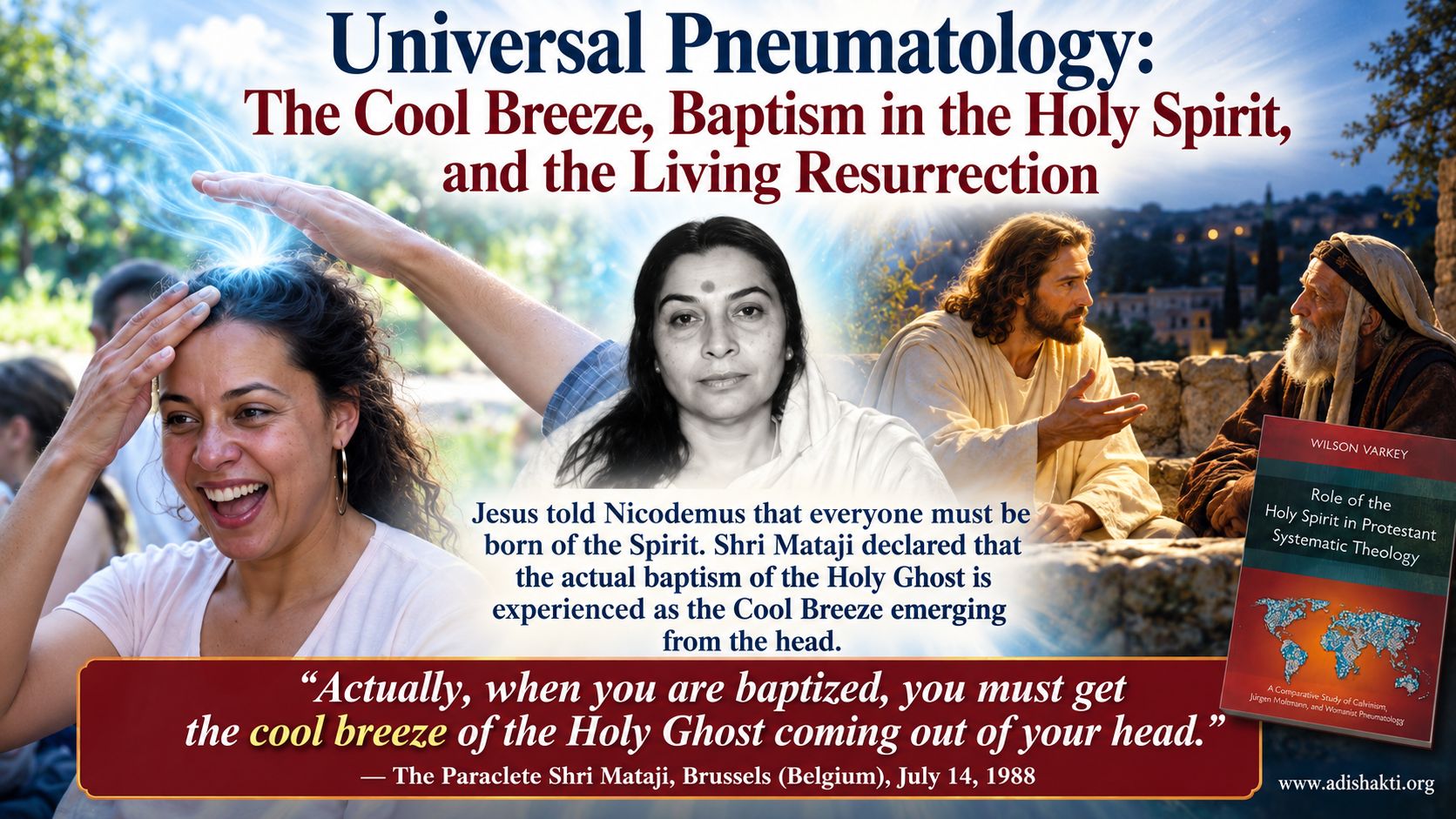
The governing thesis: Shri Mataji Nirmala Devi’s declaration—“Actually, when you are baptized, you must get the cool breeze of the Holy Ghost coming out of your head”—is presented here as the precise experiential explanation of the birth of the Spirit that Jesus required of Nicodemus in John 3:5–8. Jesus announced the necessity of the new birth and described the Spirit through the mystery of the wind; Shri Mataji, in the Adishakti theological reading, identified what the recipient of that baptism can actually feel.
This claim is not based on one isolated remark. Across approximately four decades of public teaching, Shri Mataji repeatedly associated Self-Realization, the awakened Kundalini, the Holy Spirit and the felt Cool Breeze. The searchable Nirmala Vidya Amruta archive has displayed more than 1,000 results for “Cool Breeze.” This is an index of the breadth of the theme, not an independently audited count of distinct talks.
1. Introduction: What Jesus Required of Nicodemus
Jesus did not present rebirth as an optional religious refinement. When Nicodemus came to him, Jesus insisted that a person must be born anew to see the Kingdom of God (John 3:3). The question is therefore not merely what Christians should believe about the Holy Spirit, but what it means to undergo the birth of the Spirit. In the Adishakti reading, Shri Mataji answered this question by identifying an inward event that can be directly experienced. Her explanation shifts the discussion from intellectual assent alone to the living transformation Jesus demanded. The companion study on Nicodemus develops this connection.
2. The Brussels Declaration: The Experience of True Baptism
At Brussels on 14 July 1988, Shri Mataji declared: “Actually, when you are baptized, you must get the cool breeze of the Holy Ghost coming out of your head.” The significance of her words lies in “actually” and “must”: she was not speaking of baptism merely as a social affiliation, a ceremony or a proposition about grace. She described baptism in the Holy Ghost as an event with a recognizable spiritual manifestation. Within Sahaja Yoga, this is understood as the awakening of Kundalini and its passage through the Sahasrara, the crown centre. The Cool Breeze is presented as the felt sign of connection with the all-pervading divine power. Her identification of that experience with the Holy Ghost supplies the bridge to Jesus’ teaching.
3. John 3:5–8: Born of Water and the Spirit
Jesus says in John 3:5 that entry into the Kingdom requires birth “of water and of the Spirit,” and in John 3:6 distinguishes what is born of flesh from what is born of Spirit. In verse 7, he repeats the necessity: “Ye must be born again” (KJV). The progression is decisive. Nicodemus understands birth in physical terms; Jesus redirects him to a new origin of life through the Spirit. The Adishakti interpretation holds that Shri Mataji did not introduce an unrelated spiritual requirement: she described the experience corresponding to this rebirth. This is a theological identification, however; John 3 itself does not prescribe a cool sensation or explicitly name the Sahasrara.
4. The Wind of the Spirit and the Cool Breeze
John 3:8 gives the governing analogy: “The wind bloweth where it listeth, and thou hearest the sound thereof ... so is every one that is born of the Spirit” (KJV, abbreviated). The Greek pneuma can mean wind, breath or spirit, giving Jesus’ imagery unusual force. The wind is invisible, yet its effects can be encountered. Shri Mataji’s teaching makes this analogy strikingly concrete: the unseen Holy Spirit is said to become perceptible as the Cool Breeze. The central claim of this paper is that her baptismal declaration explains in experiential terms the reality Jesus was describing to Nicodemus. It is not a claim that Jesus explicitly taught a sensation at the crown; rather, it is an interpretation of how his teaching can be fulfilled in living experience.
5. Four Decades of Teaching: Hundreds of Talks and the Amruta Archive
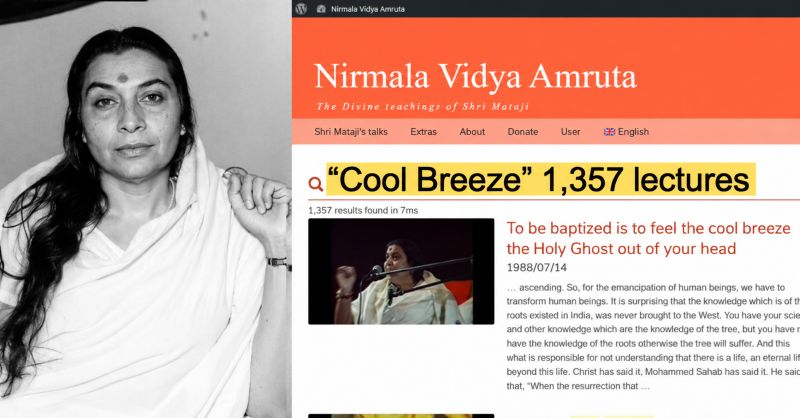
The Brussels declaration is not an isolated sentence chosen to sustain a theological theory. For roughly four decades, from the early years of her public mission until 2011, Shri Mataji returned repeatedly to the Cool Breeze as a manifestation of Self-Realization, the Holy Spirit and the divine power. Hundreds of her talks discuss the Cool Breeze. The public Nirmala Vidya Amruta search for “Cool Breeze” has shown more than 1,000 results, enabling readers to examine her words across dates, countries and audiences. Search hits may include repeated references, translations, transcripts or other indexed pages, so the result count should not be equated mechanically with 1,000 separate lectures. Nevertheless, the searchable record demonstrates that the Cool Breeze was a recurring and sustained element of her message, not a marginal illustration. Her teaching provides a continuous pneumatological framework in which the birth of the Spirit is intended to be experienced.
6. Baptism as Living Spiritual Transformation
This approach creates a pointed distinction between an outward sign and the inward reality to which baptism points. Christian traditions differ in their understanding of water baptism, regeneration and the baptism of the Holy Spirit; the present paper does not erase those differences. It argues instead that Shri Mataji’s statement challenges any account of baptism that leaves the recipient with no expectation of an inward encounter with the Spirit. For her, the Cool Breeze signifies an awakening, not simply the completion of a rite. Jesus’ demand that Nicodemus be born of the Spirit is thus interpreted as a living transformation rather than a label inherited by religious membership.
7. The Paraclete and the Glorification of Jesus
In John 14:26, the Paraclete is identified with the Holy Spirit, who teaches and brings Jesus’ words to remembrance; in John 16:13–14, the Spirit guides into truth and glorifies Christ. Within Adishakti theology, Shri Mataji’s teaching about the Cool Breeze is understood as a work of this promised Spirit: it calls attention back to Jesus’ requirement of spiritual birth and insists that his words can become a present reality. This identification of Shri Mataji with the promised Paraclete belongs to the site’s confessional interpretation and is not the standard historical or doctrinal interpretation of the Johannine passages.
8. The Living Resurrection and Salvation by the Spirit
The theological consequence is a doctrine of salvation that cannot be reduced to recollecting a past event. In John 5:24, Jesus speaks of the believer passing from death into life; John 5:25 speaks of the dead hearing the voice of the Son of God and living. The Adishakti reading brings these passages into conversation with the birth of the Spirit: the Living Resurrection begins as a present awakening to divine life. Shri Mataji’s Cool Breeze doctrine is thereby interpreted as a pneumatology of salvation—an inward participation in the life Jesus promises. This present emphasis does not replace the future resurrection central to historic Christian belief.
9. What the Cool Breeze Claim Does—and Does Not—Establish
The evidence must be carefully distinguished. The Brussels statement establishes what Shri Mataji taught; the many indexed talks show the continuity and breadth of her teaching; and testimonies of the Cool Breeze document experiences reported by practitioners. None of these, on its own, scientifically demonstrates that a physical sensation is caused by the Holy Spirit or proves that John 3 was originally intended to specify a crown sensation. The paper’s stronger claim is theological and experiential: within Shri Mataji’s account of Self-Realization, the Cool Breeze is understood as the recognizable manifestation of the Spirit-birth Jesus required.
10. Testing Spiritual Experience by Its Fruits
A spiritual experience cannot be judged solely by temperature or sensation. Jesus’ teaching calls for a new life, and Galatians 5:22–23 identifies the Spirit’s fruit in love, joy, peace, patience, kindness and self-control. Accordingly, a claim to baptism in the Holy Spirit should be examined alongside enduring ethical and spiritual transformation. The Cool Breeze, in the Adishakti framework, is an initiating sign of connection, not permission to neglect humility, compassion, discernment or moral responsibility.
11. Universal Pneumatology: The Invitation to All Humanity
The invitation in Jesus’ conversation with Nicodemus concerns the human need for birth from above, not the privilege of a particular nation or class. The Pentecost narrative similarly presents the outpouring of the Spirit in expansive terms (Acts 2:17), and Acts 10 depicts the Spirit reaching beyond previously assumed boundaries. Shri Mataji’s public teaching extends that universal horizon by asserting that Self-Realization is available to ordinary people across religious backgrounds. Universal pneumatology here means a universally offered possibility of direct encounter with the Spirit—not an assertion that everyone necessarily reports an identical sensation.
12. Conclusion: The New Birth Made Experiential
The argument returns to its starting point. Jesus told Nicodemus that he must be born of the Spirit and compared the Spirit’s action to the wind. Shri Mataji declared that when a person is actually baptized in the Holy Ghost, the Cool Breeze comes out of the head. In the Adishakti interpretation, these are not two unrelated teachings: Shri Mataji was identifying the experience of the very spiritual rebirth that Jesus commanded. Her repeated discussion of the Cool Breeze across hundreds of talks, searchable through an archive showing over 1,000 results for the phrase, makes this a sustained doctrine of experiential pneumatology. Its final significance is the promise that salvation and the Living Resurrection are not merely subjects of theological discourse but realities to be encountered through the Holy Spirit.
Retained Companion Sources and Supplied Links
All links supplied with the paper and layout reference are preserved in the separate complete source-and-resource catalogue . Its layout examples and unused image resources are not evidence for this paper’s thesis. The original paper’s comparative companion links are also retained: Chi, Prana, Holy Spirit , Qi and the Pneuma Mentioned by Jesus , and Chi as a Bridge Between God and Humanity . They are not developed as non-Christian themes in this revision.
The supplied Gospel of Thomas directory duplicate returned 404 during inspection; its original address is preserved rather than silently removed or treated as support. Selected Christian page-image pairs were checked against the AdiShakti.org homepage .
Primary source: Shri Mataji Nirmala Devi, Brussels public program, 14 July 1988, declaration concerning baptism and the Cool Breeze of the Holy Ghost.
Lecture archive: Nirmala Vidya Amruta, search results for “Cool Breeze” (search-result counts can change).
Companion paper: Jesus Tells Nicodemus of the Wind of the Spirit — Part One.
References
Search Adishakti.org
Interactive Chat
Explore the article’s scripture, sources, and theological interpretation.
Open chat