Winds Of Qiyamah/Resurrection
(Riah Al-Qiyamah) Are Blowing!
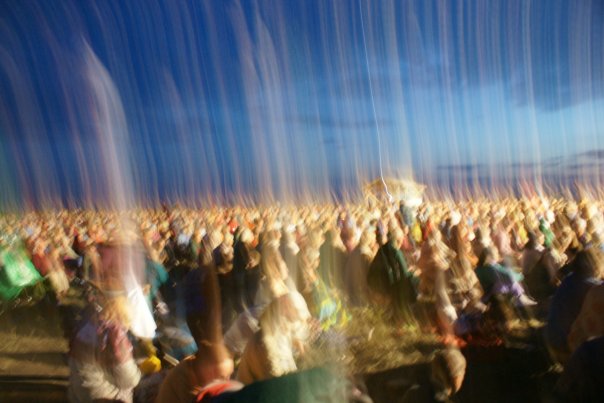
those taking part in the Resurrection (Photo
taken 1st August 2008 in Russia of Ruach
which, though invisible to the naked eye,
can be felt as Cool Breeze flowing from the
hands, head and other parts of the body.
(Click image for uncropped original)
Even more remarkable is the fact that the deeds man has performed will themselves take shape before his astonished eyes. This must definitely be regarded as the most veracious form of testimony possible; it closes off before the offender any defense, deception or flight from chastisement, and strips him of denial and sophistry. No crime remain unproven, and the sinners will be overtaken by shame and humiliation.”- Imam al-Sadiq
Even So Will The Winds Of Resurrection Blow
It is Allah who sends forth the Winds so that they raise up the Clouds, (3881)
And We drive them to a Land that is dead,
And revive the earth therewith after its death:
Even so (will be) the Resurrection!
surah 35:9 Fatir (The Originator of Creation)
"3881. The allegory here is double. (1) Dry, unpromising soil may seem, to all intents and purposes, dead; there is no source of water near; moisture is sucked up by the sun's heat in a far-off ocean, and clouds are formed; winds arise; it seems as if the wind 'bloweth as it liseth,' but it is really Allah's Providence that drives it to the dead land; the rain falls, and behold! There is life and motion and beauty everywhere! So in the spiritual world Allah's Revelation is His Mercy and His Rain; there may be the individual resurrection (Nushur) or unfolding of the soul. (2) So again, may be the general Resurrection (Nushur), the unfolding of a New World in the Hereafter, out of an old World that is folded up and dead.”
Abdullah Yusuf Ali, The Holy Qur'n, 1989.
Jesus answered and said unto him,
Verily, verily I say unto thee, except a man born be born again,
He cannot see the Kingdom of God.
Nicodemus saith unto him,
How can a man be born again when he is old?
Can he enter the second time into his mother's womb, and be born?
Jesus answered: Verily, verily, I say unto thee,
Except a man born of water and the Spirit,
He cannot enter into the Kingdom of God.
That which is born of flesh is flesh and that which is born of Spirit is spirit,
Marvel not that I said unto thee: Ye must be born again.
The wind bloweth where it listeth, and thou hearest the sound thereof,
But cannot tell whence it comes and where it goeth:
So is every one that is born of the Spirit.
John 3:3-8
It is written both in the Qur'an and Bible that during Qiyamah (Resurrection) those who get their Self-Realization will have Cool Breeze or Wind (Riah Al-Qiyamah) coming out of their hands, head and other parts of the body. The 'hands will speak' to inform the individual of any wrong-doing on a particular finger(s) which correspond to certain problems. This experience is part and parcel of the human subtle system which is activated after the Baptism of Allah (Self-Realization).
Prophet Jesus also preached that those born again of the Spirit will experience the Wind, but will have no idea where it comes from or goes, i.e., this is not the normal wind which humans daily experience but a Divine Wind from within.

image for uncropped original)
So how does one account for Cool Breeze blowing out of hands and head, especially during meditation which is a daily experience of all who surrender to the Great Announcement that Al-Qiyamah has begun? Maybe Sayyid Mujtaba Musavi Lari, son of the late Ayatullah Sayyid Ali Asghar Lari, one of the great religious scholars and social personalities of Iran, may have the answer in his "Testimony by the Most Veracious of Witnesses":
"The Noble Qur'n makes it clear that the testimony given by sinners in the court of divine justice will be utterly unique in nature, bearing absolutely no similarity to the juridical procedures of this world.
The verses of the Qur'n that speak of the giving of testimony on the day of resurrection proclaim that the hands, feet and even the skin of the sinners will disclose the hidden sins that they committed during their lives and that were previously unknown to all but God; the sinner will stand revealed, to his utter dismay and terror. The animation of these witnesses and the testimony they will bear to the events that have happened in the world show that all the deeds we perform are recorded both in the external world and in the various organs and limbs of our bodies. When the conditions of this world are replaced by those of the hereafter, on the day when, as the Qur'n puts it," secrets are made manifest and none will be able to conceal anything or seek help from anyone.” (86:9-10) all the deeds that have been recorded will pour forth and begin to bear witness.
We can indeed observe in this world a pale and feeble example of what is meant by things acquiring speech.
A doctor, for example, understands the language of the body. The rate of the pulse may indicate fever, and yellowness of the eye proclaims the presence of jaundice. To give another example, we can tell the age of a tree from the circles within its trunk.
It is nonetheless true that we cannot know the exact modality of the testimony that will be given in the hereafter. However, once the veil is lifted from men's sight, their power of vision will increase and their level of perception will be raised. They will embark on a new life with enhanced means of perception and will see many things that surrounded them in this world although they were unaware of them. Thus the Qur'n says:
"You were in a state of negligence; now We have lifted the veil from you so that your sight is today keen.” (50:22).
Other verses speak of the multiplicity of the witnesses that will come forward:
"Let them fear a day on which their tongues, their hands and their feet shall bear testimony against them.” (24:24).
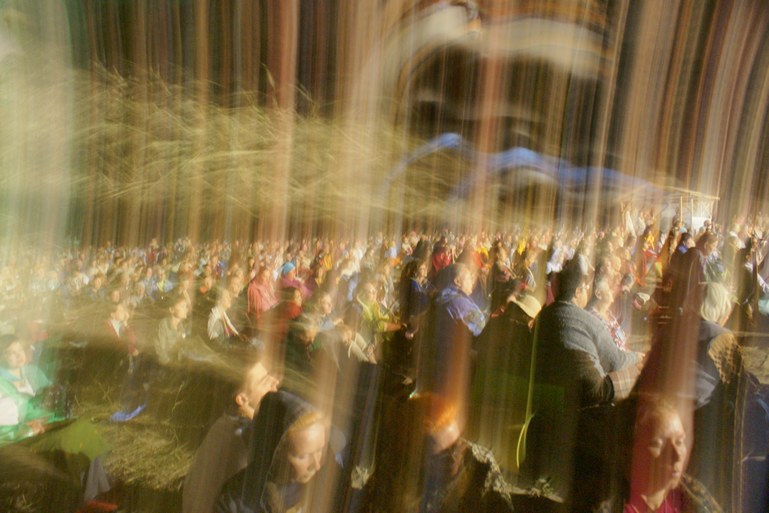
Spirit's power, to bring
humanity to salvation (Click
image for cropped original)
This verse stresses that man is unable, in the last resort, to conceal the sins he has committed with his limbs. This is not because he under estimates his bodily form, which in the end turns out to have been a means for recording his deeds, but because he imagines that things are essentially autonomous and that much of what he has done will be beyond the reach of God's knowledge. It is this unawareness of the fact that nothing in creation is hidden to God that casts men into the pit of eternal wretchedness.
The Qur'n further proclaims:
"Today We place the seal of silence on the mouths of the unbelievers and transgressors. Their hands shall speak to us, and their feet shall bear witness to what they have done.” (36:65).
Imam al-Sadiq, upon whom be peace, said the following in clarification of this matter:
"When men are gathered together before God on the day of resurrection, everyone will be given the record of his deeds. When they see the list of their crimes and their sins, they will begin to deny them and they will refuse to confess. Then the angels will bear witness to those sins having occurred, but still the sinners will swear that they have done none of the deeds of which they are accused. This is referred to in the verse, 'On the day when God shall resurrect them all and they will swear lyingly to God as they once swore lyingly to you' (58:18). It is then that God will place a seal on their tongues and cause their bodies to begin speaking about what they have done.” (Tafsir al-Qummi, p. 552)
Irrefutable witness
Even more remarkable is the fact that the deeds man has performed will themselves take shape before his astonished eyes. This must definitely be regarded as the most veracious form of testimony possible; it closes off before the offender any defense, deception or flight from chastisement, and strips him of denial and sophistry. No crime remain unproven, and the sinners will be overtaken by shame and humiliation.
The Qur'n says:
"On the day of resurrection they will find whatever they have done confronting them.” (18:49).
Or again:
"There will be a day on which everyone who has done a good deed will find it confronting him, and those who have done evil will wish that it were kept far distant from them. God warns you against His punishment for He is in truth compassionate toward His servants" (3:30).
Since it is impossible for deeds to disappear in the hereafter, the most that sinners can hope for is that a distance be maintained between them and their deeds, a clear expression of their disgust with what they them selves have done.
In addition to all the forgoing, and still more important than it, God describes Himself as the witness to all the deeds of men:
"Why do they not believe in the signs of God? He is a witness to all that you do.” (3:98).
The Qur'n also mentions the prophets and those who have drawn close to God as witnesses to man's deeds:
"The earth will shine with the light of its Lord. The record of men's deeds will be brought forth and the prophets and the martyrs shall be summoned to bear witness and judge among men so that none shall be wronged.” (39:69).
It should be borne in mind that such witness and testimony will not be restricted to the outer aspect of men's deeds. What is meant is rather testimony to the quality of deeds with respect to their good or their evil, and whether they represented obedience or sin: in short, the inner aspect of deeds.
The giving of witness on the day of resurrection is a sign of honor and respect for those who are called upon, but it also indicates that while in this world they had a certain awareness of men's inner beings, that they were able to observe them just like their outer beings and thus to record their deeds with precision and inerrancy. It is obvious that conventional knowledge and sense perception are quite inadequate for testimony of this kind; it depends on a more profound mode of awareness that is able to embrace the inner dimensions of man, an awareness that transcends our normal capacities and permits an unfailing distinction to be made between the pure and the impure.
Such testimony is based upon a clear vision of reality, and as such it is infallible.
The Qur'n says:
"Tell men that whatever they do God will display to them whatever they do, and the Messenger and the believers are aware of it. Then they shall return to God Who knows the hidden and the manifest, so that they will be requited for their good and their evil.” (9:105).
According to commentaries on the Qur'n, what is meant here by "The believers" is the Inerrant Imams from the Household of the Prophet, peace and blessings be upon him and his family. They are distinguished from other Godfearing people by the special grace and favor they have received from in that they are both inwardly pure and have been utterly purified by God. It is for this reason that the giving of testimony in the hereafter has not been vouchsafed to all men of piety.
Imam al-Baqir, peace be upon him, said in a certain tradition:
"No group or class of men can bear witness to the deeds of men except the Inerrant Imams and the prophets of God. The generality of the community has not been described by God as witnesses, because in this world there are people whose testimony cannot be trusted even for a handful of grass.” (Tafsir al-Mizan, Vol. I, p. 332)
All the deeds of men have a profound effect on their beings. If someone knows that injustice and crime are sinful but nonetheless engages in them at the behest of his instinctual nature, a contradiction will arise in his inner being that will burn and torment him profoundly. But is it not he who has created this contradiction?
If envy gnaws away at a man's inner being, is anyone responsible apart from himself?
Imam al-Sadiq, upon whom be peace, said:
"Sin cuts more deeply than a knife.” (Bihar al-Anwar, Vol. LXXIII, p. 358)
All of our words and deeds are stored in the vast and mysterious archive of our body and our soul, and they will be brought forth in the tribunal of resurrection. The totality of our acts, good and bad, are stored up within us and will ultimately take shape to confront us.
The reckoning of men's deeds that will take place in the hereafter will, then, be utterly unique. No one may hope to obfuscate the truth or to deny the contents of the precise record that is laid before him. Everyone will be compelled to accept the truth and to submit to its consequences. The hands, the feet and the skin will be called on to give witness; God from Whose knowledge not at single atom in the heavens and earth is hidden and Who is aware of the falling of leaf from a tree, will also be a witness; and the prophets and the Imams will bear their witness to whatever we have wrought.
It is obvious that it is impossible for us now to understand and perceive fully all these dimensions of the inevitable reckoning that will follow resurrection.”
This Wind of Qiyamah now flowing from their limbs is the undeniable evidence that they are being resurrected and cleansed of all evil within, and will also bear witness in the Hereafter.
"All of our words and deeds are stored in the vast and mysterious archive of our body and our soul, and they will be brought forth in the tribunal of resurrection. The totality of our acts, good and bad, are stored up within us and will ultimately take shape to confront us.”
This Wind of Qiyamah is the indisputable Sure Sign that Qiyamah — Allah's Glad Tidings of Compassion and Mercy to all humankind — has begun. The Wind of Allah that will issue forth from the True Believers (Al-Mu'minun) is unquestionable proof that Qiyamah has commenced on Earth, and in the Hereafter will be the most veracious of witnesses! No Muslim, Jew, Christian, Hindu, or Buddhist can deny or defy the Great News (surah 78:1-5 An-Naba) of Qiyamah now!
We only send the apostles to give Glad Tidings and to give warnings: But the unbelievers dispute with vain argument, in order therewith to weaken the truth, and they treat My Signs as a jest, as also the fact that they are warned!
And who doth more wrong than one who is reminded of the Signs of his Lord, but turns away from them, forgetting the (deeds) which his hands have sent forth? Verily We have set veils over their hearts lest they should understand this, and over their ears, deafness, if thou callest them to guidance, even then will they never accept guidance.
surah 18:56-7 Muhammad
(Abdullah Yusuf Ali, The Holy Qur'an, 1989.)
But they are prophesied to dispute it:
Concerning the Great News [5889] about which they cannot agree.
Verily, they shall soon (come to) know!
Verily, verily they shall soon (come to) know!
surah 78:1-5 Al Naba' (The Great News)
"5889. Great News: usually understood to mean the News or Message of the Resurrection.”
surah 78:1-5 Al Naba' (The Great News)
Abdullah Yusuf Ali, The Holy Qur'an
Of what do they question one another?
Of the Mighty Tiding
Whereon they are at variance.
No indeed; they shall soon know!
Again, no indeed; they shall soon know.
surah 78:1-40 Al Naba' (The Tiding)
Arthur J. Arberry, The Koran Interpreted

Of the great NEWS,
The theme of their disputes.
Nay! They shall certainly know its truth! Again.
Nay! They shall certainly know it.
surah 78:1-5 The News
J.M. Rodwell, The Koran
Of what are they asking one another?
(Is it) of the Great Announcement
About which they have been differing?
Indeed they will come to know soon;
They will indeed come to know soon.
surah 78:1-5 The Announcement (An-Nabi)
Ahmed Ali, Islam: The Qur'an
About the Great Event,
About which they differ?
Nay! they shall soon come to know.
Nay! Nay! they shall soon know.
surah 78:1-5 Al Naba
Muhammed Shakir, The Holy Qur'n
Of what ask they of one another?
Of the great NEWS, the theme of their disputes.
Nay! they shall certainly know its truth!
Again. Nay! they shall certainly know it.
surah 78:1-40 Al Naba' (The News)
J.M. Rodwell, The Koran

(Is it) of the Great Announcement, about which they have been differing?
They will indeed come to know soon;
They will indeed come to know soon.
surah 78:1-40 Al Naba' (The Announcement)
Ahmad Ali, Islam: The Qur'n
What are they questioning?
The Great Event that is disputed by them.
Indeed, they will find out.
Most assuredly, they will find out.
surah 78:1-5 Al Naba' (The Event)
Rashad Khalifa, Quran: The Final Scripture

78:1 Of what do they ask one another?
78:2 Of the Tremendous Announcement
78:3 About which they differ.
78:4 Nay, they will soon know;
78:5 Nay, again, they will soon know.
The Holy Quran, Chapter 78
Al-Naba: THE ANNOUNCEMENT
http://www.seventhfam.com/
[78:0] In the name of God, Most Gracious, Most Merciful
[78:1] What are they questioning?
[78:2] The Great Event.
[78:3] That is disputed by them.
[78:4] Indeed, they will find out.
[78:5] Most assuredly, they will find out.
Sura 78 The Event (Al-Naba')
http://www.submission.org/

[78:1] What are they questioning?
[78:2] The Great Event.
[78:3] That is disputed by them.
[78:4] Indeed, they will find out.
[78:5] Most assuredly, they will find out.
Sura 78 The Event (Al-Naba')
http://www.quranbrowser.org/
Allah in the name of the Most Affectionate, the Merciful.
1. What they are questioning for among themselves?
2. About the Great News.
3. In which they differ.
4 Yes, they will now know.
5. Again, yes, they will soon know.
SURAH AL-NABA (The Great News)
http://trueteacher.bizland.com/

78:1 What are they questioning?
78:2 The Great Event.
78:3 That is disputed by them.
78:4 Indeed, they will find out.
78:5 Most assuredly, they will find out.
Sura 78: The Event (Al-Naba')
http://www.quranbrowser.org/
In the name of Allah, the Beneficent, the Merciful.
1. Of what do they ask one another?
2. Of the Tremendous Announcement
3. About which they differ.
4. Nay, they will soon know;
5. Nay, again, they will soon know.
Chapter 78: (Al-Naba' - The Announcement)
http://aaiil.org/

[78:1] What do they question one another about?
[78:2] About the Mighty Event,
[78:3] Concerning which they differ.
[78:4] Nay, soon they will come to know.
[78:5] Nay, We say it again, they will soon come to know.
The Holy Quran : Chapter 78: Al-Naba'
http://www3.alislam.org/
Allah - beginning with the name of - the Most Gracious, the Most Merciful
[Naba 78:1] What are they questioning each other about?
[Naba 78:2] About the Great Tidings!
[Naba 78:3] Regarding which they hold different views.
[Naba 78:4] Surely yes, they will soon come to know!
[Naba 78:5] Again surely yes, they will soon come to know!
AL NABA (THE TIDINGS)
http://aqibfarid.tripod.com/

078.002 Concerning the Great News,
078.003 About which they cannot agree.
078.004 Verily, they shall soon (come to) know!
078.005 Verily, verily they shall soon (come to) know!
Surah 78 - Al Naba' THE GREAT NEWS
http://www.jannah.org/
In the name of Allah, the Compassionate, the Merciful.
[78.1] Concerning what are they disputing?
[78.2] Concerning the Great News,
[78.3] About which they cannot agree.
[78.4] Verily, they shall soon (come to) know!
[78.5] Verily, verily they shall soon (come to) know!
AN-NABA (THE TIDINGS)
http://www.agnatemoslem.com/
[78.1] What do they question each other about!
[78.2] About the Great News
[78.3] whereupon they are at variance?
[78.4] Indeed, they shall know!
[78.5] Again, indeed, they shall know!
The News - An-Naba'
http://www.idleb.com/
In the name of Allah, the Beneficent, the Merciful.
Of what do they ask one another?
Of the Tremendous Announcement bout which they differ.
Nay, they will soon know;
Nay, again, they will soon know.
The Holy Quran, Chapter 78 Al-Naba: THE ANNOUNCEMENT www.seventhfam.com
WA-LAA UQSIM BI-AN-NAFSAL-LAWWAAMAH
I do call to witness the Resurrection Day;
And I do call to witness the self-reproaching Spirit.
Concerning what are they disputing?
Concerning the Great News. [5889]
About which they cannot agree.
Verily, they shall soon (come to) know!
Verily, verily they shall soon (come to) know!
surah 78:1-5 Al Naba' (The Great News)
"5889. Great News: usually understood to mean the News or Message of the Resurrection.”
Abdullah Yusuf Ali, The Holy Qur'n, Amana Corporation, 1989.
“As for the Day of Resurrection (yawm al-qiyamah), one must distinguish here between the individual experience of eschatological realities and the eschatological events concerning the whole of humanity. Usually the Day of Resurrection or Yawm al-qiyamah refers in fact not to the death of the individual but to the final end of present humanity not the eschatological experience which every individual must understand at the moment of his or her death, but that of the world of the present humanity itself. The Islamic teachings reserve the term al-qiyamah for cosmic eschatological event crowned by the resurrection of creation at well as the resurrection of the individual. More specifically these sources distinguish between the greater resurrection, al-Qiyamat al kubra which is that of the cosmos followed by the resurrection of the whole of humanity and the individual death and resurrection al-Qiyamat al-sughra which the soul undergoes following upon the event of death. What takes place between the death of the individual and the resurrection of the whole of humanity has been debated by various schools of Islamic thought and cannot be discussed in this work because it involves very complicated theological and philosophical issues.
The Qur'n also refers to eschatological events which concern the whole of humanity. As already mentioned Islam believes that this world in which we live is not eternal. It has a beginning and an end after which Allah will create other worlds. For He is always the Creator, al-khaliq. But this present world was created with a definite beginning and will have a definite end marked by eschatological events. According to traditional sources, these events involve, first of all, the appearance of a figure whose name is Muhammad al-Mahdi. This appearance is anticipated on the basis of the hadith of the Prophet who said that where oppression and iniquity cover the earth"A member of my tribe shall appear whose name will be the same as mine.”Therefore, throughout the centuries, Muslims, both Sunni and Shi'ite, have believed that a figure will appear one day who will be the Mahdi, the Guided One, who will destroy iniquity, reestablish the rule of Islam and bring back justice and peace to the world. His rule, however, will be fairly short and it will followed by the return of Christ.
Islam and Christianity share the same vision concerning the second coming of Christ because Christians also believe in his return. Moreover, the Muslims also accept, as do the Christians, that Christ's return will occur in Jerusalem and that this city will be the place where final eschatological events will take place. Islam in contrast to Christianity, however, sees the function of the Mahdi and Christ as being associated with each other and their coming as part of the same major eschatological events. While the Mahdi will rule for some years on earth, the coming of Christ will coincide with the termination of the present history of mankind and of time as we ordinarily experience it. Historical time comes to an end and is followed by the Day Resurrection, the final judgment of all human beings, the weighing of the good and evil acts, the determination of the inhabitants of heaven, purgatory and hell and the coming to end of the history of the cosmos. These very complicated events have been described in Islam in such a way that no man, no matter what claims he makes, can predict exactly when the Hour will arrive. In fact, there is a hadith of the Prophet which says that all those who predict the time of the coming of the Hour are liars. Nevertheless, all Muslims believe that the Hour will come, that is, there is an end to human history, that Allah intervenes finally like lightning upon the stage of ordinary time/space consciousness, that there is the final death and resurrection of humanity and that there is an accounting for all that men have done in this world.
Most of the details of these teachings are usually put aside in every day life by ordinary Muslims who are not given to meditating and thinking about them. It is for theologians, philosophers and other authorities in the religious sciences to deal with their ultimate significance. But as their consequences are concerned, they are meant for all Muslims to think about them. First of all, we all die whether we are illiterate or great religious scholars, kings or beggars; therefore, the reality of death and what happens to the human soul after death are the concern of every human being. Not only every Muslim, but every human being whether Muslim, Christian, Jew or other thinks naturally of his or her end. The consequences of the eschatological teachings of Islam are there for the benefit of all Muslims and they have been thought about by all types of people and in very different forms ranging all the way from popular stories and old wives' tales to the most scholarly and intellectual expositions in which these realities have been presented in metaphysical and theological terms.
The important lesson, as far as the general teachings of Islam are concerned, is to keep in mind at all times the reality of death and the afterlife, the ultimate consequence of our human actions and our responsibility to Allah for what we do. The precious gift of human life, while has allowed us by the grace of Allah to possesses the freedom to act and to accept Allah's teachings on the basis of our freedom and not by coercion, must always be kept in mind. Without the eschatological realities the other teachings of religion would lose much of their compelling influence and the spiritual tension of human life in this world which is part and parcel of the reality of being human would disappear, leaving human life without any ultimate meaning. This would happen since no matter what man achieves in this world, there is always the certitude that these achievements will ultimately flounder and disappear. The greatest material achievements, not only of the individual but also of whole civilizations, can and in fact do whither away. It is only the eschatological realities which bring into focus the permanent, abiding and eternal consequences of human actions precisely because human beings are being created for immortality and the eternal world.”
www.lankarani.org/
Combating Deviations of Reason
"Another evidence in favour of the Qur'n's affirmation of the authority of reason—which is more conclusive than that mentioned above—is the battle it launched against all those agents which obstruct the proper functioning of reason. For clarification of this point, we are forced to mention certain things in the way of an introduction.
The human mind can, in many cases, fall into error. This fact is acknowledged by all of us. However, this danger is not limited to the intellect alone, but can equally befall the senses, and feelings as well. Just for the sense of vision, scores of visual errors and optical illusions have been pointed out. In the case of reason, too, there are times when people frame an argument and rationale and draw an inference on its basis, but later on they realize that the basis of their conclusion was erroneous. Here the question arises, whether the faculty of reason should be suspended on account of its occasional failures, or whether we should employ other means for discovering the errors of the intellect and seek to avoid such errors. In answering this question, the Sophists said that reason should not be relied upon, and that, basically, argumentation and reasoning is an absurd practice. Other philosophers have given a fitting reply to the Sophists, and said that though the senses can also err like reason, but no one has ever recommended their suspension. Since it was not possible to discard reason, the philosophers resolved to find ways of making reason secure from error. During their efforts in this regard, they discovered that all arguments consist of two parts, namely, matter and form. Like a building which has various ingredients in its construction, like, lime, cement, steel, etc. (matter), to acquire a specific structure (form). In order to attain the permanence and perfection of its construction, it is essential to procure proper material as well as to draw a perfect and faultless plan. For the correctness and accuracy of an argument, too, it is essential that its content and form be both free of error and defect. For judging the validity of the form of any argument, the Aristotelian or formal logic came into existence. The function of formal logic is to determine the accuracy or inaccuracy of the form of an argument, and help the mind to avoid errors in the process of reasoning.
But the major problem that remains is that solely formal logic is inadequate for this purpose, because it cannot alone guarantee the validity of an argument. It can give assurance about one aspect alone. To obtain the perfection of the material aspect, the use of material logic is also essential, that is, we need certain criteria for controlling the quality of the rational material.
Thinkers like Bacon and Descartes strove hard to evolve some kind of material logic similar to the formal logic of Aristotle, which was devised for formal reasoning. They did obtain certain criteria in this regard, though they are not as universal as those of Aristotelian logic, but are, to a limited extent, helpful in preventing the mind from committing errors in reasoning. Some may be surprised to know that the Qur'n has presented such principles for the prevention of any lapses in the process of reasoning, which surpass in merit and precedence the efforts of philosophers like Descartes and others.
The Qur'nic Viewpoint Regarding the Sources of Error
Among various sources of error mentioned by the Qur'n, one is that of taking conjecture and hypothesis for certainty and conviction. If a person were to adhere to the principle of putting conviction only in certainties and of not confusing between conjectures and certainties, he would not fall into error. The Qur'n lays great emphasis on this problem, and has clearly stated in one place that one of the biggest errors of the human mind is pursuit of conjectures and hypotheses. In another verse, which is addressed to the Prophet (S), the Qur'n says:
If thou obeyest the most part of those on earth, they will lead thee astray from the path of God: they follow only surmise, merely conjecturing. (6:116)
In another verse, the Qur'n say:
And pursue not that thou has no knowledge of ... (17:36)
This is the word of caution to mankind extended by the Qur'n, for the first time in the history of human ideas, warning mankind against this kind of error.
The second source of error in the reasoning process, which is particularly relevant in social issues, is imitation. Most people are such that they accept whatever beliefs that are current in their society. They adopt certain beliefs merely for the reason that they were followed by their preceding generation. The Qur'n bids people to carefully scrutinize all ideas and judge them by the criteria of reason —neither to follow blindly the conventional beliefs and traditions of their ancestors, nor to reject them totally without any rational justification. It reminds us that there are many false doctrines that were introduced in the past, but were accepted by the people, and there are also certain truths that were presented in the distant past, but people resisted them on account of their ignorance. In accepting any ideas or principles, men are advised to make use of their intellects and rational faculties, and not to indulge in blind imitation. Very often, the Qur'n puts imitation of ancestors in direct opposition to reason and intellect:
And when it is said to them: 'Follow what God has sent down', they say, 'No; but we will follow such things as we found our fathers doing.' What? Even if their fathers had no understanding of anything, and if they were not guided? (2:170)
The Qur'n constantly reiterates the view that the idea of antiquity of an idea is neither the evidence of its falsity, nor is it a testimony of its truthfulness. Antiquity affects material objects; but the eternal truths of existence never become old and outmoded. Truths like:
God changes not what is in a people, until they change what is in themselves ... (13:11)
are true for ever and ever. The Qur'n asks us to face issues with the weapon of reason and intellect. One should neither forsake a belief for fear of becoming the target of others' ridicule and banter, nor should he accept a belief just because it is upheld by some important and well- known persons. We should ourselves study and investigate the roots of all matters and draw our own conclusions.
A third effective source of error pointed out by the Qur'n is
Selfish motives tarnish virtue and merit,
A cascade of curtains gallops from the heart towards vision.
Unless one maintains objectivity and neutrality in every matter, he is unlikely to think correctly. Reason can function properly only in an atmosphere that is free of selfish desires and motives. A well-known anecdote of al-Allamah al-Hilli, can illustrate this point...
The Qur'n contains a large number of warnings regarding the evil of submission to personal desires. The following is just one instance of it:
They follow nothing except conjecture, and what the self desires ... (53:25)"
al-islam.org
Disclaimer: Our material may be copied, printed and distributed by referring to this site. This site also contains copyrighted material the use of which has not always been specifically authorized by the copyright owner. We are making such material available to our readers under the education and research provisions of "fair use" in an effort to advance freedom of inquiry for a better understanding of religious, spiritual and inter-faith issues. The material on this site is distributed without profit. If you wish to use copyrighted material for purposes other than "fair use" you must request permission from the copyright owner.

 WINDS OF QIYAMAH ARE BLOWING (FATIR)