The Mustard Seed: Planted in Jesus’ Age, Matured in Paraclete's Age to Come
Summary
Logion 20 of the Gospel of Thomas is not merely a saying about personal inner awakening. Its central movement is eschatological: the mustard seed planted in the time of Jesus is the beginning of the Kingdom of Heaven, while its full maturation belongs to the future Age to Come. There, the Kingdom becomes the shelter of those who take part in the Resurrection and make their way to eternal life in God. In the framework of Shri Mataji Nirmala Devi’s teachings, the Paraclete is the one sent in Jesus’ name to complete the message of the Kingdom and the Resurrection, bringing the planted seed to its destined maturity.
Introduction
The central contrast in Logion 20 is between the mustard seed planted during Jesus’ ministry and the shelter of the mature tree in the Age to Come. The interpretation developed here connects that future fulfillment with the Paraclete and the Resurrection.
The Mustard Seed Planted by Jesus
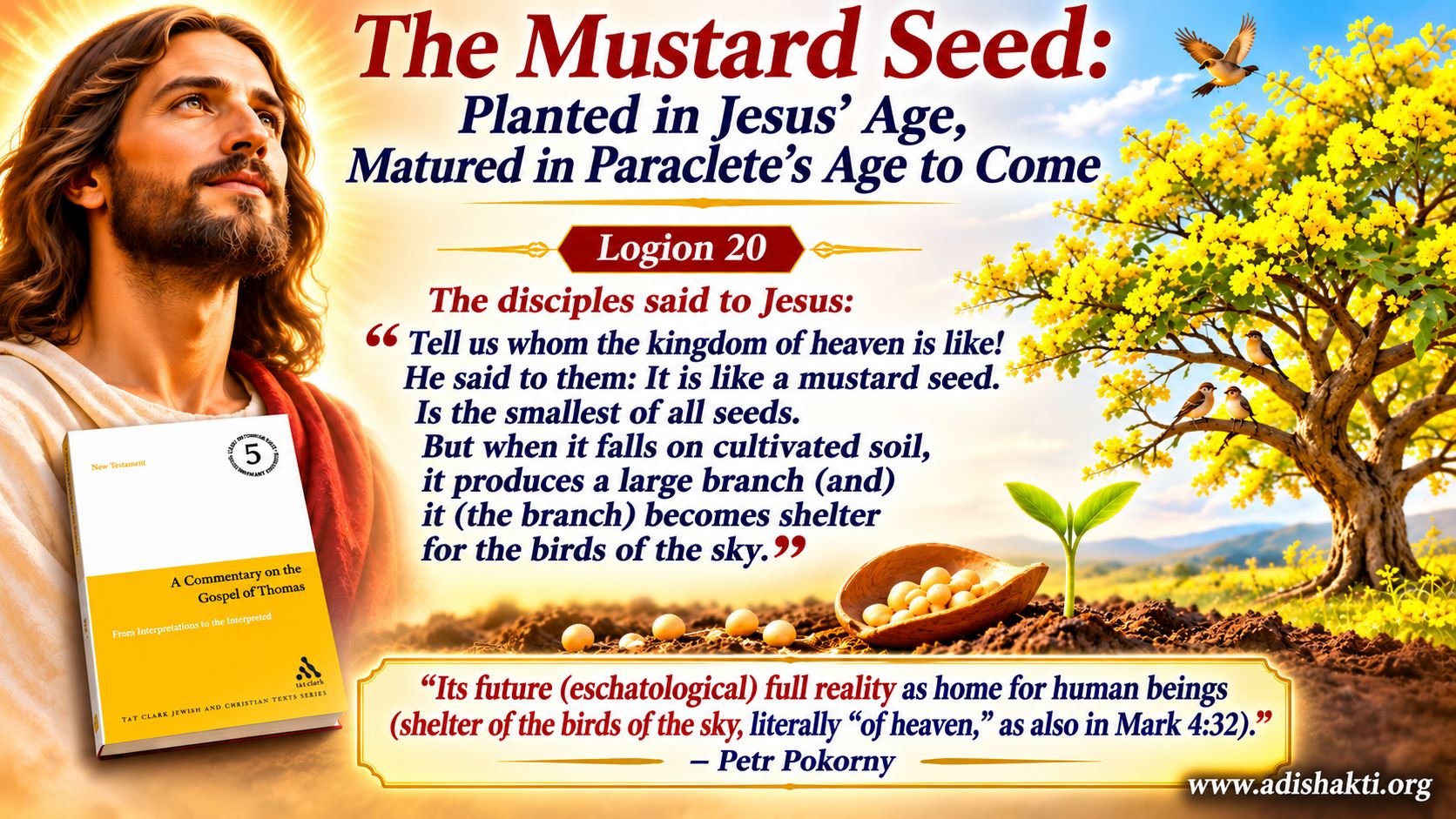
Jesus tells the disciples that the Kingdom of Heaven is like a mustard seed, “the smallest of all seeds.” The seed is not the full-grown tree; it is the beginning, the hidden potential of what will later become a shelter for the birds of the sky.
In this reading, the seed was planted at the time of Jesus. His life, death, resurrection, and teaching established the living seed of the Kingdom in human history. The Kingdom did not appear as an immediate political empire or a fully visible world-order. It began small, concealed, and easily dismissed, yet it carried within it the divine promise of a future cosmic fulfillment.
The “cultivated soil” therefore represents the receptive ground prepared for Jesus’ message: the disciples, the seekers, and all those who receive his word with faith. The seed is planted in that Age, but its complete growth is not confined to that Age. It extends forward into the eschatological fulfillment still to come.
From Present Seed to Future Tree
Petr Pokorný rightly emphasizes the contrast between the Kingdom’s “present small and seemingly insignificant status” and its “future (eschatological) full reality as home for human beings.” The mustard seed is the Kingdom in its seed-stage; the mature tree is the Kingdom in its final, universal form.
This distinction is essential. The Kingdom is already planted, but it is not yet fully mature. It is present as a living seed, but it awaits the Age to Come, when it will become the shelter of the “birds of the sky”—literally, the “birds of heaven.”
The birds are not merely decorative imagery. They represent the beings who will find refuge in the mature Kingdom: those who participate in the Resurrection and enter into eternal life. The tree does not exist for itself; it exists as a home, a refuge, and a destination for those who are being gathered into God.
The Age to Come
The parable therefore points beyond the immediate ministry of Jesus toward the Age to Come. In that future Age, the seed planted by Jesus reaches its full maturity. The Kingdom is no longer a small, hidden seed but a great tree whose branches offer shelter to the redeemed.
This eschatological reading gives the parable its full force. The Kingdom is not simply an inner feeling, a private mystical experience, or a present institutional reality. It is the divine reality that begins in time, grows through history, and reaches its fulfillment in the Resurrection and eternal life.
The “births of heaven” can be understood as the spiritual births by which human beings enter this future Kingdom. Those who take part in the Resurrection are those who have been born anew, transformed from the old order of mortality into the eternal life promised by Christ.
The Paraclete Sent in Jesus’ Name
The full maturation of the mustard tree is inseparable from the coming of the Paraclete. Jesus promises that the Paraclete will be sent in his name, continuing and completing the work he began. The Paraclete does not replace Jesus; rather, the Paraclete brings to fullness the seed Jesus planted.
In the teachings of Shri Mataji Nirmala Devi, this completion is understood as the awakening of the divine Spirit within the human being. The Paraclete completes the message of the Kingdom by making its inner reality accessible: the seeker is born anew, experiences the resurrection of the spirit, and begins the journey toward eternal life.
Thus, the mustard seed planted by Jesus reaches its maturity precisely in the Age when the Paraclete arrives. The Paraclete does not create a new Kingdom apart from Christ; the Paraclete brings to completion the Kingdom Christ inaugurated. The seed and the tree belong to one divine plan.
Resurrection and Eternal Life
The shelter for the birds of the sky is the final image of the parable, and it points directly to the Resurrection. Those who take part in the Resurrection are those who have passed from death into life, from the old order into the new creation.
In Shri Mataji’s teachings, this resurrection is not merely a future bodily event but a present spiritual transformation that anticipates and participates in the final resurrection. The seeker who receives self-realization experiences a birth from above, a rebirth into the divine life. This is the beginning of the “births of heaven” by which one enters the Kingdom.
The mature mustard tree, therefore, is the eschatological home of the resurrected. It is the Kingdom in its fullness, where those who have been born of the Spirit find eternal shelter. The parable does not end with the seed; it ends with the tree, the branch, and the shelter. This is the direction of the entire divine plan.
The Kingdom of God in Shri Mataji’s Lectures
Shri Mataji Nirmala Devi’s teachings repeatedly return to the Kingdom of God. An Amruta archive search for the phrase returns 1,077 search results, indicating the breadth and centrality of this theme across her recorded talks.
These lectures present the Kingdom as both a present inner reality and a future eschatological fulfillment. The seeker experiences the Kingdom now through self-realization, but this experience points toward the Age to Come, when the Kingdom will be fully realized as the eternal home of the redeemed.
The 1,077 search results therefore testify not to a single, uniform interpretation but to the persistent centrality of the Kingdom in Shri Mataji’s message. The Kingdom is the axis around which her entire teaching turns: from inner awakening to collective transformation, from the seed planted by Jesus to the tree that shelters the resurrected.
The Overriding Theme
The overriding theme of Logion 20, read in this eschatological key, is this: the mustard seed planted at the time of Jesus will reach its full maturation in the Age to Come, when the Paraclete sent in his name completes the message of the Kingdom and the Resurrection to eternal life.
The seed is Jesus’ planting. The cultivated soil is the receptive seeker. The large branch is the growth of the Kingdom through history. The shelter for the birds of the sky is the final home of those who take part in the Resurrection and enter the Kingdom of God. The Paraclete is the one who brings this plan to completion.
This is not a parable about a static inner state. It is a parable about a living, growing, eschatological reality: a Kingdom that begins in time, matures through the work of the Paraclete, and reaches its fulfillment in the eternal life of the Age to Come.
Conclusion
Logion 20 presents the Kingdom of Heaven as a mustard seed planted in the time of Jesus, destined to mature into a great tree that shelters the birds of the sky. In the teachings of Shri Mataji Nirmala Devi, this maturation occurs in the Age to Come, when the Paraclete sent in Jesus’ name completes the message of the Kingdom and the Resurrection to eternal life.
The parable’s true force lies in its eschatological horizon. It is not content with the seed alone; it points toward the tree, the branch, and the shelter. It is not content with the present Age alone; it points toward the Age to Come. And it is not content with inner awakening alone; it points toward the Resurrection and eternal life in the Kingdom of God.
References
- Pokorný, Petr. A Commentary on the Gospel of Thomas. T&T Clark, reprint edition, December 22, 2011, pp. 62–63.
- Bible Gateway, Luke 17:20–21.
- Bible Gateway, Luke 17:21, translation notes.
- Bible Study Tools, list of Jesus’ parables and Kingdom references.
- Bible Hub, Luke 13:18–19.
- Bible Gateway, Matthew 13:31–33, 44–52.
- Amruta archive search for “Kingdom of God,” 1,077 indexed lectures.