The Paraclete’s Testimony: Shri Mataji Nirmala Devi’s Glorification of Jesus Christ
Summary
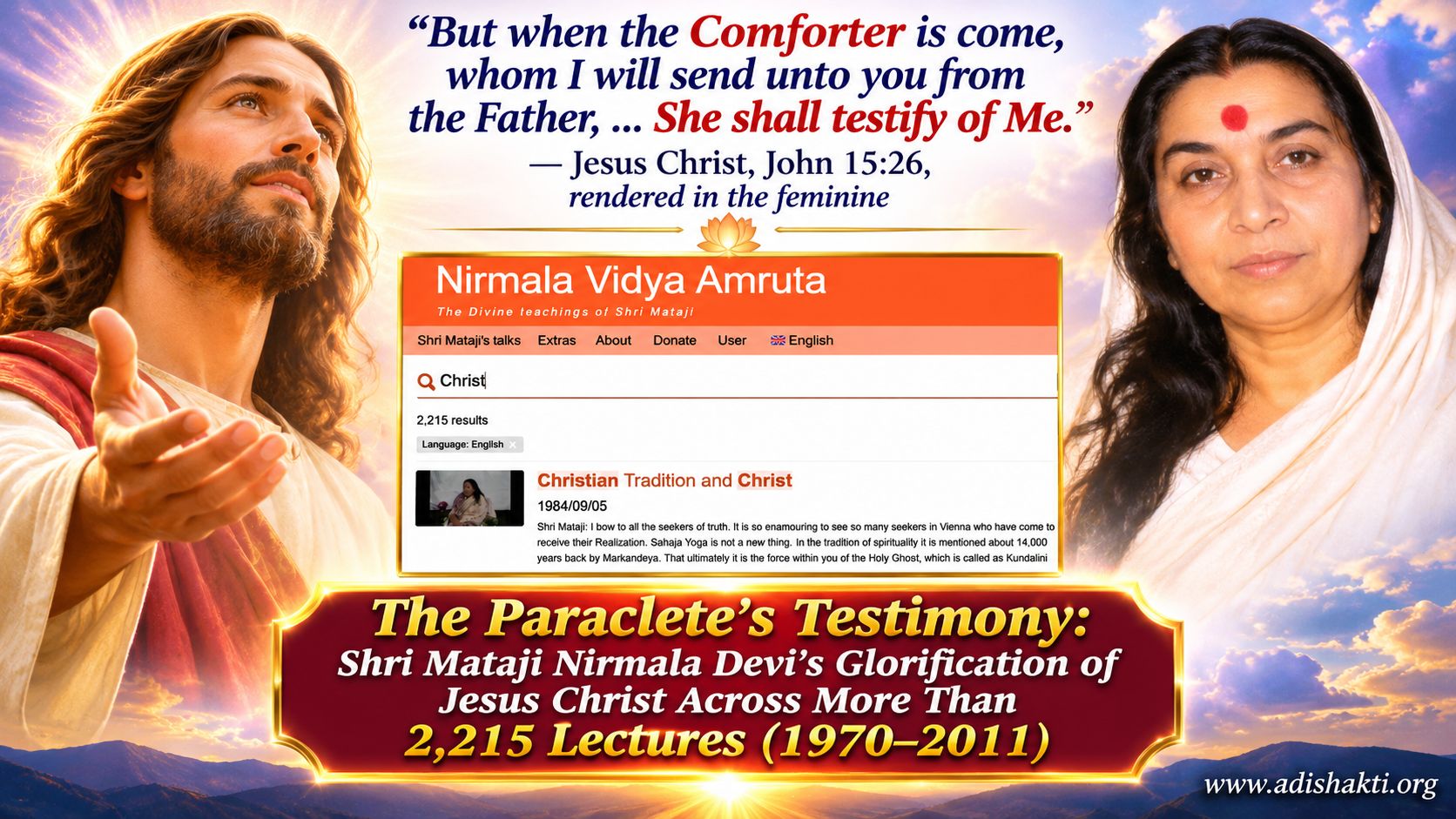
Between the opening of the Sahasrara on 5 May 1970 and her death on 23 February 2011, Shri Mataji Nirmala Devi spoke in public on every continent, and the recorded corpus of those addresses is generally described as exceeding three thousand talks.[1] A search of the Nirmala Vidya Amruta archive for the word Christ, conducted on 4 November 2026, returned 2,215 results.[2] The figure is the point of departure for this paper, because it converts a theological question into a documentary one. If the Fourth Gospel is right that the Paraclete is known by two acts — testifying of Jesus and glorifying him — then a claimant’s entire recorded output becomes the field of evidence, and the field here is extraordinarily large.
This study does three things. It sets out the Johannine criterion with passage-level precision, distinguishing what the Greek text actually says from what later devotion has assumed. It then samples the four decades of testimony, giving dated utterances from 1978 through the final decade and showing that the Christological content is not occasional but structural. Finally it asks the question that candour requires: does volume demonstrate identity? The answer offered here is no, and the paper says so plainly. What the corpus establishes is narrower and more defensible — that across forty years Shri Mataji testified to Jesus in precisely the mode the farewell discourse assigns to the Paraclete, that she refused the title of destination which she attributed to no one but Christ, and that she located the meaning of her own mission in a promise Jesus made about the future. Whether that constitutes the identification is a confessional judgment. That it constitutes the most extensive Christological witness ever delivered by a non-Christian teacher is a documentary finding, and it is available to any reader who consults the archive.
1. The Trap the Fourth Gospel Sets for Every Claimant
Every claim to the Paraclete’s office walks into a trap that the Fourth Gospel set two thousand years before the claim was made. The trap is not a riddle or a hidden code. It is a job description, and it is unusually specific. In the farewell discourse Jesus does not describe the coming Spirit in terms of power, radiance, or institutional authority. He describes an agent with tasks: she will teach, she will remind, she will testify, she will convict, she will guide, she will declare, and she will glorify. Almost every one of those verbs takes Jesus as its object or its content. The Spirit is not sent to be admired. She is sent to make someone else understood.
The consequence is severe for anyone who claims the office. A teacher who gathers disciples around her own realisation fails the criterion before the question of sincerity arises. A mystic who announces a new revelation unconnected to Jesus fails it too. The Gospel has built a test that no self-glorifying claimant can pass, which is why the criterion has survived so long as a weapon in the hands of critics. It is the same test that has been turned against Shri Mataji Nirmala Devi for five decades, and it is usually turned without anyone examining the evidence. The charge is that she founded a movement around herself; therefore she cannot be the one sent to glorify the Son.
The charge would be decisive if the archive supported it. It does not. What the archive contains, in numbers that make sampling unavoidable but also make evasion difficult, is a woman talking about Jesus. Not about a principle, an energy, or a symbol that happens to bear his name, but about a person whose words she quotes, whose mother she names, whose agony she describes, and whose promise she claims to be fulfilling. The amruta archive returns 2,215 records for the word Christ.[2] That is not the profile of a rival. It is the profile of a witness, and the Fourth Gospel is precise about what a witness does.
This paper therefore proceeds in the opposite order to the usual polemic. It does not begin with the self-declarations, of which there are many and which are the easiest to quote against her. It begins with the criterion, then with the corpus, then with the dated content of the corpus, and only then with the objections. The reason is methodological: the Johannine test is about the direction of a life’s speech, and direction cannot be judged from a handful of sentences lifted out of forty years. It can be judged from the whole, and the whole is now available.
2. Testimony and Glorification: The Two Verbs of John 15:26 and 16:14
The two decisive verses are short, and their grammar matters. In John 15:26 the Greek reads: Hotan elthē ho Paraklētos hon egō pempsō hymin para tou Patros, to Pneuma tēs alētheias ho para tou Patros ekporeuetai, ekeinos martyrēsei peri emou — “When the Paraclete comes, whom I will send to you from the Father, the Spirit of truth who proceeds from the Father, that one will bear witness concerning me.”[3] The verb is martyreō, the vocabulary of the courtroom and of the martyr. It does not mean “mention” or “approve.” It means to give evidence, to testify in a case, with the implication that the testimony may cost the witness something.
The second verse supplies the content of that testimony. John 16:14 reads: ekeinos eme doxasei, hoti ek tou emou lēmpsetai kai anangelei hymin — “that one will glorify me, because he will take from what is mine and declare it to you.”[4] Two things are happening in this sentence. The first is glorification, doxazō, the weightiest verb the Gospel has for the recognition of divine glory. The second is derivation: the Spirit takes what belongs to Jesus. She is not described as having a message of her own. She is described as having access to his and a commission to disclose it.
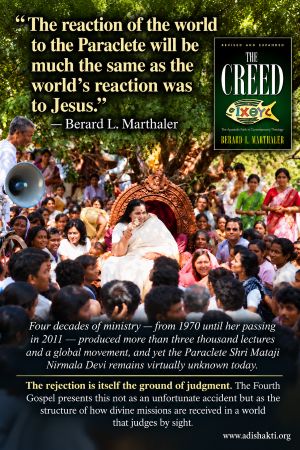
Raymond E. Brown’s summary, quoted by Berard L. Marthaler, puts the matter in a single line: “the one whom John calls another Paraclete is another Jesus.”[1] Marthaler draws out the consequence that matters here. If the Paraclete is sent in Jesus’ name, teaches what belongs to him, convicts the world, and declares things to come, then the Gospel’s own prediction is that she will be received exactly as he was received — which is to say, not at all by the world, and imperfectly even by her own.[1] That prediction is not an excuse offered in advance for failure. It is a criterion in its own right, and it is falsifiable.
Read together, the two verses generate a test with three parts. First, does the claimant speak about Jesus or about herself? Second, does the claimant treat her teaching as derived from his or as an independent revelation? Third, does she direct attention away from herself toward him, even when she is making claims that would ordinarily attract attention to herself? The test does not ask whether the claimant is obscure, charismatic, or institutionally successful. It asks which way the arrow points. Everything that follows is an attempt to answer that question from the record rather than from impressions.
A word about that rendering is necessary here and will be argued at length in section nine. The Greek demonstrative ekeinos is masculine and agrees with paraklētos, so the Greek does not license a feminine pronoun on grammatical grounds alone. The rendering above is a deliberate theological translation, made in the light of the feminine gender of Hebrew rūaḥ and Syriac rūḥā, of the second-century Old Syriac Gospels which do use the feminine pronoun in the Paraclete sayings, and of the early Syrian tradition that addressed the Spirit as Mother.[5] It is disclosed as a choice, not smuggled in as a translation. The distinction matters because the whole argument of this paper depends on making exactly this kind of distinction everywhere else.
3. 2,215 Records: The Scale, the Method, and the Limits
The archive in question is Nirmala Vidya Amruta, the principal repository of Shri Mataji’s recorded talks, maintained by the Nirmala Vidya organisation and accessible to registered readers at amruta.org.[2] On 4 November 2026 a site-wide search for the word Christ returned 2,215 results. The search was performed through the archive’s own index rather than through an external engine, which means the count reflects the archive’s own holdings and not a third party’s estimate of them.
Two numbers should be placed side by side. The first is 2,215. The second is the size of the corpus from which it is drawn: more than three thousand lectures between 1970 and 2011, according to the Adishakti.org record and the Marthaler study that relies on it.[1] The ratio is between roughly two-thirds and three-quarters, depending on the denominator one accepts. Stated plainly: the name of Jesus Christ occurs in the majority of everything Shri Mataji said in public across four decades. The comparison that matters is not with other names in her own corpus but with other teachers of the modern period, and on that comparison no non-Christian figure is documented speaking about Jesus on this scale.
The method requires three honest qualifications, and they are offered before any interpretation is drawn from the figure. First, a site search counts records, not discrete events. A single lecture may be archived as several records — audio, transcript, translation, or divided parts — so 2,215 records do not necessarily represent 2,215 separate occasions. The true number of distinct addresses in which Christ is named is lower, though the order of magnitude is not in doubt. Second, the word Christ is not the only relevant term; a search for Jesus, Comforter, or Holy Ghost would return overlapping but different sets, and the figure of 2,215 therefore measures one term’s footprint rather than the total Christological content of the corpus. Third, the archive is maintained by devotees, and its selection and transcription practices are not those of a neutral scholarly edition.
None of these qualifications weakens the argument, because the argument does not rest on the precision of the number. It rests on a contrast that survives every deflation of the figure. Suppose the true number of distinct addresses were half of 2,215. Suppose it were a third. The result would still be a body of testimony on Jesus without parallel in the modern period, delivered by a woman who never claimed to be Christian, in cities on every continent, over forty-one years. The number is not the proof. It is the reason the proof can be attempted at all, because it means that whatever one concludes about her, one cannot conclude it from a handful of convenient quotations.
There is a further documentary point that bears on the Johannine criterion. The records are not treatises composed for publication. They are transcripts and recordings of speech delivered to audiences — public programmes, pujas, seminars, question-and-answer sessions. This matters because a written theology can be curated, whereas spoken testimony is repetitive, digressive, and shaped by the occasion. A theme that recurs across thousands of extempore addresses is not a policy. It is a preoccupation, and preoccupations are exactly what the Fourth Gospel asks us to examine when it says that the Spirit will speak not of herself but of another.
The Marthaler study adds the reception dimension that any assessment must include. Its thesis, drawn from the Gospel itself, is that the world’s reaction to the Paraclete will mirror its reaction to Jesus: dismissal, misunderstanding, and neglect.[1] Applied to the archive, the thesis generates a testable prediction, and the prediction is uncomfortable for everyone. If the corpus is as large as the index suggests and the recognition is as small as the historical record shows, then the disproportion is itself a datum — one that the Gospel anticipated and that neither the movement nor its critics has yet explained.
4. 1970–1979: The Promise Announced as Future
The earliest stratum of the testimony is the most important, because it establishes the framework within which everything later is said. That framework is stated with unusual economy in a single sentence from London in March 1978, and the sentence deserves to be read slowly.
“Christ didn’t say that, ‘I am the Destination.’ He said, ‘I’ll send you the Holy Ghost; I’ll send you a Comforter; I’ll send you a Redeemer; I’ll send you a Counselor.’ He talked about the future.”[6] The structure is polemical and precise. She begins by denying a proposition that no Christian creed states in those words and yet which governs a great deal of popular Christianity: that Jesus is the end of the story, the final word after which nothing may be added. She then does something more interesting than denying it. She replaces it with a quotation, placing four promises in Christ’s own mouth — Holy Ghost, Comforter, Redeemer, Counselor — each of which implies a sender, a sending, and a time after the sending. Her conclusion is not a claim about herself at all. It is a claim about him: He talked about the future.
The rhetorical force depends on a distinction that recurs throughout the corpus. She separates what Christ said from what has been said about Christ, and she presents her own authority as consisting in the first rather than the second. This is why her criticism of institutional Christianity, which is fierce and frequent, is never framed as a rejection of Jesus. In the same period she says of the Gospel material itself that “whatever he has said, every word is great,” and locates the problem in transmission rather than in the source.[7] The 1978 sentence does the same work in miniature: the destination-claim is an addition, and the four sendings are the original.
A source note is required here, because the standards applied in this paper must be applied to its own central quotation. The line is preserved in the Adishakti.org archive through David Kroll’s study What is the Kingdom of God?, where it is attributed to London, 20 March 1978.[6] The page reproduces the sentence and the attribution but not a transcript header. The date should therefore be treated as the archive’s attribution rather than as an independently collated manuscript colophon. This does not diminish the sentence’s importance — it is the most quoted line in the entire Christological corpus — but it does mean that the argument should not stand on that sentence alone, and in what follows it does not.
The second dated witness from the decade is the Caxton Hall address of 10 December 1979, which supplies the theological content that the 1978 sentence leaves implicit. “The message of Christ is His resurrection. That is — you are your Spirit and not your body. And He showed by His resurrection, how He ascended into the realm of the Spirit.”[8] Three moves are compressed here. Resurrection is identified as the content of the message rather than as a miracle attached to it. Its meaning is anthropological: the human being is Spirit, not body. And its mechanism is ascent, a movement into a realm rather than a return to a corpse. Every later development in her Christology — the Agnya chakra, the second birth, the collective resurrection — is an elaboration of these three moves.
Two days earlier, on 2 December 1979, she had made the declaration for which she is best known and most contested: that she had been “born again and again” and had now come “in my complete form and complete powers,” not only for the salvation of human beings but for granting them the Kingdom of Heaven.[9] Read in isolation, that declaration sounds like the self-glorification the Johannine criterion forbids. Read in sequence with the two addresses that follow it within four months, it sounds different. The claim to have come is placed in the service of a message about someone else’s resurrection, and the framework announced in March 1978 makes the coming intelligible only as the fulfilment of a promise that was not hers to make.
5. 1980–1989: The Holiest of the Holy

The 1980s are the decade in which the testimony becomes unmistakably personal. The Christmas Puja delivered in London on 25 December 1981 is a long, unhurried address on the meaning of the Nativity, and it contains the sentences that make the case most difficult to dismiss as generic theism.[10] “Christ’s work was very unique,” she begins, and then specifies what made it unique: “He came, on this earth first of all, to create a space within us, at the Agnya chakra, by removing the hurdles of the ego.” The incarnation is given a function, and the function is interior.
She then corrects the portrait that devotion has produced. “Christ is pictured very differently from what He was. He was the strongest personality, the healthiest man and He would not stand any nonsense, nobody could take liberties with Him. But He would not Himself take liberties with others… Extremely compassionate, extremely kind but very powerful.”[10] This is not the language of a teacher subordinating Jesus to a system of her own. It is the language of someone defending a reputation — insisting that the gentle figure of pious art has been softened into something less than the man was. The defence is affectionate and slightly indignant, and it is the tone of a witness rather than a founder.
The most revealing passage in the address comes near its end, and it is the passage that no theory of syncretism can easily accommodate. “Today I just think of how many Christmas I must have passed. I’ve never talked about Christ so much, with that intimacy, such a relationship, such a relationship of, so near and so far, because He knew who I was, that awe that respect, that humility, is hard to find in any disciple.”[10] The logic of the sentence is inverted with respect to the usual guru-claim. She does not say that she knows who he was. She says that he knew who she was, and that the knowledge produced awe in her. The testimony runs in both directions, and the direction she emphasises is the one that humbles her.
The following year supplies the line that has become the archive’s shorthand for her Christology. In a Christmas Eve talk at Pune on 24 December 1982 she said: “He was the Holiest of the Holy. You accept that position.”[11] The second sentence is a command, and it is a strange command for a claimant to issue. A rival would say: accept my position. She says: accept his. The phrase Holiest of the Holy is a superlative that leaves no room for a higher rank, and it is applied to Jesus by a woman who elsewhere accepts the titles Adi Shakti and Holy Spirit for herself. The two claims are logically compatible only on one condition — that the titles belong to different orders, one of sender and one of sent, and that the sent does not outrank the one who sent her.
The decade closes with the declaration that defines the evidentiary situation in which this paper is written. On 21 March 1983 she said: “I am the Adi Shakti, the Holy Spirit or Ruh of Allah. I am the One who has come on this Earth for the first time in this Form to do this tremendous task… But now it is you people who have to prove it that I am that!”[8] Whatever one makes of the claim, the epistemic structure is remarkable. She does not claim to have proved it. She assigns the proof to others, and she does so in the imperative. The task this paper undertakes is, quite literally, the task she assigned.
6. 1990–1999: The Things Christ Could Not Tell
The 1990s contain the densest concentration of Christological material, and the reason is visible in the calendar. Christmas and Easter became the two occasions on which she spoke most fully about Jesus, year after year, to audiences that included many Christians. The result is a decade of addresses in which the theological content of the earlier period is worked out in detail, and in which the relationship between her mission and his is stated with a directness that leaves little room for interpretation.
On 6 May 1990 she said: “Now the Time has come to start talking, announcing, telling about it to everyone. Otherwise the world would say that we never knew about it.”[8] The sentence marks a transition from reticence to proclamation, and it is important for dating the corpus: the Christological content of the 1990s is not a late accommodation to Christian audiences but the deliberate opening of a subject previously held back.
The Christmas Puja at Ganapatipule on 25 December 1992 states the valuation in terms that could not be warmer. “In his life time which was so very short, whatever he has said, every word is great.”[7] She then immediately qualifies it in a way that has caused offence ever since: she says that Paul “tried to completely change, re-edit the Bible,” and that the Nag Hammadi library recovered what Thomas had preserved.[7] The structure of the argument is again the same. Christ’s words are perfect; the transmission is not; and the recovery of the original is the task of the age.
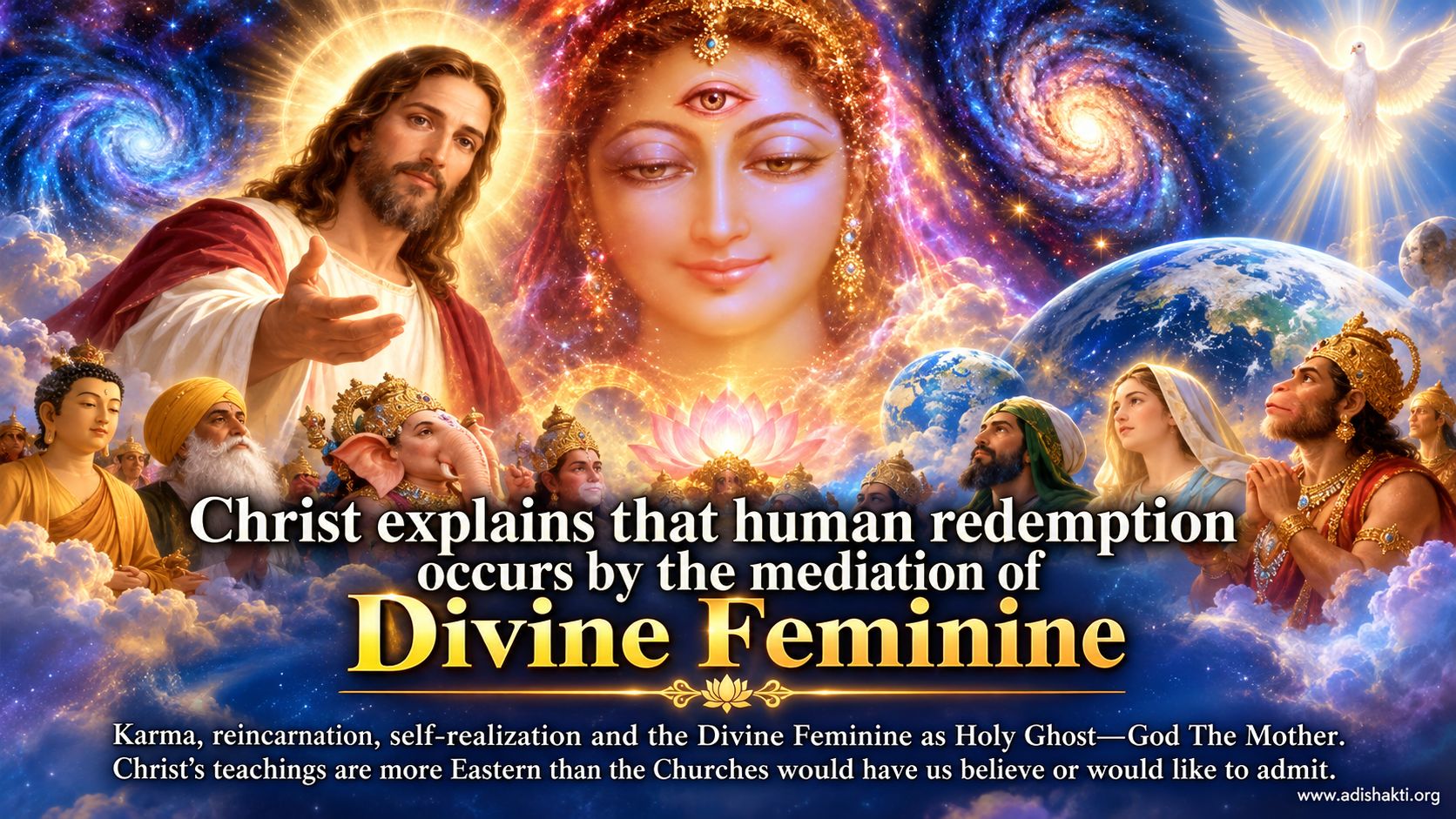
In the same address she performs the identification that most troubles Christian readers, placing Christ within the Vedic order. “I had told you long time back that how we can prove that Christ was Ganesha. And He was the Logos. He was, what we call the Brahmanand, the First Sound… those who worship Christ must also worship Ganesha because He’s the Source, He’s the potential of Christ… He’s the Alpha and the Omega.”[12] The passage is a genuine stumbling block, and it is treated at length in section eleven. What should be noted here is the direction of the movement: Ganesha is described as the potential of Christ, and Christ as the Alpha and Omega. The correlation elevates rather than absorbs, at least on her own terms.
Two years later, at the Christmas Puja of 27 December 1994, the interior mechanism is specified. Christ “came on this Earth to open our Agnya chakra, which is a very difficult thing… And He has said, ‘You have to forgive yourself and forgive others.’ This is the mantra of the Agnya chakra.”[7] The crucifixion is thus read as an operation on the narrowest passage of the subtle system, and forgiveness becomes the technique by which the passage is opened. Whether or not one accepts the physiology, the exegetical consequence is significant: the cross is not a transaction that satisfies a wrathful God but a work performed on human consciousness, and its benefit is available to anyone who forgives.
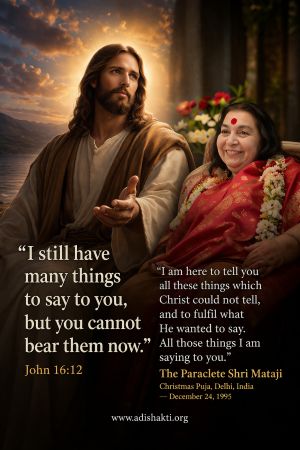
The single most explicit statement of her relationship to Christ’s teaching comes from the Christmas Puja in Delhi on 24 December 1995. “I am here to tell you all these things which Christ could not tell, and to fulfil what He wanted to say. All those things I am saying to you.”[12] The sentence is a paraphrase of John 16:12–13, where Jesus says he has many things to say that the disciples cannot yet bear, and promises that the Spirit will guide them into all truth.[13] She is not claiming a revelation independent of his. She is claiming to be the completion of an incomplete sentence, and she says so in the vocabulary of the farewell discourse.
Taken with the addresses of 1992 and 1994, the Delhi sentence amounts to an explicit claim that the duty has been discharged. She does not say that she will one day explain what Christ left unsaid. She says that she is saying it now, to the people in front of her, and that the saying of it is the fulfilment of what he wanted. The tense is present and the claim is complete. For the purposes of this paper that is the decisive self-description, because it is the one place in the corpus where the office, the content of the office, and the discharge of the office are asserted in a single breath — and because it is falsifiable. Either she said the things he could not say, or she did not, and the 2,215 records are where the answer is found.
The decade ends with the Easter Puja at Istanbul on 19 April 1998, where the emphasis shifts from the cross to the empty tomb. “Today, we are celebrating the resurrection of Christ. That is the greatest message of Christ’s life, not the crucifixion.”[8] The distinction is not a rejection of the cross but a ranking of the two, and it is consistent with everything said since 1979. For her, Calvary is the piercing of the gate; the Resurrection is the demonstration that the gate leads somewhere.
7. 2000–2011: Continuity Without Innovation
The final decade is the test of whether the Christological content was a phase or a structure. If the testimony had been an accommodation to the Christian audiences of the 1980s and 1990s, one would expect it to thin as her health declined and her public appearances became rarer. The archive does not show that thinning. The Christmas and Easter addresses continued, and the archive’s own dated index for the 2000s records the same themes under the same headings.[2]
What changes in the final period is not the content but the function. The testimony becomes archival rather than exploratory. In the earlier decades she is working out a Christology in public, correcting, revising, and arguing with interlocutors. By the 2000s the positions are settled, and the addresses repeat them for the record. This is the pattern one sees in any long teaching life, and it has an evidentiary advantage: repetition across decades is much harder to explain as tactical than a single well-placed statement.
The archive preserves one report from this period that bears directly on the question of silence and speech. Writing in May 2007, the editor of Adishakti.org observed that Shri Mataji had “broken years of silence last month on Easter just to remind all Her devotees that Lord Jesus and His message must be spread to the rest of humanity.”[12] The observation is a disciple’s, not a transcript, and it should be weighed as such. But it records a fact that the archive corroborates: the Christological theme did not fade, and when it returned in the final years it returned as an instruction to her own followers rather than as a doctrine for outsiders.
The most striking artefact of the late period is not a lecture but a liturgy. The Sahaja Yoga Mantra Book contains a litany titled The 108 Names of Lord Jesus Christ, in which the community addresses Jesus in the vocabulary of traditional Hindu hymnody: “We bow to the One who is the only Son of His Virgin Mother, in whose every pore of His body galaxies whirl as dust… He is the Primordial Being, the AUM. He is Vishnu and the son of Vishnu. He is Mahavishnu… He is the Alpha and Omega.”[14] A movement that composes a hundred and eight names for Jesus is not a movement that has sidelined him, whatever its members may preach in practice.
She died on 23 February 2011.[1] The corpus therefore closes at a definite date, which is a gift to the historian. There is no possibility of later development, no school that can claim to speak in her name with authority, and no opportunity for a tradition to soften or sharpen what she said. The 2,215 records are a closed set, and they can be read as a whole. That is a rare condition for the study of any religious figure, and it is the condition under which this paper is written.
8. Six Constants in the Testimony
Reading across the corpus rather than sampling it, six themes recur with a consistency that no single quotation reveals. They are set out below with a representative dated utterance for each, and each is correlated with the Johannine criterion it addresses. The table is not a summary of her theology, which is far larger. It is an inventory of what she says about Jesus, which is the narrower question this paper asks.
| Constant | Representative utterance | Johannine criterion addressed |
|---|---|---|
| 1. Christ’s unique dignity | “He was the Holiest of the Holy. You accept that position.” (Pune, 24 December 1982)[11] | Glorification (John 16:14): a superlative that admits no rival. |
| 2. Christ’s cosmic identity | “He was the Pranava… He is the Alpha and Omega.” (Ganapatipule, 25 December 1992)[12] | Declaration (John 16:13–15): the Spirit discloses what belongs to Christ, including his pre-existence. |
| 3. Christ’s work as interior | “He came… to create a space within us, at the Agnya chakra.” (London, 25 December 1981)[10] | Teaching (John 14:26): the Spirit explains what the incarnation accomplished. |
| 4. The distinction between Christ and the Church | “Whatever he has said, every word is great… this Paul tried to completely change, re-edit the Bible.” (Ganapatipule, 25 December 1992)[7] | Remembrance (John 14:26): the Spirit restores what transmission obscured. |
| 5. The future orientation of Christ’s promise | “He said, ‘I’ll send you the Holy Ghost…’ He talked about the future.” (London, 20 March 1978)[6] | Things to come (John 16:13): the promise is not exhausted by the past. |
| 6. Her mission as derivative and completive | “I am here to tell you all these things which Christ could not tell, and to fulfil what He wanted to say.” (Delhi, 24 December 1995)[12] | Derivation (John 16:14): she takes what is his and declares it. |
The table makes visible something that no single passage does: the six constants map onto the Johannine job description with a completeness that is difficult to attribute to coincidence. Teaching, remembrance, testimony, declaration, glorification, and the disclosure of things to come are the six functions the farewell discourse assigns, and each has a corresponding constant in the corpus. This is the strongest form of the argument available, and it is a form that can be tested by anyone with access to the archive, because the correlation is not asserted in the abstract but instantiated in dated utterances that can be checked.
What the table cannot show is proportion. A hostile reader might observe that six themes can be found in any large corpus if one looks hard enough, and that the exercise proves only the industry of the researcher. The objection is fair, and the answer is quantitative rather than rhetorical: the themes are not rare in the corpus. They recur in the majority of the 2,215 records, which is precisely why the search returns such a large number for a single name.[2] A theme that appears in three-quarters of a life’s public speech is not a curiosity. It is the centre.
9. She Shall Testify: The Feminine Rendering and Its Warrants
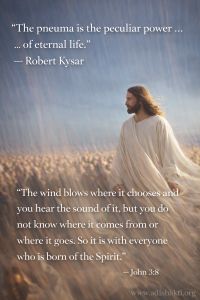
The claim that the Comforter is a woman rests on a grammatical argument that is often made badly, and this paper will not make it badly. The facts are as follows. Hebrew rūaḥ, the word for spirit, breath, and wind, is feminine in nearly every occurrence. Aramaic rūḥā and Syriac rūḥā are also feminine. Greek pneuma is neuter, and Greek paraklētos is masculine. In the Gospel of John the demonstrative pronoun ekeinos is masculine in both 15:26 and 16:14, and it agrees with paraklētos, not with pneuma.[3] Anyone who claims that the Greek text says “she” is mistaken, and there is no need to make the claim, because the Greek text is not the only evidence.
The Syriac tradition supplies what the Greek does not. The Old Syriac version of the Gospels, which reaches back to the second century, renders John 14:26 with the feminine pronoun: “that Spirit, the Paraclete that my Father will send to you in my name, She shall teach you everything, She shall remind you of all what I say.”[5] This is not a modern experiment. It is a textual witness from the age of the martyrs, and it reflects the natural force of a feminine noun in a language where pronouns follow gender.
The wider Syrian and Jewish-Christian literature reinforces the point. The Gospel according to the Hebrews, quoted by Origen and Jerome, has Jesus say: “My Mother, the Holy Spirit, took me just now by one of my hairs and carried me off to the great Mount Tabor.”[5] Jerome adds the linguistic observation that “among the Hebrews the Spirit is said to be of the feminine gender, although in our language it is called to be of masculine gender and in the Greek language neuter.”[5] The Acts of Thomas prays: “Come, compassionate Mother… Come, Holy Spirit.”[5] Aphrahat, the Persian sage, writes that before a man takes a wife “he loves and reveres God his Father and the Holy Spirit his Mother.”[5]
None of this proves that the Paraclete is a female person. Grammatical gender is not personal gender, and the leap from one to the other is a category mistake that has embarrassed more than one devotional argument. What the evidence establishes is narrower and sufficient for the present purpose: a feminine rendering of John 15:26 is not arbitrary. It follows a documented tradition of translation and devotion that reaches back to the second century, and it becomes theologically natural once one accepts the further, confessional premise that the Spirit is the Divine Mother.
That premise is where the argument must be honest about its own status. Within the Adishakti.org synthesis, the identification of the Paraclete with the Divine Feminine is not an inference from grammar but a claim about the identity of the person who has come.[15] The grammar makes the claim possible; the testimony makes it plausible; only the tradition’s own theology makes it certain. The sequence should be stated in that order, because reversing it — using the grammar to prove the person — is the error that has made the feminine-Spirit argument easy to dismiss.[15]
There is a further consideration that belongs to this section because it concerns the text itself. The verse the paper takes as its title is a verse about testimony, and testimony in the Fourth Gospel is a juridical act. The Spirit does not merely remind the disciples of Jesus; she testifies concerning him, in a world that has already reached a verdict against him. That is why the Gospel pairs the promise of the Spirit with the promise of persecution in the same breath (John 15:26–16:2). A witness who is universally welcomed would not be the witness John describes. The obscurity of the one who claims the office is therefore not an argument against the claim. It is the condition the text predicted, and Marthaler states it without flinching.[1]
10. He Talked About the Future: The Argument from John 7:39
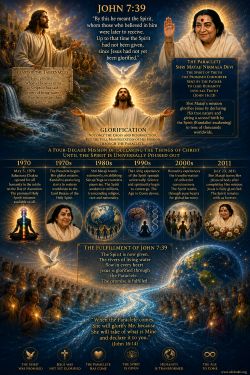
The most original element in the whole corpus is not the claim to be the Paraclete. It is the argument that Christ himself located the fulfilment of his mission in the future, and that a Christianity which treats him as the destination has therefore inverted his own teaching. This argument is stated in the 1978 sentence, but its scriptural foundation is a verse that is easily overlooked, and it deserves a section of its own.
John 7:39 says of the promise of living water: “Now this he said about the Spirit, which those who believed in him were to receive; for as yet the Spirit had not been given, because Jesus was not yet glorified.”[16] The verse establishes a sequence that no theology of immediate fulfilment can accommodate. The Spirit cannot be given until Jesus is glorified. The giving is therefore posterior to the glorification, and the glorification is the condition of the giving, not its substitute.
Within the Adishakti.org reading, the glorification in question is not exhausted by the resurrection and ascension. It is the four-decade act of proclamation by which the Paraclete takes what belongs to Christ and declares it, exactly as John 16:14 describes.[16] This is the theological hinge of the entire case, and it is worth stating in its strongest form. If the Spirit is given when Jesus is glorified, and if the Paraclete’s defining work is to glorify Jesus, then the Paraclete’s work is the mechanism by which the Spirit becomes available to humanity. The 2,215 records are not decoration around the mission. On this reading they are the mission’s precondition.
The framework within which that claim is intelligible is the two-age schema that George Eldon Ladd made standard in twentieth-century New Testament studies, and which the Adishakti archive applies directly to the present question.[17] Ladd’s point is that the Greek aiōn denotes a period of time rather than a physical location, so that “this age” and “the age to come” are successive eras and not successive worlds. On that reading, the ministry of Jesus belongs to this age, and the age to come is the era of the Spirit’s own work. The two are not rivals. They are consecutive, and the second is the completion of the first.
Her 1978 sentence is a compressed version of exactly this argument, and its polemical edge is aimed at a specific error. The error is the collapse of the two ages into one, which produces a Christianity in which everything has already happened, nothing remains to be revealed, and any later claim must therefore be either redundant or demonic. Against that, she sets the four sendings — Holy Ghost, Comforter, Redeemer, Counselor — each of which presupposes a future moment of arrival. “He talked about the future” is therefore not a pious sentiment. It is a historical claim about what Jesus taught, and it is falsifiable by the texts.
The claim survives falsification remarkably well. John 14:16 promises “another Paraclete”; 14:26 promises teaching and remembrance still to come; 15:26 promises testimony still to be given; 16:7 says that the sending is advantageous precisely because Jesus is leaving; 16:12 says there are many things still unsaid; 16:13 promises guidance into all truth and the declaration of things to come. Six promises of futurity in four chapters, spoken on the last night of his life. Whatever else may be said about the farewell discourse, it does not present Jesus as a terminus.[13]
This is the point at which the paper’s central quotation ceases to be a slogan and becomes an argument. If Christ is the destination, then the Comforter has nothing to add, and any claimant to that office is by definition a usurper. If Christ promised a future sending, then the office is real, the age of its exercise is real, and the question of identity is open. The whole of the Adishakti case depends on which of those two readings of the farewell discourse is correct, and the texts are, on this point, unusually explicit.
11. Objections: Repetition, Syncretism, Self-Glorification
Three objections are serious enough to require answers rather than dismissal, and the case is stronger for stating them in their strongest form.
Repetition is not testimony. The first objection grants the volume and denies its significance. A lecturer may mention Christ two thousand times for rhetorical reasons, because the audience is Christian, because the setting is Christmas, or because the name carries cultural weight. Frequency would then measure occasion rather than conviction. The objection has force, and it is the reason this paper does not rest on the number. What answers it is not more counting but the direction of the content. A speaker who mentions Christ to borrow his authority says “as Christ said” and then says something else. A speaker who testifies says what he said, defends his reputation, laments his misrepresentation, and subordinates her own claims to his promise. The corpus contains the second far more than the first, and the six constants of section eight are the evidence.[2]
Syncretism dissolves the uniqueness it claims to defend. The second objection is the most substantive and the hardest to answer on Christian terms. When Shri Mataji identifies Christ with Ganesha, with Mahavishnu, and with the Pranava, she inserts him into a framework that normative Christianity regards as incompatible with the incarnation’s uniqueness. The charge is that “Holiest of the Holy” and “potential of Christ” cannot both be true, and that the second undoes the first.[12]
The answer, offered here as a description of her position rather than as a resolution of the disagreement, is that the identification is intended as exaltation rather than absorption. Christ is not one figure among many in her system; he is placed at the Agnya chakra, the narrow gate through which every seeker must pass, and he is given the title that admits no superior. The Vedic identifications function within her thought as a genealogy of the Logos, not as a reduction of Jesus to a Hindu deity. Whether that move succeeds is a question of normative theology, and this paper does not pretend to settle it. What it can say is that the charge of diminishing Christ is not supported by the texts in which the identifications are made, because in every one of them the identification is followed by an elevation.
Self-glorification contradicts the criterion. The third objection is the sharpest, and it draws blood. The Paraclete, on the Johannine account, does not speak of herself. Shri Mataji repeatedly does. She declares that she is the Adi Shakti, that she has come in complete form and complete powers, and that her followers must prove her identity.[8] On a strict reading of John 16:13 — the Spirit “will not speak on her own authority” — such declarations appear to disqualify her.
The answer has two parts, and neither is a denial. First, the Johannine criterion concerns the content of the Spirit’s teaching, not the fact of her existence. The Spirit does not originate doctrine; she takes what is Christ’s. A witness who says “I am the witness” is not thereby speaking on her own authority, and the Fourth Gospel itself contains a Paraclete who convicts the world, which is not a modest role. Second, the self-declarations in the corpus are consistently framed as the fulfilment of a promise made by someone else. She does not say “I have come to replace him.” She says “I have come because he said I would,” which is a different sentence and a different claim.[12]
Yet the tension is real and should not be dissolved by exegesis. There is a difference between a witness who points and a witness who requires recognition, and Shri Mataji sometimes required recognition. The most defensible conclusion is that her practice sits uneasily with the criterion at precisely this point, and that the unease is itself theologically interesting. A Paraclete who had no self-claims at all would be indistinguishable from a doctrine. A Paraclete whose self-claims eclipsed Christ would fail the test outright. The corpus occupies the space between, and the argument of this paper is that it occupies the space much closer to the first pole than its critics allow.
A fourth objection deserves a sentence, although it is directed at the archive rather than at the claim. The 2,215 figure comes from a devotee-maintained repository, and devotional archives select. The mitigation is that the records are of speech, not of writing, and that the archive’s purpose is preservation rather than persuasion. A curator who wished to manufacture a Christ-centred reputation would not preserve thousands of hours of digressions, repetitions, and occasional contradictions. The archive’s disorder is the best evidence of its honesty.
12. Conclusion
The question this paper set out to answer was whether the documentary record supports the claim that Shri Mataji Nirmala Devi discharged the Paraclete’s duty of testifying about Jesus Christ. Four findings emerge, and they are of unequal strength.
The first is a matter of fact and is not seriously disputable. Between 1970 and 2011 she spoke about Jesus Christ in 2,215 archived records drawn from a corpus of more than three thousand public addresses.[2] Whatever the qualifications about duplicate records and overlapping search terms, the density is without parallel among modern teachers outside Christianity, and it is documented rather than asserted.
The second is a matter of content and is strongly supported. The Christology in the corpus is consistently subordinate rather than competitive. She calls him the Holiest of the Holy and commands her hearers to accept that position. She places him at the gate through which all must pass. She treats his words as perfect and the transmission as damaged. She describes her own teaching as the completion of what he could not say. These are not the moves of a founder building a rival system. They are the moves the farewell discourse assigns to the Spirit.[11]
The third is exegetical and is the paper’s most original contribution. Her insistence that Christ “talked about the future” restores an element of the farewell discourse that is often domesticated in Christian preaching. John 7:39 makes the giving of the Spirit depend on the glorification of Jesus; John 16:12–14 makes the Spirit’s work consist in saying what was left unsaid and in glorifying the Son. On that sequence, the Paraclete’s testimony is not an appendix to the gospel. It is the mechanism by which the gospel becomes available.[16]
The fourth is a matter of judgment and is offered as such. The identification of Shri Mataji with the Paraclete is a confessional conclusion. It cannot be derived from grammar, from statistics, or from the functional correlations of section eight, because functional resemblance is not identity — many Christian traditions hold that the Spirit has been active since Pentecost, and the resemblance argument does not by itself adjudicate between them.[15] What the evidence does establish is that the descriptive conditions are met at a level of specificity that demands explanation, and that the usual explanations — syncretism, audience accommodation, self-aggrandisement — account for parts of the corpus but not for its centre.
The last word belongs to the verse that supplies this paper’s title, and to the woman who quoted it in the feminine. “She shall testify of Me.” If the sentence is true, then somewhere in history there must be a body of testimony, delivered in a human voice, over a human lifetime, pointing away from itself toward Jesus. The claim of Adishakti.org is that this body of testimony exists, that it has been preserved, and that on 4 November 2026 its index returned 2,215 results for the name it was sent to glorify.[2]
References
- [1] “The World’s Reaction to the Paraclete Will Mirror Its Reaction to Jesus.” Adishakti.org, Authenticity Series, 28 October 2026, citing Berard L. Marthaler and Raymond E. Brown.
- [2] “Site search for the word Christ in the Nirmala Vidya Amruta archive.” Nirmala Vidya Amruta, amruta.org, search executed 4 November 2026; 2,215 results returned.
- [3] “John 15:26 — Greek Text Analysis.” Bible Hub, interlinear and morphological text of the Nestle, Westcott–Hort and Byzantine editions, accessed 4 November 2026.
- [4] “John 16:14 — Greek Text Analysis.” Bible Hub, interlinear and morphological text, accessed 4 November 2026.
- [5] van Oort, Johannes. “The Holy Spirit as feminine: Early Christian testimonies and their interpretation.” HTS Teologiese Studies / Theological Studies, vol. 72, no. 1, 2016, open access.
- [6] “Therefore this promise of the coming Spirit points to the future.” Adishakti.org, reproducing the London address of 20 March 1978 together with David Kroll, What is the Kingdom of God?
- [7] “Christ Explains That Human Redemption Occurs by the Mediation of the Divine Feminine.” Adishakti.org, 25 September 2026, with dated citations of 25 December 1992 and 27 December 1994.
- [8] “The Paraclete at the Cross: Isabelle’s Vision and the Fulfillment of the Resurrection.” Adishakti.org, 30 May 2026, with dated citations of 10 December 1979, 21 March 1983, 6 May 1990 and 19 April 1998.
- [9] “I Remember When I Was There at the Time of Christ.” Adishakti.org, 2024, with the declaration of 2 December 1979 and the testimony of Ruth Flint.
- [10] Shri Mataji Nirmala Devi. “Christmas Puja — You Have To Be Peaceful.” London, 25 December 1981. Transcript, Sahaja Library.
- [11] “He, Jesus, Was the Holiest of the Holy.” Adishakti.org forum archive, 3 September 2008, citing the Christmas Eve Talk, Pune, 24 December 1982.
- [12] “Why Does Shri Mataji Keep Reminding Us of Jesus Christ?” Adishakti.org forum archive, 7 May 2007, reproducing the Christmas Puja, Delhi, 24 December 1995, and the Christmas Puja, Ganapatipule, 25 December 1992.
- [13] “The Unbearable Truth: John 16:12 and the Paraclete.” Adishakti.org, 9 April 2026.
- [14] “The 108 Names of Lord Jesus Christ.” Sahaja Yoga Mantra Book, Vishwa Nirmala Dharma, 1996, pp. 42–44, digitised copy at the Internet Archive.
- [15] “Holy Spirit of Christ Is a Feminine Spirit.” Adishakti.org, 8 October 2026, on Hebrew rūaḥ, Syriac rūḥā, and the Greek pronoun question.
- [16] “Meeting the Universal Savior.” Adishakti.org, 23 June 2026, on John 7:39 and the glorification of Christ as the condition for the giving of the Spirit.
- [17] “The Two Ages — The Age of Jesus and the Age to Come of the Paraclete.” Adishakti.org, 19 April 2026, engaging George Eldon Ladd, The Gospel of the Kingdom.