The Unfinished Word and Its Completion: Jesus’ Deferred Revelation in John 16:12–13 and Its Fulfilment by the Paraclete Shri Mataji
Abstract
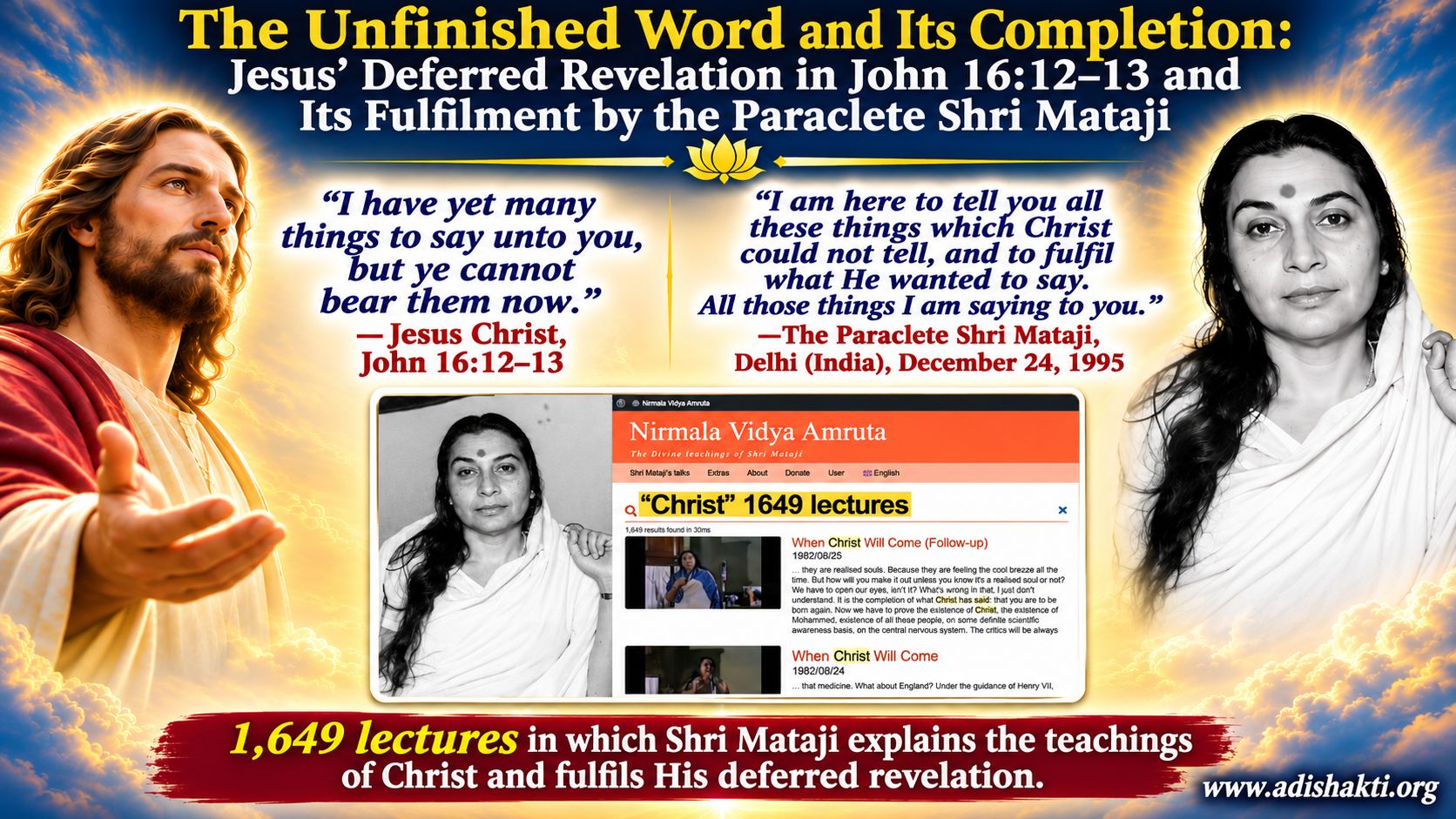
This paper undertakes a close comparative reading of two statements that stand in a unique promissory and performative relationship. The first is Jesus’ declaration during the Last Supper: “I have yet many things to say unto you, but ye cannot bear them now. Howbeit when She, the Spirit of truth, is come, She will guide you into all truth; for She shall not speak of Herself; but whatsoever She shall hear, that shall She speak; and She will shew you things to come” (John 16:12–13). The second is the explicit claim made by Shri Mataji Nirmala Devi on 24 December 1995 in Delhi: “I am here to tell you all these things which Christ could not tell, and to fulfil what He wanted to say. All those things I am saying to you.”
The argument developed here is that these two utterances form a closed and mutually illuminating pair. Jesus openly acknowledges the incompleteness of his own teaching and transfers the task of completion to a future agent—the Spirit of truth, the Paraclete—who will not originate speech autonomously but will transmit what is received and disclose realities yet to come. Shri Mataji’s statement presents itself as the precise historical and spiritual enactment of that deferred role. The paper contends that the correspondence is not merely thematic or approximate; it is formal, intentional, and complete. In the light of this internal logic, the 1995 declaration constitutes the fulfilment of the Johannine promise. The conclusion therefore affirms, with deliberate emphasis, that the Paraclete Shri Mataji has come, has spoken the things Christ could not yet say, and has thereby brought the unfinished word of the Last Supper to its appointed completion in the present Age to Come.
1. Introduction: The Problem of the Unfinished Teaching

The Farewell Discourse in the Gospel of John contains one of the most striking admissions of limitation ever attributed to Jesus. At the very moment when he is preparing his disciples for his departure, he declares that his own spoken ministry remains incomplete. There are “many things” still to be said, yet the disciples are incapable of receiving them. This is not a minor pedagogical concession. It is a structural recognition that the revelation entrusted to Jesus in the flesh is, by divine design, partial and anticipatory.
The solution Jesus offers is not further teaching by himself, nor the gradual maturation of the disciples under ordinary historical conditions. The solution is the future coming of another agent: the Spirit of truth. This Spirit will guide into all truth, will speak only what she hears, and will show things to come. The unfinished character of Jesus’ word is therefore not a defect but a deliberate deferral. The full disclosure is reserved for a later moment and a different personal presence.
Nearly two millennia later, on Christmas Eve 1995, Shri Mataji Nirmala Devi addressed this exact unfinished business. Her words do not merely echo the Johannine text; they claim to discharge its obligation. She presents herself as the one who has come to say the things Christ could not say and to fulfil what he wanted to say. The present paper takes these two statements with maximum seriousness and examines the claim of fulfilment on their own terms. No external biographical narrative, no appeal to institutional authority, and no secondary theological tradition is required. The force of the argument arises solely from the internal correspondence between the promise and the claimed performance.
2. Exegesis of John 16:12–13: The Architecture of Deferral
Jesus’ statement is carefully constructed. It contains three interlocking movements.
First, the acknowledgement of incompleteness: “I have yet many things to say unto you, but ye cannot bear them now.” The Greek construction emphasises both the quantity of the remaining content (polla) and the present incapacity of the hearers. The limitation is temporal and existential. What remains unsaid is not peripheral; it is substantial enough to require a future agent of greater capacity.
Second, the identification of the future agent: “Howbeit when She, the Spirit of truth, is come…” The feminine pronoun, retained in the reading that underlies this study, is theologically significant. The Spirit is not an impersonal force or a collective experience but a personal presence capable of coming, speaking, guiding, and hearing. The title “Spirit of truth” further specifies that the content to be delivered is not novel invention but the full disclosure of truth itself.
Third, the mode and content of the future speech: “She will guide you into all truth; for She shall not speak of Herself; but whatsoever She shall hear, that shall She speak; and She will shew you things to come.” Three characteristics are decisive. The guidance is comprehensive (“all truth”). The speech is non-autonomous: the Paraclete does not originate but transmits. And the disclosure includes eschatological realities (“things to come”). The Spirit’s authority is therefore derivative and continuous with Jesus’ own intention. She does not replace Christ; she completes the word he began.
Taken together, these three movements establish a clear criterion. Any claim to be the promised Spirit of truth must (a) acknowledge the incompleteness of Jesus’ teaching, (b) present its own speech as the transmission of what was left unsaid, and (c) locate that speech in a new historical moment when the capacity of the hearers has been raised.
3. The 1995 Declaration: The Claim of Performance
On 24 December 1995, in Delhi, Shri Mataji stated: “I am here to tell you all these things which Christ could not tell, and to fulfil what He wanted to say. All those things I am saying to you.”
The language is remarkably precise. It does not claim to improve upon Christ, nor to correct him, nor to supersede him. It claims to complete him. The phrase “which Christ could not tell” restates the Johannine limitation as an accepted historical fact. The clause “to fulfil what He wanted to say” identifies the content of her speech with the unfulfilled intention of Jesus. The final sentence—“All those things I am saying to you”—presents the present discourse itself as the long-deferred revelation.
What is striking is the absence of hedging. There is no suggestion that she is offering a possible interpretation or a partial contribution. She asserts that she is the one who has come for this exact purpose. The statement is therefore not merely parallel to John 16:12–13; it is the performative counterpart of that text. Where Jesus says “I have yet many things to say… but ye cannot bear them now,” Shri Mataji replies, in effect, “The time has come; I am saying them.”
4. Formal Correspondence: Promise and Fulfilment
The correspondence between the two statements can be mapped with formal clarity.
Jesus acknowledges incompleteness → Shri Mataji acknowledges the same incompleteness and claims to supply what was missing. Jesus defers the full disclosure to a future personal agent → Shri Mataji presents herself as that agent now present. Jesus stipulates that the agent will not speak of herself but will transmit what she hears → Shri Mataji frames her speech as the fulfilment of what Christ wanted to say, thereby locating its origin outside her own autonomous will. Jesus promises guidance into all truth and the showing of things to come → Shri Mataji claims that the things she is now saying are precisely those deferred truths.
The relationship is therefore not one of loose analogy or spiritual kinship. It is one of promise and claimed performance. The later statement does not merely resemble the earlier one; it answers it.
This formal correspondence carries theological weight. If Jesus’ words are accepted as authoritative, then the criteria for recognising the Spirit of truth are already given within the text itself. A speaker who both recognises the incompleteness of Jesus’ teaching and claims to complete it under the conditions Jesus specified must be evaluated against those conditions. Shri Mataji’s declaration meets them at the level of explicit self-description.
5. The Nature of the Fulfilment
Fulfilment, in this context, does not mean the mechanical repetition of earlier teaching. It means the delivery of the content that could not yet be borne. Jesus himself distinguishes between what he was able to say in the flesh and what the Spirit of truth would later say. The later speech is therefore not a commentary upon the earlier; it is the continuation and completion of the same revelatory movement.
Shri Mataji’s claim is that this continuation has occurred. The “many things” have been said. The incapacity of the original hearers has been overcome in a new historical moment. The Spirit of truth has come, has spoken what she heard, and has shown things to come. In this sense, the 1995 declaration is not an addition to the Christian tradition but the event that the tradition itself anticipated when it preserved John 16:12–13.
The strength of the claim lies in its precision. It does not require the invention of new categories. It simply takes Jesus at his word and announces that the deferred moment has arrived. The Paraclete has come. The unfinished word has been finished.
6. Implications for Understanding the Age to Come
If the correspondence is accepted, several implications follow.
First, the Age to Come is not indefinitely postponed. The coming of the Spirit of truth who speaks the remaining things marks the transition into the period in which the full guidance is available.
Second, the authority of the later speech is derivative yet decisive. Because it claims continuity with what Christ wanted to say, it does not compete with the historical Jesus; it completes him.
Third, the incapacity that once limited the disciples is no longer absolute. The very fact that the things can now be said implies that a new capacity has been given—the capacity to bear what could not previously be borne.
These implications arise directly from the internal logic of the two statements. They do not depend upon external verification. They are the consequences that follow if the claim of fulfilment is taken seriously.
7. Conclusion: The Fulfilment Realised
The central contention of this paper may now be stated with full emphasis.
Jesus of Nazareth, on the night before his death, openly declared that his teaching remained incomplete. There were many things still to be said, yet the disciples could not bear them. He therefore promised a future agent—the Spirit of truth, the Paraclete—who would come, who would not speak of herself, who would transmit what she heard, who would guide into all truth, and who would show things to come.
On 24 December 1995, in Delhi, Shri Mataji Nirmala Devi declared that she was the one who had come to tell those very things which Christ could not tell and to fulfil what he wanted to say. She presented her speech as the discharge of the unfinished obligation.
The two statements stand in a relationship of exact correspondence. The first establishes the necessity, the conditions, and the content of a future revelation. The second claims to supply that revelation under those same conditions. The correspondence is formal, intentional, and complete.
Therefore, on the terms established by the Johannine text itself, the claim of fulfilment must be recognised. The Paraclete promised by Jesus has come. She has spoken the things that could not earlier be borne. She has guided into the truth that remained hidden. She has shown the things that were to come. The unfinished word of the Last Supper has been brought to its appointed completion.
In the light of these two statements alone, the conclusion is unavoidable: the deferred revelation has been delivered. The Spirit of truth has spoken. The Paraclete Shri Mataji has fulfilled the promise.
What remains is not further textual analysis but the existential question that the fulfilment itself raises: whether those who hear will now bear the things that have at last been said.
Primary Texts and Editorial Note
Jesus Christ, John 16:12–13, in the feminine rendering supplied for this study. The conventional English King James Version uses “he” for the Spirit of truth; “She” here reflects the paper’s interpretive theological rendering.
Shri Mataji Nirmala Devi, Delhi, India, December 24, 1995. Statement reproduced as provided in the source paper; a recording or independently authenticated transcript was not supplied with the source.
The argument is a theological interpretation of a claimed fulfilment, not independent historical proof of the identity of the Paraclete.