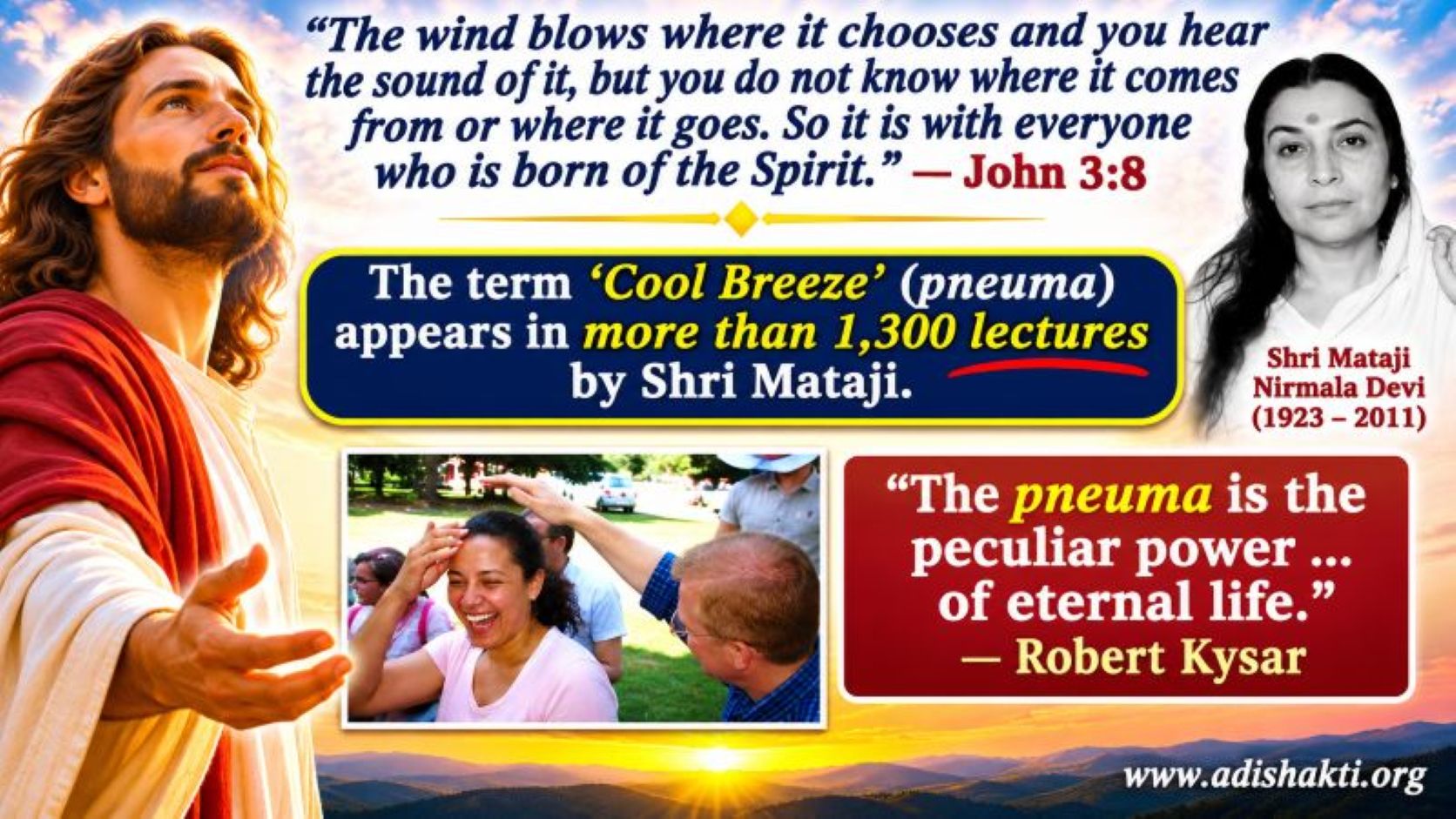
“The pneuma (Cool Breeze) is the peculiar power … of eternal life” Robert Kysar
Robert Kysar, the Cool Breeze, and the Paraclete’s witness to the living Resurrection
Robert Kysar — Voyages with John: Charting the Fourth Gospel
“The fascinating concepts of the Spirit and the Paraclete have provoked much concern among those interested in the religious thought of the Fourth Gospel (cf. e.g., Brown, Commentary—Gospel 2:1135-36, 'Paraclete in the Fourth' 113-14, and 'Paraclete in the Light' 158ff.). What we might summarize as two contexts enables us to comprehend the general concept of the Spirit. First, for some Johannine pneumatology is primarily a function of the christology and of the testimony themes of the gospel. In this case, the Spirit is closely associated with the question of the birth of faith just discussed. Second, for others, however, the pneumatology is primarily a function of the eschatology of the gospel.”
Johannine pneumatology as primarily a function of christology. The recent work of F. Porsch contributes significantly to the efforts of those who hold this position. He discovers through his study that the notion of the Spirit is 'christologically concentrated.' The Spirit enables one to recognize Jesus as the God-sent revealer, to execute an awakening, and to deepen and strengthen faith. Characteristic of Johannine pneumatology is that the concept of Spirit is associated with word. The word of Jesus is Spirit (6:63), and hence the 'word-event' is pneumatic event, and pneumatic event is word event. The pneuma is the peculiar power by which the word becomes the words of eternal life. The Fourth Gospel is supremely, then, a 'pneumatic gospel.' It always presents the Spirit as another 'form of appearance' ('Erscheinungsform') or designation for the presence of Christ. The Spirit is above all the power of the word (Porsch, 405-7).
J. M. Boice seems to agree with much of Porsch's analysis, because he understands that, throughout John, it is the Spirit that makes possible the witness of the apostles to revelation. The Spirit also supplies the 'internal witness' that, in turn, makes the embracing of revelation an option. The Spirit is part of the fourth evangelist's understanding of how the kerygma is received and affirmed (120-22, 143-45). H. Schlier, too, believes John's author holds that the truth of revelation is grasped and affirmed by person's only by means of the Spirit ('Heilige'). In a comparable manner, de La Potterie thinks that the Spirit is a necessary ingredient in the Johannine scheme of salvation. It is the Spirit who interprets the revelation which otherwise remains obscure and mysterious ('Paraclet' 96, and 'Parole et Esprit').
Pneumatology as a primarily function of the eschatology. Those who connect pneumatology with Johannine eschatology stress more the role it plays in the gospel's system of present eschatology. G. Locher argues that the Spirit makes the past as well as the future present for the believers (578). J. Blank maintains that Johannine realized eschatology is possible only because of a peculiar and strong view of the Spirit (Krisis 215)...
The attribution of the title, 'spirit of truth,' to the paraclete constitutes another problem. What did the fourth evangelist intend by this title? Boice understands that the title identifies the Spirit-Paraclete with God and Christ, as well as denoting the function of this figure as the one who delivers the truth to humans. Porsch thinks that the unity of word and Spirit enlightens the tile. 'The spirit of truth' is the forensic description of the word empowered by the Spirit. For Muller, the title gives expression to the peculiarly Johannine notion of the Spirit arising as it does from the dualism and christology of John's gospel. Locher contends that it is simply a functional designation for the work of the Spirit. The Spirit leads people from ignorance to truth.
About the function of the Spirit-Paraclete there is little significant disagreement. Most often it is said that the paraclete functions in two realms—among the disciples and in the world. In the first realm, the paraclete is the interpreter of the revelation in Christ and the one who enables persons to appropriate the revelation. De La Potterie speaks of this function as the 'interiorization and spiritualization' of the witness of Christ, and Schlier holds that the Spirit is the continuation of the revelatory work begun in Christ. In the second realm, Brown and De La Potterie understand the function in a negative way—the indictment of the opponents of Christ and the revelation. Schlier, however, suggests a more positive function for the Paraclete, namely, the illumination of the situation of the world and its alienation from its Creator.”
Robert Kysar, Voyages with John: Charting the Fourth Gospel
Baylor University Press, 2005, pages 133–135.
Summary
Robert Kysar’s account of Johannine pneumatology locates the power of eternal life in the Spirit’s relation to the word of Jesus. This paper places that account alongside the Cool Breeze reported by participants in Sahaja Yoga and understood by Shri Mataji Nirmala Devi as an experience of the Holy Spirit. Within the AdiShakti interpretation, Shri Mataji is the Paraclete who glorifies Jesus, awakens the inner spiritual life, and enables seekers to participate in the Resurrection before bodily death. The argument is Christ-centered: the Cool Breeze is significant because it is read in relation to Jesus’ promise of new birth, His words of life, and the fruits of the Spirit. The substantial talk corpus adds depth and continuity to this interpretation. The paper also distinguishes the experience reported by participants from its theological identification: the former is documented testimony; the latter is a confession of faith, not a conclusion established by Kysar, a photograph, or a laboratory study.
“The pneuma is the peculiar power by which the word becomes the words of eternal life.”
— Robert Kysar, Voyages with John, as reproduced in the supplied source [1]
A note on the purpose of this study
This AI-assisted paper brings scriptural texts, Shri Mataji’s recorded teachings, practitioner testimony, and scholarly research into conversation. It advances the AdiShakti reading as a theological interpretation while distinguishing it from the historical meaning of the texts and from claims that can be established by observation.
What would it mean for the Spirit of whom Jesus speaks to be known not only as an object of belief but as a living presence? Robert Kysar’s study of the Fourth Gospel supplies the theological starting point. In the passage reproduced in the supplied material, he describes pneuma—Greek for spirit, breath, or wind—as the power through which the word becomes the words of eternal life. The quotation is not a general equation of every religious sensation with the Holy Spirit. Its immediate concern is the relationship between the Spirit and the revelation of Jesus. [1]
This paper approaches Kysar from the standpoint of a particular contemporary confession. In the AdiShakti reading, Shri Mataji Nirmala Devi is identified with the promised Paraclete, and the Cool Breeze associated with the awakening of Kundalini is understood as an experiential sign of the Spirit’s life-giving action. The purpose is not to make Kysar speak for a movement he did not discuss. It is to ask how his formulation can illuminate a community’s testimony that Christ’s promise is encountered in the present. [2]
2. The Spirit, the word, and eternal life
Kysar distinguishes approaches that relate Johannine pneumatology primarily to Christology from those that emphasize eschatology. In his discussion of the first, he summarizes Felix Porsch’s interpretation: the Spirit is bound to Jesus’ revelation, making recognition and reception of that revelation possible. The statement about the “peculiar power” belongs to this discussion. Kysar cites Porsch’s pages 405–407; the supplied extract identifies pages 133–135 for the longer passage, while a Google Books phrase index locates this sentence on page 133. The bracketed gloss “Cool Breeze” in an earlier devotional presentation is an interpretation, not part of the unaltered sentence reproduced in the user-supplied excerpt. [1]
Jesus says in John 6:63 that the Spirit gives life and that His words are “spirit and life”; in verse 68 Peter addresses Him as the one who has “the words of eternal life.” The relationship is therefore not between an isolated sensation and an independently established immortality. It is between the living word of Christ and the Spirit who makes that word fruitful in the hearer. The power is “peculiar” in the sense that its role is distinctive: the Spirit opens the life-giving significance of the word. [3]
From this follows the paper’s central proposal. When the Cool Breeze is interpreted as the action of the Holy Spirit, it is not treated merely as an unusual temperature sensation. Its fullest meaning lies in the believer’s reception of Jesus, renewed consciousness, and a life shaped by His teaching. This is a theological extension of Kysar’s insight; it is not a claim that Kysar himself described the Cool Breeze or endorsed the identification of Shri Mataji with the Paraclete.
3. John 3: the wind and birth from the Spirit
Jesus tells Nicodemus that one must be born of water and Spirit. He then says: “The wind blows where it chooses, and you hear the sound of it.” The comparison ends: “So it is with everyone who is born of the Spirit” (John 3:5–8). In Greek, pneuma can mean both wind and spirit. The double sense permits the passage to speak of the freedom and perceptible effects of an action whose origin and destination remain beyond human control. [4]
The text does not say that Nicodemus felt cool air, that all who are born of the Spirit must feel a breeze, or that the word pneuma by itself means “cool breeze.” Shri Mataji’s identification is a later experiential reading of the passage, not a literal translation of its Greek. Recognizing this difference does not eliminate the force of the comparison for a believer: it makes clear where Jesus’ image ends and the community’s interpretation begins.
Within that interpretation, the Cool Breeze gives bodily immediacy to the invitation to be “born from above.” The experience is not the manufacture of spiritual life by the will; it is received as a gift. The language of inner awakening is therefore read in the light of Jesus’ insistence that entry into the kingdom is a birth of the Spirit, not simply a change of outward affiliation.
4. The Resurrection as life already received
John’s Gospel gives a strong basis for speaking of eternal life in the present. Jesus says that the person who hears His word and believes “has eternal life” and “has passed from death to life” (John 5:24). In John 11:25 He declares, “I am the resurrection and the life.” These sayings permit the Resurrection to be approached as participation in Christ’s life now, rather than only as a promise postponed until after physical death. [5] [6]
The contemporary AdiShakti reading calls this participation inner Resurrection: the seeker, awakened by the Spirit, begins to live in a new relationship with Christ and God while still embodied. The reported Cool Breeze is received as a sign accompanying that second birth. Eternal life here means life in divine presence, already begun; it is not the claim that a human body has become biologically immortal.
There is also a necessary textual distinction. John 5:28–29 speaks of a future hour when those in the tombs will come out, and John 6:54 joins present eternal life to being raised on the last day. Paul similarly speaks of the Spirit dwelling in believers and of God giving life to their mortal bodies (Romans 8:11). Paul J. Creevey’s study emphasizes that John’s present gift of life and future resurrection hope are both present in the Gospel. The inward, present-centered interpretation advanced here is a confessional emphasis; it should not be attributed to John as an exclusive rejection of future resurrection or to Kysar as a demonstrated conclusion. [7] [6]
5. The Paraclete, the glorification of Jesus, and the gift of the Spirit
In John 14:16–17 and 14:26, Jesus promises another Advocate, identified as the Spirit of truth and the Holy Spirit, who remains with the disciples, teaches, and recalls His words. John 15:26 adds that She testifies to Jesus; John 16:13–15 says that She guides into truth and glorifies Him by declaring what is His. These passages make remembrance, truth, witness, and glorification central to the Spirit’s mission. The feminine pronouns in this paper express its devotional convention; they are not a claim that the Greek grammatical gender independently identifies the Spirit with a woman. [8]
John 7:37–39 connects Jesus’ promise of living water with the Spirit believers were to receive, and the narrator says that Jesus had not yet been glorified. In the Gospel’s own narrative, His glorification is bound to His hour, death, and exaltation; John 20:22 depicts the risen Jesus breathing on the disciples and saying, “Receive the Holy Spirit.” The text does not mention a forty-year ministry by a later teacher. [9]
The AdiShakti interpretation nevertheless connects these texts with Shri Mataji’s approximately four-decade public ministry. It holds that, as the Paraclete, She glorified Jesus through Her sustained witness and enabled seekers to receive the Spirit through awakening and Self-Realization. In this reading, the fulfillment of John 7:39 is understood in the light of John 16:14 and Her continuing glorification of Christ. That is a substantive devotional claim. It differs from interpretations that locate the giving of the Spirit in the events narrated by John and Acts; neither the duration of Her ministry nor the proposed identification follows from the words of John 7:39 alone. [2]
6. The number and depth of Shri Mataji’s talks
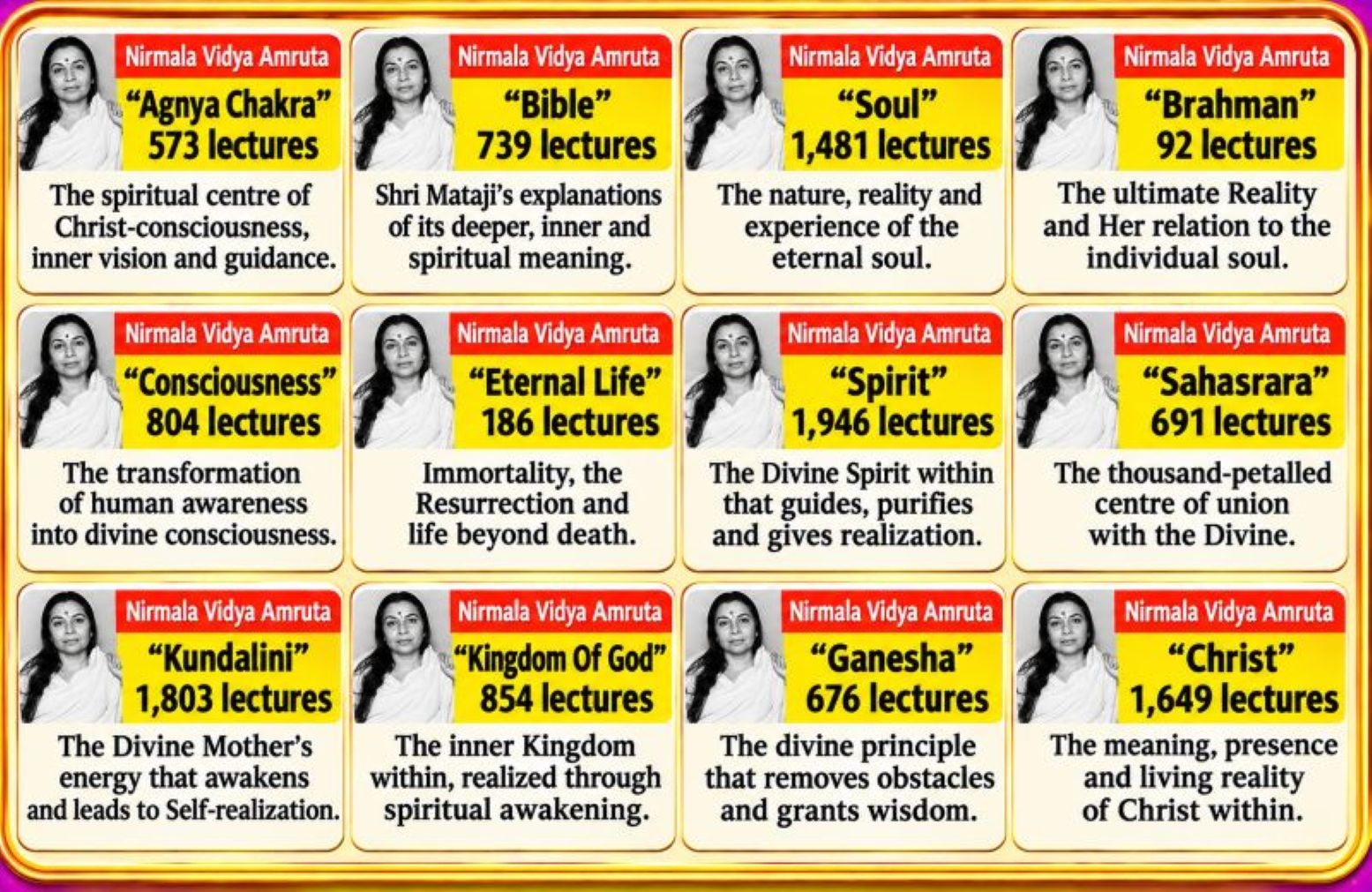
The source supplied for this paper contains 395 indexed excerpts from the first 20 pages of a reported 69-page English-language Amruta search for “Cool Breeze.” The collection reports more than 1,300 search results. A separate AdiShakti article reproduces an undated archive image displaying 1,357 results for “Cool Breeze.” These are figures for an index and its selected excerpts, not verified counts of distinct talks or of people who felt a breeze. [10] Repeated records, excerpts from the same occasion, incomplete transcripts, and archive indexing can affect the totals. The supplied collection preserves the dates and titles of the results, but does not claim to have independently authenticated each talk’s date or location. [11]
A separate AdiShakti study reports that an Amruta search for “Christ” on November 4, 2026 returned 2,215 records. This is a reported search-result count for that term, not a verified count of 2,215 separate Christ-centered lectures. It cannot be added to the Cool Breeze figure: the two searches can overlap, and the unique talks have not been deduplicated. Even with those limits, the search results and dated excerpts show why the corpus deserves sustained attention rather than a conclusion drawn from one isolated quotation. [12]
The depth of Shri Mataji’s teaching appears in the relationship among its themes. In a talk excerpt attributed to the United Kingdom on December 10, 1979, She says, “The message of Christ is His resurrection.” The statement places Christ’s Resurrection at the center of Her account of the life of the Spirit. A 1981 talk excerpt in the supplied collection brings together the felt breeze, a request for forgiveness from Christ, and the practice of forgiving. A 1983 excerpt describes the awakening and the Cool Breeze of the Holy Ghost as “real baptism,” connecting the experience with being born again. A draft transcript of a Brussels public program on July 14, 1988 records Her statement that baptism is accompanied by “the cool breeze of the Holy Ghost coming out of your head.” [13] These are not identical claims: they move from Christ’s Resurrection to forgiveness, baptism, and inner transformation. [14] [11] [10]
The same range is visible in the Christological materials summarized by AdiShakti. It reproduces a 1981 London address on Christ’s work in the interior life and attributes to a 1995 Delhi address Shri Mataji’s statement that She had come to tell what Christ had not yet told His disciples. The latter can be read devotionally alongside Jesus’ promise that the Spirit will guide the disciples into truth (John 16:12–15). The transcriptions document what the source reports Her as saying; they do not independently establish the identity claimed in the theological reading. Together with the later archival record, they demonstrate a substantial and recurrent engagement with Jesus over the decades of Her ministry. [15]
Her revelations, in the framework of this paper, have several interdependent dimensions: Christological, because they direct attention to Jesus and His Resurrection; pneumatological, because they identify the Holy Spirit as the giver of new life; experiential, because they invite seekers to attend to the Cool Breeze; and ethical, because forgiveness and transformation matter more than an isolated sensation. The interpretation draws its depth from the relation among these dimensions, not from a raw number of search hits.
7. The Cool Breeze as reported experience
The supplied collection contains not only assertions about the breeze but moments in which Shri Mataji asks people what they feel. In a talk dated June 15, 1979, one seeker answers that the sensation is “hard to describe,” while another answers yes to a question about the breeze. In a Geneva program dated August 24, 1982, She asks newcomers who felt a Cool Breeze the previous day to raise their hands, then links the exercise to forgiveness and attention. Such excerpts preserve an interaction, but neither the number of raised hands nor the experience of every participant can be reconstructed from a search snippet. [11]
Two more accessible draft transcripts add fuller exchanges. In a Sydney radio program dated March 31, 1981, a questioner asks whether the Cool Breeze is the Holy Spirit; Shri Mataji affirms the identification. Later a caller, asked about the Comforter, reports “cool tingling” through the body. In a BBC interview dated August 13, 1984, interviewer Julia Booth says she feels coolness above Shri Mataji’s head, while also saying it is “hard to know.” These are reported experiences in interviews, not independent determinations of their physical or divine cause. The transcripts are marked as drafts and have not been checked here against the recordings. [16] [17]
In Her teaching, the inward awakening called Kundalini is associated with sensations in the palms and above the head, and with an attentive quietness often described as thoughtless awareness. The Cool Breeze is understood within Sahaja Yoga as the touch of the Holy Spirit rather than as merely a metaphor. This paper respects that self-understanding: for a practitioner, the sensation may be the occasion on which Christ’s promise ceases to feel remote and becomes a matter of lived encounter.
At the same time, the excerpts themselves include uncertainty and variation: some people report warmth, tingling, pressure, or no sensation, and some are unsure. A responsible account should not turn an experience reported by some into a universal physical requirement. Nor should it conclude that a person who feels nothing is unloved by God or incapable of spiritual life. The Christian significance of the claimed sign must be considered in relation to faith, love, and the continuing work of the Spirit.
8. Testimony, research, and the meaning of confirmation
The sociologist Judith Coney begins her study of Sahaja Yoga with a 1992 account from an acquaintance who reported feeling a cool breeze at the top of his head after contact with a practitioner. She investigates how such experiences and their interpretations develop within a social setting. The testimony is important because it documents a report outside the present paper’s devotional voice. It does not by itself establish the divine cause of the sensation. [18]
In the passage from page 60 reproduced in the supplied manuscript, Coney also observes that people who report cool sensations do not necessarily become members. This challenges a simple equation of “feeling something” with accepting a particular theology. Her observation does not prove that the reported feeling was unreal, nor does it identify why every person declined further involvement. [19]
A 2021 study by Alfonso Barrós-Loscertales and colleagues compared resting-state brain connectivity in 23 experienced Sahaja Yoga meditators and 23 non-meditators. The article describes the Cool Breeze as a subjective feature associated with the practice. Its observational comparison was not designed to establish that a breeze was divine, that the Spirit was present, or that eternal life had been empirically measured. It provides context for studying meditation, not a scientific verification of the paper’s theological identification. [20]
The earlier AdiShakti source also interprets a photograph associated with Russia on August 1, 2008 as a manifestation of the Spirit. The present research has not independently established the photograph’s provenance or the cause of any visible feature. Even an authenticated photograph of a gathering would not, by itself, settle its spiritual meaning or prove that its participants had received eternal life. The picture is therefore evidence of a claim and its devotional interpretation, not independent proof of a supernatural event. [21]
What, then, can “confirmation” mean? At the level of testimony, the sources confirm that a community describes and interprets experiences of coolness. At the level of theological reasoning, those experiences can be read as confirmatory signs within a prior faith in the Paraclete’s mission. They do not logically establish that every sensation is the Holy Spirit, that Shri Mataji’s identity is demonstrable by measurement, or that Kysar endorsed this application. The distinction preserves both the seriousness of lived experience and the difference between spiritual discernment and empirical proof.
9. Living the Resurrection: Christ’s word and the Spirit’s fruit
For John, the lasting question is what becomes of those who receive the word. Jesus says, “Abide in me, and I in you,” and commands His disciples to love one another (John 15:4, 12). Paul describes the fruit of the Spirit in terms that include love, joy, peace, patience, kindness, and self-control (Galatians 5:22–23). A Christian reading of the Cool Breeze is strongest when the experience leads toward these fruits rather than becoming an end in itself. [22]
Living the Resurrection therefore means returning in daily life to the presence of Christ: listening before reacting, forgiving where resentment has taken hold, acting truthfully, and meeting others with compassion. Quiet prayer or meditation can become a setting in which the believer attends to the Spirit; its value is expressed not only during the exercise but in work, family life, and service. First John’s call to “test the spirits” also supports discernment rather than the assumption that any striking experience authenticates itself. [23]
For those who receive Shri Mataji as the Paraclete, these practices express the claim that She glorifies Jesus rather than replacing Him. Her reported call to forgiveness and Her teaching about the living Spirit are read as invitations to let His word become effective in ordinary life. The believer’s response is not to prove another person’s spiritual condition, but to live more deeply the life of Christ.
10. Conclusion
Kysar’s full sentence gives the central question its proper shape: the pneuma is “the peculiar power by which the word becomes the words of eternal life.” In John, the Spirit and the words of Jesus belong together. The AdiShakti reading places the Cool Breeze within that relationship: the Paraclete Shri Mataji’s ministry is understood to make Christ’s promised Spirit and the Resurrection of inner life experientially present.
The supplied collection’s 395 excerpts, its reported search count of more than 1,300 Cool Breeze results, the separate 1,357-result snapshot, and the separately reported 2,215 “Christ” records indicate a substantial archive. They must not be treated as counts of unique talks, practitioners, or independently verified supernatural events. The dated passages nevertheless show a teaching of considerable theological depth, bringing Christ’s Resurrection, forgiveness, Spirit-birth, and the experience of the Cool Breeze into a sustained relationship.
Within the confession advanced here, the Cool Breeze is a lived sign that the Spirit makes Christ’s word a present power of eternal life.
References
[1] Kysar, Robert D. Voyages with John: Charting the Fourth Gospel. Baylor University Press, 2005, p. 133 as located by a Google Books phrase index. The quoted passage is reproduced in the supplied extract and AdiShakti’s transcription; the book page was not directly inspected. The publisher lists the paperback release in 2006. Kysar cites Felix Porsch’s pp. 405–407; those pages were not independently inspected.
[2] AdiShakti.org. “The Spirit Is Now Given.” AdiShakti AI Research Articles, n.d. Confessional account of the Paraclete, John 7:39, and Shri Mataji’s ministry.
[3] The Holy Bible, John 6:63, 68, New Revised Standard Version Updated Edition, Bible Gateway.
[4] The Holy Bible, John 3:3–8, New Revised Standard Version Updated Edition; United Bible Societies, translation notes on John 3:8.
[5] The Holy Bible, John 5:24–29, New Revised Standard Version Updated Edition, Bible Gateway.
[6] The Holy Bible, John 11:24–26; 6:54; Romans 8:9–11, 23, New Revised Standard Version Updated Edition, Bible Gateway; cf. USCCB notes on Romans 8.
[7] Creevey, Paul J. “John’s realised eschatology as an expression of the wisdom of God.” In die Skriflig 58, no. 1 (2024), article a3096. DOI: 10.4102/ids.v58i1.3096.
[8] The Holy Bible, John 14:16–17, 26; 15:26; 16:7, 12–15, New Revised Standard Version Updated Edition, Bible Gateway; USCCB, John 14:16–17 and notes on the Paraclete.
[9] The Holy Bible, John 7:37–39; 12:23–24, 32–33; 20:19–23, New Revised Standard Version Updated Edition, Bible Gateway; USCCB notes on John 7:39.
[10] AdiShakti.org. “Universal Pneumatology: The Cool Breeze, Baptism in the Holy Spirit, and the Living Resurrection.” AdiShakti Authenticity Series, October 22, 2026. Reproduces an undated image showing 1,357 search results and attributes the baptism quotation to Brussels, July 14, 1988; this is not a verified count of distinct talks.
[11] User-supplied compilation, “Cool Breeze — Shri Mataji Nirmala Devi Talk Excerpts.” Compilation of 395 excerpts from Amruta search pages 1–20, n.d. Intended AdiShakti source URL was supplied by the user but returned HTTP 404 on November 15, 2026. The linked local copy preserves the supplied collection; Amruta search may require authentication.
[12] AdiShakti.org. “The Paraclete’s Testimony: Shri Mataji’s Witness to Jesus.” AdiShakti AI Research Articles, November 4, 2026. Reports 2,215 search results for “Christ”; the present paper has not independently audited the search or deduplicated its records.
[13] Shri Mataji Nirmala Devi. “To Be Baptized Is to Feel the Cool Breeze of the Holy Ghost out of Your Head.” Learn Sahaja Yoga / Nirmala Vidya Amruta, public program, Auditorium 44, Brussels, Belgium, July 14, 1988. Draft English transcript; the recording was not independently checked.
[14] Shri Mataji Nirmala Devi. “The message of Christ is His resurrection.” Sahajayoga-a-Mahayoga, December 10, 2017; excerpt attributed to a United Kingdom talk, December 10, 1979. The original recording was not independently examined.
[15] AdiShakti.org. “The Paraclete’s Testimony: Shri Mataji’s Witness to Jesus.” AdiShakti AI Research Articles, November 4, 2026, sections 5–7. Reproduces dated Christ-centered statements; original recordings were not independently examined.
[16] Shri Mataji Nirmala Devi. “Radio interview, Talkback Radio 2UE.” Learn Sahaja Yoga / Nirmala Vidya Amruta, Sydney, Australia, March 31, 1981. Draft English transcript; the recording was not independently checked.
[17] Shri Mataji Nirmala Devi and Julia Booth. “Look East BBC TV Interview.” Learn Sahaja Yoga / Nirmala Vidya Amruta, Cambridge, England, August 13, 1984. Draft English transcript; the recording was not independently checked.
[18] Coney, Judith. Sahaja Yoga: Socializing Processes in a South Asian New Religious Movement. Curzon Press, 1999, introduction, p. 1; publisher preview, reissued by Routledge, 2013.
[19] Coney, Judith. Sahaja Yoga: Socializing Processes in a South Asian New Religious Movement. Curzon Press, 1999, p. 60, as indexed by Google Books and reproduced in the supplied manuscript and AdiShakti’s account. The full page was not directly examined.
[20] Barrós-Loscertales, Alfonso, Sergio Elías Hernández, Yaqiong Xiao, José Luis González-Mora, and Katya Rubia. “Resting State Functional Connectivity Associated With Sahaja Yoga Meditation.” Frontiers in Human Neuroscience 15 (2021): 614882. DOI: 10.3389/fnhum.2021.614882.
[21] AdiShakti.org. “The Pneuma Is the Peculiar Power of Eternal Life.” AdiShakti.org, n.d. Reports a spiritual interpretation of a purported Russia, August 1, 2008 photograph; neither its provenance nor a supernatural cause is independently established here.
[22] The Holy Bible, John 15:1–17 and Galatians 5:22–23, King James Version, Bible Gateway.
[23] The Holy Bible, 1 John 4:1–3, King James Version, Bible Gateway.