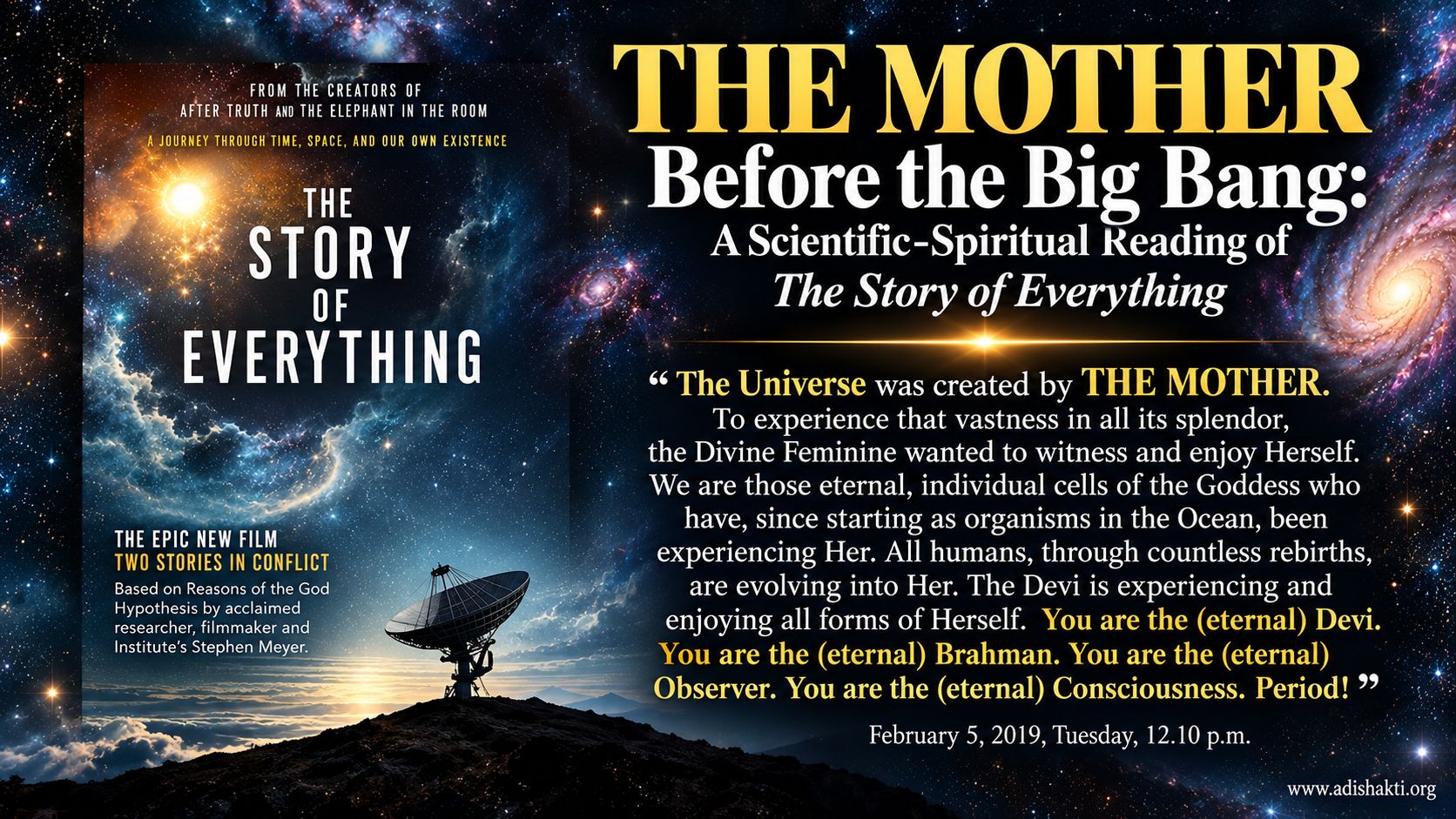
THE MOTHER Before the Big Bang: A Scientific-Spiritual Reading of The Story of Everything documentary
“May all the gods attend to what I have to say. By merely hearing these words of mine, one attains my essential nature. I alone existed in the beginning; there was nothing else at all, O Mountain King. My true Self is known as pure consciousness, the highest intelligence, the one supreme Brahman.”
Summary
This paper is centered on one primary-text claim: in C. Mackenzie Brown’s scholarly translation of the Devī Gītā , the Goddess openly declares that She alone existed in the beginning and identifies Her true Self as pure consciousness, the highest intelligence, and the one supreme Brahman . [2] The user names the opening declaration as 2.1–2; the full English sequence quoted here is cited in Brown’s translation as 2.1–3. The numbering detail does not alter the thesis: the text presents the Devī as preexistent ultimate reality, not as a secondary deity within a prior cosmos.
The Story of Everything presents a modern design argument: its official materials ask readers to see intentionality in cosmic law, star-forming structures, cells, and DNA. [3] The documentary does not name the Devī. This paper therefore makes no claim that its makers historically intended a Śākta identification. Rather, within the contemporary confessional synthesis advanced here, the film’s unnamed Intelligent Mind is identified with the Devī who has already named Herself in scripture as primordial consciousness and highest intelligence. The text gives the Mother’s own answer to the question the film raises.
The scientific literature is used with discipline. Cosmology measures and models cosmic history; fine-tuning research studies parameter sensitivity; neuroscience studies competing accounts of conscious experience. None of these disciplines experimentally identifies a deity. Their importance is different: they sharpen the questions of origin, intelligibility, order, and consciousness to which the Devī Gītā speaks in a theological register. The result is not a laboratory proof of the Mother but a rigorous scientific-spiritual reading in which science describes the cosmos and Śākta scripture names its ultimate ground.
Introduction
This paper reads the documentary’s argument for an Intelligent Mind alongside the Devī Gītā’s theological identification of the Divine Mother with primordial consciousness, intelligence, and Brahman. The comparison is interpretive rather than a scientific proof of divinity.
1. The Scriptural Hinge: Devī Gītā 2.1–3
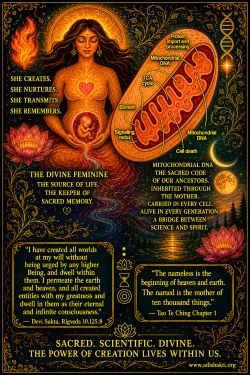
The revised argument begins neither with the Big Bang nor with an inference from physics. It begins with a first-person divine proclamation. In the Brown translation, the Goddess does not merely receive the title of supreme being from a devotee or commentator. She speaks: “I alone existed in the beginning; there was nothing else at all.” The grammar is absolute. The speaker claims singular primacy at the source of all that appears. In Śākta theology, this is not a statement that the Goddess was the first object in an already-existing timeline. It is the declaration that time, world, and all finite distinction rest in Her prior reality. [4]
This source is primary theological evidence, not scientific evidence. Its force is scriptural and metaphysical. Yet it is exact evidence for the article’s religious claim: the Devī Gītā itself presents the Devī as preexistent to the manifest cosmos. The later language of the Mother as “before the Big Bang” is therefore not invented to force a modern metaphor upon a silent text. It is a contemporary way of translating the older claim of ontological priority into a cosmological age.
The AdiShakti.org essay The Primordial Mother of Humanity preserves this same Brown-based passage and explicitly reads it as a statement that the Goddess is the sole reality before creation. That is a contemporary confessional reading of the text, not a consensus conclusion of physics; its direct relevance is that it shows the living theological meaning of the verse for the Mother-centered interpretation developed here. [5]
2. Close Reading: The Mother’s Sevenfold Proclamation
Each clause of the declaration contributes to a single ontology. The text does not merely say that the Mother made a world; it says who She is before, within, and beyond the world.
This opening establishes divine self-disclosure. The Goddess speaks before the gods rather than being defined by them. Within the text’s theological world, Her authority is not delegated from another being. The claim is not that a modern scientist must accept this scene as empirical history. It is that the scripture positions the Goddess as the authority who interprets the gods, reality, and liberation. [6]
The sentence joins revelation and transformation. The Mother’s words do not function as detached cosmological information. They disclose a reality that the hearer is invited to realize. The aim is not only to know about the first cause but to awaken to the consciousness that the text identifies as the deepest ground of the self.
This is the clause that makes the title necessary. If the Goddess alone existed in the beginning, then she is not a product of cosmic matter, a creature within space, or an effect of an earlier physical event. In the article’s Śākta reading, this is a declaration of preexistence and causal priority. She is the source on which every beginning depends.
The primordial reality is not described as inert substance. It is cit : consciousness. This makes the Mother’s ultimacy directly relevant to the question of mind. The passage does not begin with matter and add awareness as a late accident. It begins with awareness as the deepest name of being.
Here the bridge to The Story of Everything becomes unmistakable at the level of theological category. The film searches for an intelligent cause or mind behind the ordered cosmos. The Devī Gītā identifies the source of manifestation as the highest intelligence. The film does not utter the name Devī; the scripture does. Within this confessional reading, the unnamed Mind sought by the film is the Mother who declares herself as supreme intelligence.
Brahman is not one object among others. The term names ultimate, unlimited reality. The Goddess is therefore not merely a highly powerful divine person who happens to be first in a sequence. The text identifies Her with the unconditioned reality in which all conditions arise. Scholarly work on the Devī Māhātmya and Hindu Goddess traditions provides historical context for the theological seriousness of feminine ultimacy, while not substituting academic description for the scripture’s own confession. [7]
3. THE MOTHER Before the Big Bang
Calling the Devī “before the Big Bang” must be done with precision. Standard cosmology describes the early hot, dense history of the observable universe. It does not experimentally photograph absolute nothingness, nor does it settle every question about the physical boundary of cosmic history. The final Planck analysis reported remarkable consistency between the cosmic microwave background data and a six-parameter ΛCDM model, while retaining the ordinary scientific posture of model constraints, uncertainties, and open tensions. [8]
The Borde–Guth–Vilenkin theorem is likewise meaningful but limited. Under specified conditions, a spacetime with positive average expansion is past-incomplete. The theorem does not identify a divine cause, prove creation from absolute nothing, or describe a material moment at which a deity acts. It establishes a conditional conclusion about the extension of certain cosmological spacetimes. [9]
For that reason, “before” in this article is pre-temporal and ontological , not a date prior to a date. The Mother is not placed at an earlier tick of a cosmic clock. She is interpreted as the ground on which clocks, time, energy, space, matter, and any physical origin may arise. The Devī Gītā uses the language of sole existence in the beginning; contemporary cosmology supplies the language of the Big Bang. The article brings them into dialogue without confusing their methods.
The Mother is not the earliest item in the universe. Within the Śākta reading of 2.1–3, She is the unconditioned reality by which any universe, any beginning, and any account of the Big Bang is possible.
4. What The Story of Everything Argues
The film’s official synopsis describes a cinematic exploration of the cosmos that traces evidence of intentional design from physical laws governing stars to patterns in living cells and DNA. Its own presentation is therefore an argument from observed order and complexity toward a mind behind the universe. [10] Fathom’s release page similarly identifies the production as a journey through cosmic design and names its featured figures. [11]
Director Eric Esau’s interview gives the clearest production context: the film brings arguments associated with Stephen C. Meyer’s work into cinematic form through interviews and animation. This helps the reader distinguish the documentary’s stated philosophical design case from a consensus statement of cosmological science. [12]
The article’s claim can now be stated exactly. The documentary asks whether the universe’s origin and intelligibility point to an Intelligent Mind that is not reducible to the physical cosmos. The Devī Gītā supplies a primary Śākta answer: the preexistent source is the Devī, whose true Self is pure consciousness, highest intelligence, and supreme Brahman. The relation is not historical authorship and not scientific deduction. It is a direct theological identification made by this article: the Devī is the Intelligent Mind.
5. Why the Devī Is the Intelligent Mind
The identification rests on three textual predicates, not on an arbitrary substitution of one religious name for another. First, the Devī declares preexistence: She alone existed in the beginning. Second, She declares consciousness: Her true Self is pure consciousness. Third, She declares intelligence: She is the highest intelligence. These are exactly the predicates required for the article’s reading of the film’s unembodied, pre-cosmic Mind.
Within this Śākta confessional synthesis, the documentary’s argument and the scripture’s proclamation converge without being confused. The film begins from a modern observation of cosmic order and asks for an ultimate explanation. The text begins from revelation and names the ultimate reality. The former is an inferential proposal; the latter is a divine self-declaration within a sacred tradition. The claim of this paper is that they meet in the one reality named by the Goddess: THE MOTHER.
Peer-reviewed scholarship does not adjudicate the truth of this identification. It does establish that Hindu Goddess traditions have articulated feminine divine ultimacy with philosophical complexity. Raj Balkaran’s study describes the Devī Māhātmya as an articulation of ultimate divinity as feminine; Mikel Burley’s work treats the Hindu Divine Mother as a serious and multivalent theological subject. Such scholarship supports the legitimacy and depth of the tradition’s conceptual world. It does not turn a theological identity claim into a laboratory finding. [13] [14]
6. Science in Its Proper Strength
Scientific depth is not gained by converting every mystery into evidence for the Mother. It is gained by preserving what the sciences have actually established. Fine-tuning research studies how the ranges of some physical and cosmological parameters affect stars, chemistry, planets, and complex structures. Fred Adams’s major review carefully maps such constraints while emphasizing that a complete probability assessment requires underlying distributions that are not known. It supports serious discussion of parameter sensitivity; it does not deliver a consensus proof of a designer. [15]
Díaz-Pachón, Hössjer, and Marks offer a Bayesian approach to questions of tuning and show that conclusions depend upon explicit modeling choices and assumptions. Their work is useful precisely because it resists slogans. In the Mother-centered reading, scientific exactness becomes an act of reverence: it prevents devotion from claiming more than data can bear. [16]
Consciousness research has a similar role. Contemporary neuroscience investigates neural correlates and competing theories of experience. A major review by Seth and Bayne emphasizes the plurality of theories and the problem of empirically distinguishing them. This does not demonstrate that consciousness is divine. It leaves open the philosophical profundity of experience and explains why the text’s claim that ultimate reality is pure consciousness remains a serious metaphysical proposal rather than a discarded primitive idea. [17]
Brogaard and Gatzia’s discussion of the hard problem further clarifies the point. The relation between brain processes and subjective experience is a central research question, not a gap automatically occupied by theology. The Devī Gītā’s language of consciousness belongs to a different inquiry: the nature of ultimate reality and the ground of the knower. Science studies the embodied conditions of awareness; Śākta theology identifies awareness itself with the Mother’s supreme form. [18]
7. From Preexistent Consciousness to Manifest Cosmos
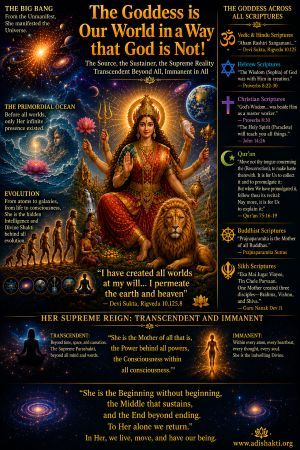
Chapter 2 identifies the Mother’s ultimate nature. Chapter 3 gives the text’s language for manifestation: “I, as Māyā , create the whole world and then enter within it.” The sequence is decisive for the paper’s claim. The Mother is not merely the first cause who recedes after creation. She is both transcendent source and immanent presence. She creates, enters, sustains, and is recognized within the world without being exhausted by it. [19]
In the article’s devotional synthesis, this makes the universe the Mother’s living self-expression. The phrase does not mean that the universe is a biological body in a literal scientific sense. It means that creation is internal to the divine life: the cosmos depends on the Mother, manifests Her power, and is pervaded by Her presence. The AdiShakti.org essay The Goddess as Our World explicitly advances this confessional reading of the Goddess as Brahman, source, world, and indwelling consciousness. [20]
This is why the title does not stop at a remote, pre-Big-Bang deity. The Mother who precedes every cosmic beginning is also the Mother present in every form. Her priority does not distance Her. It makes divine immanence more intimate: if all things arise in Her, no thing is metaphysically outside Her sustaining presence.
8. Human Participation: Witness, Memory, and Liberation
The Devī Gītā proclamation is addressed to hearers because its end is realization. “By merely hearing these words of mine, one attains my essential nature” points beyond cosmological speculation toward transformation. The Mother is not only the explanation of a distant first event. She is the consciousness by which the listener hears, recognizes, and returns. The cosmic question therefore becomes a question of identity: what is the deepest self that asks where the universe came from?
The related Devī Sūkta of Ṛgveda 10.125 gives a further primary textual witness to the Goddess’s universal scope. In the scholarly translation of Jamison and Brereton, this hymn is a foundational Vedic locus for a female divine voice that moves through cosmic and human reality. It does not need modern cosmology to be meaningful; it supplies the theological horizon in which the Mother’s power is both universal and immanent. [21]
Within the contemporary AdiShakti.org confessional synthesis, the human being is called to remember that the apparent separateness of the individual is not ultimate. The Mother who says She alone existed in the beginning is also said, in the later manifestation passage, to enter the world. This makes spiritual awakening neither self-aggrandizement nor escape from life. It is the recovery of relationship: each person is a finite, responsible locus of the consciousness that the text calls the Mother. [22]
9. What the Sources Support
| Source type | What it supports | What it does not establish |
|---|---|---|
| Primary Śākta text | The Devī Gītā presents the Goddess as sole primordial reality, pure consciousness, highest intelligence, and Brahman. | A universally binding scientific conclusion. |
| Film primary sources | The film advances a design-oriented argument toward an intelligent mind behind the cosmos. | That the film itself names the Devī. |
| Peer-reviewed cosmology and consciousness research | Empirical constraints, model success, parameter debates, and unresolved accounts of conscious experience. | Experimental identification of a Divine Feminine creator. |
| Hindu studies scholarship | The historical and philosophical seriousness of Mahādevī and Divine Mother traditions. | Proof that any theological claim is empirically true. |
| Contemporary confessional synthesis | The devotional conclusion that the Devī is the Intelligent Mind and the Mother before the Big Bang. | A claim to speak for all scientific or religious communities. |
This differentiation is the source of the paper’s strength. The Mother does not need a false scientific certificate. The scripture names Her; science refines the physical questions; theology gives the identification its metaphysical grammar. The result is a devotional conclusion that is intense without becoming intellectually careless.
10. Conclusion: The Mother’s Own Declaration
The Story of Everything asks a modern question: what account can be given of a universe whose origins, laws, complexity, and conscious observers seem to invite reflection on an Intelligent Mind? The Devī Gītā answers in the first person. The Goddess declares that before manifestation She alone existed, and that Her true Self is pure consciousness, highest intelligence, and the one supreme Brahman.
Therefore the title is not decorative. THE MOTHER Before the Big Bang names the exact Śākta claim at the heart of the paper. The Mother precedes the Big Bang not as an earlier material object but as the pre-temporal ground of every possible cosmic beginning. She is the preexisting cause because the text identifies Her as the sole reality before the world. She is the Intelligent Mind because the text identifies Her as highest intelligence. She is not a separate rival to Brahman because the text identifies Her as the one supreme Brahman.
Within the contemporary confessional reading advanced here, the documentary’s Intelligent Mind is the Devī. Science does not compel that identification; neither is science asked to do so. Rather, its questions about cosmic order, origin, and consciousness become occasions to hear the Mother’s scriptural proclamation with new depth. The cosmos is then not merely a puzzle pointing toward an unnamed cause. It is the Mother’s manifestation, Her sacred self-expression, and the field in which consciousness remembers its source.
References
[1]
Brown, C. Mackenzie, trans. “
The
Devī Gītā
: The Song of the Goddess
.”
State University of New York Press
, 1998, ch. 2, vv. 1–3.
[2]
Brown, C. Mackenzie. “
The
Devī Gītā
: The Song of the Goddess
.”
State University of New York Press
, 1998, ch. 2, vv. 1–3.
[3]
The Story of Everything Film. “
The Story of Everything: Official Synopsis
.”
The Story of Everything Film
, 2026.
[4]
Brown, C. Mackenzie, trans. “
The
Devī Gītā
: The Song of the Goddess
.”
State University of New York Press
, 1998, ch. 2, vv. 1–3.
[5]
Adi Shakti. “
The Primordial Mother of Humanity
.”
Adishakti.org
, accessed October 12, 2026.
[6]
Brown, C. Mackenzie, trans. “
The
Devī Gītā
: The Song of the Goddess
.”
State University of New York Press
, 1998, ch. 2, vv. 1–3.
[7]
Balkaran, Raj. “
Visions and Revisions of the Hindu Goddess: Sound, Structure, and Artful Ambivalence in the
Devī Māhātmya
.”
Religions
, vol. 10, no. 5, 2019, article 322.
[8]
Aghanim, N., et al. “
Planck 2018 Results. VI. Cosmological Parameters
.”
Astronomy & Astrophysics
, vol. 641, 2020, A6.
[9]
Borde, Arvind, Alan H. Guth, and Alexander Vilenkin. “
Inflationary Spacetimes Are Not Past-Complete
.”
Physical Review Letters
, vol. 90, no. 15, 2003, 151301.
[10]
The Story of Everything Film. “
The Story of Everything: Official Synopsis
.”
The Story of Everything Film
, 2026.
[11]
Fathom Entertainment. “
The Story of Everything
.”
Fathom Entertainment
, 2026.
[12]
McDiarmid, Andrew. “
Eric Esau on Directing The Story of Everything
.”
ID the Future
, April 13, 2026.
[13]
Balkaran, Raj. “
Visions and Revisions of the Hindu Goddess: Sound, Structure, and Artful Ambivalence in the
Devī Māhātmya
.”
Religions
, vol. 10, no. 5, 2019, article 322.
[14]
Burley, Mikel. “
The Nature and Significance of the Hindu Divine Mother in Embodied Thealogical Perspective
.”
Religious Studies
, vol. 58, supplement 1, 2022, pp. S4–S16.
[15]
Adams, Fred C. “
The Degree of Fine-Tuning in Our Universe—and Others
.”
Physics Reports
, vol. 807, 2019, pp. 1–111.
[16]
Díaz-Pachón, Daniel Andrés, Ola Hössjer, and Robert J. Marks II. “
Is Cosmological Tuning Fine or Coarse?
”
Journal of Cosmology and Astroparticle Physics
, no. 07, 2021, 020.
[17]
Seth, Anil K., and Tim Bayne. “
Theories of Consciousness
.”
Nature Reviews Neuroscience
, vol. 23, 2022, pp. 439–452.
[18]
Brogaard, Berit, and Dimitria Electra Gatzia. “
What Can Neuroscience Tell Us about the Hard Problem of Consciousness?
”
Frontiers in Neuroscience
, vol. 10, 2016, article 395.
[19]
Brown, C. Mackenzie, trans. “
The
Devī Gītā
: The Song of the Goddess
.”
State University of New York Press
, 1998, ch. 3, vv. 3–5.
[20]
Adi Shakti. “
The Goddess as Our World
.”
Adishakti.org
, July 9, 2026.
[21]
Jamison, Stephanie W., and Joel P. Brereton, trans. “
The
Rigveda
: The Earliest Religious Poetry of India
.”
Oxford University Press
, 2014, vol. 3, 10.125.
[22]
Adi Shakti. “
Devī Gītā: Primordial Reality and Cosmic Liberation
.”
Adishakti.org
, accessed October 12, 2026.