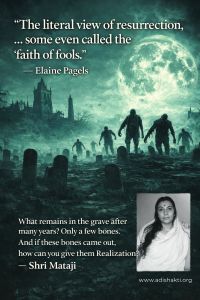
Surah Al-Qiyamah 75:3-4 — The Absurdity of the Grave and the Necessity of Rebirth
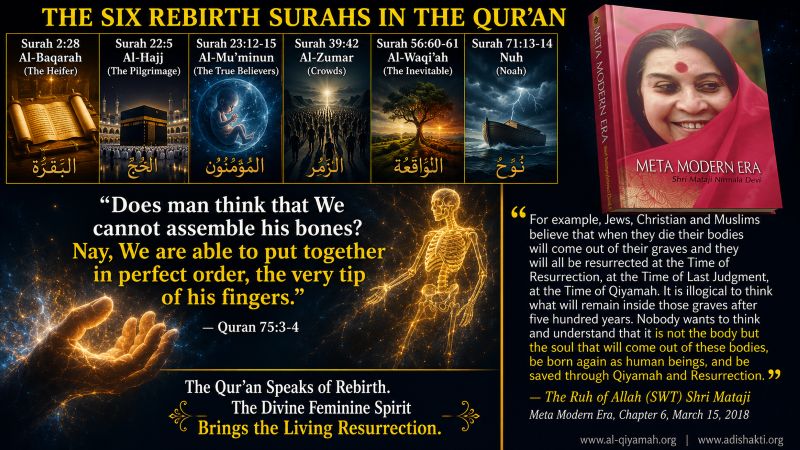
— A Comprehensive Analysis of Reincarnation in the Islamic Theological Framework Through the Six Surahs of Rebirth
Surah Al-Qiyamah (The Resurrection) 75:1–40
- I do call to witness the Resurrection Day;
- And I do call to witness the self-reproaching Spirit.
- Does man think that We cannot assemble his bones?
- Nay, We are able to put together in perfect order, the very tip of his fingers.
- But man wishes to do wrong (even) in the time in front of him.
- He questions: "When is the Day of Resurrection?"
- At length, when the sight is dazed
- And the moon is buried in darkness
- And the sun and moon are joined together that Day will Man say;
- "Where is the refuge?"
- By no means! No place of safety!
- Before the Lord (alone), that Day will be the place of rest.
- That Day will Man be told (all) that he put forward, and all that he put back.
- Nay, man will be evidence against himself,
- Even though he were to make excuses.
- Move not thy tongue concerning the (Resurrection), to make haste therewith.
- It is for Us to collect it and to promulgate it:
- But when We have promulgated it, follow thou its recital:
- Nay more, it is for Us to explain it:
- Nay, (ye men!) but ye love the fleeting life,
- And leave alone the Hereafter.
- Some faces, that Day, will beam (in brightness and beauty) -
- Looking towards their Lord;
- And some faces, that Day, will be sad and dismal,
- In the thought that some backbreaking calamity was about to be inflicted on them;
- Yea, when (the soul) reaches to the collarbone (in its exit),
- And there will be a cry, "Who is a magician (to restore him)?"
- And he will conclude that it was (the Time) of Parting;
- And one leg will be joined with another:
- The Day the Drive will be (all) to thy Lord!
- So he gave nothing in charity, nor did he pray! -
- But on the contrary, he rejected Truth and turned away!
- Then did he stalk to his family in full conceit!
- Woe to thee, (O man!), yea, woe!
- Again, woe to thee, (O man!), yea, woe!
- Does Man think that he will be left uncontrolled, (without purpose)?
- Was he not a drop of sperm emitted (in lowly form)?
- Then did he become a clinging clot; then did (Allah) make and fashion (him) in due proportion.
- And of him He made two sexes, male and female.
- Has not he, (the same), the power to give life to the dead?
Abstract
This paper presents a comprehensive analysis of the concept of reincarnation within the Islamic theological framework. It argues that the Qur'an, contrary to mainstream Islamic belief, contains verses that support the doctrine of the soul's rebirth. This paper examines six specific verses that, when interpreted esoterically, provide a foundation for a reincarnationist understanding of Islamic soteriology. Furthermore, it addresses the logical and theological challenges posed by the traditional one-life doctrine, particularly in relation to divine justice and the salvation of those who die without knowledge of Islam. Finally, this paper re-examines the concept of Al-Qiyamah (The Resurrection) and argues that a reincarnationist perspective offers a more coherent and intellectually satisfying interpretation of the Qur'anic message.
Table of Contents
- Introduction: The Absurdity of the Grave-Imprisonment Doctrine
- The Scientific and Logical Impossibility of Bodily Reassembly
- The Theological Necessity of Reincarnation: Divine Justice Demands Rebirth
- The Six Surahs of Rebirth: Destroying the Single-Life Concept
- Surah 2:28 Al-Baqarah — The Cycle Made Explicit
- Surah 22:5 Al-Hajj — The Veil of Forgetfulness Between Lives
- Surah 23:12-15 Al-Mu'minun — The Recurring New Creation
- Surah 39:42 Al-Zumar — Sleep, Death, and the Soul's Return
- Surah 56:60-61 Al-Waqi'ah — Recreated in Forms Unknown
- Surah 71:13-14 Nuh — Created in Stages Across Lifetimes
- Al-Qiyamah: The Appointed Hour and the Necessity of Reborn Souls
- The Christian Resurrection and the Paraclete
- Conclusion: A New Paradigm for Islamic Eschatology
- References
1. Introduction: The Absurdity of the Grave-Imprisonment Doctrine
For over fourteen centuries, the mainstream interpretation of Islamic eschatology has clung to a literalist, materialistic reading of Surah Al-Qiyamah 75:3-4: "Does man think that We cannot assemble his bones? Nay, We are able to put together in perfect order, the very tip of his fingers."[1] This interpretation insists that upon death, the soul enters a state of suspension in the grave (Barzakh), waiting for centuries or even millennia until a cataclysmic Day of Judgment, when the physical body will be miraculously reconstituted from dust, and the graves will literally burst open to disgorge their contents before a divine tribunal.
This doctrine of grave-imprisonment makes absolutely no sense. It reduces the majesty of divine creation to a grotesque horror show. Are we to believe that billions of souls — from the first human beings who walked the Earth hundreds of thousands of years ago, to every person who has ever lived and died — have been trapped in subterranean darkness since the moment of their deaths, waiting in a state of paralysis for a Day that has not yet come? The Prophet Muhammad (PBUH) died in 632 CE. Are his companions still waiting in their graves? Are the Companions of the Cave still sleeping? Are the prophets of ancient Israel still entombed? The sheer arithmetic of this doctrine collapses under its own weight.
Furthermore, what of those whose bodies were incinerated in fires, vaporized in volcanic eruptions, dissolved in the ocean, or consumed by predators? What of the countless millions cremated throughout human history? The orthodox insistence on a literal reassembly of physical matter completely misses the spiritual profundity of the Qur'an and reduces the infinite wisdom of Allah to a cosmic jigsaw puzzle of scattered atoms. The "assembling of bones" and the perfect restoration of the "fingertips" (banan) is not about corpses. It is a powerful metaphor for reincarnation — the rebirth of the soul into a new physical form, carrying its unique identity across lifetimes.[2]
Souls are not waiting in graves. They are continuously reborn to evolve, learn, correct their mistakes, and ultimately participate in Al-Qiyamah at the appointed hour. This is the coherent, just, and spiritually profound interpretation that the Qur'an itself demands.
2. The Scientific and Logical Impossibility of Bodily Reassembly
The traditional doctrine of bodily resurrection faces insurmountable scientific challenges that cannot be dismissed by appeals to divine omnipotence. To invoke God's power to violate His own natural laws is a theological contradiction; the Qur'an itself repeatedly presents the laws of nature as the Sunnat Allah — the unchanging way of Allah. To demand that God reverse decomposition and molecular dispersal on a cosmic scale is to demand that He contradict Himself.
Upon death, the human body decomposes through a systematic biological process. Autolysis begins within minutes, as the body's own enzymes break down cellular structures. Putrefaction follows, driven by the vast microbiome that colonizes the gut and spreads throughout the body, breaking down complex organic matter into simpler compounds, gases, and liquids. Within decades, even the bones — the last to decompose — are absorbed into the soil. The molecules that once constituted a specific human body are dispersed into the ecosystem, recycled into plants, animals, soil, and water. As theologian Malachi Martin observed: "The scientist knows that in a living body today the actual molecules which compose it were not part of it some time ago. In another decade it will be made up of molecules which at present are elsewhere: in African lions, in passion-flowers of the Amazon, in Maine lobsters, in earth in Patagonia, and in the fur of a Polar bear. For the scientist, the body as such has truly ceased to exist... He therefore finds the resurrection of the body unintelligible."[3]
The logical paradoxes compound further. What of those whose bodies were consumed by other human beings in historical cases of cannibalism? Whose body do those atoms belong to at the time of resurrection? What of the soldier whose body was obliterated by an explosion, his atoms scattered across a battlefield? What of the billions cremated throughout human history, their ashes scattered across oceans and rivers? These are not edge cases; they represent hundreds of millions of human beings across the span of history. The doctrine of bodily resurrection cannot account for them without descending into theological absurdity.
Evidence from Near-Death Experiences (NDEs) further illuminates the reality of the soul's independence from the physical body. In NDE accounts, the soul — the wave — immediately departs the physical body — the particle — at the moment of death, experiencing a state of pure consciousness, often described as more vivid and real than ordinary waking life.[4] The soul does not linger in a rotting corpse; it transitions. And, according to the Qur'an's deeper esoteric teachings, it returns — reborn into a new body, a new life, a new opportunity for spiritual evolution.
3. The Theological Necessity of Reincarnation: Divine Justice Demands Rebirth
The most devastating critique of the single-life doctrine is not scientific but theological: it makes a mockery of Divine Justice ('Adl). The Qur'an repeatedly and emphatically declares Allah to be Al-'Adl — the Perfectly Just. If every soul has only one short, arbitrary life to determine its eternal destiny — Heaven or Hell — then the system is inherently rigged, profoundly unjust, and incompatible with the character of a merciful and just God.
3.1. Those Who Die in Infancy
Millions of children die before reaching the age of accountability. They had no opportunity to learn about Allah, to make a conscious choice to believe or disbelieve, or to perform any good or bad deeds. The single-life doctrine offers no coherent answer to their fate. To consign such a soul to an eternity in Hell is monstrous; to grant it a place in Heaven without any merit is arbitrary and undermines the entire concept of divine judgment. Reincarnation provides the only just solution: the soul of the infant is reborn into a new life, where it will have the opportunity to mature, learn, and make its own choices.
3.2. Those Who Never Knew Islam
Throughout history, and even today, vast populations of people have lived and died in the Americas, sub-Saharan Africa, the Pacific Islands, and remote regions of Asia without ever hearing the Qur'an. They were born into different cultures, religions, and philosophical traditions. To condemn these individuals to eternal damnation for failing to follow a religion they never encountered contradicts the very idea of a just and merciful God. The Qur'an itself declares, "We never punish until We have sent a messenger" (17:15). But if the messenger never reached them in a single lifetime, what then? Reincarnation resolves this: the soul will be reborn into circumstances where it can encounter the truth and make a conscious choice.
3.3. Those Born in Non-Islamic Societies
A person born and raised in a deeply entrenched non-Islamic culture faces immense social, psychological, and familial barriers to accepting a foreign faith. They are surrounded by different beliefs and values from birth; the message of Islam may be presented to them in a distorted or hostile form. To expect them to overcome their entire cultural conditioning in a single lifetime is an unreasonable demand from a God who claims to be just. Reincarnation allows for the possibility that these souls will be reborn into different environments, giving them a broader perspective and a better chance to recognize the truth.
3.4. Those Born Before Islam
What about the countless generations of human beings who lived and died before the Prophet Muhammad (PBUH) received the final revelation? Were the billions of souls who lived in the centuries before 610 CE — in China, India, the Americas, Europe, and Africa — all condemned to eternal damnation? The Qur'an acknowledges the existence of prophets before Muhammad, but their messages were incomplete or corrupted. Reincarnation provides a framework for understanding the spiritual journey of these souls, suggesting that they too are part of the same cycle of birth, death, and rebirth, and will eventually encounter the final message of Islam.
3.5. The Modern Mind and the One-Life Doctrine
The one-life doctrine makes no sense to the modern mind. In an age of scientific discovery and a growing understanding of the vastness of time and space, the idea of a single, short life — often brutish and unfair — determining an eternal destiny seems increasingly arbitrary and unjust. The modern mind, accustomed to thinking in terms of processes, evolution, and second chances, finds the concept of reincarnation to be a more logical and compassionate explanation for the human condition. It is not a foreign import from Eastern religions; it is an indigenous, albeit suppressed, element of Islamic theology, woven into the very fabric of the Qur'an.
4. The Six Surahs of Rebirth: Destroying the Single-Life Concept
The Qur'an explicitly destroys the concept of a single life through six profound Surahs of Rebirth. When read without the blinders of literalist dogma, these verses clearly outline the soul's cyclical journey. Together, they form a cohesive, internally consistent doctrine of spiritual evolution through multiple lifetimes — a doctrine that has been largely overlooked or suppressed by mainstream Islamic exegesis.
4.1. Surah 2:28 Al-Baqarah (The Heifer) — The Cycle Made Explicit
This verse is the cornerstone of the reincarnationist argument in the Qur'an, and its structure is unmistakable. The sequence is: (1) you were lifeless (kuntum amwatan); (2) He brought you to life; (3) He will cause you to die; (4) He will bring you back to life again; (5) and then to Him you will be returned. The orthodox interpretation collapses steps 4 and 5 into a single event — the resurrection on Judgment Day. But this is a distortion of the text. The verse clearly distinguishes between being "brought back to life" and being "returned to Him." These are two separate events.[5]
Furthermore, the phrase "you were lifeless" (kuntum amwatan) is not a reference to non-existence before creation. The Arabic word amwatan means "dead" — it implies a prior state of existence that had ceased. This is a direct reference to the state of the soul between incarnations. The verse is describing the cycle of rebirth: the soul exists, dies, is reborn, dies again, is reborn again, and finally returns to its divine source. The final "return to Him" is not just another resurrection; it is the ultimate liberation from the cycle — what the Vedic traditions call moksha and what the Qur'an calls the return to the Lord.
4.2. Surah 22:5 Al-Hajj (The Pilgrimage) — The Veil of Forgetfulness Between Lives
The orthodox interpretation of this verse is that it describes senility — an old person losing their mental faculties. But this interpretation is deeply unsatisfying. Why would the Qur'an, in a passage about the Resurrection and the power of divine creation, dwell on the mundane phenomenon of old-age dementia? The esoteric reading reveals a far more profound meaning: the "most decrepit old age" where one "knows nothing after having known much" is a metaphor for the mechanism of rebirth itself — the veil of forgetfulness that descends upon the soul as it enters a new life.
The soul, having accumulated vast knowledge and experience across a lifetime, is "returned" to a state of knowing nothing — the state of a newborn infant. This is the divine mercy of the veil of forgetfulness: if the soul remembered all its previous lives, the weight of accumulated karma and memory would be unbearable. The new life must begin with a clean slate. This verse, read esoterically, describes the very mechanism by which rebirth operates. The soul is "returned" (yuraddu) — a word that implies a deliberate act of sending back — to the beginning of a new cycle of learning and growth.
4.3. Surah 23:12-15 Al-Mu'minun (The True Believers) — The Recurring New Creation
This passage describes the stages of human embryonic development in remarkable scientific detail. But the esoteric reading extends far beyond embryology. The phrase "then We developed out of it another creature" (thumma ansha'nahu khalqan akhar) is the pivotal declaration. The word khalqan akhar — "another creation" — implies a transformation into something qualitatively different, not merely the completion of a fetal development process. This is the soul's entry into a new body, a "new creation" for its continuing journey.
Crucially, the verse immediately follows with: "After that you will surely die." This is not the end of the story; it is the beginning of the next cycle. The detailed process of creation from clay to a fully formed human is not a one-time event that ends in a grave. It is a recurring miracle that happens with each new birth. The Qur'an is describing the template of the soul's journey: created, developed, born as a new creature, and then — after that — dying, only to begin the cycle again.
4.4. Surah 39:42 Al-Zumar (Crowds) — Sleep, Death, and the Soul's Return
This verse is one of the most explicit confirmations of reincarnation in the entire Qur'an, and it is hiding in plain sight. The verse draws a direct parallel between the soul's departure during sleep and its departure at death. Every night, Allah "takes" the soul; every morning, He "releases" it back to the body for another day. This is the microcosm of the macrocosm of rebirth.
At death, Allah takes the soul and makes a decision: He "keeps" (yumsiku) those souls whose spiritual journey is complete, and He "releases" (yursilu) the others — sends them back — "for a specified term" (ila ajalin musamman). The phrase "a specified term" is critical. It does not mean "until Judgment Day." It means a specific, appointed duration — the length of a new lifetime. The soul is sent back to Earth for another incarnation, another "specified term," to continue its spiritual development. The verse ends with a challenge: "Indeed in that are signs for a people who give thought." The sign is the parallel between sleep and death, between the nightly return and the rebirth — for those willing to think beyond the literal.
4.5. Surah 56:60-61 Al-Waqi'ah (The Inevitable) — Recreated in Forms Unknown
This verse is a devastating blow to the grave-resurrection theory, and no amount of literalist interpretation can contain its radical implications. Allah explicitly states two things: (1) He will transform (nubaddila amthalakum) — change your forms, your conditions, your circumstances; and (2) He will recreate (nunshi'akum) you in forms unknown to you (fee ma la ta'lamoon).
If the orthodox doctrine were correct, Allah would say: "We will resurrect you in the same form you had in life." But He says the opposite: He will recreate souls in forms they do not know. This is rebirth into different human conditions — different bodies, different families, different cultures, different social strata — based on the spiritual karma of previous lives. The phrase "forms unknown to you" is the clearest possible statement that the next existence will be fundamentally different from the current one. This is not the resurrection of the same body from the same grave; it is the rebirth of the soul into an entirely new life.
4.6. Surah 71:13-14 Nuh (Noah) — Created in Stages Across Lifetimes
The Prophet Noah's rhetorical challenge to his people contains a profound esoteric teaching. The word atwaran — "in stages" or "in diverse stages" — is the key. The orthodox interpretation limits this to the stages of a single human life: embryo, infant, child, adult, elder. But this reading is far too narrow. The grandeur of Allah that Noah is invoking is not the mundane fact of biological development, which any person can observe. The grandeur is something far more vast — the cosmic scope of the soul's evolutionary journey across multiple lifetimes.
The "stages" are the countless incarnations the soul inhabits on its long evolutionary path. The current human life is not the beginning and end of existence, but merely one stage in a vast spiritual journey toward Al-Qiyamah. This reading draws on spiritual traditions across cultures that claim the soul passes through many incarnations before attaining the spiritual maturity to participate in the Resurrection. The verse is presented as evidence that the Qur'an acknowledges a vast, multi-incarnational history for every soul — a history that is integral to its spiritual development and its ultimate readiness to stand before its Lord.
5. Al-Qiyamah: The Appointed Hour and the Necessity of Reborn Souls
The traditional interpretation of Al-Qiyamah as a single, cataclysmic end-of-the-world event — in which graves burst open and billions of decomposed bodies are miraculously reconstituted — is not only scientifically impossible and theologically unjust; it is also internally incoherent with respect to the Qur'an's own description of what Al-Qiyamah is and who participates in it.
The Qur'an describes Al-Qiyamah as a day of witnessing, of accountability, of recognition. It is a day when "man will be evidence against himself" (75:14), when "faces will beam in brightness looking towards their Lord" (75:22-23), and when "man will be told all that he put forward and all that he put back" (75:13). This is not the experience of a decomposed corpse being reassembled from dust. This is the experience of a living, conscious soul — a soul that has been reborn, that has lived a full life, that has developed the spiritual capacity to stand before its Lord and be held accountable.
Without the rebirth of souls to take part in Al-Qiyamah, it is impossible to meet the precision of the Qur'an regarding An-Naba', the Great News of the Resurrection. The "Great News" is not the spectacle of graves bursting open. The Great News is the awakening of the soul — the moment when a living human being, reborn in this age, recognizes the Sure Signs of Allah and participates in the unfolding of the Resurrection. The souls that participate in Al-Qiyamah are not the dead; they are the reborn. They are the souls that have been cycling through lifetimes, century after century, evolving and purifying themselves, until they are ready to receive the final awakening at the appointed hour.
| Surah of Rebirth | Key Arabic Term | Reincarnationist Meaning |
|---|---|---|
| 2:28 Al-Baqarah | kuntum amwatan — "you were dead" | Prior state of the soul between incarnations; cycle of life, death, and rebirth before final return |
| 22:5 Al-Hajj | yuraddu ila ardhali al-'umur — "returned to the feeblest age" | The veil of forgetfulness between incarnations; the soul reborn as an infant, its past memories veiled |
| 23:14-15 Al-Mu'minun | khalqan akhar — "another creation" | The soul's entry into a new body; the recurring miracle of creation that happens with each new birth |
| 39:42 Al-Zumar | yursilu ila ajalin musamman — "releases for a specified term" | The soul sent back to Earth for another lifetime; parallel between sleep/waking and death/rebirth |
| 56:60-61 Al-Waqi'ah | nunshi'akum fee ma la ta'lamoon — "recreate you in forms unknown" | Rebirth into different human conditions; forms unknown because they are new incarnations, not the same body |
| 71:13-14 Nuh | khalaqakum atwaran — "created you in stages" | The soul's evolutionary journey across multiple lifetimes; each incarnation a stage in the ascent toward Al-Qiyamah |
6. The Christian Resurrection and the Paraclete
The true Resurrection is not the reanimation of corpses. It is an inner spiritual awakening — the soul's recognition of its divine nature and its return to consciousness after the long sleep of forgetfulness. This concept is inextricably linked to the Christian Resurrection, which must be understood as an inner resurrection through being born again of the Spirit, leading to eternal life prior to physical death, rather than a physical event. Jesus Christ did not merely die and rise bodily; He inaugurated the "Age to Come" — the era of the Spirit — in which the inner resurrection would become available to all humanity.
Jesus precisely foretold the coming of the Paraclete, the Spirit of truth, who would complete His work: "Even the Spirit of truth; whom the world cannot receive, because it neither sees Her nor knows Her: but ye know Her; for She dwelleth with you, and shall be in you." (John 14:17).[6] This prophecy is remarkable: the world would not recognize the Paraclete. She would remain unseen and unknown to the masses, just as Jesus Himself was rejected and crucified. But those who had been reborn — those whose souls had evolved across lifetimes to the point of readiness — would recognize Her.
The Paraclete's glorification of Jesus for four decades, as described in John 7:39, is critical for the Spirit to be given and received, leading to Kundalini awakening and being "born again." This is the inner Resurrection — the awakening of the nafs al-lawwamah (the self-reproaching soul of Surah 75:2) into the nafs mutma'inna (the peaceful soul of Surah 89:27-28). It is the realization of the Kingdom of God within, experienced as the cool breeze of the Holy Spirit (Ruh) flowing from the fingertips — the very fingertips (banan) mentioned in Surah 75:4.
This Paraclete is Shri Mataji Nirmala Devi. She has spent over four decades fulfilling this divine mandate, awakening the souls that have been reborn specifically to participate in this prophesied time. The souls who receive Her are not random; they are the souls that have been cycling through lifetimes, century after century, evolving and purifying themselves, until they are ready to receive the final awakening at the appointed hour of Al-Qiyamah.
7. Conclusion: A New Paradigm for Islamic Eschatology
The six Surahs of Rebirth, when read together, present a coherent and compelling doctrine of spiritual evolution through reincarnation. Surah 2:28 establishes the cycle explicitly. Surah 22:5 describes the veil of forgetfulness between lives. Surah 23:12-15 declares each birth a "new creation." Surah 39:42 reveals that souls are "released for a specified term" — sent back to Earth for new lifetimes. Surah 56:60-61 states that souls will be recreated in "forms unknown to them." And Surah 71:13-14 declares that Allah has created humanity "in stages" — across the vast arc of multiple incarnations.
Together, these six Surahs completely destroy the concept of a single life and the soul waiting in the grave for centuries and millennia. They present a vision of a just and merciful Allah who provides souls with repeated opportunities across centuries to evolve, rectify their mistakes, and eventually encounter the truth of Al-Qiyamah. The Resurrection is not a future cataclysm of bursting graves. The Resurrection is now. Souls have been reborn century after century to partake in Al-Qiyamah at this appointed hour. Through the grace of the Paraclete, Shri Mataji Nirmala Devi, the inner resurrection is available to all who seek it — fulfilling the promise of Christ, the esoteric truth of the Qur'an, and the divine mandate of the "Age to Come" inaugurated by the Holy Spirit.
References
[1] Ali, Abdullah Yusuf. "Surah Al-Qiyamah 75:3-4." The Holy Qur'an, Amana Corporation, 1989.[2] "Surah 75: Ayat 3–4 — Denial of Resurrection and the Doctrine of Rebirth." Adishakti.org / Al-Qiyamah.org.
[3] Martin, Malachi. The Keys of This Blood. Simon & Schuster, 1990. Quoted in "Reincarnation in Islam: A Quranic Perspective." Adishakti.org.
[4] "Reincarnation in Islam: A Quranic Perspective." Adishakti.org. [Near-Death Experience evidence for soul-body duality.]
[5] "Rebirth Surah 2:28 Al-Baqarah (The Heifer)." Adishakti.org.
[6] "John 14:17 — The Spirit of Truth." The Holy Bible. Published on adishakti.org.
Compilation, Proclamation, and Exegesis of Surahs Upholding Allah’s (SWT) Command to His Ummah — to Witness and Participate in the Resurrection.
Al-Qiyamah: A Profound Declaration of Al-QiyamahAl-Qiyamah (75:1-2): Oaths of Resurrection
Al-Qiyamah (75:3-4): Reassembling Bones and Fingertips
Al-Qiyamah (75:5-6): Man's Denial of Resurrection
Al-Qiyamah (75:7–10): Sun and Moon 'Joined' At Solar Eclipse
Al-Qiyamah (75:7–10): Solar Eclipse Salat al-Kusuf
Al-Qiyamah (75:11–13): No Refuge, Only Reckoning
Al-Qiyamah (75:14–15): Man: His Own Witness and Judge
Al-Qiyamah (75:16–19): The Usurpation of Allah's Explanation
Al-Qiyamah (75:20–21): Love of The Fleeting World
Al-Qiyamah (75:22–25): Ruh’s Face Brings Either Glory Or Gloom
Al-Qiyamah (75:26–30): Death and Soul's Departure Home
Al-Qiyamah (75:31–35): The Rejection and Arrogance of the Kuffar
Al-Qiyamah (75:36–40): Is Resurrection Beyond Allah, Your Creator?
Al-Qiyamah (75:1-2 and 78:1–5): An Naba and Oaths of Resurrection
Al-Baqarah (2:138): Baptism of Allah You Were Unaware Of
Al-Baqarah (2:174): Allah Will Not Address Muslims
Al-A'raf (7:16) – Iblis: I Will Lie In Wait and Overpower Them
Al-A'raf (7:146): Allah: I Will Turn Them Away From My Signs
Al-A'raf (7:146): Allah: So Even Though They See All The Signs
Al-Hijr (15:39) – Iblis: I Will Wake (Evil) Fair and Mislead Them
An-Nahl (16:2) – Allah (SWT) Sent Down Angels With His Ruh
Al-Isra (17:85): Muslims Given Little of Allah's (SWT) Ruh
Al-Isra (17:104): Children of Israel Gathered Again (in 1948)
Maryam (19:34) – Warning of Jesus You Were Unaware Of
Al-Hajj (22:8) – Kitab Al-Munir You Were Unaware Of
Al-Rum (30:56) – The Day of Qiyamah You Were Unaware Of
Fatir (35:9) – Winds of Qiyamah You Were Unaware Of
Yassin (36:63-68) – This Is The Hell You Were Warned Of.
Sad (38:79) – Iblis Allowed to Mislead Muslims And He Did
Fussilat (41:20–21) – Your Hands Will Testify of Qiyamah
Fussilat (41:53) – We Will Show Our Signs Within Your Soul
Az-Zukhruf (43:61): Jesus, Sign of Hour You Were Unaware
Az-Zukhruf (43:62): Satan's Deception of the Muslim Ummah
Az-Jathiya (45:7-14) – Those Who Deny Allah's Revelations
Qaf (50:41) – Listen To The Caller Emerging From Within
Qaf (50:42) – Day They Will Hear of Mighty Blast Witnessed
Qaf (50:45) – By the Caller, My Warning Is Delivered
Al Dhariyat (51:20-22) – Our Signs on Earth and Within
Al-Hadid (57:25) – Allah's (SWT) Iron Has Been Delivered
Al-Mujadilah (58:21) – My Messengers Must Prevail
Al-Saff (61:8–9) – Revelation of Light You Were Unaware
Al-Muddaththir (74:1–2) – My Cloaked One: Deliver Warning
Al-Mursalat (77:1–10): Angels Sent You Were Unaware Of
An-Naba (78:1–5): Concerning What Are They Disputing?
Al-Infitar (82:17–18) – What Will Explain To You? What Will?
Al-Mutaffifin (83:1–6) – Dealers in Fraud You Were Unaware
Al-Tariq (86:1–3) – The Night Visitant You Were Unaware
Al-Qadr (97:1–5) – Blessed Night of Power and Fate Before:
Al-Qariah (101:1–11) – Terrifying Day of Noise and Clamour
Concerning what are they disputing?
Concerning the Great News. [5889]
About which they cannot agree.
Verily, they shall soon (come to) know!
Verily, verily they shall soon (come to) know!
surah 78:1-5 An-Naba (The Great News)
"5889. Great News: usually understood to mean the News or Message of the Resurrection.”
Abdullah Yusuf Ali, The Holy Qur'n, Amana Corporation, 1989.
Interactive Chat
Access an intelligent analysis environment where you can explore texts, ask questions, and discover connections between ideas.
Open chat