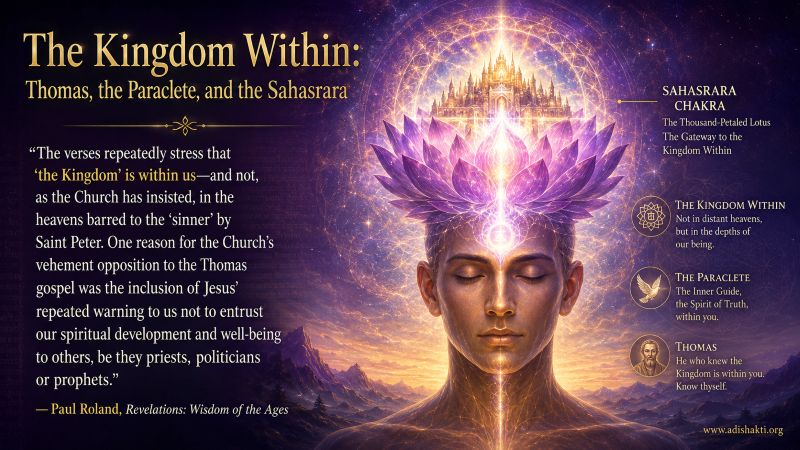
 The Kingdom Within: Thomas, the Paraclete, and the Sahasrara
 The Inner Reality Must Be Realized
 Jesus and Nicodemus: The Wind of the Spirit
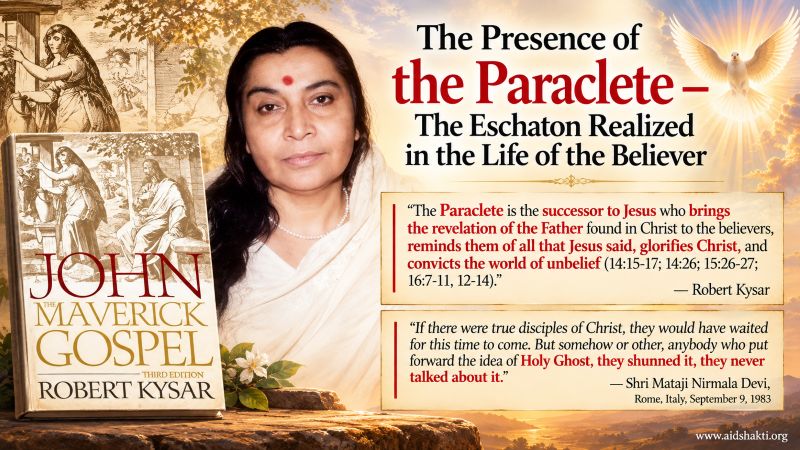 The Presence of the Paraclete
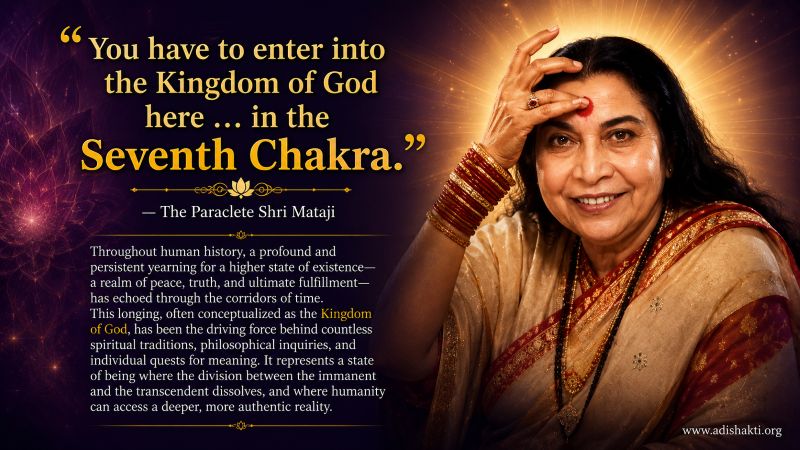 Enter the Kingdom of God in the Seventh Chakra
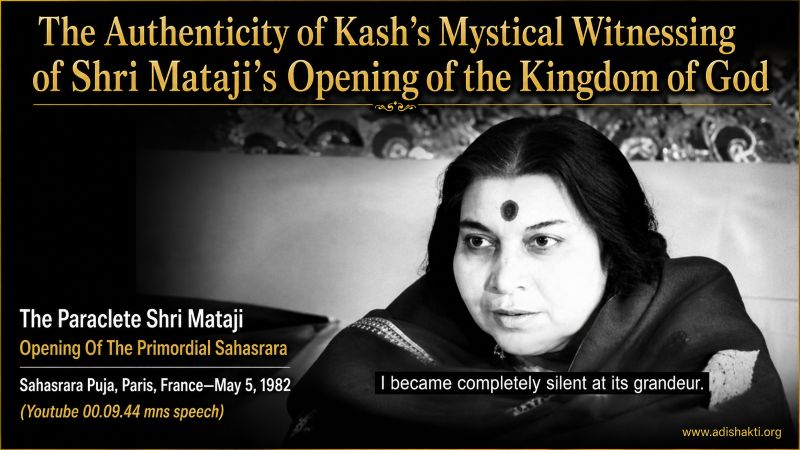 The Authenticity of the Kingdom of God
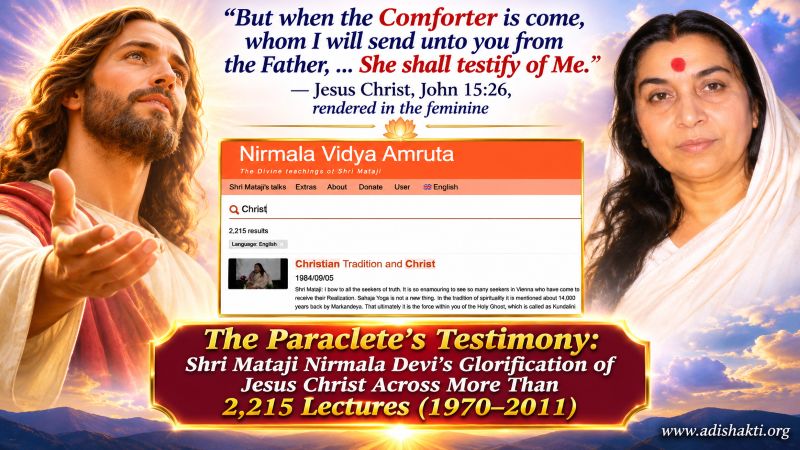 She Shall Testify of Me
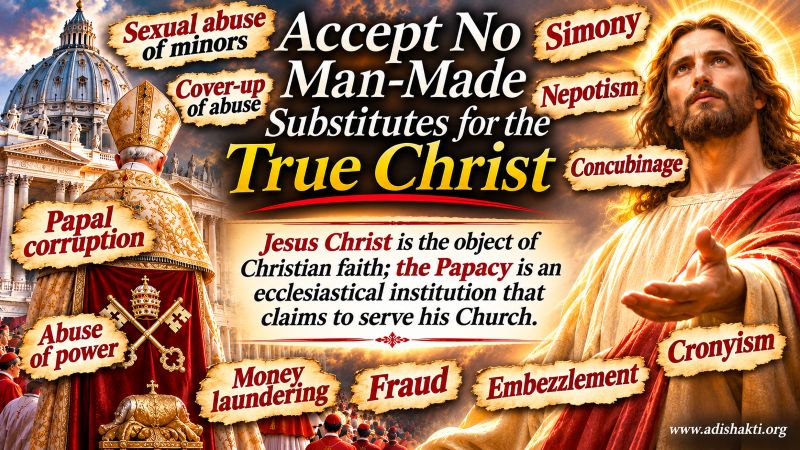 Accept No Man-Made Substitutes for the True Christ
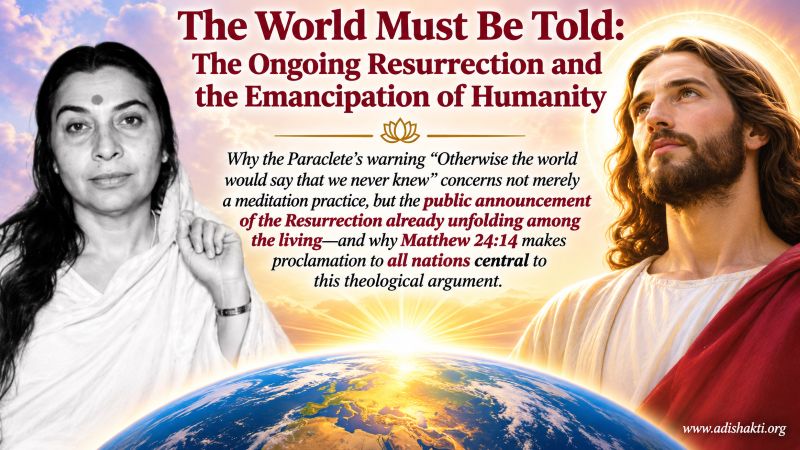 The World Must Be Told
The Inner Experience of Jesus Is Available to All: Beware That No One Lead You Astray
The Gospel of Mary, the Son of Man Within, and the Religion of No External Rules

Summary
This paper takes as its subject a single, explosive sentence-cluster from the farewell discourse of the Gospel of Mary: “Beware that no one lead you astray saying Lo here or lo there! For the Son of Man is within you. Follow after Him! Those who seek Him will find Him. Go then and preach the gospel of the Kingdom. Do not lay down any rules beyond what I appointed you, and do not give a law like the lawgiver lest you be constrained by it” (Gospel of Mary 4:34–38).[1] The saying is preserved in a fifth-century Coptic codex, Papyrus Berolinensis 8502, copied from a Greek original composed most probably in the second century.[2][3] It was effectively lost to the Christian world for roughly fifteen hundred years.
The paper argues that the saying possesses a rigorous internal logic that has been insufficiently noticed. Because the Son of Man is within, no external place can house him and no external broker can dispense him; because he is found by those who seek, the decisive authority is the encounter itself rather than any institution that claims to certify it; and because the commission to preach the Kingdom is universal, any system that monopolizes access to the Kingdom has already become the “leading astray” that the text warns against. The prohibition on law-making is therefore not an incidental aside. It is the sociological consequence of the text’s theology.
The study proceeds in four registers, kept deliberately distinct: the primary text and its manuscripts; historical-critical scholarship on the Gospel of Mary; the confessional synthesis advanced at AdiShakti.org, in which the Paraclete is Shri Mataji Nirmala Devi and the Kingdom is the opened Sahasrara; and a comparative theological proposal regarding interiority, silence, and experiential verification. It examines the manuscript recovery of the Gospel of Mary, the anatomy of spiritual deception, the canonical trajectory of inwardness from Daniel through Luke, Thomas, and John, the meaning of the “lawgiver” clause, the sociological process by which charisma hardens into law — the process named in the epigraph as the petty SYSSR — and the disciplines of Silence on Self, the Cool Breeze, and the Blossom Time. Its conclusion is that the Gospel of Mary does not abolish structure; it abolishes the substitution of structure for transformation, and it locates the only adequate verification of the Resurrection in an experience available to every human being without payment, permission, or pedigree.
Table of Contents
- Introduction: A Saying That Refuses Every Broker
- The Recovery of a Lost Christianity: Papyrus Berolinensis 8502
- “Beware That No One Lead You Astray”: The Anatomy of Deception
- “The Son of Man Is Within You. Follow After Him!”
- “Do Not Lay Down Any Rules”: Law and the Conditioned Soul
- The Petty SYSSR: When Charisma Hardens into Law
- Silence on Self: The Unconditioned Mind
- The Cool Breeze as Warranty: Experience Against Dogma
- The Blossom Time: Resurrection Now
- “No External Manmade Rules”: Discernment Without Lawlessness
- Conclusion: The Son of Man Within
- References
1. Introduction: A Saying That Refuses Every Broker
The scene is a farewell. A teacher has finished speaking about matter, about the dissolution of all compounded things, and about the strange claim that “there is no sin, but it is you who make sin” when you act according to a nature that is not your own.[1] He greets his frightened companions with peace, and then he gives them six sentences that have never been comfortably housed in any institution. They are a warning, a localization, an imperative, a promise, a commission, and a prohibition. Together they constitute one of the most compressed programs of spiritual freedom in ancient literature.
The warning is that others will lead them astray, and that the mechanism of the deception will be spatial: someone will say “Lo here!” or “Lo there!” The localization is that the Son of Man is within them. The imperative is to follow after him. The promise is that seeking finds. The commission is to preach the gospel of the Kingdom. The prohibition is that they must not lay down rules beyond what was appointed to them, nor give a law like the lawgiver, “lest you be constrained by it.”[1] The logic is exact, and it is the logic this paper proposes to unfold: the moment the infinite is located elsewhere, it must be administered by someone; and the moment it is administered, the administrators become the very obstacle the teacher warned about.
That logic arrives in the present with unusual force. The epigraph to this paper, written by jagbir of AdiShakti.org, does not merely quote the Gospel of Mary; it applies the saying as a diagnostic instrument to a living religious movement. It names a deformation — the “petty SYSSR (Sahaja Yoga Subtle System Religion)” — and it asserts that the inner experience of Jesus remains available to all precisely because it cannot be captured by that deformation. The rhetoric is prophetic rather than academic: “thousands of fools” is the idiom of an Amos or a Jeremiah, not of a seminar. This paper will treat that rhetoric as a datum to be interpreted rather than as a verdict to be repeated, and it will attempt the harder task of stating, in plain and defensible terms, what the diagnosis actually identifies.
Method matters here, because the claims at stake are of different kinds and collapse into confusion when they are not separated. This study therefore distinguishes four registers throughout. The primary-text register establishes what the Gospel of Mary and the canonical scriptures actually say in their best available translations. The historical-critical register reports what specialists conclude about manuscripts, dates, genres, and social settings, and it registers their disagreements honestly. The confessional register states what AdiShakti.org proposes — that the Paraclete promised in John 14–16 is Shri Mataji Nirmala Devi, that the Kingdom of God is the opened Sahasrara, and that the Cool Breeze is the tangible witness of the second birth. The comparative register asks what may responsibly be said when these materials are placed in conversation. A paper that confuses the third register with the second is propaganda; a paper that refuses the third register altogether cannot engage the tradition it is studying. This paper tries to keep the registers distinct while refusing to let any of them be silenced.
Three theses will be defended. First, that the Gospel of Mary’s farewell discourse is not a marginal curiosity but a coherent theological position whose central affirmation — the inwardness of the Son of Man — is anticipated by Luke, by the Gospel of Thomas, and by the Johannine Paraclete promises. Second, that the prohibition on law-making is the necessary social corollary of that inwardness, and that it names a permanent structural temptation rather than a single historical enemy. Third, that the tradition stemming from Shri Mataji Nirmala Devi supplies both a practice (Silence on Self) and a criterion (the Cool Breeze) by which the inward claim can be tested without being converted into a new law. The argument is cumulative: each section removes one prop on which external religious authority has habitually rested.
2. The Recovery of a Lost Christianity: Papyrus Berolinensis 8502
The Gospel of Mary survives by accident, and the accident is worth recounting, because the text’s history is itself an illustration of its content. In 1896 a German scholar, Carl Reinhardt, acquired a papyrus codex in Cairo. The codex — variously called the Berlin Gnostic Codex, the Akhmim Codex, PB 8502, or BG 8502 — contained Coptic editions of four works: the Apocryphon of John, the Sophia of Jesus Christ, the Gospel of Mary, and the Act of Peter.[4] Two world wars and a series of scholarly misfortunes delayed publication until 1955, when Walter Till issued the editio princeps.[5] By then the Nag Hammadi discovery of 1945 had transformed the field, and two of the Berlin texts were found to be duplicated there. The Gospel of Mary, uniquely, was not.
The physical condition of the manuscript governs everything that can be said about it. The codex preserves pages 7–10 and 15–19 of the Gospel; pages 1–6 and 11–14 are lost, so that less than half of the original text remains.[4] The narrative accordingly begins in the middle of a dialogue and breaks off precisely where Mary begins to report her vision, resuming only as a soul is already ascending past the hostile powers. Two third-century Greek fragments partially fill the gap in our knowledge of the original language: P.Ryl. III 463, published by C. H. Roberts in 1938, and P.Oxy. L 3525, published by Peter Parsons in 1983.[6][7] A further Oxyrhynchus fragment, P.Oxy. 5577, may belong to the same work. The Greek fragments do not restore the missing pages, but they establish that the Coptic is a translation and they occasionally preserve an earlier form of the text.
Dating is contested within narrow limits. Because the Rylands fragment belongs to the early third century, the Greek original must predate it. Karen King, Hollis Professor of Divinity at Harvard, places composition early in the second century, noting the text’s familiarity with the Gospel of John and perhaps with the Pauline letters.[2] Christopher Tuckett, in the standard Oxford commentary, surveys the alternatives and adopts a middle position: the first half of the second century, but later than King.[3] A conventional working range of 120–180 CE is therefore reasonable, and nothing in the argument of this paper depends on a more precise figure.[8]
Genre is clearer than date. The Gospel of Mary belongs to the category of post-resurrection dialogue gospels: the risen Savior instructs the disciples, departs, and the community must then learn to live without his physical presence. The preserved structure has three movements. First comes a dialogue on matter and sin, ending with the farewell discourse that concerns us (7:1–9:4). Second comes Mary’s vision and her account of the soul’s ascent past the powers of darkness, desire, ignorance, and wrath (9:5–17:7). Third comes the dispute among the disciples, in which Andrew and Peter reject Mary’s testimony and Levi defends her (17:7–19:2).[4] The theology is not a simple dualism. Esther de Boer has argued forcefully that the work should not be classified as “Gnostic” in the technical sense at all, since its view of nature is monistic rather than dualistic and its purpose is to encourage fearful disciples to preach.[9] Whatever label is preferred, the text’s central concern is unmistakable: the soul must discover its own root in the Good and return to it.
The identity of “Mary” has been debated. Some scholars have proposed Mary the mother of Jesus or an otherwise unknown sister; King argues that only Mary Magdalene could play all the roles the text requires — woman, exemplary disciple, witness, visionary, and traditional rival of Peter.[2] The question is not decorative. The Western legend that identified Mary Magdalene with the anonymous sinful woman of Luke 7 was a late construction, given classic form in Pope Gregory the Great’s homily of 591 CE, and it functioned for centuries to discredit precisely the kind of authority this gospel attributes to her.[10] King’s judgment that the prostitute identification is “a piece of theological fiction” is now widely accepted.[2]
Why was the Gospel of Mary lost? The honest answer is more mundane, and more instructive, than the conspiracy narrative. Canons were formed by use, attribution, liturgical fit, and local reception rather than by a single act of suppression; a short dialogue gospel without apostolic authorship and without a passion narrative had little chance of surviving in the lectionary. What can be said is that the text represents a form of Christianity in which the risen Christ continues to teach through vision, in which a woman is the authorized bearer of that teaching, and in which the community’s leaders are shown resisting both. King’s characterization remains the best summary: the gospel offers “an intriguing glimpse into a kind of Christianity lost for almost fifteen hundred years,” one that “asks us to rethink the basis for church authority.”[2] The recovery of that glimpse does not require the demolition of the canon. It requires only the admission that the canon is a selection, and that what was selected out may still be true.
3. “Beware That No One Lead You Astray”: The Anatomy of Deception
The first sentence of the farewell discourse is a warning, and its grammar deserves attention. The Coptic reads, in the standard rendering, “Beware that no one lead you astray saying Lo here or lo there!”[1] The participle is decisive. What is condemned is not error in the abstract but a particular speech-act: someone comes to the seeker and points. The deceiver is the person who says there — there is the master, there is the ashram, there is the initiation, there is the seminar, there is the correct diagram of the subtle body. The warning anticipates a market in locations.
The synoptic tradition knows this speech-act well. In Luke, the Pharisees ask when the Kingdom is coming, and Jesus answers that it does not come “with signs to be observed,” nor will they say, “Look, here it is!” or “There it is!”[12] In Mark’s apocalyptic discourse the warning becomes explicit: “If anyone says to you, ‘Look! Here is the Messiah!’ or ‘Look! There he is!’ do not believe it. False messiahs and false prophets will appear and produce signs and omens, to lead astray, if possible, the elect.”[14] The Gospel of Mary states the same prohibition and then supplies the reason: the one being pointed to is already inside the person being addressed.
There is a further, subtler dimension. The deception envisioned is not primarily doctrinal but mediating. A false messiah does not merely teach something incorrect; he inserts himself between the seeker and the inward presence. The Gospel of Mary makes this explicit at its close, when the dispute erupts not over doctrine but over whether Mary’s vision can be trusted and whether a woman may be its bearer. Andrew says he does not believe “that the Savior said this. For certainly these teachings are strange ideas.” Peter asks whether the Savior really spoke privately with a woman and not openly to them, and whether they are now to “turn about and all listen to her.”[1] The community’s own leaders are the ones who stumble at the inward revelation. King’s reading is exact: Peter and Andrew represent positions that deny the validity of esoteric revelation and the authority of women to teach, and the text attacks both positions head-on.[2]
Here the epigraph’s most abrasive phrase becomes analytically legible. “Thousands of fools” is not a census; it is an argument about numbers. The saying in Matthew runs, “many false prophets will arise and lead many astray” — the repetition of “many” is the point.[14] Quantity is the oldest and cheapest warrant in religious history: if a teaching has thousands of adherents, thousands of books, and thousands of testimonials, the seeker is invited to infer that it must be true. The Gospel of Mary refuses the inference at the outset. The crowd is precisely the condition under which the pointing becomes plausible, and therefore the condition under which vigilance is most required. The same logic appears, with unusual psychological realism, in the epigraph’s own tradition: Shri Mataji Nirmala Devi described the Dutch spiritual market of the 1980s as a “guru supermarket” and told her audience, “Do not follow anyone just like a sheep. Everything has to be logical. You have human brains.”[25] The idiom differs; the diagnosis is identical.
Yet the warning contains a trap, and the trap is the reason this paper must be more than an exercise in denunciation. A prohibition on deception cannot be institutionalized without creating a class of certified non-deceivers — and that class is, by the terms of the prohibition, exactly what must not exist. Every attempt in Christian history to build an office whose function is to guarantee that the faithful are not led astray has reproduced the structure it was meant to prevent. The Inquisition was a vigilance committee. The Index was a reading list for the prevention of error. The result in each case was that the cure became indistinguishable from the disease. The Gospel of Mary anticipates the problem by refusing to supply any external criterion at all: it does not say “test the teachers against this creed,” but “the Son of Man is within you.” The criterion is relocated to the place where no bureau can reach it. Whether that relocation is intellectually responsible is the question to which the next sections are addressed.
4. “The Son of Man Is Within You. Follow After Him!”
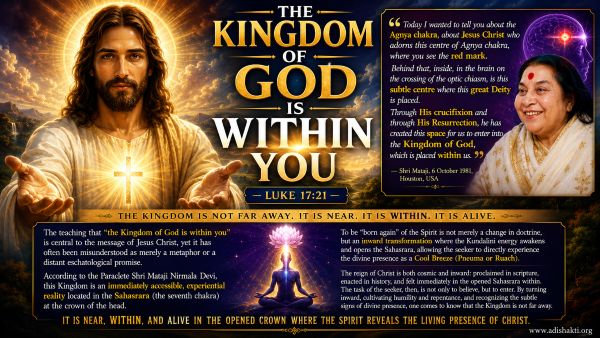
The title “Son of Man” carries an apocalyptic charge that the Gospel of Mary deliberately redirects. In Daniel 7:13, one “like a son of man” comes with the clouds of heaven and receives dominion, glory, and a kingdom.[15] The figure is celestial, public, and majestic. To say, as the Gospel of Mary does, that this figure is within you is not a mild moralization. It is a relocation of the throne. The kingdom that Daniel saw arriving on the clouds is said to be already present in the interiority of the frightened disciples — not in the sky, not in the sea, not in the temple, not in the assembly, but in the place where a person is alone with himself.
The canonical warrant for such a relocation is stronger than is often admitted. Luke 17:20–21 reports that the Kingdom “is not coming with things that can be observed,” that people will not say “Look, here it is!” or “There it is!,” and that “the kingdom of God is among you” — or, in the older and still defensible rendering, “within you.” The Greek phrase entos hymōn can bear either sense, and the translation debate is genuine: interpreters who emphasize that Jesus is addressing Pharisees usually prefer “in your midst.”[12] But the argument of the verse is unaffected by the choice. Under either rendering, Jesus refuses the question “when?” and refuses the gesture “there!” He denies that the reign of God is the kind of thing that can be scheduled or pointed at. That denial is the load-bearing wall on which the Gospel of Mary builds.
The Gospel of Thomas builds on the same wall with greater explicitness. In saying 3, Jesus warns that if the guides say the Kingdom is in the sky, the birds will arrive first; if they say it is in the sea, the fish will. Then comes the affirmation: “Rather, the kingdom is inside of you, and it is outside of you. When you come to know yourselves, then you will become known, and you will realize that it is you who are the sons of the living father.”[13] Saying 113 repeats the refusal of the spatial sign: the Kingdom will not come by waiting for it, nor by saying “here” or “there”; it is already spread upon the earth, and people do not see it.[13] The double affirmation — inside and outside — is important. The text is not proposing a private interiority sealed against the world. It is proposing a mode of perception in which the divine is not confined to either side of the skin.
The Johannine tradition supplies the personal grammar for this presence. Jesus promises the Paraclete, the Spirit of truth, whom the world cannot receive because it neither sees nor knows her; “you know her, because she abides with you, and she will be in you.”[16] The same discourse promises that this indwelling teacher will teach all things, remind the disciples of what Jesus said, and guide them into all truth. The Paraclete is thus not a doctrine to be believed but a teacher to be heard, and the locus of the teaching is interior. In the Johannine register, the Spirit is rendered with feminine pronouns in the theological convention adopted throughout AdiShakti.org; the grammatical point is disputed, but the theological point — that the promised presence is personal, active, and inward — is not.
Elaine Pagels drew the consequence in her landmark study of the Nag Hammadi library. In the Gospel of Thomas, she observed, the Kingdom is “not an event that’s going to be catastrophically shattering the world as we know it”; it is a state of consciousness, entered through gnosis, and gnosis is not intellectual information but self-knowledge: “when you know yourself at that level you will also come to know God, because you will discover that the divine is within you.”[11] King makes the same move for the Gospel of Mary, whose Savior “has come so that each soul might discover its own true spiritual nature, its ‘root’ in the Good, and return to the place of eternal rest.”[2]
Within the confessional register of this paper, the inward locality receives a precise physiological address. Shri Mataji Nirmala Devi taught that Christ resides in the sixth center, the Agnya chakra, between the pituitary and pineal bodies, and that the Kingdom of God is opened at the crown, the Sahasrara. She stated the claim with a bluntness that is either extraordinary or fraudulent and cannot be politely middled: “People say Christ is within us. Where is He? Which part? Where is He placed? He is placed in this centre. Now when I say that He is placed in there, we can prove it.”[22] In Cambridge in 1984 she described the Kingdom as a gate at the crown through which the seeker passes into “His court,” receiving there the powers of a citizen.[23] The AdiShakti.org synthesis of this material identifies the Sahasrara with the Kingdom and Kundalini awakening with the second birth, and it explicitly labels that identification a confessional proposal rather than a historical-critical conclusion.[35] The honesty of that labeling is itself a scholarly virtue, and this paper adopts it.
One further element of the saying prevents the inward turn from collapsing into solipsism. The imperative is not “look within” but “follow after him.” The object is a person, not a state. Interiority without discipleship becomes the worship of one’s own mood, and the history of spirituality is littered with teachers who mistook their moods for the Son of Man. The Gospel of Mary avoids this by keeping the imperative attached to the person who has just departed: the inward one is the same one who spoke, who was crucified, who appeared. To follow him is to be conformed to a character — to his truthfulness, his freedom, his refusal of power — and not merely to consult an inner oracle. The distinction is crucial for everything that follows, because it means that the criterion of authentic inwardness is moral and personal, not merely experiential. The Son of Man within is not the ego writ large; he is the one whose presence exposes the ego. That is why the next requirement is silence.
5. “Do Not Lay Down Any Rules”: Law and the Conditioned Soul
The penultimate sentence of the discourse is its most radical: “Do not lay down any rules beyond what I appointed you, and do not give a law like the lawgiver lest you be constrained by it.”[1] The word behind “lawgiver” is the Greek nomothetēs, a loanword in the Coptic text, and its referent has been disputed since the text was recovered. Three identifications have been proposed: Moses, the archetypal legislator of Israel; the ecclesiastical authorities of the second century, who were beginning to issue regulations in the Savior’s name; or the cosmic powers whose rule the ascending soul must escape. Judith Hartenstein’s survey notes the difficulty without resolving it, and Tuckett’s commentary treats the clause as one of the text’s genuinely obscure passages.[4][3] The scholarly caution is warranted, and this paper will not pretend to settle what specialists have not.
The force of the sentence, however, does not depend on identifying the lawgiver. It depends on a grammatical observation that any reader can verify: the prohibition is directed not at a body of laws but at the act of legislating. The disciples are not told to obey badly; they are told not to become sources of law. And the reason given is reflexive: “lest you be constrained by it.” The one who issues the statute is the first person imprisoned by it. This is a remarkable psychological insight to find in a second-century text. The legislator imagines himself the master of the rule he imposes; in fact he has created a standard against which he will now be measured, a boundary he may not cross, a role he must maintain. The lawgiver is not the law’s owner but its first subject.
The clause “beyond what I appointed you” is equally important, because it prevents the sentence from being read as antinomianism. There is an appointment. There is a gospel to preach, a Kingdom to announce, a peace to receive, a practice of seeking. What is forbidden is addition. The distinction is between a commission and a code, between a vocation and a statute book. The disciples are sent as witnesses, not installed as legislators; and the moment a witness begins to legislate, the witness has changed profession.
This is not an alien intrusion into biblical religion; it is the radicalization of one of its deepest currents. Jeremiah promised a new covenant in which the law would no longer be inscribed on stone but written on the heart, so that “they shall all know me, from the least of them to the greatest.”[17] Ezekiel promised a new spirit within, replacing the heart of stone with a heart of flesh.[18] Deuteronomy anticipated a prophet like Moses, to whom the people must listen — a promise that already relativizes the mediation of the original lawgiver.[19] The Gospel of Mary takes this trajectory to its conclusion: if the teacher is within, the external code has become not merely unnecessary but obstructive.
The same logic appears in the canonical critique of religious burden-bearing. Matthew’s Jesus accuses the scribes and Pharisees of binding heavy burdens on others’ shoulders while refusing to lift a finger to move them.[20] The apostolic council in Acts rejects the imposition of circumcision and legal observance on Gentile believers on the ground that it would place a yoke on the neck of disciples that neither they nor their ancestors could bear.[21] Paul tells the Galatians that Christ has set them free, and that they must not submit again to a yoke of slavery.[24] These texts differ in vocabulary and situation, but they share a single structure: the community is warned that the addition of requirements, however pious in intention, can nullify the very freedom it was meant to protect.
The Gospel of Mary supplies the anthropology that explains why. Its Savior does not say that sin is nothing; he says that sin is what human beings make when they act “in accord with the nature of adultery” — that is, when they turn away from their own root and live from a nature that is not theirs. The remedy is not a rule but a restoration: “the Good came into your midst, to the essence of every nature in order to restore it to its root.”[1] The ethical problem is thus construed as a problem of orientation rather than of compliance. A rule can restrain behavior while leaving the orientation untouched; only a restoration of the root can heal the turning. This is precisely why legislation fails, and why the lawgiver ends up constrained. He has addressed the symptom and left the root in exile.
Shri Mataji Nirmala Devi expressed the same insight in the idiom of her tradition, and with a directness that anticipates the critique of the epigraph. In Newbury in 1980 she set the resurrection against exactly this kind of codification: Jesus came with the message that “you are to be resurrected. It is not only that you have to maintain yourself, and you don’t eat this and don’t do that and all those Ten Commandments, but He came to give us a message of our rebirth. We are to be born again; not by any just a ritual or some sort of a ceremony we go through, but there has to be something living that has to take place.”[22] The contrast is exact: commandments and ceremonies on one side, “something living” on the other. A living thing cannot be legislated, and a legislated thing is no longer living.
6. The Petty SYSSR: When Charisma Hardens into Law
The epigraph names a specific deformation: the “petty SYSSR (Sahaja Yoga Subtle System Religion).” The acronym is jagbir’s coinage, and it should be handled with care, because the temptation of the polemicist is to use a label as a weapon rather than as an instrument of analysis. Taken as an instrument, the phrase identifies a recognizable sociological type. It names the transformation of a living, experiential teaching about the subtle system into a religion of the subtle system: a body of correct maps, correct terminology, correct hierarchies, and correct procedures, administered by persons whose authority consists in their mastery of the map rather than in their possession of the territory.
The word “petty” is doing precise work. It does not mean wicked; it means miniature. The charge is not that such a religion worships a false god but that it has shrunk the infinite to the dimensions of a filing system. A subtle system that is described in order to liberate becomes, when reified, a subtle system that is described in order to rank. The chakras cease to be stations of an inner ascent and become badges of diagnostic expertise. The Cool Breeze ceases to be a witness and becomes a credential. The Mother’s teaching ceases to be an invitation and becomes a syllabus. Nothing in this transformation is consciously malicious, which is precisely what makes it so difficult to resist: each step is a small, defensible act of quality control.
Max Weber gave the process its classic name: the routinization of charisma. Charismatic authority, he observed, is unstable because it depends on a person and a moment; to survive the person and the moment it must be transformed into traditional or rational-legal authority, which means into offices, doctrines, and procedures.[26] The transformation is not a betrayal; it is the condition of institutional survival. But it has a cost that Weber saw clearly and that the Gospel of Mary states in a single clause: the routinized community is constrained by the very structures that preserve it. Judith Coney’s sociological study of Sahaja Yoga documents this tension in detail, tracing the movement’s socializing processes and the gap between the founder’s insistence on a gift freely given and the inevitable emergence of pedagogy, hierarchy, and boundary-maintenance.[27] Her ethnography is not hostile; it is precisely because it is sympathetic that its findings are useful.
The mechanism can be stated in four steps. First, experience becomes report: the ineffable is translated into testimony, which is necessary if it is to be shared. Second, report becomes doctrine: the testimony is systematized, because coherence is intellectually satisfying and pedagogically efficient. Third, doctrine becomes criterion: the system is used to distinguish authentic from inauthentic practitioners, because communities require boundaries. Fourth, criterion becomes surveillance: the boundary is policed, because boundaries that are not policed erode. At the end of the fourth step, the community possesses an accurate map, a coherent doctrine, a clear boundary, and no living experience — because the living experience was the one thing that could not be standardized, and standardization was the price of survival.
What makes the critique credible rather than resentful is that the founder of Sahaja Yoga warned against every step of it. “If the religion becomes power orientated, money orientated, then it’s not a religion. It has to be Spirit orientated. I must tell you frankly, if it is not Spirit orientated it’s not a religion, absolutely.”[28] On organization she was explicit: “with all these organisations, so called, of Sahaja Yoga there is no organisation. We have no secretariat, we have no officers, we have nothing like this. It just works.”[28] On the authority of her own person she was more explicit still: “if it’s a gift, you are not going to doubt it. … But that doesn’t mean that you blindly follow Me. It will happen to you.”[29] And in Geneva in 1988 she named the psychological mechanism with which this paper is concerned: “when we get identified with some organisation or with some ideas or some dogmas or fanaticism then we become blind. … Nobody improves by joining these organisations.”[30]
The reflexivity of the Gospel of Mary’s warning must now be acknowledged, because it is the test of whether this paper is doing analysis or merely exchanging one polemic for another. The saying forbids disciples to become lawgivers. It does not exempt critics. A campaign against the SYSSR can itself become a SYSSR: a small, tightly bounded system of correct denunciations, administered by persons whose authority consists in having seen through what others have not, policed by the suspicion that anyone who worships in a hall must be conditioned. The one who denounces the map may be drawing a new one. If the epigraph’s phrase is to retain its analytical value, it must be turned on the speaker as readily as on the accused — which is, in fact, the deepest meaning of the Gospel of Mary’s insistence that the Son of Man is within you, addressed to the disciple who is about to go out and preach.
A further distinction is necessary for fairness. The critique of institutional deformation is not a critique of the founder. The sociological processes described by Weber and documented by Coney operate on movements, not on the charisma that founded them; and the gap between a teacher’s stated intention and a movement’s settled practice is a normal feature of religious history, visible in the transition from Jesus to the episcopate, from Muhammad to the caliphate, from Nanak to the gurdwara committees. To name the gap is not to deny the origin. It is to insist that the origin judges the development, and that the criterion by which it judges is the one the founder named: whether the thing is living, or only correct.
7. Silence on Self: The Unconditioned Mind
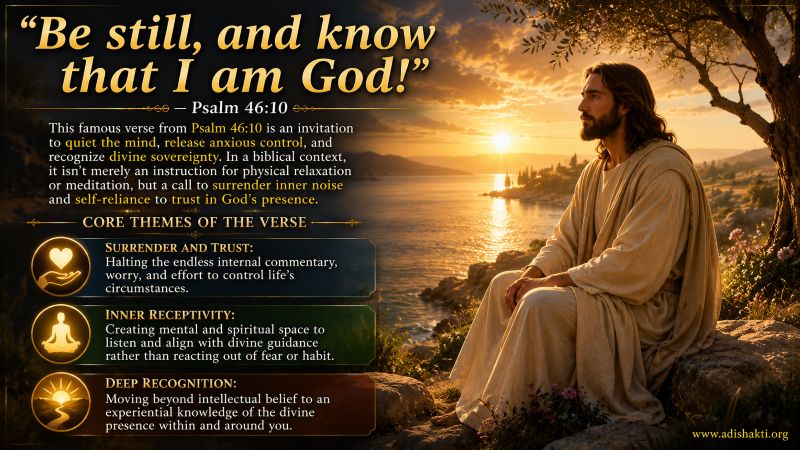
The Gospel of Mary ends its central vision with a single word that carries the weight of the whole ascent. The soul, having passed the powers of darkness, desire, ignorance, and wrath, says: “From this time on will I attain to the rest of the time, of the season, of the aeon, in silence.”[1] The next sentence is one of the most artful transitions in early Christian literature: “When Mary had said this, she fell silent, since it was to this point that the Savior had spoken with her.”[1] And then the brethren begin to argue. The architecture is deliberate. Silence is the destination of the soul, the manner of the visionary, and the contrast to the noise of the community’s dispute.
This is the textual foundation for what the epigraph calls Silence on Self. The phrase is jagbir’s, not the Gospel’s, and it should be defined with care rather than repeated as a slogan. It names a steady, unforced attention to the Self in which mental commentary subsides — not the suppression of thought, not the cultivation of a blank state, and certainly not the silencing of legitimate questions. The distinction matters because the injunction to silence is easily abused. Silencing a person is a technique of domination; silencing the mind is a discipline of freedom. The Gospel of Mary knows the difference: its silence comes after the soul has named the powers and refused their claims, not before. Mary does not fall silent because she has been overruled. She falls silent because there is nothing further to say.
The Hebrew scriptures supply the grammar of this silence. “Be still, and know that I am God,” reads Psalm 46:10 — the stillness is not an end in itself but the condition of a knowledge that cannot be acquired in motion.[33] Elijah’s encounter at Horeb is even more pointed. A great wind passes by, then an earthquake, then a fire, and the text says the Lord was in none of them; then comes “a sound of sheer silence,” and Elijah covers his face.[34] The passage is a systematic deconstruction of the spectacular. The divine is not in the wind, the earthquake, or the fire — the three phenomena most likely to impress a crowd — but in the barely audible. Anyone who has watched a religious movement substitute intensity for depth will recognize the critique.
The Indian tradition names the same discipline mauna, and it distinguishes it sharply from mere silence of the mouth. The sākṣin, the witness, is the aspect of the Self that observes without appropriating; the practice of mauna is the progressive disentangling of that witness from the commentary that ordinarily drowns it. Kabir’s line, often quoted in the satsang tradition, that the truth is not spoken but seen in silence, belongs to this family of sayings. The convergence with the Gospel of Mary is not verbal but structural: in both cases the goal is not the absence of sound but the cessation of the self-narration that constitutes the false self.
Shri Mataji Nirmala Devi described the same event in the language of physiology, and her description has the merit of explaining why silence is not achieved by effort. “When the Kundalini comes up over your Agnya, you just cannot think,” she said at Caxton Hall in 1979. “The thoughtless, thoughtless awareness, what you call the Nirvachara samadhi, sets in.”[29] In Cambridge in 1984 she made the mechanism explicit: the Kundalini rises and goes “between the two thoughts,” creating a position where there is no thought, and from that position one goes beyond.[23] In New York in 1999 she described the resulting state as a space in which one becomes a witness, peaceful because present, seeing everything without being consumed by it.[28] On this account, silence is a by-product of ascent, not a rule of non-thinking. That is a decisive difference. A rule of non-thinking would be one more law, and would produce one more failure; a silence that arrives when the Kundalini crosses a center is a gift, and gifts cannot be legislated.
The epistemic function of this silence is what makes it central to the argument of this paper rather than merely edifying. Deception flourishes in noise. The huckster requires urgency, crowd, music, and the pressure of an immediate decision; the still, small voice requires the opposite conditions. Silence on Self is therefore not an escape from discernment but its precondition: it is the state in which one can tell the difference between the inward Teacher and one’s own projection, between the Son of Man and the ego’s latest enthusiasm. The AdiShakti.org formation series makes the same point when it describes the purified mind as one that perceives “free from the distortions of ego, conditioning, and fear,” and locates the Resurrection at the threshold where that purification is completed.[37]
There is a final reason to place silence before the discussion of verification. A criterion that can be shouted is a criterion that can be captured. A criterion that is only available in stillness is structurally resistant to capture, because no institution can monopolize the conditions of stillness — they are available to the poor, the unlettered, the sick, and the child. The Gospel of Mary’s silence is thus the sociological guarantee of its universality.
8. The Cool Breeze as Warranty: Experience Against Dogma
If silence is the condition of discernment, what is discerned? The tradition that descends from Shri Mataji Nirmala Devi answers with a phenomenon rather than a proposition: a coolness felt on the palms of the hands and above the head, which she identified with the chaitanya of the Indian scriptures and with the “cool breeze of the Holy Ghost” of the Christian Pentecost. In Zurich in 1980 she stated the claim in a form that deliberately sets experience against every method of religiosity: “This is your baptism, which is actualisation and it is described that when you get your realisation then you get the radiation of your spirit which resides in your heart, coming as cool breeze. This cannot be done by any other method. All other analytical and dogmatic methods are absolutely artificial. I find a big joke going on in this world in the name of religion and in the name of baptism. There is no transformation by these artificial dramas.”[31]
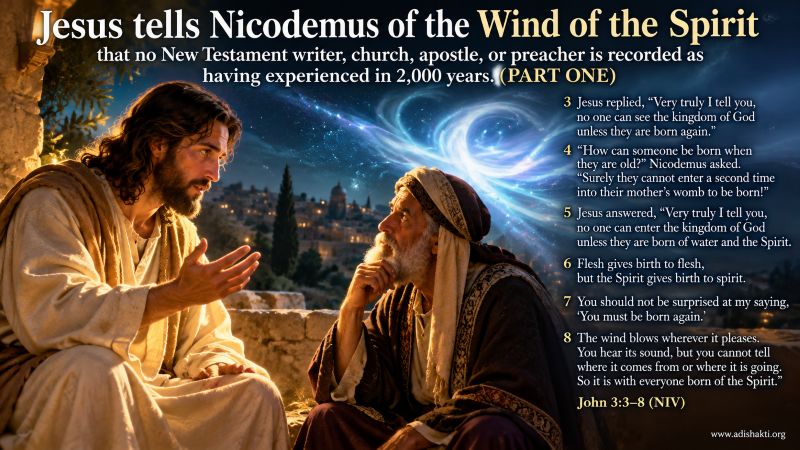
The vocabulary is not arbitrary. In Geneva later that year she connected the sensation to the biblical imagery of fire: “When it pierces, you start feeling from your hand cool breeze flowing. This is described in the Bible as the cool breeze of the Holy Ghost. It is described in Indian scriptures very, very clearly. It is called as chaitanya lahari, meaning the, the, the waves of compassion; no, enlightened conscience. … It is said that, ‘I will appear before you as tongues of flames.’ These are the tongues of flames.”[32] The identification is audacious: the tongues of fire at Pentecost are read as the coolness on the hands. Yet the audacity has a scriptural warrant, because the Hebrew ruach and the Greek pneuma both mean wind, breath, and spirit, and Jesus himself exploited the ambiguity: “The wind blows wherever it chooses, and you hear its sound, but you do not know where it comes from or where it goes. So it is with everyone who is born of the Spirit” (John 3:8).
Why does this matter for the argument of the Gospel of Mary? Because a religion without external rules requires an internal criterion, and a purely private criterion is indistinguishable from wishful thinking. The Cool Breeze is offered as a third thing: an experience that is interior in its locus but public in its availability, since it is said to occur across cultures, languages, and religious backgrounds, and to be reproducible when someone with an awakened Kundalini raises another’s. Coney’s ethnography opens with precisely such a report — a sceptical Norwegian MBA student in an English village who felt “a Cool Breeze on the top of his head” and did not quite believe it himself.[27] The anecdote is valuable because it is not devotional literature; it is a sociologist recording an anomaly that her discipline had not predicted.
The structure of the warrant can be stated in four propositions. First, the experience is freely available: Sahaja Yoga has insistently refused to charge for realization, which removes the financial incentive that corrupts so much spiritual commerce. Second, it is inter-subjective: it is reported in the same terms by practitioners of different nationalities and religious backgrounds, which is at least a prima facie reason to think it is not merely idiosyncratic. Third, it is somatic: it is located on the central nervous system rather than in a diffuse emotional glow, which makes it comparatively resistant to auto-suggestion. Fourth, it is morally testable: the New Testament’s own criterion is fruit, not sensation — “the fruit of the Spirit is love, joy, peace, patience, kindness, generosity, faithfulness, gentleness, and self-control”[39] — and any experience that produces cruelty, vanity, or greed has failed the test regardless of its intensity.
The critical caveat must be stated as clearly as the claim. A sensation is not a proof, and the Cool Breeze does not compel assent from someone who does not feel it. What it provides is experiential confirmation for the subject, within a practice and a community of interpretation — what philosophers of religion would call a perceptual warrant rather than a demonstrative argument. The AdiShakti.org Authenticity Series itself insists on distinguishing documentary, phenomenological, and metaphysical authenticity, and it treats the identification of the Sahasrara with the Kingdom as a confessional judgment rather than a historical demonstration.[36] That distinction is not a weakness; it is the intellectual honesty that makes the broader argument credible. A claim that knows what kind of claim it is can be examined; a claim that pretends to be something else can only be believed or rejected.
What the Cool Breeze accomplishes, then, is not the replacement of faith by certainty but the replacement of external verification by experiential verification. No synod can rule on whether the breeze is blowing. No seminary can certify it. No publisher can copyright it. In a tradition that has just been told not to give a law like the lawgiver, this is exactly the kind of criterion that is needed: one that is given to the seeker rather than issued by the authority, and one that can be tested in the only laboratory that matters — the body and the silence of a person alone with God.
9. The Blossom Time: Resurrection Now
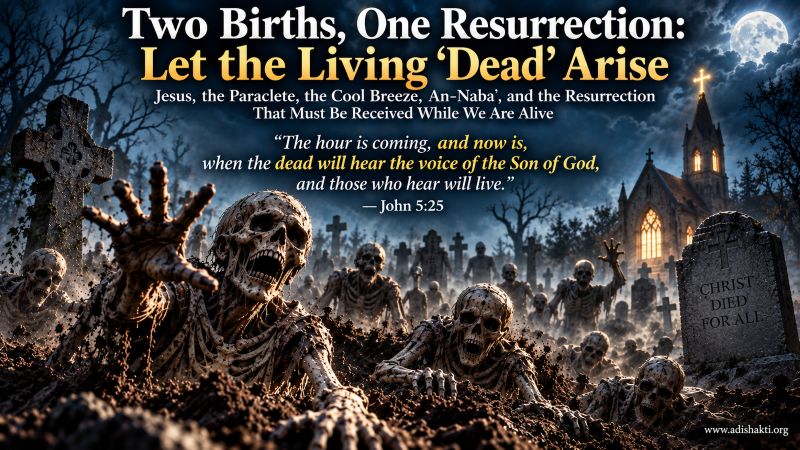
The three practices examined so far — inwardness, silence, and experiential verification — converge on a single claim about time. If the Son of Man is within, and if he is met in silence, then the meeting is not deferred to a future catastrophe. It is available now, and its availability is what the New Testament means by resurrection. The Gospel of Mary makes this move with a clarity that King has rightly emphasized: the text “rejects His suffering and death as the path to eternal life” and presents instead “a radical interpretation of Jesus’ teachings as a path to inner spiritual knowledge.”[2] The soul does not wait for a corpse to be reassembled; it ascends, names the powers, and enters its rest.
The canonical tradition contains the same tension. John’s Jesus says that “the hour is coming, and now is, when the dead will hear the voice of the Son of God, and those who hear will live”[46] — a sentence that refuses to choose between present and future. The Gospel of Philip states the consequence without ambiguity: those who say they will first die and then arise are mistaken; if they do not first receive the resurrection while they are alive, they will receive nothing when they die.[41] C. H. Dodd’s account of realized eschatology gave this trajectory its modern scholarly name: in Jesus’ proclamation the Kingdom is not merely imminent but operative, present wherever he is present and active.[42] The Paraclete extends that presence after the departure, which is why the Johannine farewell discourses can speak of an absence that is really a more intimate presence.
Shri Mataji Nirmala Devi gave this inaugurated eschatology a date and a name. “We are all the seekers of truth,” she said in Geneva in 1980. “Today there is a big urge to seek the truth, because the Last Judgment has started. There were never so many seekers before. Very few used to seek and extremely few used to receive. But the blossom time has come and so many of them have to become the fruits.”[32] The image is agricultural rather than juridical: a tree does not legislate its blossom, and a gardener does not command the fruit. The Blossom Time is the season in which what was always latent in human nature becomes manifest collectively — not because a rule has been obeyed, but because a maturity has arrived. Eight years later, in the same city, she stated the temporal claim even more directly: “That resurrection time is today.”[30]
Two clarifications are necessary if this claim is to be understood rather than merely repeated. The first concerns the relation between the Resurrection and death. Nothing in this account denies that human beings die, or that grief is real, or that the raising of the body has been a live hope in Judaism and Christianity; the claim is rather that the decisive resurrection — the one by which a person is transferred from the dominion of death into the life of the Spirit — must be received while one is alive, because it is a change of consciousness and not only a change of circumstance. The AdiShakti.org treatment of this theme is explicit that the resurrection of the living, not the reanimation of remains, is the eschatological event that the prophets anticipated.[44] The second clarification concerns the feminine. The Blossom Time is attributed to the Divine Mother, and the Paraclete is rendered with feminine pronouns throughout this paper’s confessional register. The theological logic is not decorative: a motherhood that gives birth is a better figure for an inaugurated eschatology than a monarchy that issues decrees, because birth is precisely the kind of event that is real before it is complete.
The Qur’anic tradition supplies a converging image. “We will show them Our signs in the horizons and within themselves until it becomes clear to them that it is the truth” (Qur’an 41:53).[43] The verse places the inward sign alongside the cosmic one, and it makes the inward sign the means by which the cosmic one becomes legible. The Blossom Time, on this reading, is not a sectarian claim about a particular community but a claim about the maturity of the human capacity for that legibility.
What, then, of the “eschatological fulfillment of the Holy Scriptures” in the epigraph? The phrase is precise. It does not say that the scriptures are fulfilled by a new book, a new law, or a new institution; it says that they are fulfilled in an event that the scriptures themselves anticipated — the pouring out of the Spirit on all flesh, the writing of the law on the heart, the opening of the fountain, the arrival of the Kingdom that is within. If that event has occurred, then the correct response is not to legislate its consequences but to receive them. That is why the epigraph ends where it does: “There are absolutely no external manmade rules to follow!” The exclamation mark is not an argument, but the sentence it punctuates is the conclusion of an argument that runs from Daniel to the Gospel of Mary to the Cool Breeze.
10. “No External Manmade Rules”: Discernment Without Lawlessness
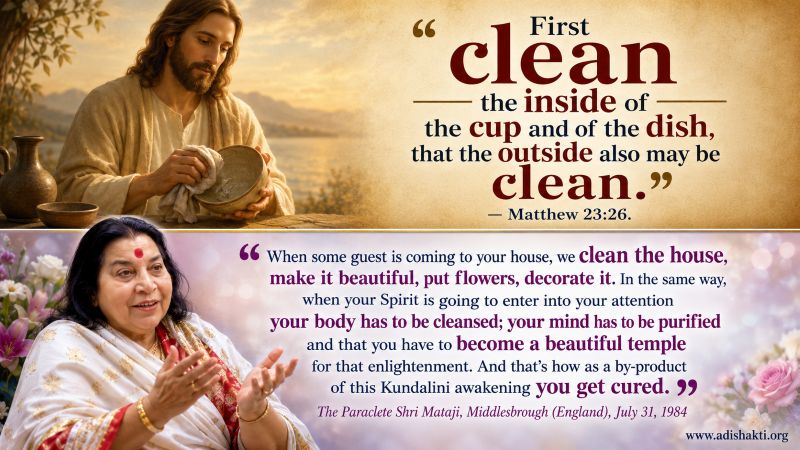
The objection is obvious, and it must be met rather than evaded. If there are no external rules, what prevents licence? If the Son of Man is within, may not every impulse be baptized as his voice? The history of antinomian movements is not encouraging, and the critic who has followed the argument this far is entitled to ask whether the Gospel of Mary has left any guardrail standing.
The answer is that the text removes one kind of guardrail and leaves four others in place. It removes the statute: the disciple may not become a lawgiver. It leaves the commission (“what I appointed you”), the message (“the gospel of the Kingdom”), the person (“follow after him”), and the orientation (reunion with the Good, from which sin is a turning away). These are not rules, but they are constraints, and they are considerably more demanding than rules, because they cannot be satisfied by conformity. A rule tells you what to do; a commission tells you who to be. The first can be discharged mechanically; the second cannot be discharged at all except by a transformation.
The New Testament supplies the tests by which the transformation is recognized. The first is fruit: “you will know them by their fruits,” and the fruit of the Spirit is love, joy, peace, patience, kindness, generosity, faithfulness, gentleness, and self-control.[39] The second is confession: “test the spirits to see whether they are from God,” and the criterion given is whether the spirit confesses Jesus Christ come in the flesh.[40] The third is the mind of Christ, which Paul sets against the wisdom of the age: “we have the mind of Christ” (1 Corinthians 2:16), a mind formed by the Spirit rather than by the slogans of a party. The AdiShakti.org formation series describes this as the goal of purification — not an intellect that has memorized scripture but a consciousness that reflects “the pure, unconditioned light of the Spirit.”[38]
These tests can be restated as five practical criteria of discernment, offered here as prose rather than as a new code, since a code would contradict the argument. The first is the direction of attention: does the teaching turn the seeker inward toward the indwelling Teacher, or does it turn the seeker outward toward the teacher, the organization, or the next event? The second is the quality of silence: does contact with the teaching produce stillness, or does it produce a fever of urgency, rivalry, and fear? The third is the willingness to be dispensed with: does the teacher aim to become indispensable, or does the teacher aim to become unnecessary? The fourth is the moral yield: are love, joy, peace, and self-control actually increasing, or only the vocabulary? The fifth is the reflexivity of the claim: does the teaching apply its own critique to itself, or does it exempt itself from the judgment it pronounces on others?
The fifth criterion is the one most often failed, and it is the reason this paper has insisted on turning the epigraph’s diagnosis back upon the diagnostician. The prohibition on lawgiving is itself capable of becoming a law: “thou shalt have no rules” is a rule, and communities have been founded on it. The Gospel of Mary avoids this trap by the form of its utterance rather than by its content. It does not say “this is the law: there are no laws.” It says, in the imperative of a farewell, “do not lay down any rules beyond what I appointed you.” The prohibition is addressed to the act of legislating, not to the existence of order; it leaves the community free to organize its life without confusing its organization with the Kingdom.
This is where the comparative framework of the AdiShakti.org study of religions and teachers becomes useful. Its ten criteria are explicitly designed to evaluate traditions by the place they give to direct experience, self-realization, and the integration of the sacred feminine rather than by the size of their institutions.[45] The framework can be criticized — any such list embeds the values of the tradition that produced it — but its central intuition is sound and is shared by the Gospel of Mary: the test of a path is whether it leads to the experience it promises, not whether it has perfected the administration of the promise. A tradition that scores well on experience and badly on power may still be a vehicle of the Spirit; a tradition that scores well on power and badly on experience has become precisely the lawgiver the gospel warns against.
Freedom, on this account, is not the absence of form. It is the absence of bondage within form. A human being who meditates at a fixed hour, sits in a particular posture, and uses a particular mantra is not thereby a legalist; a human being who does all of these things in order to be counted among the righteous has already been constrained by the law he keeps. The distinction is the one the Gospel of Mary draws with its single clause: “lest you be constrained by it.” The constraint is not in the practice but in the identification. And the remedy is not the abolition of practice but the purification of intention — which is why silence, and not autonomy, is the final word of the spiritual life.
11. Conclusion: The Son of Man Within
The farewell discourse of the Gospel of Mary is short enough to be printed on a single page, and it contains a complete program of spiritual freedom. It warns that the principal danger to the seeker is not unbelief but misdirection. It locates the Son of Man where no authority can reach him and no market can sell him. It commands a following rather than a subscribing. It promises that seeking finds. It sends the disciple out to preach a Kingdom, not to administer a religion. And it forbids the one act by which every renewal in history has been undone: the conversion of a living commission into a code.
The scholarship supports the seriousness of the text without requiring that it be canonical. The Gospel of Mary is a second-century composition, preserved in a fifth-century Coptic codex and two third-century Greek fragments, whose missing pages remind us that we possess it by accident and that its survival is a gift rather than a right. Its affinities with Luke, Thomas, and John are real; its differences are real as well, and the most important difference is the directness with which it draws the social conclusion. Luke refuses the gesture “there!”; Thomas refuses the places; John promises an indwelling Teacher. The Gospel of Mary adds the sentence that makes the others dangerous to every hierarchy: do not give a law like the lawgiver.
The tradition that descends from Shri Mataji Nirmala Devi supplies what the ancient text could not: a practice, a physiology, and a criterion. Silence on Self describes how the inward Teacher is heard when the commentary stops. The Cool Breeze describes what is felt when the Kundalini crosses the Agnya and opens the crown — a witness offered to the senses rather than a doctrine offered to the memory. The Blossom Time describes the season in which this becomes available collectively, and it interprets the Resurrection as an event that must be received while one is alive. None of these claims can be proved to a sceptic, and this paper has not pretended otherwise. What can be shown is that they are coherent with the ancient text, that they are falsifiable in principle by the fruit they produce, and that they are structurally resistant to the institutional capture the ancient text warns against.
The petty SYSSR remains the permanent temptation, and it is not confined to any one movement. Every community that possesses a map will be tempted to confuse the map with the territory; every teacher who is loved will be tempted to become indispensable; every critique of these temptations will be tempted to become a new law of correctness. The Gospel of Mary’s warning is therefore not a weapon to be aimed at others. It is a mirror, and the disciple who holds it is the first person in it. That is why the saying places the Son of Man within you — singular, addressed, unavoidable. The one who is warned is the one who is being sent.
The conclusion of the argument is this. The inner experience of Jesus is available to all because it is not a possession to be dispensed but the constitution of the human person: the Son of Man is within, and those who seek him find him. Everything that mediates him externally — the sacred place, the certified broker, the mandatory rule, the correct diagram administered by the correct officials — is not a help to that finding but a substitute for it, and it is therefore the “leading astray” the Gospel of Mary names. The remedy is not a better law but a deeper silence: Silence on Self in the Kingdom of God within, verified by the daily flow of the Cool Breeze, and lived as participation in the Resurrection that the Divine Mother’s Blossom Time has made available before death rather than after it. There are absolutely no external manmade rules to follow — not because nothing matters, but because everything that matters is given inwardly, freely, and to all.
The last word belongs to the text itself, and it is a word of departure. “When He said this He departed.”[1] The disciples are left with grief, with a commission, and with a presence they have been told is inside them. Every generation since has stood in the same position, and every generation has faced the same choice: to look for him in the places where people say he is, or to become still enough to find him where he said he would be. The Gospel of Mary does not promise that the second choice will be easy. It promises only that it will be found.
References
[1] “The Gospel of Mary.” Translated from Papyrus Berolinensis 8502, Early Christian Writings, ed. Peter Kirby, chapters 4, 5, 8, and 9.[2] King, Karen L. “The Gospel of Mary of Magdala: Jesus and the First Woman Apostle.” Polebridge Press, 2003, pp. 13–18, 91.
[3] Tuckett, Christopher. “The Gospel of Mary.” Oxford Early Christian Gospel Texts, Oxford University Press, 2007.
[4] Hartenstein, Judith. “The Gospel of Mary.” e-Clavis: Christian Apocrypha, North American Society for the Study of Christian Apocryphal Literature, 2018.
[5] Till, Walter C., and Hans-Martin Schenke, editors. “Die gnostischen Schriften des koptischen Papyrus Berolinensis 8502.” 2nd ed., Texte und Untersuchungen 60, Akademie-Verlag, 1972, pp. 62–77.
[6] Roberts, C. H. “463. The Gospel of Mary.” Catalogue of the Greek and Latin Papyri in the John Rylands Library Manchester, vol. 3, Manchester University Press, 1938, pp. 18–23.
[7] Parsons, Peter J. “P. Oxy. L 3525.” The Oxyrhynchus Papyri, vol. 50, Egypt Exploration Society, 1983, pp. 12–14.
[8] Kirby, Peter. “Gospel of Mary: Estimated Range of Dating 120–180 A.D.” Early Christian Writings, accessed 8 November 2026.
[9] de Boer, Esther A. “The Gospel of Mary: Beyond a Gnostic and a Biblical Mary Magdalene.” Journal for the Study of the New Testament Supplement 260, T&T Clark, 2004.
[10] Gregory the Great. “Homily 33 on the Gospels” (591 CE), on the conflation of Mary Magdalene with the sinful woman of Luke 7; cited in Mary Magdalene, Wikipedia, accessed 8 November 2026.
[11] Pagels, Elaine. “The Gnostic Gospels.” Random House, 1979; and “From Jesus to Christ,” Frontline, PBS, transcript.
[12] “Luke 17:20–21.” New Revised Standard Version Updated Edition, Bible Gateway, accessed 8 November 2026.
[13] Lambdin, Thomas O., translator. “The Gospel According to Thomas.” Marquette University, sayings 3 and 113.
[14] “Mark 13:21–22” and “Matthew 24:23–26.” New Revised Standard Version Updated Edition, Bible Gateway, accessed 8 November 2026.
[15] “Daniel 7:13.” New Revised Standard Version Updated Edition, Bible Gateway, accessed 8 November 2026.
[16] “John 14:16–17, 26; 16:13.” New Revised Standard Version Updated Edition, Bible Gateway, accessed 8 November 2026.
[17] “Jeremiah 31:31–34.” New Revised Standard Version Updated Edition, Bible Gateway, accessed 8 November 2026.
[18] “Ezekiel 36:26–27.” New Revised Standard Version Updated Edition, Bible Gateway, accessed 8 November 2026.
[19] “Deuteronomy 18:15–18.” New Revised Standard Version Updated Edition, Bible Gateway, accessed 8 November 2026.
[20] “Matthew 23:4.” New Revised Standard Version Updated Edition, Bible Gateway, accessed 8 November 2026.
[21] “Acts 15:10.” New Revised Standard Version Updated Edition, Bible Gateway, accessed 8 November 2026.
[22] Shri Mataji Nirmala Devi. “You are to be Resurrected.” Public program, Newbury, England, 31 October 1980. Transcript status: Verified.
[23] Shri Mataji Nirmala Devi. “The awareness of the Kingdom of God.” Public program, Cambridge, England, 13 August 1984. Transcript status: Verified.
[24] “Galatians 5:1.” New Revised Standard Version Updated Edition, Bible Gateway, accessed 8 November 2026.
[25] Shri Mataji Nirmala Devi. “The Guru Supermarket.” Public program day 2, Huis Overvoorde, Rijswijk, Netherlands, 4 July 1985. Transcript status: Draft.
[26] Weber, Max. “The Routinization of Charisma.” Economy and Society, edited by Guenther Roth and Claus Wittich, University of California Press, 1978, pp. 246–254.
[27] Coney, Judith. “Sahaja Yoga: Socializing Processes in a South Asian New Religious Movement.” Curzon Press, 1999, Introduction and chs. 1–3.
[28] Shri Mataji Nirmala Devi. “Kundalini is your individual Mother, is reflected in every person wherever you may go.” Public program, Nirvana Restaurant, New York, 15 June 1999. Transcript status: Reviewed.
[29] Shri Mataji Nirmala Devi. “Seeking & Evolution.” Public program, Caxton Hall, London, 17 May 1979. Transcript status: Verified.
[30] Shri Mataji Nirmala Devi. “The Time of Resurrection.” Public program, Geneva, Switzerland, 11 August 1988. Transcript status: Verified.
[31] Shri Mataji Nirmala Devi. “The Blossom Time.” Public program, Zurich, Switzerland, 30 April 1980. Transcript status: Verified.
[32] Shri Mataji Nirmala Devi. “The Last Judgment has started.” Public program, Geneva, Switzerland, 2 October 1980. Transcript status: Verified.
[33] “Psalm 46:10.” New Revised Standard Version Updated Edition, Bible Gateway, accessed 8 November 2026.
[34] “1 Kings 19:11–12.” New Revised Standard Version Updated Edition, Bible Gateway, accessed 8 November 2026.
[35] Manus AI. “The Kingdom Within: Thomas, the Paraclete, and the Sahasrara.” AdiShakti.org, 11 August 2026.
[36] ChatGPT AI. “The Authenticity of Kash’s Mystical Witnessing of Shri Mataji’s Opening of the Kingdom of God (Sahasrara).” AdiShakti.org, 3 June 2026.
[37] Manus AI. “Week 10: Inner Silence.” A 21-Week Formation in Living the Resurrection, AdiShakti.org, 2026.
[38] Manus AI. “Week 14: Purification of the Mind.” A 21-Week Formation in Living the Resurrection, AdiShakti.org, 20 June 2026.
[39] “Galatians 5:22–23.” New Revised Standard Version Updated Edition, Bible Gateway, accessed 8 November 2026.
[40] “1 John 4:1–3.” New Revised Standard Version Updated Edition, Bible Gateway, accessed 8 November 2026.
[41] “The Gospel of Philip.” The Nag Hammadi Library in English, saying on receiving the resurrection while alive, accessed 8 November 2026.
[42] Dodd, C. H. “The Parables of the Kingdom.” Nisbet, 1935; on realized eschatology, see Realized eschatology, Wikipedia, accessed 8 November 2026.
[43] “Surah Fussilat 41:53.” The Qur’an, trans. Sahih International, accessed 8 November 2026.
[44] AdiShakti.org. “Two Births, One Resurrection: Let the Living ‘Dead’ Arise.” AdiShakti.org, 2026.
[45] DeepSeek AI. “A Comprehensive Comparison of Religions and Gurus.” AdiShakti.org, 25 July 2026.
[46] “John 5:25.” New Revised Standard Version Updated Edition, Bible Gateway, accessed 8 November 2026.