Jesus rebukes those who seek access to God elsewhere


"According to Thomas, Jesus rebukes those who seek access to God elsewhere, even—perhaps especially—those who seek it by trying to "follow Jesus" himself. When certain disciples plead with Jesus to "show us the place where you are, since it is necessary for us to seek it," he does not bother to answer so misguided a question and redirects the disciples away from themselves toward the light hidden within each person: `There is light within a person of light, and it lights up the whole universe; If it does not shine, there is darkness.' In other words, one either discovers the light within that illuminates `the whole universe' or lives in darkness, within and without." - Elaine Pagels

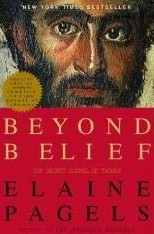
Beyond Belief
The Secret Gospel of Thomas

by Elaine Pagels
published 2003 by Random House, New York

Elaine Pagels, professor of religion at Princeton University, became famous – well, at least well known – with the publication of her book, The Gnostic Gospels, in 1979. She has written several other books as well on the history of Christianity, establishing her as the foremost popular scholar in the field.

Beyond Belief, published in 2003 by Random House, is a sort of sequel to The Secret Gospels, in that it incorporates the new scholarship that has come to light since that book was published. Since Ms. Pagels' infant son was diagnosed with fatal pulmonary hypertension, her pursuit of knowledge about who Jesus really was has become a question of personal urgency for her. This need is reflected in the text and transforms the book into much more than a scholarly treatise for the curious. She wants to know what Christ meant to his followers before doctrine and dogmas, in other words, before Christianity was invented by the Church.

The discovery of the Gospel of Thomas, along with other early Christian texts, offers revealing clues. Pagels compares Thomas's gospel (which claims to give Jesus' secret teaching, and indicates an affinity with the Kabbalah) with the canonic texts to show how the early Church chose to include some gospels and exclude others from the collection we know as the New Testament – and why. During the time of persecution of Christians, the church fathers constructed the canon, creed and hierarchy, suppressing many of its spiritual resources in the process, in order to avoid conflict with Roman law and religion.

A prime example is the label of heresy attached to the Gospel of Thomas, and its subsequent suppression. If a copy hadn't been found by accident (or destiny?) in the caves of Nag Hammadi, along with many other documents during the middle of the twentieth century, we'd have never even known of its existence. Such secret writings had been denounced by Irenaeus, bishop of Lyon (c.180) as "an abyss of madness, and blasphemy against Christ." Pagels had therefore expected to find madness and blasphemy in these texts, but when she first studied them in Harvard graduate school she found the contrary in sayings such as this from Thomas. "Jesus said: If you bring forth what is within you, what you will bring forth will save you. If you do not bring forth what is within you, what you do not bring forth will destroy you. Pagels found that "..the strength of this saying is that it does not tell us what to believe but challenges us to discover what lies hidden within ourselves; and, with a shock of recognition, I realized that this perspective seemed to me to be self- evidently true."

However, certain church leaders from the second through the fourth centuries rejected many of these sources of revelation and constructed instead the New Testament gospel canon of Matthew, Mark, Luke and John, which has defined Christianity to this day. The Gospel of John is of special importance in church dogma, and its basic tenets seem to be in direct opposition to Thomas. John says that he writes "so that you may believe, and believing may have life in [Jesus'] name." Thomas's gospel, however, encourages us not so much to believe in Jesus, as John demands, as to seek to know God through one's own, divinely given capacity, since all are created in the image of God. "For Christians of later generations, the Gospel of John helped provide a foundation for a unified church, which Thomas, with its emphasis on each person's search for God, did not."

According to Pagels, John is the only evangelist who actually states that Jesus is God incarnated. But not only Pagels says so. In one of his commentaries on John, Origen – a church father, (c.240) - writes that while the other gospels describe Jesus as human, "none of them clearly spoke of his divinity, as John does." One may object that the other three, synoptic ("seeing together") gospels call Jesus "son of God", and this is virtually the same thing. But such titles (son of God, messiah) in Jesus' time designated human, not divine roles. When translated into English fifteen centuries later, these were capitalized – a linguistic convention that does not occur in the original Greek. When all four gospels, together with Paul's letters, were united in the New Testament (c. 160 to 360) most Christians had come to read all four through John's lens, that Jesus is "Lord and God".

Pagels feels that if the Gospel of Thomas were included in the New Testament instead of that of John, or even if it were included along with John, the development of Christianity would have been quite different. Whereas Mark, Matthew and Luke identify Jesus as God's human agent, John and Thomas characterize him as God's own light in human form. Both claim to reveal, at least to a certain extent, Jesus' "secret teachings", and assume that their readers are already familiar with the synoptic gospels.

Despite their similarities, John and Thomas point the secret teachings in sharply different directions. John claims that we can experience God only through the divine light embodied in Jesus, while Thomas says that the divine light embodied in Jesus is already shared by humanity since we are all made "in the image of God". Thomas thus expresses what would become a central theme of Jewish, and later Christian, mysticism a thousand years later: that the "image of God" is hidden within everyone, and it is a question of recognizing this and finding it through one's own efforts.

At one point in her description of the dispute among the early Christians about who Jesus really was, Pagels quotes Mark: …he asked his disciples, "Who do people say that I am?" And they told him, "John the Baptist; and others say Elijah; and others, one of the prophets." And he asked them, "But who do you say that I am?" Peter answered him, "You are the messiah." In view of this passage, it has always seemed contradictory to me the contention that Christianity – and Judaism – do not embrace the idea of reincarnation, even reject it, when these first Jewish Christians seem to act as though it were common knowledge.

The synoptic gospels claim that Jesus' teaching predicted the coming of the kingdom of God some time in the future, an interpretation still adhered to by many Christians. However, both John and Thomas say something different, the latter very specifically: Jesus said, If those who lead you say to you, `Look, the kingdom is in the sky', then the birds of the sky will get there before you….If they say to you, `It is in the sea,' then the fish will get there before you. And: His disciples said to him, `When will the resurrection of the dead come, and when will the new world come?' He said to them, `What you look forward to has already come, but you do not recognize it.'

Though the Gospel of Luke includes an alternative version of the same idea ("…the kingdom of God is within you"), Luke later retreats from this position and concludes with the apocalyptic warning that the Son of Man is not a divine presence in us all but a terrifying judge.

A century ago Leo Tolstoy, in his monumental The Kingdom of God is Within you, urged Christians to give up coercion and violence in order to realize God's kingdom here and now. Thomas Merton, the twentieth century writer and Trappist monk, agreed with Tolstoy but interpreted his kingdom mystically rather then practically. We are confronted here with the Catholic church's insistence that humanity is sinful, base and unworthy by nature and that salvation from the pangs of hell is only possible through faith in Jesus and, by obvious extension, his church, and his representative on earth, the pope. But the Gospel of Thomas leaves spiritual destiny up to each individual. There Jesus treats us as equals, or at least as struggling siblings:

"According to Thomas, Jesus rebukes those who seek access to God elsewhere, even—perhaps especially—those who seek it by trying to "follow Jesus" himself. When certain disciples plead with Jesus to "show us the place where you are, since it is necessary for us to seek it," he does not bother to answer so misguided a question and redirects the disciples away from themselves toward the light hidden within each person: `There is light within a person of light, and it lights up the whole universe; If it does not shine, there is darkness.' In other words, one either discovers the light within that illuminates `the whole universe' or lives in darkness, within and without."

Finally, after so many centuries, the heretics are having their say. Another most interesting document found at Nag Hammadi is the Gospel of Philip, who explains baptism. Sometimes the person who receives baptism "receives the holy spirit…this is what happens when one experiences a mystery." Divine grace, this implies, isn't sufficient; the initiate's capacity for spiritual understanding is also a factor. "Faith is our earth, in which we take root; hope is the water through which we are nourished; love is the air through which we grow; gnosis is the light through which we become fully grown.

Beyond Belief
The Secret Gospel of Thomas


>
> Then a most important realization came before the inaugural
> celebration of Divine Feminine Day 13 November 2008. It was as if
> the Adi Shakti has given me this realization as a blessing to our
> pending celebrations of the Divine Feminine - after nearly 15 years
> it finally dawned on me that Kash was first shown the Light, the
> presence of God Almighty within us ......... before being shown His
> Power, the Adi Shakti, the next day!
>
> Kash, Arwinder and Lalita have all claimed that this extremely
> bright Light is always above Shri Mataji's abode. But it was Lalita
> who revealed that this Light is God Almighty:
>
> Tue Mar 15, 2005 2:59 pm
>
> A few months ago i asked my ten-year-old daughter Lalita what that
> immensely brilliant Light above the Adi Shakti in her Sahasrara is.
> She replied "God!"
>
> i remained silent for a long time to absorb the immensity of that
> single word answer.
>

antar jot pargat paasaaraa.
Deep within the self is the Light of God; It radiates throughout the expanse of His creation.

gur saakhee miti-aa anDhi-aaraa.
Through the Guru's Teachings, the darkness of spiritual ignorance is dispelled.

kamal bigaas sadaa sukh paa-i-aa jotee jot milaavani-aa.
The heart-lotus blossoms forth, and eternal peace is obtained, as one's light merges into the Light.

Guru Granth Sahib, p.126


"The most magnetic of all religious symbols is the light, the light that radiates everywhere within and without — the light that never was on land or sea. Great mystics have realised the Peerless One in the form of Light. Moses saw the burning bush and received the word of God. The Upanishad seers saw It as Jothi Aham — the Splendour in the self.

In many a Devaram and Tiruvacagam, and the lyrics of Tayumanavar and Ramalinga Swamigal, we have allusions to light as the symbol of the formless God; and Light also indicates goals and the radiance of Wisdom, as well as the illumination of Supreme Awareness.

Gleaming as the earth and all the spheres
Oh Thou expanse of matchless Effulgence!
In radiant forms of Light art Thou beheld
Oh Formless One!

Tiruvacagam 22.8.9.

Hinduism Today


“As Jesus talks with his three chosen disciples, Matthew asks him to show him the “place of life,” which is, he says, the “pure light.” Jesus answers, “Every one [of you] who has known himself has seen it.”53 Here again, he deflects the question, pointing the disciple instead toward his own self-discovery.”

Elaine Pagels, The Gnostic Gospels
Random House, New York, 1989, p. 131.
(53. Dialogue of the Savior 132.15 — 16, in NHL 233.)


In the beginning was the Word, and the Word was with God, and the Word was God.
The same was in the beginning with God.
All things were made by Him;
And without Him was not anything made that was made.
In Him was life; and the life was the Light of men.
And the Light shineth in darkness; and the darkness comprehend it not.
There was a man sent from God, whose name was John.
The same came for a witness,
To bear witness to the Light that all men through him might believe.
He was not that Light, but was sent to bear witness to that Light.
That was the true Light,
Which lighteth every man that cometh into the world.

John 1:1-10


"The Bible is seen to be full of terms about light. Lossky tells us that "for the mystical theology of the eastern Church these are not metaphors, rhetorical figures but words expressing a real aspect of godliness." "The godly light does not have an abstract and allegorical meaning. It is a data of the mystical experience." The author then referred to "Gnostics", the highest level of godly knowledge [that] is an experience (a living) of the noncreated light, where the experience itself is the light: in lumine tuo videbimus lumen (in Your Light we shall see light.)"

Eternal, endless, existing beyond time and space, it appeared in the theophanies of the Old Testament as the Glory of God. The Glory is "the Uncreated Light, His Eternal Kingdom." Being bestowed to the Christians by the Holy Spirit, the energies appear no longer as external causes but as grace, as inner light." Makarius the Egyptian wrote: "It is . . . the enlightenment of the holy souls, the steadiness of the heavenly powers" (Spiritual Homilies V.8.)

"The godly light appears here, in this world, in time. It is disclosed in the history but it is not of this world; it is eternal, it means going out from the historical existence: ‘the secret of the eight day’, the secret of the true knowledge, the fulfillment of the Gnosis . . . It is exactly the beginning of parousia in the holy souls, the beginning of the revealing at the end of times, when God will be disclosed to everyone in this distant Light."

Dan Costian, Bible Enlightened
Computex Graphics, 1995, p.415


"This universal symbol of Light is surely one of the best symbols Man has found to express the delicate balance that almost all cultures have tried to maintain, with varying success, between a merely this- worldly or atheistic attitude and a totally otherworldly or transcendent attitude. There must be some link between the world of Men and the world of the Gods, between the material and the spiritual, the immanent and the transcendent. If this link is of a substantial nature, pantheism is unavoidable. If the link is exclusively epistemic, as Indian and many other scholasticisms tend to affirm, the reality of this world will ultimately vanish. The symbol of Light avoids these two pitfalls by allowing for a specific sharing in its nature by both worlds or even by the "three worlds."

This is the supreme light spoken of in the Rig Veda and in the Brahmanas; it is mentioned also in the Chandogya Upanishad and in the well-known prayer of the Brihadaranyaka Upanishad: "Lead me from darkness to light!" It is also the refulgent light of the golden vessel stationed in the dwelling place of the Divine: "The impregnable stronghold of the Gods has eight circles and nine gates. It contains a golden vessel, turned toward heaven and suffused with light." This light is neither exclusively divine nor exclusively human, neither merely material nor merely spiritual, neither from this side only nor from the other. It is precisely this fact that "links the two shores." This light is cosmic as well as transcosmic.”

Professor Raimundo Panikkar, The Vedic Experience


"Cultivating the Awareness of the Light Within

The heart and mind can find peace and harmony by contemplating the transcendental nature of the true self as supreme effulgent light.

From the Yoga Sutra of PATANJALI, second century B.C.

Patanjali is often called the father of yoga because he was the first person to codify and write down yoga practices. In this meditation instruction, he is telling us to let go of all distracting sights, smells, and sounds and meditate on our spiritual nature, our luminous true self. He is telling us to look inside and experience the radiance within.

All cultures, peoples, and religious groups through all times have talked about the phenomena of light in the context of the religious or mystical experience. Those who have seen visions of holy beings typically see them surrounded by white light. People have always described going to the light, finding the light, being called by the light, dissolving in the light. We read about light in The Egyptian Book of the Dead as well as The Tibetan Book of the Dead. Men, women, and children who have had classic near-death experiences vividly describe arriving in a place of white light; they speak of themselves and others as being bathed in white light.

Prior to being described as the light of any religion, light was just light. Light is a part of the primary source material. Later, as the history of mankind developed, the concept of light became institutionalized; it was then interpreted according to cultural and religious beliefs. Pure light thus became light of God, light of truth, light of Buddha, light of Jesus, cosmic light, and ocean of light depending upon where you were born and what you were taught. Light, however, is constant. It is fundamental energy.

The New Testament, referring to John the Baptist, reads: "He came for testimony, to bear witness to the light that all might believe through him." Later Jesus says, "Put your trust in the light while you have it so that you may become sons of light."...

British mystic George Fox, who founded the Quaker religion, used the term "inner light" to describe our ability to personally experience God within ourselves. He himself had such an experience, which left him with the lifelong conviction that everyone can hear God's voice directly without mediation by priests or church ritual. This is the central tenet of the Society of Friends.

According to Buddhism, all beings are imbued with a spark of inner divine light. In describing our original Buddha-nature, we use such phrases as innate luminosity, primordial radiance, the unobscured clear natural mind, and the clear light of reality.... The Jewish mystics use similar words when they speak of the inner spark or the spark of God. The Koran, referring to man, talks about the little candle flame burning in a niche in the wall of God's temple.

Almost inevitably a spiritual search becomes a search for divine or sacred light. By cultivating our inner core, we search for this light in ourselves as well as the divine."

Lama Surya Das, Awakening to the Sacred


“ “Lead me from darkness to light, from death to immortality.” This famed Vedic prayer proclaims the human urge to survive, to conquer death and to know the joys of illuminated consciousness. People often pilgrimage to an isolated place in expectation of a vision, be it a jungle of fauna and foliage or cement and glass. Every person is on a vision quest. But for all souls, at the time of the great departure, mahaprasthana, a vision comes as a tunnel of light at the end of which are beings of divine nature. Many having had the near-death experience have sworn their testimony of such transforming encounters. An American woman who “died” during childbirth, but was brought back to life by quick medical action, recounted: “It was an incredible energy — a light you wouldn't believe. I almost floated in it. It was feeding my consciousness feelings of unconditional love, complete safety and complete, total perfection. And then, and then, a piece of knowledge came in — it was that I was immortal, indestructible. I cannot be hurt, cannot be lost, and that the world is perfect.” Hundreds of people report similar experiences, affirming what Hinduism has always taught — that death is a blissful, light- filled transition from one state to another, as simple and natural as changing clothes, far from the morbid, even hellish alternatives some dread. A Vedic funeral hymn intones: “Where eternal luster glows, the realm in which the light divine is set, place me, Purifier, in that deathless, imperishable world. Make me immortal in that realm where movement is accordant to wish, in the third region, the third heaven of heavens, where the worlds are resplendent” (Rig Veda, Aitareya Aranyaka 6-11).”


Satguru Sivaya Subramuniyaswami, January 1997


"As Jesus talks with his three chosen disciples, Matthew asks him to show him the "place of life," which is, he says, the "pure light." Jesus answers, "Every one [of you] who has known himself has seen it."53 Here again, he deflects the question, pointing the disciple instead toward his own self-discovery."
(53. Dialogue of the Savior 132.15 — 16, in NHL 233.)

Elaine Pagels, The Gnostic Gospels,
Random House, New York, 1989, p. 131


"It is such a powerful Light. You can verify it whether it is eternal or not. You have to see for yourself you have such a unique Light within you. In the history of spirituality of this world so many have got Realization — such a Light in them. How could these stupid, flimsy, useless conditionings dominate you now, when you are the carrier of Eternal Light?"

Shri Mataji Nirmala Devi

Being The Light Of Pure Compassion, Istanbul, Turkey
November 6, 1994


“One has to know on this point that you have got the Light... It is such a powerful Light. You can verify it whether it is eternal or not. You have to see for yourself you have such a unique Light within you. In the history of spirituality of this world so many have got Realization — such a Light in them. How could these stupid, flimsy, useless conditionings dominate you now, when you are the carrier of Eternal Light.”

Shri Mataji Nirmala Devi
Being The Light Of Pure Compassion,
Istanbul, Turkey — November 6, 1994


The Great Adi Shakti Shri Mataji
The Paraclete Shri Mataji
"The Self is the Spirit. This Spirit resides in the heart of every human being and is in a witness-like state. The Spirit is the projection of God Almighty, while the Kundalini is the projection of the power of God, of His desire which is the Primordial Mother, or you can call it Adi Shakti, Holy Ghost or Athena. So the Kundalini is the projection of the Holy Ghost, while the Spirit is the projection of God Almighty. The All-pervading Power of love is the power of the Primordial Mother, which creates and evolves, and does all the living work." - Shri Mataji Nirmal Devi


"Chopra: Deep stuff or New Age fluff?

ST. PETERSBURG

Motivational guru Deepak Chopra believes he provides answers for a new age, teaching his international body of followers that the key to solving problems is to seek God within. Chopra's philosophy, zealously marketed through books, seminars and tapes, has won him legions of fans...

“There is no guilt in his system. There is no need for remorse or anything like that. It is not like you have to stop sinning (or) you have to clean up your act. There are no commandments,” John Morreall, professor of religious studies at USF, said of Chopra's teachings. “People want easy, digestible stuff that doesn't require them to change their life, and any way you can package that will be successful,” Morreall added.

In fact, a sell-out crowd is expected Monday when Chopra makes an appearance at the Mahaffey Theater, said the Rev. Joan Pinkston, minister at the Center for Positive Living, which is sponsoring his visit.

She said this is the third time her church, at 5200 29th Ave. N, has brought Chopra to Tampa Bay.

“He is so popular and he does bring a universal message of truth for those who are ready to hear it,” Pinkston said. “He brings it to the masses who are unchurched and who may never capture that message other than through the secular community.”

In a telephone interview, Chopra, who was born in India, said he prefers to be thought of as spiritual rather than religious. “The founders of religion were universal beings,” he said. “But at some point it developed dogma and ideology and unfortunately we have had more anguish and more war and more hatred and more bigotry and more suffering in the name of religion than in every other name. . . . I like to think of myself as seeking spirituality, which is the basis of religion. God gave humans the truth, and the devil came and he said, 'Let's give it a name and call it religion.' ”

Chopra, whose teachings are based in part on the Vedantas, the sacred writings that are the root of Hinduism, added that it often is said that God created man in his own image. “I think it is the other way. Man created God in his own image,” he said. “The image of God is usually a dead white man in the sky. That is just an image. It is not satisfactory. Why can't God be black or a woman? . . . All the conflict in the world is because we have different images of God. God is beyond image. As soon as you create an image about God, you limit God.” But, he said, that is what defines most religion.

Spirituality is different, giving one the ability to love and have compassion, added Chopra, author of 22 books, including best-sellers Ageless Body, Timeless Mind, The Seven Spiritual Laws of Success and The Pathway to Love. “It is the capacity to experience joy and spread it to others,” he said. “It is the security of knowing that your life has meaning and purpose. It is a sense of connection to the creative power of the universe. This creative power of the universe is by various religions called God. “In my experience, it is infinite. It is unbounded. It's immanent and transcendent. It is timeless. It expresses itself in the infinite organization of the universe and in the infinite intelligence of the universe.”

And to find God, those caught up in the search must get in touch with what Chopra refers to as “the essence” of their own being. That essence, he explained, is God. And it is within every person, said Chopra, quoting Jesus in the book of John...

And it seems to sell particularly well among intellectuals, Morreall said. For those trying to cope with stressful conditions, Chopra's message finds a ready welcome.

“What Chopra offers is the promise that you will be able to quiet down the noise and you will be able to control your world. And that is immensely appealing,” Morreall said.

To members of the Center for Positive Living, part of the Spokane, Wash.-based Religious Science organization, Chopra reaffirms a familiar philosophy.

“With what we teach, we believe in one power and it doesn't matter what you call it, whether it is God, spirit, nature, life,” Pinkston said. “It is the ultimate one power. What we believe is true about God is also true about us. The one thing that may separate us from other mainline, traditional religions is that we truly believe that this power that created us is within us and is not something that is outside and separate from us and that it is, yes, greater than we are and that we can use it and we are using it every moment.” Chopra's popularity, she said, is based on his universal message.

“Here is a medical doctor who has taught at Tufts University, and he is very well-read. I believe that people are really hungry for the message . . . that the soul responds to — that we are divine beings,” added Pinkston, a former Baptist who began searching for a new path about 30 years ago.

“We teach the metaphysical, the inner message of Jesus the Christ,” Pinkston said. “(Chopra) is teaching the same message. The way he is teaching is that love can renew, heal. Love can make us safe. Love can inspire us and bring us closer to God and that is what we are all searching for, the union of the self and the spirit.”...

What morsels of wisdom will he leave with his audience Monday?

“I only want to achieve one thing in that when they leave they will say to themselves there is a lot to think about,” he said. “And in some of them it will start a new journey which will radically affect the way they live their life.” "

Kitty Bennett, Times researcher, UMI Company 1998


Vensus A. George, Authentic human destiny: the paths of Shankara and Heidegger
PARAA VIDHYAA
THE NOUMENAL STATE OF MAN


In the last chapter, we looked into the phenomenal state of man, as considered by Shankara. This chapter attempts to study the noumenal state of man. According to Shankara, man's ultimate destiny does not consist in being caught up in the phenomenal existence; rather, man is called to live at a depth at which he must experience the source of the universe within himself. The task of man is not to search for his ultimate destiny outside, but to move into himself and discovering the ultimate in the cave of his heart. It is not a new knowledge, but a realization of what one really is. Paraa vidhyaa, therefore, is nothing else but a self-realization in which one experiences Brahman (Brahmaanubhava) as one's own indwelling spirit (Aatman). This chapter deals with the goal, nature and characteristics of para vidhya.

2.1.1. THE GOAL OF PARAA VIDHYAA

The goal of para vidhya is Brahman, the ultimate universal spirit behind the universe and Aatman, the ultimate principle in the individual. Only when one has true knowledge about both Brahman and Aatman, can one begin to experience the oneness between these two. In this section, we will clarify these two notions, in preparation for the analysis of the nature of para vidhya.

2.1.1. BRAHMAN

The word `Brahman'[1] is derived from the Sanskrit root `brih' which literally means `to gush forth', `to grow', `to be great', and `to increase'. The suffix `man' added to the root `brih' signifies the absence of limitation. Thus, the term `Brahman' etymologically means that which is absolutely the greatest.[2] So `Brahman' denotes "that first … reality from which the entire universe of our experience has sprung up."[3] In the words of the Vedaanta-Suutras, "Brahman is that omniscient, omnipotent cause from which proceeds the origin of the world."[4] Thus, the term `Brahman' signifies the absolute and ultimate reality which is the substratum and the foundation of the world we know, and on which everything depends for its existence. Brahman is self-sufficient and does not depend on anything else for its existence. Hence it must be spiritual entity, since matter is not self-sufficient, limited and subject to change. George Thibault, in his introduction to the Vedaanta-Suutraas, says that whatever exists is in reality one, and this one universal being is called Brahman. This being is absolutely homogeneous in nature; it is pure Being, Intelligence and Thought. Intelligence or thought is not predicated of Brahman as its attribute, but constitutes its substance. Brahman is not a thinking being, but thought itself. It is absolutely destitute of qualities and whatever qualities or attributes are conceivable can only be denied of it.[5] Thus, Brahman is without qualities (nirguna), beyond the order of our empirical and worldly experience. We cannot grasp Brahman with our empirical experiences, since the being of Brahman is necessary for anything to exist, and even for the possibility of empirical experience. In other words, Brahman is a priori and cannot be grasped by a posteriori or limited experience.

Because of our inability to grasp the true nature of Brahman, whatever positive description is developed about Brahman will remain in the level of phenomenal experience, and Brahman is beyond all phenomena. That is why we find contrary characteristics attributed to Brahman. In Brhadaaranyaka Upanishad, we read that Brahman is "light and not light, desire and absence of desire, anger and absence of anger, righteousness and absence of righteousness."[6] Kaatha Upanishad speaks of Brahman as "smaller than the small, greater than the great, sitting yet moving, lying and yet going everywhere."[7] Brahman is light and not light, in the sense that it is only because there is Brahman that there is light and darkness. Again there exist small and the greater only because Brahman exists.

At the same time the word `existence' cannot be attributed to Brahman and to the empirical world in the same way, for Brahman's existence is different in nature. The existence of Brahman is opposed to all empirical existence, so that in comparison with this it can just as well be considered as non-existence. Brahman is the being of all beings.[8] The nature of Brahman is so transcendent, that it cannot be compared with anything in the world we know. At the same time, Brahman is present in all its manifestations, for without the Being of Brahman nothing can exist. Yet the empirical experience of Brahman is not possible. Thus, Brahman is that unalterable and absolute Being which remains identical with itself in all its manifestations. It is the basis and ground of all experience, and is different from the space-time-cause world. Brahman has nothing similar to it, nothing different from it, and no internal differentiation, for all these are empirical distinctions. It is non-empirical, non-objective, wholly other, but it is not non-being.[9]

Shankara repeatedly speaks of, and strongly defends, the absolute, unchangeable, attributeless nature of Brahman, alluding to many texts in the scripture which points to the nirgunaa Brahman.[10] Commenting on the Upanishadic text, "as a lump of salt is without interior or exterior, entire and purely saline taste, even so is the self (Brahman) without exterior or interior, entire and pure intelligence only,[11] Shankara points to the oneness of Brahman. In the lump of salt there is nothing other than salt, so too Brahman is nothing other than itself. It is the absolute being without a second.[12] Shankara also uses the example of the sun reflecting in water and appearing as many, in order to bring home the same truth. He says that just as the reflection of the sun in water increases with the increase of water, and decreases with its reduction, it moves when the water moves, and it differs as the water differs, so is the self. The sun seem to conform to the characteristics of water, but in reality the sun never has these increasing or decreasing qualities. So also Brahman, which from the highest point of view always retains its sameness, seems to conform to such characteristics as increase and decrease of the limiting adjunct owing to its entry into such an adjunct as a body.[13]

For Shankara, therefore, Brahman is a principle of utter simplicity. There is no duality in Brahman, for no qualities are found in his concept of Brahman. It is also simple in the sense that it is not subject to inner contradictions, which would make it changeable and transitory. Though Shankara uses logic and arguments to understand the nature of Brahman and to speak of Brahman, still for him in its reality Brahman is not a metaphysical postulate that can be proved logically, but must be experienced in silence.[14] Thus, Brahman is one: It is not a `He', a personal being; nor is it an `It', an impersonal concept. It is that state which comes about when all subject-object distinctions are obliterated. Ultimately, Brahman is a name for the experience of the timeless plenitude of Being.[15]

2.1.2. AATMAN

The term `Aatman' comes from the Sanskrit root `an' which etymologically means `to breathe'. It is often rendered as `soul' or `self', and signifies the most fundamental being of the individual. There is no one who can deny the existence of the self for it is the basis of all individual actions. Everyone is conscious of the existence of his self and never thinks that he is not.[16] To doubt the existence of the self would be a contradiction in terms because then one would doubt the existence of the very doubter who engages in the doubt. The doubter of the self is often compared by Advaitins to a person who searches for the necklace while wearing it; or to a person who wears the spectacles on his face and at the same time looks for them elsewhere. Without the existence of the self, it is impossible for us to entertain the idea even of its being capable of refutation. For the knowledge of the self is not established through the so-called means of right knowledge, but it is self-established.[17] Thus, the very existence of understanding and its functions presuppose an intelligence known as the self which is different from them, which is self-established and which they subserve. [18] The very possibility of knowledge and the means of knowledge (pramaanas) have relevance if there exists the self which is the source of all knowledge. Therefore, Aatman is beyond all doubt, "for it is the essential nature of him who denies it." [19] Therefore, Shankara believed that it was the nature of the self and not its reality, which is to be proved. "The self must seek itself in order to find what it is, not that it is." [20]

Having established the existence of the self, we can turn now to the discussion of the nature of the Aatman. Aatman is the deathless, birthless, eternal and real substance in every individual soul. It is the unchanging reality behind the changing body, sense organs, mind and ego. It is the spirit, which is pure consciousness and in unaffected by time, space and causality. It is limitless and without a second. [21] Vedantins speak of three states of consciousness, namely the waking state (vishwa), the dream state (taijasa), and the state of dreamless sleep (pragna). The basic underlying principle which witnesses all these three states of one's existence is the pure consciousness (chaitanyam), the self. It is because of the presence of this ultimate substratum, that the body, the senses, the mind and the intellect function properly. At the same time it is not identified with these, nor affected by the changes that take place in the body, in the other sense or intellectual functions. Thus, Aatman.is the "unrelated witness of the experiences of the three stages, which include a man's diverse activities." [22]

Shankara gives a number of illustrations to clarify the nature of the self, especially in its role of being a witness (saakshin) to all activities of body, mind, senses, and intellect. Firstly, Shankara gives the analogy of a king's court. In the court, the king sits in his high throne as the observer of the activities of his ministers, councilors and all the others present. But because of his majesty as the king, he is unique and different from all. So too the self which is pure consciousness dwells in the body as a witness to the functions of the body, mind and other faculties, while at the same time it is different from them by its natural light. Thus, the witness is the absolute consciousness, the unchanging intelligence that underlies the finer and grosser bodies. It is neither Iishvara nor jiva, but it is Aatman which is untouched by the distinction of Iishvara and jiva. [23]

To those who come with the objection that the self is not only a mere observer or witness, but also participates in the activities of the body, Shankara replies using the analogy of the moon and the clouds. The movement of the clouds on a moonlight night suggests that the moon is moving, whereas in fact it is the clouds that move. Likewise, the activities of the mind and senses create the illusion that the self is active. [24] To the one who would say that activity belongs to the senses or other faculties and considers them the self, Shankara gives the following illustrations. Just as the iron filings become active at the presence of the magnet, so also it is the presence of the self that makes the body, the senses and all the other faculties active. It is fire which makes the iron ball red-hot. So also neither can the mind, the intellect or the body combined make the self. It is the self which is the source of all their activities. Just as a man who works with the help of the light that in inherent in the sun does so without ever affecting the sun, so too the mind, the body, the intellect, and the senses, engage in their respective activities with the help of the self, but without exerting any influence on the self. [25] All these illustrations point to the basic and absolute nature of the Aatman. The following Upanishadic statement bear witness to this reality. "That the imperishable is the unseen seer, the unheard hearer, the unthought thinker, the ununderstood understander. Other than It, there is naught that hears, other than It, there is naught that thinks; other than It, there is naught that understands. [26]

The terms `Brahman' and `Aatman', both basically denote one and the same underlying principle: the former stands for the underlying and unchanging principle of the universe; while the latter refers to the unchanging reality in the individuals. Both of these terms are used in the Upanishads and by the interpreters as synonyms they do interchange these two terms in the same sentence. Commenting on the Upanishadic statement: "Who is an Aatman? What is Brahman?", [27] Shankara remarks: "By Brahman, the limitations implied in the Aatman are removed, and by the Aatman the conception of Brahman as a divinity to be worshipped is condemned."[28] These two terms fundamentally refer to one and the same reality, which is the ground of everything. In other words, these two terms stand for two different descriptions of the same ultimate reality, from the point of view of the universe and the individual. The ultimate reality represented by these two terms is the goal of paraa vidhya or Brahmaanubhava.

2.2. NATURE OF PARAA VIDHYAA

We have analyzed the goal of paraa vidhya, in the preceding section. Here, we must attempt to clarify the nature of paraa vidhya, in which the Brahman-realization is attained by the seeker. We elaborate the nature of paraa vidhya, by looking into its meaning and clarifying the identity between Brahman and Aatman.

2.2.1. MEANING

Paraa Vidhya or Brahmaanubhava is the ultimate and monumental state of man. The term `Bramaanubhava' is a compound word, which consists of two Sanskrit words, viz. `Brahman' (absolute reality) and `anubhava' (intuitive experience or knowledge). The term `anubhava' means not a mere theoretical or intellectual knowledge, but the knowledge obtained through an integral experience. Anubhava is not the immediacy of an uninterrupted sensation, where the existence and the content of what is apprehended are separated. It is related to artistic insight rather than to animal instinct; it is an immediate knowledge.[29] Thus, literally the term `Brahmaanubhava' means the integral and intuitive experience of the absolute reality. When we speak of the intuitive experience of Brahman, from the Advaitic point of view there arise many basic questions as to the nature of Brahmaanubhava. How is it possible to have an experience if there is no subject to experience and no object to be experienced? Besides, if there is no duality in an experience, can it be described? If Brahmaanubhava is an experience, and if it has no duality in itself as an experience, then what is the nature of the experience involved in Brahmaanubhava? These questions stem from the fact that the Advaita philosophy of Shankara does not permit the possibility of duality in this fundamental experience.

Possession of intellectual knowledge about the nature of Brahman and that of Brahmaanubhava is the first step towards the attainment of Brahmaanubhava. Obtaining intellectual knowledge by the study of the Scriptures, especially by understanding the meaning and the import of the Vedantic statements like `That art Thou', is necessary for Brahmaanubhava. In knowing the nature of Brahman intellectually, one can work towards the attainment of Brahmaanubhava. When we speak of the attainment of Brahmaanubhava, we use the term attainment' (labdha) in a figurative sense (upacara). [30] In an empirical experience we attain some new knowledge, i.e., knowledge which had not been previously existed as far as we were concerned. In Brahmaanubhava, however, we do not attain anything new, but only realize what we are, i.e., our true nature, the identity with Brahman. According to Shankara, we are Brahman, and Brahmaanubhava is that experience by which we recognize our own real nature.

Many texts in Shankara's works point to the fact that the attainment of Brahmaanubhava consists in the recognition and the realization that one's real and true nature is Brahman. "The state of being Brahman is the same as the realization of the self." [31] "Perfect knowledge … is the realization of the Aatman as one with Brahman."[32] "When a man knows the Aatman, and sees it inwardly and outwardly as the ground of all things animate and inanimate he has indeed reached liberation." [33] "No man who knows Brahman to be different from himself is a knower of truth." [34] "My self is pure consciousness, free from all distinctions and sufferings." [35] Thus, Brahmaanubhava which is the experience of identity with Brahman, is an attainment only from the point of view of the aspirant or the seeker of truth. From the absolute of paramaartha point of view there is no attainment of Brahman.

2.2.2. IDENTITY OF BRAHMAN AND AATMAN

From what has been said about the nature of Brahmaanubhava, so far, there arises the question, how, at all, can we know or have any kind of knowledge about this experience called Brahmaanubhava? No empirical means of knowledge (pramaana) can help us in this regard, except scriptural knowledge. Though scriptural knowledge is limited to the level of duality, still it provides knowledge about the reality of Brahman and enables us to have an intellectual understanding of Brahman.

Shankara holds the authority of the scriptural testimony in our intellectual understanding of Brahman. Nothing else on earth, except the scriptures, can reveal to us the nature of Brahman and of Brahmaanubhava. In this regard Shankara is very clear; he does not substitute any pramaana than the scriptural testimony, for the attainment of the intellectual knowledge about Brahman. He does make use of other pramaanas, but only to elucidate, clarify and demonstrate what he accepts on the basis of scriptural authority about Brahman and Brahmaanubhava. He says, "The fact of everything having its self in Brahman cannot be grasped [intellectually], without the aid of scriptural passage "That art Thou'.[36]

The word `upanishad' (scripture) derives its meaning from its capacity to lead to the truth those who, having been thoroughly dissatisfied with the things seen and unseen, seek liberation from ignorance, which is the source of bondage and suffering. The Upanishads are capable of accomplishing all these, for in them the highest end of life is embodied.[37]

Authentic human destiny: the paths of Shankara and Heidegger
Vensus A. George, Council for Research in Values & (August 1998), pp. 47-54

NOTES [1] The word `Brahman' appears for the first time in the Rig Veda as related various sacred utterances, which were believed to have magical powers. So, initially it meant `spell' or `prayer', which can be used for the attainment of one's wishes and desires. In the Brahmanas, it began to signify that which stands behind God as their ground and basis. Finally, in the Upanishads, this terms came to stand for the unitary principle of all beings, the knowledge of which frees one from finitude. Cf. Eliot Deutsch, p. 9.
[2] Cf. BSB, I, i, 1, pp. 11-12.
[3] Ramkant A Sinari, p. 67.
[4] Swami Virswarananda (trans.), Brahma-Suutra (Mayavata, Almor, Himalayas: Advaita Ashrama, (1948), I, i, 2, p. 26 (hereafter: BSB, Virsawarananda).
[5] George Thibaut (trans.), Brahma-Sutras, vol. XXIV, Introduction, pp. xxiv-xxv (hereafter: BSB, Thibaut).
[6] S. Radhakrishnan (ed.), The Principal Upanishads (London: George Allen & Unwin, 1953), p. 272.
[7] Ibid., p. 617.
[8] Cf. Paul Deussen, The System of Vedanta, trans. Charles Johnson (Chicago: Open Court Publishing Co., 1912), pp. 211-212. Cf. also BUB, II, i, 20.
[9] S. Radhakrishnan and C. A. Moore (eds.), A Source Book in Indian Philosophy, 5th printing (New Jersey: Princeton University Press, 1973), p. 507. [10] In interpreting the Upanishadic text, Shankara is of the opinion that one must accept only those texts which speak of Brahman without qualities and forms. "But other texts speaking of Brahman with form", he says, "have the injunctions about meditation as their main objectives. So long as they do not lead to some contradictions, their apparent meaning should be accepted. But, when they involve contradictions, the principle to be followed for deciding one or the other is that those that have the formless Brahman as their main purport are more authoritative than the others which have not that as their main purpose. It is according to this that one is driven to the conclusion that Brahman is formless and not its opposite". Cf. BSB, III, ii, 14, p. 612.
[11] "Brihadaaranayaka Upanishad", IV, v, 13, R. E. Hume, The Thirteen Principal Upanishads, 2nd revised ed. (New York: Princeton University Press, 1973), p. 147 (hereafter: BU., Hume).
[12] Cf. BSB, III, ii, 16, pp. 615-617.
[13] CF. ibid., III, ii, 18-20, pp. 615-617.
[14] Baskali asked Bhava three times about the nature of Brahman. The latter remained silent all three times, but finally he replied, "I have already spoken, but you cannot comprehend that the self is silence". ibid., III, ii, 17, p. 614.
[15] Cf. Eliot Detsch, p. 9.
[16] Cf. BSB, I, i, 1, p. 12.
[17] Cf. ibid., II, iii, 7, p. 455.
[18] Cf. ibid., p. 456.
[19] Ibid., p. 457.
[20] Organ Troy Wilson, The Self in Indian Philosophy (London: Mounton & Co., 1964), p. 104.
[21] Cf. AB, p. 118.
[22] Ibid., p. 133.
[23] Cf. ibid., p. 136, Cf. Mahendranath Sircar, The System of Vedaantic Thought and Culture, pp. 156-157.
[24] Cf. ibid., pp. 136-137.
[25] Cf. ibid., pp. 137-138.
[26] BU., III, viii, 1, Hume, p. 118.
[27] "Chaanduukhya Upanishad", V, ix, 1, Hume, p. 234 (hereafter: Ch. U., Hume).
[28] Paul Deussen, The Philosophy of the Upanishads (New York: Dover Publications Inc., 1996), pp. 86-87.
[29] Radhakrishnan S., Indian Philosophy, vol. II, p. 513.
[30] BUB, VI, v, 6, pp. 500-501.
[31] Shankara, Gaudapaadakaarika Bhaasya and Maanduukya Upanishad Bhaasya, trans. Swami Nihilananda (Mysore: Sri Ramakrishna Ashrama, 1955), IV, 85 (hereafter: GKB).
[32] VC, p. 65.
[33] Ibid., p. 89.
[34] Shankara, Upadeshasaahasrii, trans. Swami Jagadaananda, 6th ed. (Madras: Sri Ramakrishna Math, 1979), II, xvi, 70, p. 189 (hereafter: UI).
[35] BSB, IV, i, 2, p. 815.
[36] Ibid., I, i, 2, p. 815.
[37] Cf. A. Ramamuarthi, p. 116.


"Self-realization involves an identity-experience, wherein one realizes his oneness with the ultimate Brahman"

Vensus A. George, Self-realization
"4.1.2. Incommunicability of Self-realization

The self-realization involves an identity-experience, wherein one realizes his oneness with the ultimate Brahman. Therefore, self- realization is of the nature of Brahman, i.e., without subject-object duality, eternal and uncaused, immediate and direct, besides being incomprehensible, indescribable and trans-empirical. Brahmaanubhava is not available to the empirical experience, as the scope of the former goes far beyond that of the latter. The words and languages we use refer to the phenomenal world and relative realities. As Brahman is beyond the phenomenal, Brhamaamubhava cannot be described in ordinary language. Therefore, one can speak of self-realization only by way of negation, by denying the qualities of the empirical experience superimposed on it. For instance, the qualities that are attributed to Brahman, such as reality (satyam), knowledge (jnaanam) and infinitude (aanandam) are not positive descriptions of Brahman, but are mere negations of qualities superimposed on Brahman, such as unreality, ignorance and finitude. Thus, all statements we make about Brahman, Brahmaamubhava and Brahmajnaani are mere approximations in the light of the phenomenal knowledge. Such a philosophical position makes self-realization, for all practical purposes, incommunicable. Since, Brahmaanbhava is unknowable and indescribable, it cannot be communicated by the Brahmajnaani to any one in the realm of phenomenal existence. Since Brahman-experience cannot be passed on to the other in any form of communication, it would always remain the subjective experience of the Brahmajnaani. Any attempt to communicate it, using phenomenal language, would be nothing else but a mere phenomenal approximation of the transcendental experience. Such approximations would never take one to the core of self-realization, as it is incommunicable.

4.1.3. Insignificance of the Other's Role in Brahmaajijnaasa

Shankarite path to self-realization, viz., the movement from ignorance to knowledge, is a way that is basically walked by the aspirant alone. The only involvement of the other, on the aspirant's effort to attain the goal of Brahmaanubhava, is the Guru. He is a detached guide, who helps the student to understand the true import of the Vedaantic statements, especially at the hearing (sravana) state of Brahmaajijnaasa. The relationship that exists between the aspirant and the Guru is that of a teacher and a student. In this relationship, the aspirant is totally obedient to the Guru, does personal service to him, looks after the daily chores in the ashram and listens to the teachings of the Guru by sitting at his feet. It is not a one to one, I ƒ² Thou relationship, in which one enters into the life of the other as an equal partner. Other than the teacher, the aspirant does not have any significant relationship with any other person. This is clear from what the aspirant does in the three stages of Brahmaajijnaasa, viz., sravana, manaana and nididhyaasana. In these three stages of Brahmaajijnaasa the aspirant firstly, hears the instructions of the teacher personally. Secondly he reflects on the content of the Guru's teachings in solitude, so as to remove the apparent contradictions and to be intellectually convinced of the true import of the scriptural aphorisms. Thirdly, he meditates in silence on the truths he achieved through hearing and reflection. The various stages of Brahmaajijnaasa in the jnaana path are so centered on the individual seeker and his personal effort the presence of the other in the process is seen as an interference that would distract him from the goal of self-realization. So the seeker is basically all alone through out the process of Brahmaajijnaasa. Even after the seeker has attained self-realization, he does not need to have any relationship with the other or to a community of others, because all such relationships would be irrelevant and unreal to the Brahmajnaani. Thus, Shankara's path to self-realization does not give any significance to the I-Thou relationship that is genuine and inter- subjective communion of hearts between human persons...

From what has been said, it is clear that Shankara by his doctrine of Brahmaanubhava and the self's absolute oneness with Brahman, does not speak of a dissolution of the world. At the attainment of Brahmaanubhava, the external world is not destroyed or annihilated. But, the Brahmajnaani views the world no longer from the phenomenal point of view. He sees everything in terms of oneness, which is characteristic of Brahmaanubhava. Thus, from the point of view of the liberated man the phenomenal world is real in the relative sense, because the state he is in, i.e., his absolute identity with Brahman is that which is really real. As long as one tries to understand Shankara's Advaita philosophy purely from the phenomenal point of view, he will always meet with contradictions, for what is absolutely true is the transcendental and trans-empirical.

4.2.2. Advaita Vedaanta as Pantheism

Many consider Advaita Vedaanta to be pantheistic, because self- realization consists in the identity of the self and Brahman. Those who hold this view cite the mahaavaakya `That art Thou' in their support.9 In interpreting the above mentioned Vedaantic aphorism, we say that it cannot be interpreted in the direct meaning of `That' and `Thou', viz., Iishvara and jiiva, since such a union between the supreme Lord and the limited soul is not possible. It its implied meaning `That' refers to Brahman and `Thou' refers to Aatman. Brahman is the absolute and eternal reality in the universe and Aatman is the pure consciousness, the eternal reality behind the individual self. Brahman and Aatman are eternally identical. In Brahmaanubhava, as we know, there is not experiencer and the experienced. What really happens in Brahmaanubhava is that the self, removed of all ignorance and its effects, realizes its eternal identity with Brahman. Thus, Brahmaanubhava cannot be considered as involving an identity between supreme Lord and the soul. Besides, the terms, `union' and `identity', are used figuratively because there is not new identity reached in Brahmaanubhava, but only the existing eternal identity between Brahman and Aatman is realized. Again there is no notion of God (as a theist would understand) in Shankara's thought. He does not consider Brahman as a deity to be worshipped or to be devoted to, but as the absolute ontological reality behind all the phenomena, which is identical with the self, the pure consciousness. So, for Shankara Brahman is not to be worshipped, but to be realized. If Brahman is viewed as a deity to be worshipped, and such a deity is seen as being identical with everything in the universe, then we have a pantheistic world-view. Since Shankara does not consider Brahman as deity who is identical with the universe, it seems clear that in Shankara's Advaita there is no trace of pantheism. Advaita goes beyond the distinction of theism, atheism and pantheism, as the question of God is not at all an issue in Advaita Vedaanta. Therefore, Shankarite thought does not involve any form of `isms' that views the absolute reality in terms of Godhead. But rather it is a mystical philosophy that aims at making everyone aware of his true ontological nature, i.e., Brahman and move towards attaining it."

Vensus A. George, Self-realization (Brahmaanubhava)
Council for Research in Values & (January 2001), pp. 23-31


Related Articles:
“Jesus presented ... salvation .. based upon knowledge of self"
Who am I - Deepak Chopra
The Silence of Buddha and his Contemplation of the Truth
On being liberated from the dualities of pleasure and pain
Yoga Methods in Christian Mysticism
Each religion springs from a profound experience of the Spirit
This new mode of being and consciousness is the ...
For the mystics, Jesus was a living embodiment of union with God
Gnosis essentially is act of distinguishing soul from deepest self
People who have never even glimpsed the realm of the sacred
Eckhart Tolle's Teachings and Self-realization are in perfect harmony
Eckhart Tolle's Stillness Speaks and T. A. are in perfect harmony
The Third Jesus: The Christ We Cannot Ignore - Deepak Chopra
Jesus rebukes those who seek access to God elsewhere
Self-Atma: The Teachings of Sri Ramana Maharshi Part One & Two
Silence on Self (read it regularly till in Silence you realize your Self)
Guru Nanak taught that the way to connect with the Supreme is ...
The Resurrection of Christ Within You
The Second Birth of Man—In Spirit
Idolatry to take pride in belonging to a particular religious tradition
Muhammad (Prophet For Our Time) Conclusion: Salam (Peace)
We are all Hindus now # 1
We are all Hindus now # 2
We are all Hindus now # 3
We are all Hindus now # 4
We are all Hindus now # 5
We are all Hindus now # 6
In the twenty-first century ... “India will conquer her conqueror"
Ekam sat vipra bahudha vadanti—"that which exists is One
Jesus: "God is spirit, and those who worship him ..."
Self as Spirit: “Jesus answered them ..."
"In order to rise above darkness, people must follow ..."
Theosis is a state akin to 'enlightenment'
Look deep within
God (Brahman) exists in every living being
Aim of being reborn known to almost every religion
All Holy Scriptures uphold the Self as Spirit, for Self is God
Allâh is "closer to him (the human) than [his] jugular vein."
Has Yoga strayed from its core?
Yoga is an art of living and not a religious practice
A Christian practicing sahaja yoga meditation
Shri Mataji: "Achieve your Self, become your Self."
Shri Mataji: "But this Judgment is so beautiful."
Shri Mataji: "What Christ said ... is nothing but Advaita."
For if you walk on this road, it is impossible to go astray
Mystic’s discovery of the higher Self is only a step on a greater journey
Shri Mataji: "The ultimate act against the Spirit ..."
Shri Mataji: "Self-Realization will ... lead to the creation of a new race"
A heavenly realm where a great invisible Spirit dwells
What and where is Self/Brahman/God/Being ...?
Silence Is God's First Language


NOTE: If this page was accessed during a web search you may wish to browse the sites listed below where this topic or related issues are discussed in detail to promote global peace, religious harmony, and spiritual development of humanity:

www.adishakti.org/
www.al-qiyamah.org/
www.adi-shakti.org/  — Divine Feminine (Hinduism)
www.holyspirit-shekinah.org/  — Divine Feminine (Christianity)
www.ruach-elohim.org/  — Divine Feminine (Judaism)
www.ruh-allah.org/  — Divine Feminine (Islam)
www.tao-mother.org/  — Divine Feminine (Taoism)
www.prajnaaparamita.org/  — Divine Feminine (Buddhism)
www.aykaa-mayee.org/  — Divine Feminine (Sikhism)
www.great-spirit-mother.org/  — Divine Feminine (Native Traditions)


search www.adishakti.org