The Long Way Home: Exile, Interiority, and Mystical Epistemology in Rabindranath Tagore’s Gitanjali, Song XII
Summary
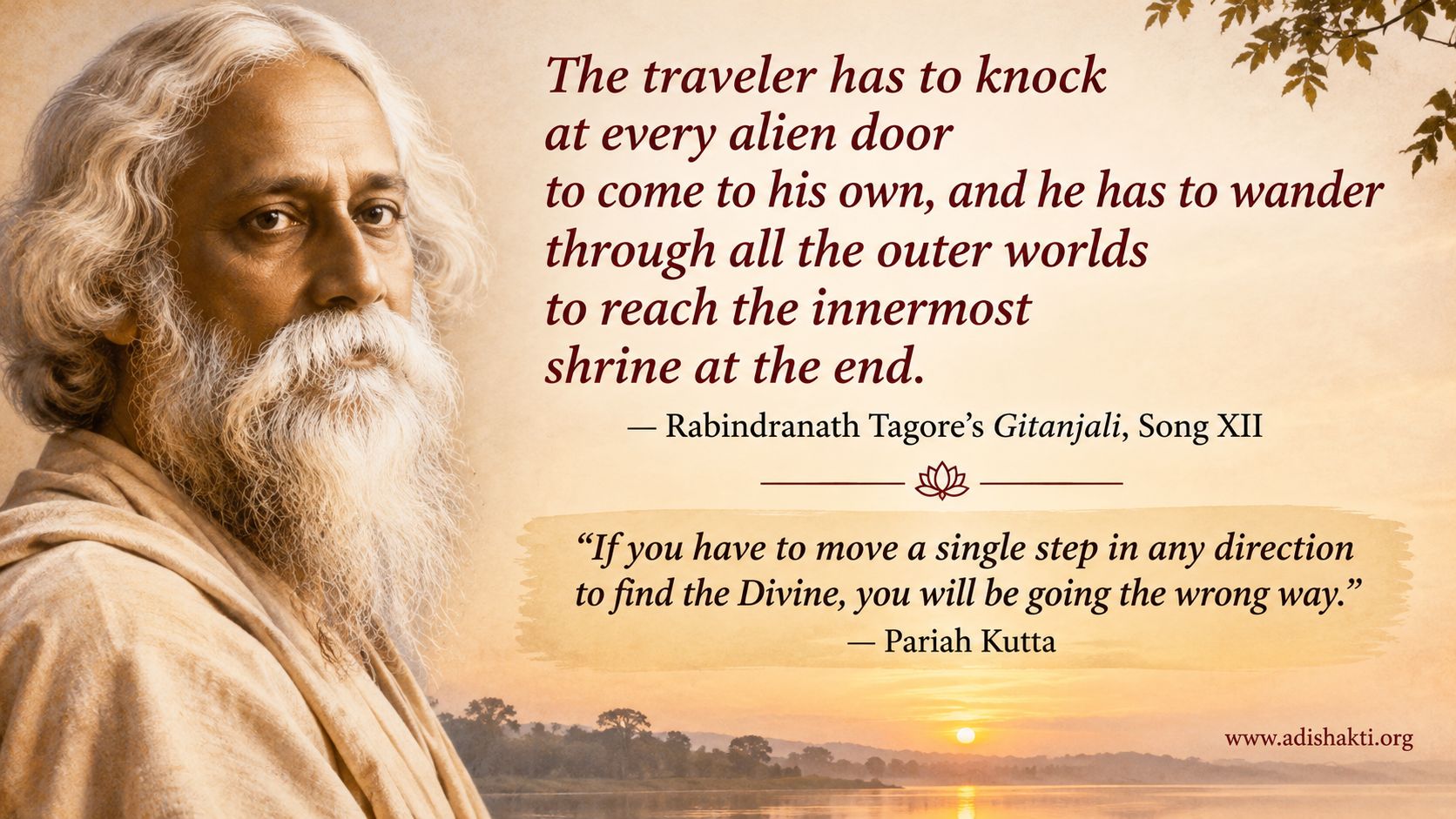
at every alien door
to come to his own, and he has to wander
through all the outer worlds
to reach the innermost
shrine at the end.
— Rabindranath Tagore’s Gitanjali, Song XII
Rabindranath Tagore’s Gitanjali, Song XII—“The traveller has to knock at every alien door / to come to his own”—articulates a paradoxical spiritual geography in which the path to the innermost shrine runs through the entirety of the outer world. This paper examines Song XII as a distillation of Tagore’s mystical epistemology, arguing that the poem’s structural placement within the opening twelve songs of Gitanjali is deliberate: it serves as a threshold text that establishes the governing logic of the entire collection. Reading the poem alongside the mystical tradition articulated in the accompanying prose fragment—which insists that the divine is simultaneously transcendent and identical with the self—this paper contends that Song XII enacts a reversal of conventional religious spatiality. Exile is not an obstacle to homecoming but its precondition; the “alien door” and the “innermost shrine” are not opposites but termini of a single movement. The paper situates this reading within Tagore’s Vedantic inheritance, particularly the Viśiṣṭādvaita framework that informs the first section of Gitanjali, and argues that the poem’s power lies in its refusal to choose between the outward and the inward, the many and the one.
I. Introduction
Rabindranath Tagore’s Gitanjali (1912; enlarged 1913) is not a random anthology of devotional lyrics but a carefully structured sequence. Scholarly analysis has identified six distinct sections, with the first twelve poems functioning as a prolegomenon to the spiritual pilgrimage that unfolds in the remainder of the collection. Within this inaugural section, Song XII occupies a position of singular importance. It states, in compressed poetic form, the governing paradox of Tagore’s religious vision:
The traveller has to knock at every alien door to come to his own, and he has to wander through all the outer worlds to reach the innermost shrine at the end.
These lines are frequently quoted in isolation as a memorable aphorism of spiritual seeking. Yet their significance becomes clearer when read both in their immediate textual context—the surrounding lines of Song XII itself—and in the structural context of the opening twelve poems. The full song begins with the declaration that “the time that my journey takes is long and the way of it long,” and it ends with the cry of recognition: “My eyes strayed far and wide before I shut them and said ‘Here art thou!’”. The journey, in other words, is not merely long; it is necessarily long. The straying of the eyes is not a regrettable detour but a constitutive phase of seeing.
This paper argues that Song XII articulates a mystical epistemology in which outward wandering and inward arrival are not sequential stages but mutually constitutive dimensions of a single movement. To develop this argument, the paper proceeds in three stages. First, it examines the poem’s imagery of travel and exile against the background of Tagore’s conception of the divine as both transcendent and indwelling. Second, it brings the poem into dialogue with the prose fragment on mysticism provided alongside the verse, which insists that “the god/Brahman is at the same time apart from creation … and it is creation itself and therefore it is in man, immo it is man itself.” Third, it considers the structural logic of Song XII’s placement within the opening section of Gitanjali, arguing that the poem functions as a threshold that prepares the reader for the dialectic of separation and union that governs the rest of the collection. The paper concludes by reflecting on what Song XII suggests about the relationship between language, negation, and mystical experience—a question that the accompanying prose fragment raises with particular urgency.
II. The Geography of Exile and the Innermost Shrine
The spatial imagination of Song XII is organized around a series of oppositions: the “alien door” and “his own,” the “outer worlds” and the “innermost shrine,” the straying of the eyes and the shutting of them in recognition. At first glance, these oppositions appear to map onto a familiar religious topology in which the external world is a realm of exile and the interior is the true homeland. Yet the poem complicates this topology in two ways.
First, the traveler does not simply pass through the alien doors on the way to his own. He must “knock at every alien door to come to his own.” The knocking is not an unfortunate necessity but the very means by which “his own” becomes accessible. The alien door is not the antithesis of the familiar; it is the condition of its discovery. This is a logic of indirect access, in which the destination is reached only by way of what appears to be its opposite.
Second, the “innermost shrine” is not described as a place that was always already there, waiting to be uncovered by a simple act of inward turning. It is reached “at the end” of a wandering “through all the outer worlds.” The inward is the product of the outward, not its pre-existing substratum. Or, more precisely, the inward becomes manifest only through the exhaustive traversal of the outward. Tagore’s contemporary interpreters have noted that in the opening section of Gitanjali, “each man must find his own path to the Divine,” and that although “paths might differ, they share one common feature: they are all long and difficult, possessed of trial and error, of hope and despair”. Song XII gives this principle its most memorable formulation.
This structure has affinities with the mystical dialectic articulated in the accompanying prose fragment. The fragment insists that the divine is not simply “inside” in a way that would make the outside irrelevant. Rather, “the god/Brahman is at the same time apart from creation (it is the ever changeless being) and it is creation itself and therefore it is in man, immo it is man itself.” The divine is both transcendent and identical with the self—a formulation that echoes the Viśiṣṭādvaita Vedānta of Rāmānuja, in which Brahman is not qualityless but is “the unity of differences constituting the world of empirical experience”. Song XII’s traveler does not leave the world behind to find the shrine; the world is the medium through which the shrine is reached.
III. Mysticism, Negation, and the Limits of Language
The prose fragment provided alongside Song XII makes a claim that is crucial for understanding the poem’s epistemology: “In mysticism god is a negative concept. This means that all you can say about god is a negation: ‘God is not this, God is not that.’” This negative theology, the fragment argues, does not diminish the divine but rather protects it from the inadequate formulations of the intellect. “The god is ultimately unknowable for the human intelligence and therefore all kinds of communications about the god fall short of their goal.”
Song XII can be read as a poetic enactment of this negative theology. The poem does not describe the innermost shrine. It does not tell us what the traveler finds there, nor does it offer a doctrine of the divine nature. It describes only the movement—the knocking, the wandering, the straying, the shutting of the eyes—and the single, minimal utterance of recognition: “Here art thou!”. The shrine remains unspecified because it cannot be specified. The poem’s language is oriented toward a reality that exceeds language, and its reticence is not a failure of poetic power but a precise registration of the limits of speech.
The fragment goes further: “By the lapse of time the mystic knows less and less about god, but he feels it more and more.” This is a striking formulation. Knowledge decreases as intimacy increases. The intellect’s grip loosens precisely as the experiential relation deepens. Song XII’s traveler, who has “strayed far and wide,” arrives not at a new piece of information about the divine but at a recognition that renders information superfluous. The eyes are shut, and in that closure there is an opening: “Here art thou!”
This convergence between the poem and the prose fragment suggests that both are participating in a shared understanding of mystical experience as essentially apophatic. The mystic does not possess the divine as an object of knowledge; the mystic becomes, as the fragment puts it, “a clean mirror of the force of nature.” The language of mirroring is significant: a mirror does not generate an image but receives and reflects one. The mystic’s perfection is not an achievement but a transparency.
IV. The Threshold Function of Song XII
The placement of Song XII within the opening twelve poems of Gitanjali is not incidental. The first section of the collection, as one analysis has shown, “serves as an introduction” and “expresses certain principles of Tagore’s ‘poet’s religion’ that are echoed throughout the remainder of the work”. Song XII is the culminating statement of this introductory sequence. It comes after songs that establish the poet’s vocation, the humility of the offering, and the purity of the heart as the seat of the divine; and it comes before the second section, which “voices the poet’s despair over separation from God”.
This structural position is significant because it means that Song XII articulates the logic of the journey before the journey proper begins. The reader is told, in advance, that the path will be long, that the alien doors must be knocked upon, and that the innermost shrine awaits at the end. The despair of the second section—the sense of separation that pervades songs 13 through 17—is therefore not a refutation of Song XII’s promise but its unfolding. The promise does not abolish the pain of exile; it reveals exile as the form that homecoming takes.
This is a distinctly Tagorean resolution of the tension between transcendence and immanence. The divine is not a destination that can be reached by bypassing the world. The world is the necessary medium of the divine’s self-disclosure. As the prose fragment puts it, “The god/Brahman is the source of everything beautiful in the world. So everything beautiful and worthwhile has a trace of the god in it.” The traveler who knocks at every alien door is not accumulating experiences that will later be discarded; the traveler is learning to see the trace of the divine in the very alienness of the door.
V. Conclusion
Song XII of Gitanjali is a brief poem, but its brevity is the condition of its density. In six lines, it articulates a complete spiritual geography: the necessity of exile, the indirectness of access, the coincidence of the outermost and the innermost. Read alongside the prose fragment on mysticism, it emerges as a poetic distillation of a negative theology in which the divine is approached through the exhaustion of every inadequate formulation. The traveler who has wandered through all the outer worlds and knocked at every alien door does not finally possess the shrine as an object. The traveler shuts the eyes, and the shrine is there—not because it was hidden inside all along, but because the wandering has made the eyes capable of closing.
The prose fragment’s final claim—“It is the only hope of mankind”—may seem too large a burden for a single song to bear. But Song XII’s hope is precisely of this order: not the hope of arriving quickly, nor of finding a shortcut, but the hope that the long way is the only way, and that the alien door, knocked upon in patience, opens onto the innermost shrine.
Works Cited
Tagore, Rabindranath. Gitanjali. Macmillan and Company, 1916. “Gitanjali 12.” Academy of American Poets, poets.org/poem/gitanjali-12/print.
“Whom dost thou worship in this lonely dark corner of a temple with doors all shut.” Zenodo, zenodo.org/records/21349337.
Inflan Writing in English. TNOU, tnou.ac.in/wp-content/uploads/2022/12/BA-eng-1st-merge_compressed-1.pdf.
“The Visvabharati Quarterly.” Internet Archive, ia802900.us.archive.org/10/items/in.ernet.dli.2015.95065.
Boboc, Raluca. “Rabindranath Tagore: the Image of the Poet as Pilgrim.” CEEOL, ceeol.com/search/article-detail?id=127782.
“Rabindranath conceives of the ultimate reality as the personal God.” Lalgola College, lalgolacollege.ac.in/studyMaterial/121435gandhi.contemporaryindi0000tmpm.pdf.