
Realization of God Starts with Cosmic Vision Contents ↑
“On whose lips the question of realisation of god does not find place? Human imagination will fail to think of a human being who is untouched by this noble thought. Remember, realisation of God is not the domain of those who have made it a profession and revel in the vain glory of being religious. Description of glory and splendour of God in pedantic and ornamental language and imparting some mantra as”Diksha”Is not in the least realisation of God.
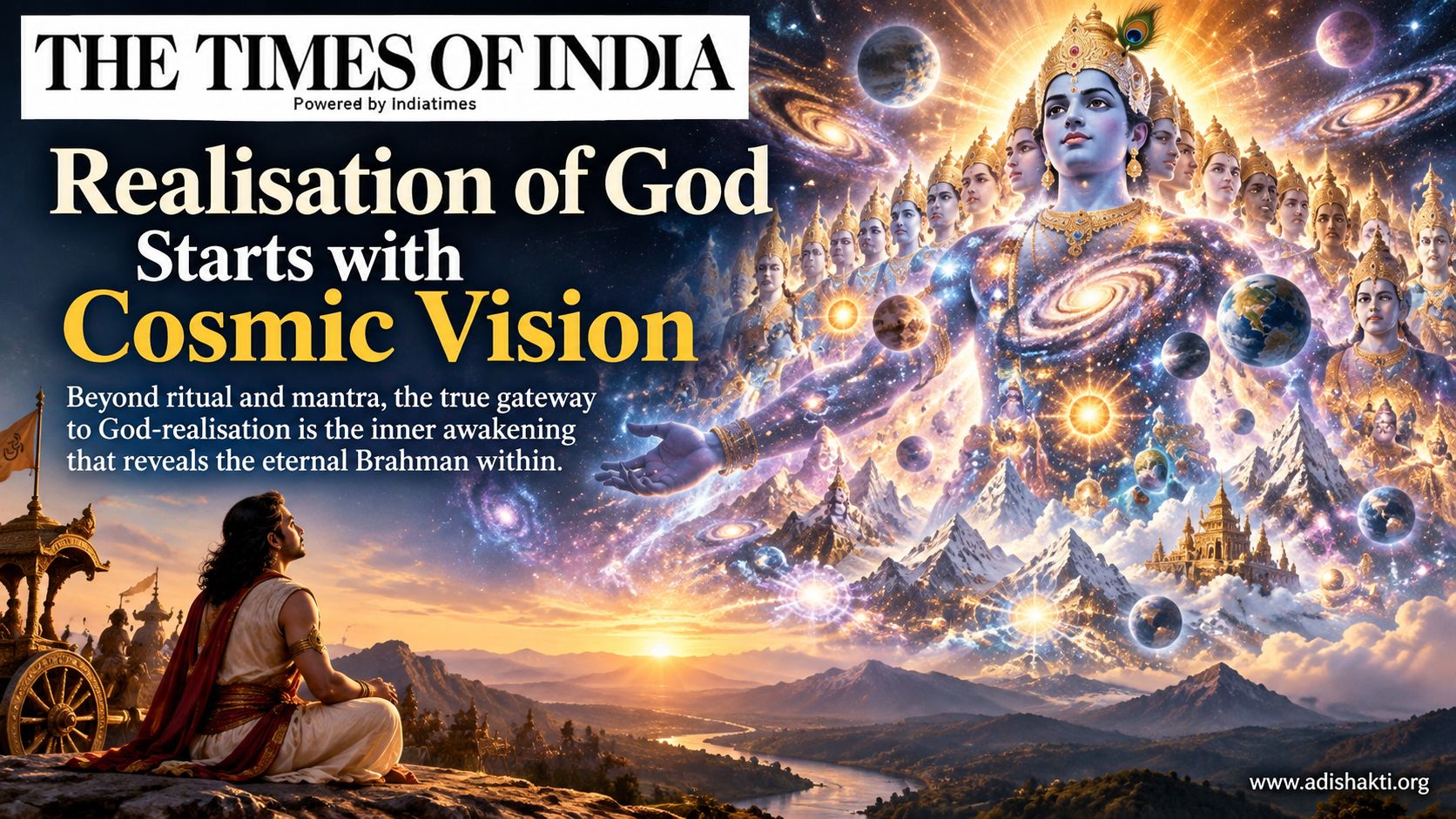
True realisation starts with metaphysical experience of God. Despite being physically with Arjuna, why did Lord Krishna say,” you do not know Me, I am not this physical body.” Lord exhorted Arjuna to know Him in His transcendental form from a wise seer. On being urged, Lord Krishna showed His omni-present cosmic form. Thereupon, all despondency of Arjuna was cleared. He was then ready to fight for extirpation of evil-doers and establishment of dharma.
It is neither the abstruse philosophical theory nor subtle intellectual treatises that can put human beings through God realisation. Prahlada and Dhruva did not receive some mantra or hymn as is usually shown in films and TV serials. Rather it was the same ancient yoga which was handed down to posterity from master to pupil. Mira and Dhanna the Jat could impel God to manifest in human garb by intense devotion and profound love for God. Yet, Lord advised them to attain him in His transcendental form. Lord Krishna told he had taken this physical body in Dwapur Yuga. He will always create means to help humankind to rise above the transitory earthly existence. Mira and Dhanna then received the eternal knowledge from saint Raidas and Swami Ramananda respectively.
In Bhagavad Gita, Krishna called it a supreme secret which only an illumined soul can unravel and bestow on an aspirant when approached with devotion and surrender. Knowledge of spirit is different from secular knowledge. With mundane knowledge, one can earn bread and butter and all physical comforts of life. It only adds to the karmic load of soul. Knowledge of Brahman leads to emancipation of soul. All kinds of formal and informal worship are only kindergartens of true bhakti.
For a man in whom there is a strong urge for merger with universal consciousness, true bhakti starts with supersensuous experience of inherent divinity. It is revelation of the cosmic spark within us. Celestial vision seen through the inner eye is in reality the individual soul - the divine spark on which one is required to meditate to quicken the pace of spiritual advancement. People have been made to believe that cosmic vision of God is not possible in the Kali Yuga. It is possible even today as the knowledge of Brahman is one which continues to be. A genuine spiritual master does so even sitting miles away.”
Times of IndiaArticle Title: "Cosmic Vision Alone Reveals the Truth"
Published Date: September 14, 2015
Source: The Times of India (Speaking Tree)
Author: As told to S K Vasudeva
Realisation of God Starts with Cosmic Vision: An Analysis
Introduction
The proposition “Realisation of God starts with Cosmic Vision” establishes a demanding criterion for spiritual knowledge. It distinguishes inherited belief, ritual observance, theological description, and intellectual assent from direct metaphysical experience. The Times of India text makes the Bhagavad Gita’s encounter between Krishna and Arjuna paradigmatic: proximity to a divine personality is not itself realization; Arjuna’s decisive transformation occurs when ordinary perception gives way to the Vishvarupa, the cosmic form. This paper therefore asks a precise question: if cosmic vision is the beginning of God-realization, what would a contemporary body of such experience look like?
The analysis first situates the claim within the Bhagavad Gita, Vedanta, bhakti, and the traditional role of the guru. It then turns to the extraordinary experiences reported by Kashwinder Singh and his siblings and preserved by Adishakti.org. Within that archive, these accounts are presented not as decorative additions to doctrine but as contemporary experiential claims: repeated entry into the Sahasrara, encounters with the Divine Mother and divine personalities, visions of events and realities unknown to the children beforehand, and episodes said to have been subsequently checked against information available in the physical world. The purpose here is to examine how those accounts function in relation to the paper’s central thesis, while distinguishing the archive’s theological interpretation from independently established historical or scientific fact.
The Primacy of Metaphysical Experience Contents ↑
The original text rejects the idea that eloquent religious discourse, professional religiosity, or the conferral of a mantra is equivalent to realization. Its alternative is emphatic: “True realisation starts with metaphysical experience of God.” In the study of mysticism, direct experience has likewise been treated as a central category, even though scholars differ over how such experiences should be interpreted and what, if anything, they establish beyond the experiencer’s testimony. [1]
This distinction is crucial for the contemporary material examined below. The significance claimed for the experiences of Kash and his siblings does not rest primarily on their ability to explain theology. On the contrary, their youth is repeatedly emphasized. The evidentiary argument made by the Adishakti.org archive is that experience preceded theological sophistication: the children reported what they said they saw, heard, visited, or learned in altered states of meditation, and adults later attempted to interpret and document those reports.
The Cosmic Vision as a Transformative Catalyst Contents ↑
The Bhagavad Gita supplies the decisive classical paradigm. In Chapter 11, Krishna tells Arjuna that ordinary eyesight is insufficient and grants him a “divine eye” through which the universal form can be perceived. Arjuna then beholds the universe gathered within the divine form. The event is immense in theological meaning: ordinary perception is surpassed, the cosmos is disclosed as contained in the Divine, and Arjuna’s understanding is permanently altered. [2]
A second Krishna narrative must be distinguished from Arjuna’s vision. The famous episode in which the universe appears inside Krishna’s mouth belongs to the Śrīmad-Bhāgavatam account of Mother Yaśodā, not to the Bhagavad Gita’s battlefield revelation to Arjuna. Yaśodā is said to see within the child Krishna’s opened mouth the cosmos, planetary systems, elements, living beings, time, karma, Vṛndāvana, and even herself. [10] The distinction matters because the present comparison is not between identical visionary events, but between different modes of cosmic disclosure.
The experiences attributed to Kash and his siblings are presented in a markedly different form. Their significance does not lie in a single momentary tableau of the universe. The archive describes recurrent entry into the Sahasrara as an interior domain of experience: a realm entered through meditation in which the children are said to meet the MahaDevi and other divine personalities, converse with them, move through sacred and cosmic environments, witness events, ask questions, receive answers, and return repeatedly. The claimed vision is therefore not merely panoramic; it is inhabited, relational, interactive, temporal, and cumulative.
This is the central comparative point of the paper. Arjuna’s Vishvarupa is a concentrated disclosure of divine totality; Yaśodā’s vision is a concentrated disclosure of the cosmos within Krishna. The Singh-family corpus, as documented and interpreted by Adishakti.org, claims something broader in experiential architecture: not one disclosure but an extended visionary world; not only seeing but entering; not only beholding cosmic totality but interacting within it; not one recipient but several children; not one episode but a developing body of experiences extending across years. It is in this specific sense—not as a dismissal of the incomparable scriptural importance of Krishna’s revelations—that the MahaDevi-centered experiences are presented here as extraordinary in breadth and depth.
The Physical vs. The Transcendental Contents ↑
The distinction between the physical and the transcendental is therefore not incidental. Vedantic traditions use Brahman to speak of ultimate reality while also allowing for divine manifestation in forms accessible to devotion and contemplation. [3] The Times of India text presses the seeker beyond identification of the divine with a merely physical body: the visible form may mediate the encounter, but realization requires penetration into the reality to which that form points.
This distinction becomes especially important in the Adishakti.org accounts of Shri Mataji. The archive differentiates encounters with Shri Mataji in ordinary embodied life from encounters with the Divine Mother in the Sahasrara. Whatever judgment a reader ultimately makes about those claims, the internal logic is consistent with the paper’s thesis: God-realization begins when consciousness encounters a reality that is not reducible to ordinary sensory perception.
The Role of the Guru Contents ↑
The original text also insists that the transition from belief to realization is not merely an intellectual achievement. It assigns a decisive role to the illumined teacher who can disclose or awaken access to transcendental knowledge. The guru in Hindu traditions is therefore more than a lecturer: the guru may be understood as the mediator of a transformative knowledge that must become experiential. [4]
The Kash narratives radicalize this claim. They describe Self-Realization and awakened Kundalini not simply as beliefs taught to a child but as the means by which repeated visionary access became possible. In the archive’s interpretation, Shri Mataji’s role is therefore tested not by rhetoric alone but by what followed: sustained reports of direct communion, instruction, travel through the Sahasrara, and encounters with figures and scenes understood as belonging to the divine realm.
The Two Paths of Knowledge Contents ↑
Vedanta distinguishes forms of knowledge directed toward the conditioned world from knowledge of ultimate reality, often expressed through the categories of apara vidya and para vidya. [5] The distinction helps clarify why the article regards religious information as insufficient. One may accumulate concepts about God without possessing what the text calls knowledge of Brahman.
The contemporary testimonies are relevant precisely because they are presented as claims to experiential knowledge rather than conceptual knowledge. Kash’s descriptions of the Sahasrara, the Divine Mother, Jesus, Vishnu, Lakshmi, Shesha, Hanuman, Sita and Rama, and other figures are offered by the archive as reports of things encountered, not merely doctrines memorized. The distinction between those two kinds of knowing is the intellectual backbone of the paper.
Bhakti: Devotion as a Path Contents ↑
The article does not dismiss devotion. Its examples of Mira and Dhanna affirm the power of intense love of God, while insisting that devotion reaches fulfillment in direct knowledge of the divine. This places bhakti and experiential realization in a complementary relationship rather than treating them as opposites. [6]
The family accounts similarly combine devotion with claimed experience. Prayer, meditation, offerings, sacred music, and requests addressed to divine figures repeatedly precede the reported visions. The theological argument is therefore not that ritual and devotion are worthless, but that their deepest purpose is fulfilled when they open into living encounter.
The Immanence of the Divine Contents ↑
The Times of India text speaks of the “cosmic spark within us” and of a celestial vision perceived through the inner eye. This resonates with Vedantic reflection on Atman and Brahman, although the precise relationship between individual self and ultimate reality differs among Vedantic schools. [7] What matters for the present argument is the inward direction of discovery: the gateway to cosmic reality is described as being within consciousness itself.
The reported experiences of Kash and his siblings are framed in exactly this inward-yet-cosmic manner. Their physical bodies remain in ordinary surroundings while meditation is said to open the Sahasrara into a realm of extraordinary scope. Thus the “inner eye” is not presented as imagination in the ordinary sense but, within the archive’s own interpretation, as an organ or mode of spiritual perception through which a larger reality becomes accessible.
The Timelessness of the Cosmic Vision Contents ↑
The most consequential assertion in the source article is that cosmic vision did not disappear with the scriptural past. It explicitly rejects the belief that such vision is impossible in Kali Yuga and maintains that knowledge of Brahman remains available. The Times of India article itself is therefore not merely interpreting an ancient episode; it is making a claim about present spiritual possibility. [8]
That assertion creates the bridge to the Singh family material. If cosmic vision remains possible, then contemporary claims cannot be dismissed solely because they occur in modernity. They still require careful evaluation, but their date is not, by itself, an argument against them. The relevant questions become: What was reported? How consistently? Under what circumstances? Was information claimed that the experiencer was not expected to know? Were there witnesses, written records, or later comparisons? The nineteen case studies below are best read through those questions.
From Cosmic Form to an Interior Cosmic Realm: The Distinctive Scope of the Sahasrara Experiences Contents ↑
The word “cosmic” can conceal an important difference. A cosmic vision may mean that the universe is disclosed to a seer in a single transcendent manifestation. But the Singh-family material claims a more extensive mode of experience: the Sahasrara itself becomes the locus of an interior cosmic reality. The children do not merely report looking at an extraordinary object from outside. They are described as entering a domain, remaining conscious within it, encountering personalities there, moving from scene to scene, and returning to ordinary awareness with memories of what occurred.
The breadth claimed for this corpus can be analyzed along several dimensions. Spatial breadth appears in accounts of cosmic regions, heavenly settings, planets, stars, and movement beyond ordinary earthly space. Temporal breadth appears in visions associated with sacred events of the past, including the Resurrection of Jesus and the opening of the Sahasrara. Religious breadth appears in encounters with figures identified with Hinduism, Christianity, Buddhism, Sikhism, and other traditions. Relational depth appears in conversations, questions, instructions, requests, offerings, recognition, and repeated meetings. Experiential continuity appears in the recurrence of the reported states over months and years rather than in a single isolated disclosure.
There is also an important difference between spectatorship and participation. Arjuna is granted divine sight in order to behold Krishna’s universal form; Yaśodā beholds the universe within Krishna’s mouth. By contrast, the Adishakti.org narratives portray Kash and his siblings as participants inside the visionary field. They are said to speak, travel, observe, inquire, receive responses, recognize recurring beings and places, and sometimes bring information from the experience back into family life. This participatory character gives the corpus a narrative and phenomenological depth that a single visionary tableau, however sublime, does not attempt to provide.
The paper therefore uses the phrase “all-encompassing Cosmic Vision” in a carefully defined sense. It does not mean that a modern family testimony can be objectively ranked above sacred scripture. It means that, within the claims preserved by the archive, the MahaDevi-centered Sahasrara experiences encompass an unusually wide range of visionary modes at once: cosmic scale, interiority, repeated access, dialogue, sacred history, multiple divine traditions, movement through visionary space, interpersonal interaction, and claimed links between events perceived inwardly and details later encountered outwardly. On those dimensions, the corpus is presented as having a scope that is difficult to parallel in a single classical vision.
This distinction substantially strengthens the governing thesis. If God-realization begins with cosmic vision, then the Singh-family accounts propose that realization need not terminate in a momentary glimpse. Cosmic vision can become an extended field of spiritual cognition. The Sahasrara is portrayed not simply as the point from which a vision is seen, but as the inner gateway through which consciousness enters the Kingdom of God. In the theological logic of the archive, the MahaDevi does not merely display the cosmos: She admits the seeker into a living cosmic order and permits sustained encounter within it.
A Contemporary Example: The Vision of Kash and His Siblings Contents ↑
Adishakti.org preserves an extensive family archive centered on the experiences of Kashwinder Singh and his siblings. [9] The cumulative character of the archive is essential. It describes not one spectacular vision but a developing sequence of experiences beginning in childhood: repeated entry into the Sahasrara; encounters with the MahaDevi; meetings with divine figures associated with several religious traditions; journeys through cosmic and sacred environments; visions of events identified with sacred history; conversations and questions; and episodes in which ordinary earthly details were said to become known during meditation.
The scale of Kash’s reported experience is also important. From November 13, 1993 to July 26, 1995 spans 621 days (49 days in late 1993, 365 days in 1994, and 207 days through July 26, 1995). At approximately two meditations each day, this represents about 1,242 meditation sessions. Because Kash was also sometimes asked questions and would reportedly return to the Sahasrara to check or confirm what he had perceived, the family record places the cumulative number of these visionary entries at more than 1,300. The significance is therefore not merely numerical: the claimed Cosmic Vision was repeated, sustained and cumulative, developing through well over a thousand occasions rather than arising from a single extraordinary episode.
This depth, recurrence, and range change the nature of the comparison with classical cosmic-vision narratives. The relevant unit is no longer a single vision but an experiential corpus. One episode may concern the Divine Mother; another Jesus; another Vishnu, Lakshmi, Shesha, Hanuman, Sita or Rama; another a household offering; another an event said to have occurred in the past; another simultaneous awareness of physical and Sahasrara experience. Read together, the cases claim a coherent interior cosmology rather than a collection of unrelated images.
The strongest academic formulation is therefore cumulative rather than triumphalist. The paper does not claim that the archive has scientifically demonstrated every theological interpretation attached to these experiences. It argues that the reported phenomenology is unusually comprehensive and deserves analysis on its own terms. Questions of sincerity, chronology, prior knowledge, witness testimony, documentary preservation, later corroboration, and alternative explanation must be kept distinct. That discipline makes the central comparison stronger, not weaker: the claimed scope of the experiences can be described precisely without pretending that description alone settles their metaphysical status.
The nineteen cases below should consequently be read as facets of one overarching claim: the MahaDevi-centered Sahasrara experience is presented as a sustained Cosmic Vision of reality itself. Its distinctive feature is not merely what was seen, but the repeated interior access through which the children are said to have encountered a world containing divine personalities, sacred history, cosmic structure, knowledge, relationship, and continuity.
Realization of Goddess Starts with Sahasrara Vision: A Comparative Analysis Contents ↑
Introduction: From Cosmic Vision to Sahasrara Vision Contents ↑
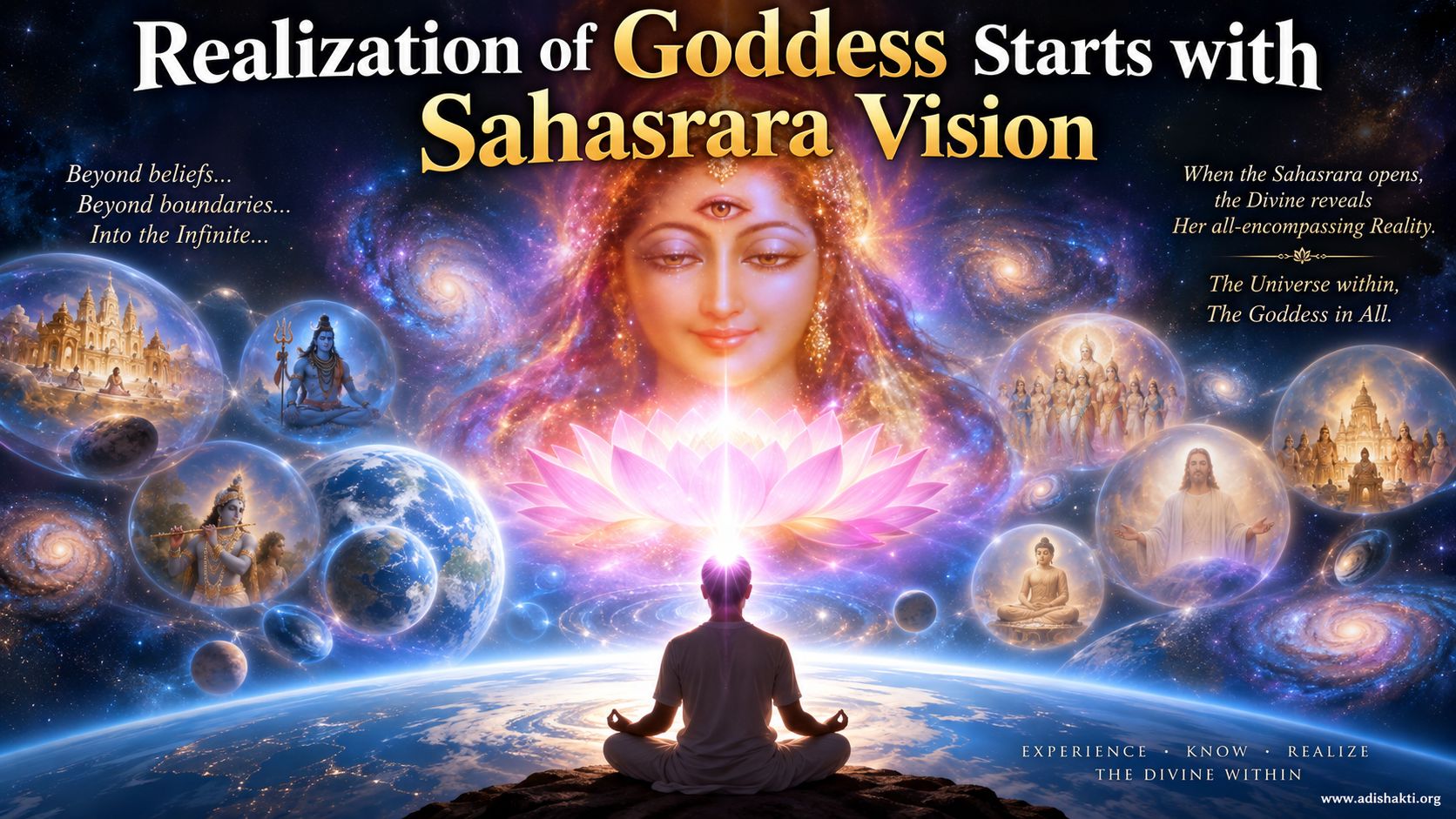
The earlier proposition that “realization of God starts with Cosmic Vision” can be carried further. In the theological framework examined here, the more specific claim is that realization of the Goddess starts with Sahasrara Vision. The Sahasrara is not treated merely as a yogic symbol at the crown of the body, but as the interior threshold through which consciousness encounters the Divine Feminine. The decisive movement is therefore from belief about the Goddess to an awakened capacity to see, enter, encounter, question, recognize, and repeatedly return to the sacred reality associated with Her.
This formulation is rooted first in Śākta scripture and then tested against the modern testimony preserved by Adishakti.org. The Bhāvana Upaniṣad identifies “the supreme divinity, Lalitā” with one’s own blissful Self, while the Lalitā Sahasranāma describes the Goddess as Sahasradala-padmasthā, seated in the thousand-petalled lotus. These texts establish a theological grammar in which the Divine Feminine, interior realization, and the crown-lotus converge. The family archive then makes a historical-religious claim: that Shri Mataji Nirmala Devi, understood within Sahaja Yoga as the Adi Shakti, opened the Sahasrara on May 5, 1970, and that the later experiences of Kashwinder, Arwinder, and Lalita constitute an extensive body of testimony to the reality made accessible through that opening.
The Goddess in the Sahasrara and the Interior Sanctuary Across Scriptures Contents ↑
The strongest Hindu foundation for this thesis is explicitly feminine. The Lalitā Sahasranāma, a central Śākta hymn to the Divine Mother, calls the Goddess Sahasradala-padmasthā—She who is seated in the thousand-petalled lotus. The Bhāvana Upaniṣad goes further by identifying Lalitā with the blissful Self. Read together, these traditions make the Sahasrara more than an anatomical or meditative diagram: it becomes a theological meeting point between the awakened human interior and the supreme Divine Feminine.
The same interiorizing pattern can be compared—carefully, without claiming that historically distinct traditions teach an identical chakra doctrine—with sacred language elsewhere. In Luke 17:20–21, Jesus says that the Kingdom of God is not located by ordinary outward observation; translations render the decisive phrase as either “within you” or “in your midst.” Qur’an 41:53 promises divine signs “in the horizons and within themselves”; Yusuf Ali’s rendering speaks of signs in the furthest regions and “in their own souls.” These texts do not name the Sahasrara, but they provide important comparative witnesses to an inward dimension of divine disclosure.
The Sikh tradition supplies a still closer spatial metaphor. The Guru Granth Sahib repeatedly speaks of the Dasam Duar, the “Tenth Door”; Sikh interpretive sources describe this gate as opening into the abode of the transcendent Creator. Buddhist literature likewise gives the thousand-petalled lotus a cosmic and supramundane symbolism. The Mahāprajñāpāramitāśāstra describes a magnificent thousand-petalled lotus in a proliferating vision of Buddhas and worlds. The Buddhist text is not thereby teaching the Hindu Sahasrara system, but the recurring thousand-petalled lotus provides a striking comparative image of transcendent multiplicity gathered into sacred unity.
The argument of this paper is therefore one of convergence without erasing difference. Hindu Śākta sources most directly identify the Goddess and the thousand-petalled lotus; Christian, Qur’anic, Sikh, and Buddhist sources contribute related languages of an inward Kingdom, signs within the self, a Tenth Door into the divine abode, and a thousand-petalled cosmic lotus. Within the Adishakti.org interpretation, these become complementary scriptural windows onto what the Sahasrara Vision discloses: the Divine is not confined to an external heaven but can be encountered through an awakened interior faculty.
The Primacy of Sahasrara Experience Contents ↑
The original text rejects the idea that eloquent religious discourse, professional religiosity, or the conferral of a mantra is equivalent to realization. Its alternative is emphatic: “True realisation starts with metaphysical experience of God.” In the study of mysticism, direct experience has likewise been treated as a central category, even though scholars differ over how such experiences should be interpreted and what, if anything, they establish beyond the experiencer’s testimony. [1]
This distinction is crucial for the contemporary material examined below. The significance claimed for the experiences of Kash and his siblings does not rest primarily on their ability to explain theology. On the contrary, their youth is repeatedly emphasized. The evidentiary argument made by the Adishakti.org archive is that experience preceded theological sophistication: the children reported what they said they saw, heard, visited, or learned in altered states of meditation, and adults later attempted to interpret and document those reports.
Krishna’s Cosmic Vision and the MahaDevi’s Sahasrara Vision Contents ↑
The Bhagavad Gita supplies the decisive classical paradigm. In Chapter 11, Krishna tells Arjuna that ordinary eyesight is insufficient and grants him a “divine eye” through which the universal form can be perceived. Arjuna then beholds the universe gathered within the divine form. The event is immense in theological meaning: ordinary perception is surpassed, the cosmos is disclosed as contained in the Divine, and Arjuna’s understanding is permanently altered. [2]
A second Krishna narrative must be distinguished from Arjuna’s vision. The famous episode in which the universe appears inside Krishna’s mouth belongs to the Śrīmad-Bhāgavatam account of Mother Yaśodā, not to the Bhagavad Gita’s battlefield revelation to Arjuna. Yaśodā is said to see within the child Krishna’s opened mouth the cosmos, planetary systems, elements, living beings, time, karma, Vṛndāvana, and even herself. [10] The distinction matters because the present comparison is not between identical visionary events, but between different modes of cosmic disclosure.
The experiences attributed to Kash and his siblings are presented in a markedly different form. Their significance does not lie in a single momentary tableau of the universe. The archive describes recurrent entry into the Sahasrara as an interior domain of experience: a realm entered through meditation in which the children are said to meet the MahaDevi and other divine personalities, converse with them, move through sacred and cosmic environments, witness events, ask questions, receive answers, and return repeatedly. The claimed vision is therefore not merely panoramic; it is inhabited, relational, interactive, temporal, and cumulative.
This is the central comparative point of the paper. Arjuna’s Vishvarupa is a concentrated disclosure of divine totality; Yaśodā’s vision is a concentrated disclosure of the cosmos within Krishna. The Singh-family corpus, as documented and interpreted by Adishakti.org, claims something broader in experiential architecture: not one disclosure but an extended visionary world; not only seeing but entering; not only beholding cosmic totality but interacting within it; not one recipient but several children; not one episode but a developing body of experiences extending across years. It is in this specific sense—not as a dismissal of the incomparable scriptural importance of Krishna’s revelations—that the MahaDevi-centered experiences are presented here as extraordinary in breadth and depth.
The Physical vs. The Transcendental Contents ↑
The distinction between the physical and the transcendental is therefore not incidental. Vedantic traditions use Brahman to speak of ultimate reality while also allowing for divine manifestation in forms accessible to devotion and contemplation. [3] The Times of India text presses the seeker beyond identification of the divine with a merely physical body: the visible form may mediate the encounter, but realization requires penetration into the reality to which that form points.
This distinction becomes especially important in the Adishakti.org accounts of Shri Mataji. The archive differentiates encounters with Shri Mataji in ordinary embodied life from encounters with the Divine Mother in the Sahasrara. Whatever judgment a reader ultimately makes about those claims, the internal logic is consistent with the paper’s thesis: God-realization begins when consciousness encounters a reality that is not reducible to ordinary sensory perception.
Shri Mataji, the Adi Shakti, and the Opening of the Sahasrara Contents ↑
The original text also insists that the transition from belief to realization is not merely an intellectual achievement. It assigns a decisive role to the illumined teacher who can disclose or awaken access to transcendental knowledge. The guru in Hindu traditions is therefore more than a lecturer: the guru may be understood as the mediator of a transformative knowledge that must become experiential. [4]
The Kash narratives radicalize this claim. They describe Self-Realization and awakened Kundalini not simply as beliefs taught to a child but as the means by which repeated visionary access became possible. In the archive’s interpretation, Shri Mataji’s role is therefore tested not by rhetoric alone but by what followed: sustained reports of direct communion, instruction, travel through the Sahasrara, and encounters with figures and scenes understood as belonging to the divine realm.
The Two Paths of Knowledge Contents ↑
Vedanta distinguishes forms of knowledge directed toward the conditioned world from knowledge of ultimate reality, often expressed through the categories of apara vidya and para vidya. [5] The distinction helps clarify why the article regards religious information as insufficient. One may accumulate concepts about God without possessing what the text calls knowledge of Brahman.
The contemporary testimonies are relevant precisely because they are presented as claims to experiential knowledge rather than conceptual knowledge. Kash’s descriptions of the Sahasrara, the Divine Mother, Jesus, Vishnu, Lakshmi, Shesha, Hanuman, Sita and Rama, and other figures are offered by the archive as reports of things encountered, not merely doctrines memorized. The distinction between those two kinds of knowing is the intellectual backbone of the paper.
Bhakti: Devotion as a Path Contents ↑
The article does not dismiss devotion. Its examples of Mira and Dhanna affirm the power of intense love of God, while insisting that devotion reaches fulfillment in direct knowledge of the divine. This places bhakti and experiential realization in a complementary relationship rather than treating them as opposites. [6]
The family accounts similarly combine devotion with claimed experience. Prayer, meditation, offerings, sacred music, and requests addressed to divine figures repeatedly precede the reported visions. The theological argument is therefore not that ritual and devotion are worthless, but that their deepest purpose is fulfilled when they open into living encounter.
The Immanence of the Divine Contents ↑
The Times of India text speaks of the “cosmic spark within us” and of a celestial vision perceived through the inner eye. This resonates with Vedantic reflection on Atman and Brahman, although the precise relationship between individual self and ultimate reality differs among Vedantic schools. [7] What matters for the present argument is the inward direction of discovery: the gateway to cosmic reality is described as being within consciousness itself.
The reported experiences of Kash and his siblings are framed in exactly this inward-yet-cosmic manner. Their physical bodies remain in ordinary surroundings while meditation is said to open the Sahasrara into a realm of extraordinary scope. Thus the “inner eye” is not presented as imagination in the ordinary sense but, within the archive’s own interpretation, as an organ or mode of spiritual perception through which a larger reality becomes accessible.
From May 5, 1970 to Repeated Sahasrara Vision Contents ↑
The most consequential assertion in the source article is that cosmic vision did not disappear with the scriptural past. It explicitly rejects the belief that such vision is impossible in Kali Yuga and maintains that knowledge of Brahman remains available. The Times of India article itself is therefore not merely interpreting an ancient episode; it is making a claim about present spiritual possibility. [8]
That assertion creates the bridge to the Singh family material. If cosmic vision remains possible, then contemporary claims cannot be dismissed solely because they occur in modernity. They still require careful evaluation, but their date is not, by itself, an argument against them. The relevant questions become: What was reported? How consistently? Under what circumstances? Was information claimed that the experiencer was not expected to know? Were there witnesses, written records, or later comparisons? The nineteen case studies below are best read through those questions.
Beyond a Single Cosmic Form: The Sahasrara as an All-Encompassing Divine Realm Contents ↑
The word “cosmic” can conceal an important difference. A cosmic vision may mean that the universe is disclosed to a seer in a single transcendent manifestation. But the Singh-family material claims a more extensive mode of experience: the Sahasrara itself becomes the locus of an interior cosmic reality. The children do not merely report looking at an extraordinary object from outside. They are described as entering a domain, remaining conscious within it, encountering personalities there, moving from scene to scene, and returning to ordinary awareness with memories of what occurred.
The breadth claimed for this corpus can be analyzed along several dimensions. Spatial breadth appears in accounts of cosmic regions, heavenly settings, planets, stars, and movement beyond ordinary earthly space. Temporal breadth appears in visions associated with sacred events of the past, including the Resurrection of Jesus and the opening of the Sahasrara. Religious breadth appears in encounters with figures identified with Hinduism, Christianity, Buddhism, Sikhism, and other traditions. Relational depth appears in conversations, questions, instructions, requests, offerings, recognition, and repeated meetings. Experiential continuity appears in the recurrence of the reported states over months and years rather than in a single isolated disclosure.
There is also an important difference between spectatorship and participation. Arjuna is granted divine sight in order to behold Krishna’s universal form; Yaśodā beholds the universe within Krishna’s mouth. By contrast, the Adishakti.org narratives portray Kash and his siblings as participants inside the visionary field. They are said to speak, travel, observe, inquire, receive responses, recognize recurring beings and places, and sometimes bring information from the experience back into family life. This participatory character gives the corpus a narrative and phenomenological depth that a single visionary tableau, however sublime, does not attempt to provide.
The paper therefore uses the phrase “all-encompassing Cosmic Vision” in a carefully defined sense. It does not mean that a modern family testimony can be objectively ranked above sacred scripture. It means that, within the claims preserved by the archive, the MahaDevi-centered Sahasrara experiences encompass an unusually wide range of visionary modes at once: cosmic scale, interiority, repeated access, dialogue, sacred history, multiple divine traditions, movement through visionary space, interpersonal interaction, and claimed links between events perceived inwardly and details later encountered outwardly. On those dimensions, the corpus is presented as having a scope that is difficult to parallel in a single classical vision.
This distinction substantially strengthens the governing thesis. If God-realization begins with cosmic vision, then the Singh-family accounts propose that realization need not terminate in a momentary glimpse. Cosmic vision can become an extended field of spiritual cognition. The Sahasrara is portrayed not simply as the point from which a vision is seen, but as the inner gateway through which consciousness enters the Kingdom of God. In the theological logic of the archive, the MahaDevi does not merely display the cosmos: She admits the seeker into a living cosmic order and permits sustained encounter within it.
The Incarnation of the Adi Shakti and the Opening of the Sahasrara Contents ↑
The paper’s theological claim reaches its fullest form in the identification of Shri Mataji Nirmala Devi with the Adi Shakti/MahaDevi. Hindu tradition accepts the principle of divine incarnation: Krishna is revered as having entered history in embodied form while remaining more than the human body through which He was known. Adishakti.org applies an analogous incarnational logic to the Divine Feminine: the primordial Shakti is understood to have taken human birth as Shri Mataji, not merely to teach about the Goddess but to open the Sahasrara as a collective possibility.
Within Sahaja Yoga history, May 5, 1970 at Nargol marks the opening of the Sahasrara by Shri Mataji. The Singh-family archive interprets the subsequent visionary experiences as experiential evidence of what that event made possible. Kash’s account is especially important because it is not presented as a solitary flash: from November 13, 1993 through July 26, 1995 the record encompasses 621 days, approximately 1,242 twice-daily meditation sessions, and additional returns to the Sahasrara to clarify questions—hence the family’s estimate of more than 1,300 Sahasrara entries. Arwinder and Lalita provide additional family testimony to the same interior sacred geography.
The Third Eye as the Faculty of Sahasrara Vision Contents ↑
A Sahasrara Vision requires more than the physical eyes. The governing claim of the family testimony is that Shri Mataji’s awakening of Kundalini opens an inner faculty of perception—the Third Eye—through which the Sahasrara can be consciously accessed. This gives the modern accounts their distinctive structure. The children are not described as receiving one involuntary apparition and then returning permanently to ordinary perception. They are said to have entered meditation repeatedly, perceived the same interior divine domain, encountered recognizable personalities, asked questions, received answers, and returned again.
This repeated accessibility is crucial. In the Bhagavad Gita, Krishna grants Arjuna divine sight for the overwhelming revelation of the Vishvarupa. In the Adishakti.org corpus, the MahaDevi-centered claim is structurally different: the awakened inner eye becomes a continuing means of Sahasrara perception. The comparison is therefore not simply between the greatness of Krishna and the greatness of the Goddess. It is between a concentrated scriptural revelation of cosmic form and a claimed continuing mode of interior access in which the Divine Mother presides over a realm containing deities, messengers, sacred events, cosmic environments, dialogue, memory, and spiritual instruction.
Kashwinder, Arwinder, and Lalita: Repeated Access to the Sahasrara Contents ↑
Adishakti.org preserves an extensive family archive centered on the experiences of Kashwinder Singh and his siblings. [9] The cumulative character of the archive is essential. It describes not one spectacular vision but a developing sequence of experiences beginning in childhood: repeated entry into the Sahasrara; encounters with the MahaDevi; meetings with divine figures associated with several religious traditions; journeys through cosmic and sacred environments; visions of events identified with sacred history; conversations and questions; and episodes in which ordinary earthly details were said to become known during meditation.
The scale of Kash’s reported experience is also important. From November 13, 1993 to July 26, 1995 spans 621 days (49 days in late 1993, 365 days in 1994, and 207 days through July 26, 1995). At approximately two meditations each day, this represents about 1,242 meditation sessions. Because Kash was also sometimes asked questions and would reportedly return to the Sahasrara to check or confirm what he had perceived, the family record places the cumulative number of these visionary entries at more than 1,300. The significance is therefore not merely numerical: the claimed Cosmic Vision was repeated, sustained and cumulative, developing through well over a thousand occasions rather than arising from a single extraordinary episode.
This depth, recurrence, and range change the nature of the comparison with classical cosmic-vision narratives. The relevant unit is no longer a single vision but an experiential corpus. One episode may concern the Divine Mother; another Jesus; another Vishnu, Lakshmi, Shesha, Hanuman, Sita or Rama; another a household offering; another an event said to have occurred in the past; another simultaneous awareness of physical and Sahasrara experience. Read together, the cases claim a coherent interior cosmology rather than a collection of unrelated images.
The strongest academic formulation is therefore cumulative rather than triumphalist. The paper does not claim that the archive has scientifically demonstrated every theological interpretation attached to these experiences. It argues that the reported phenomenology is unusually comprehensive and deserves analysis on its own terms. Questions of sincerity, chronology, prior knowledge, witness testimony, documentary preservation, later corroboration, and alternative explanation must be kept distinct. That discipline makes the central comparison stronger, not weaker: the claimed scope of the experiences can be described precisely without pretending that description alone settles their metaphysical status.
The nineteen cases below should consequently be read as facets of one overarching claim: the MahaDevi-centered Sahasrara experience is presented as a sustained Cosmic Vision of reality itself. Its distinctive feature is not merely what was seen, but the repeated interior access through which the children are said to have encountered a world containing divine personalities, sacred history, cosmic structure, knowledge, relationship, and continuity.
Kashwinder Singh’s Divine Revelations (1993-1995) Contents ↑
Source: First Permission From The Spirit Of The Living God In The Sahasrara [1]
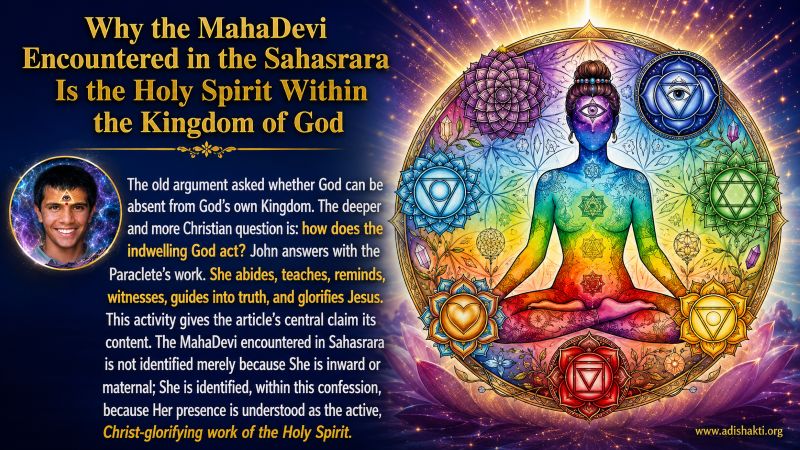
In early November 1993, a thirteen-year-old boy named Kashwinder Singh received Self-Realization through Sahaja Yoga. Immediately upon receiving this gift, he reached the Kingdom of God and underwent supreme enlightenment. For almost two years, without fail, he was shown the awesome Revelations of the Spirit World by the Great Adi Shakti Shri Nirmala Devi.
On April 2, 1995, at 11:20 a.m., Kashwinder met Shri Mataji within his Sahasrara and sought Her permission to reveal all that he had witnessed in the Kingdom of God. Shri Mataji granted Her blessings for this Divine Knowledge, authorizing the documentation of experiences that would provide irrefutable proof of the existence of The Almighty Creator and His Kingdom.
Significance: This example demonstrates that direct communion with the Adi Shakti is not dependent upon age, education, or prior spiritual training. A child of thirteen could access the Kingdom of God and receive daily revelations, proving the universality and accessibility of Shri Mataji’s grace.
Lalita Kaur’s Divine Vision (March 30, 1998) Contents ↑
Source: Papa, Yesterday I Saw Shri Mataji [2]

On March 30, 1998, at just three years and eleven months old, Lalita Kaur’s immortal atma (soul) entered the Dasvaa Duaar (Tenth Gate)—known as the Sahasrara, the Kingdom of God. There, her spirit beheld the Ekaa Maaee (One Divine Mother) who dwells beyond illusion, the eternal Source from which all life flows.
Lalita is described as “the youngest human ever to enter the Divine Gate.” The child spontaneously spoke spiritual truths without being asked anything, providing testimony that has been preserved over 25 years at adishakti.org.
Significance: This example proves that the Sahasrara is accessible even to the youngest souls, and that the Kundalini operates with perfect intelligence to awaken consciousness at every age.
Direct Communion in the Sahasrara (June 27, 1994) Contents ↑
Source: Shri Mataji — On Whom Do You Meditate? [3]

On June 27, 1994, Shri Mataji made a profound declaration: “I meditate on all those who meditate on Me.” This statement affirms Her supreme identity as the Adi Shakti, the Source of all consciousness. Kashwinder was daily meditating with all the Heavenly Hosts, including Divine Messengers (Jesus, Krishna, Muhammad, Buddha, Guru Nanak, and others). These Divine Messengers themselves were meditating on Shri Mataji Nirmala Devi in the Kingdom of the Spirit.
Significance: This example proves that the Adi Shakti is not a distant, unreachable deity, but an accessible, responsive presence with whom souls can communicate directly through the awakened Kundalini.
The Opening of the Sahasrara Chakra (May 5, 1994) Contents ↑
Source: The Opening of the Sahasrara Chakra [4]
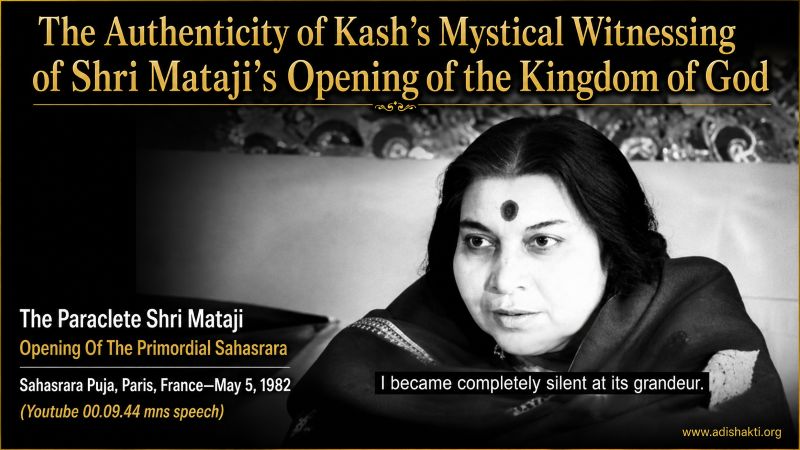
On May 5, 1994, Kashwinder witnessed a three-dimensional projection of the historical event of May 5, 1970, when Shri Mataji accomplished “the greatest spiritual feat in the history of this universe”—the opening of the Sahasrara Chakra. The event took place at Nargol, India, about 150 miles from Mumbai.
Shri Mataji immersed Her Lotus Feet in the Indian Ocean and entered a state of Supreme Samadhi. The projection showed red and yellow sparks of light bursting from the top of Shri Mataji’s head around the Brahmarandhra, looking like “fireworks,” “like a volcano erupting and shooting lava into the air.” Then a fountain of water gushed out of the top of Her Head about three feet into the air.
Significance: This example provides visual confirmation of the cosmic event that made direct communion with God accessible to all humanity.
The Divine Council and Shri Mataji’s Descent to Earth (April 3, 1994) Contents ↑
Source: MahaDevi: “Come down to Earth with Me” [5]

Before Shri Mataji incarnated on Earth, there was a major discussion in heaven among all the Divine Deities. All thirty-five crores (350 million) of gods and deities were present at this meeting. The decision was made to open the Sahasrara and grant humans direct access to the Kingdom of God. All the Messengers of God (Jesus, Krishna, Muhammad, Buddha, Guru Nanak, and others) requested that the Adi Shakti descend to Earth in human form to save humanity.
On April 3, 1994, Kashwinder witnessed this divine descent. Shri Mataji stepped down from Her Golden Throne and said to Kashwinder: “Come down to Earth with Me.” They descended together through the clouds into space, witnessing asteroids, planets, and distant stars.
Significance: This example proves that Shri Mataji’s incarnation was a unanimous decision of all Divine Beings, and that Her mission is to save humanity through the opening of the Sahasrara.
Divine Omniscience and the Clay Oil Lamps Contents ↑
Source: The Clay Oil Lamps [6]

Kashwinder’s father purchased three clay oil-lamps (deevas) from Marche Victoria in Montreal and placed them on the family altar. The same evening during meditation, Shri Mataji told Kashwinder that the lamps looked beautiful and was pleased. Shri Mataji had noticed and commented on the clay-lamps the very first time they had been placed on the altar. This demonstrates divine omniscience—Shri Mataji’s awareness of material objects placed on an altar on Earth while in communion in the Sahasrara.
Significance: This example proves that Shri Mataji’s consciousness operates simultaneously in both the material and spiritual dimensions, aware of every detail in the lives of Her devotees.
Divine Guidance on the Celibacy Fallacy (January 10, 1995) Contents ↑
Source: The Celibacy Fallacy [7]
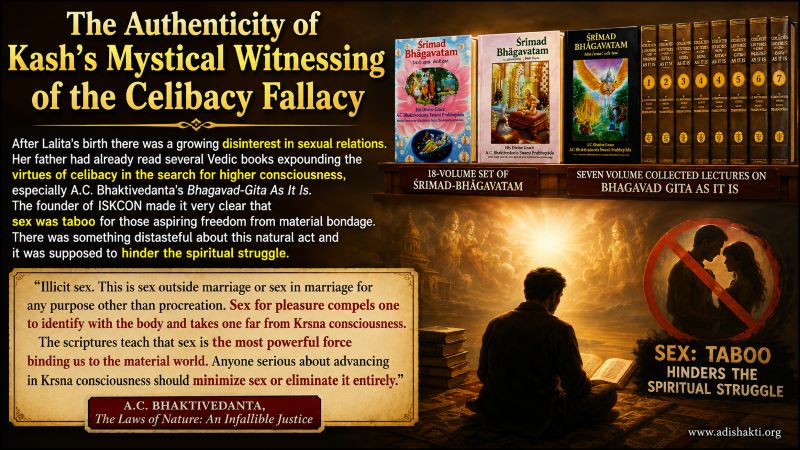
Kashwinder’s father had taken a vow of celibacy based on scriptural teachings about spiritual purity. For nine months, he strictly observed this vow. However, an inner consciousness gradually manifested that celibacy was against Self-Realization. On January 10, 1995, Kashwinder’s father ended the celibacy vow upon returning to Canada. The very next day, Shri Mataji told Kashwinder during meditation that now the family was “normal” again.
Significance: This example demonstrates Shri Mataji’s perfect knowledge of individual souls’ needs and Her ability to guide them with compassion while protecting innocence.
Dual Consciousness Across Dimensions (April 21, 1995) Contents ↑
Source: The Case of the Double Vision [8]
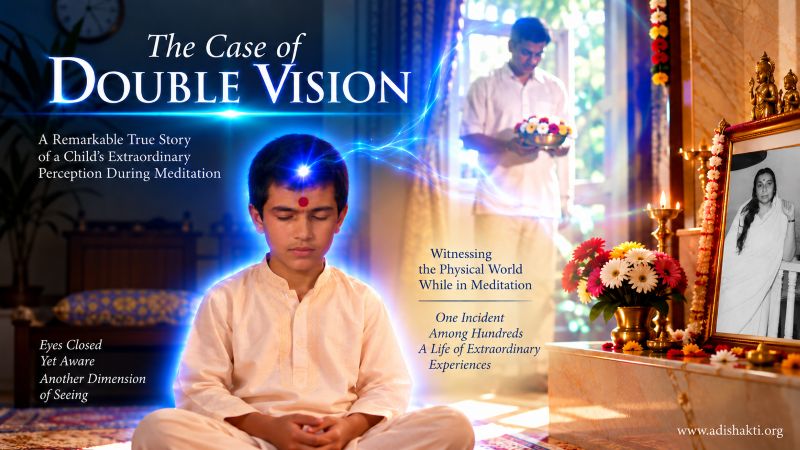
Kashwinder had numerous incidents of witnessing activities on Earth while simultaneously in the Sahasrara. On April 21, 1995, at 6:55 a.m., his father took flowers from the altar room to the balcony for watering. Kashwinder went into the room to meditate with his eyes closed. While meditating, he witnessed his father bringing the flowers back and placing them on the altar. He could see this activity while his physical eyes were closed.
Significance: This example provides scientific evidence that consciousness is not limited to the physical brain, but can operate simultaneously in multiple dimensions of reality.
The Revelation of Dual Motherhood (1994-1995) Contents ↑
Source: The Case of the Double Mothers [9]
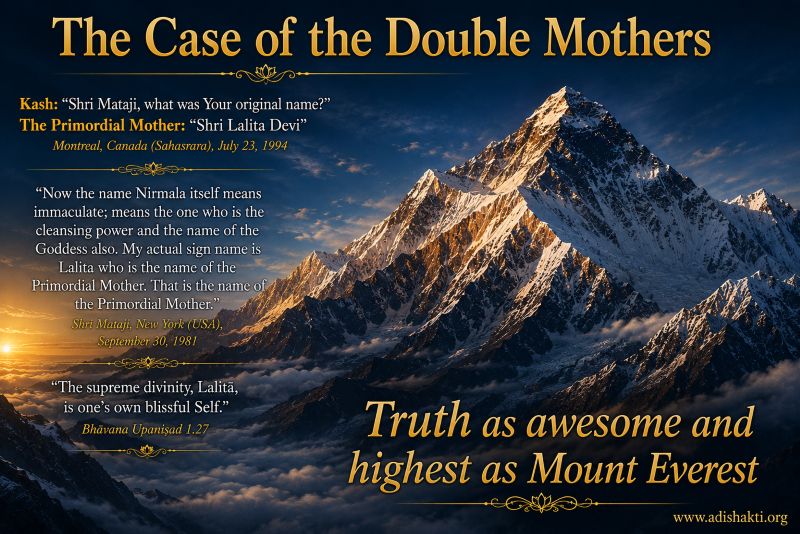
Months after Self-Realization, Kashwinder’s father began to perceive a difference between the physical Shri Mataji on Earth and the spiritual Shri Mataji in the Sahasrara. Although they are One and the same, the Adi Shakti in the Kingdom of God was perceived as the Divine World of Reality (Lahut). The Great Adi Shakti in the Kingdom of God knows everything instantly. The physical Adi Shakti on Earth has to consult Her own spiritual self within Her own Sahasrara to check facts out.
Significance: This example reveals the mystery of divine incarnation and how the Adi Shakti maintains simultaneous presence in both material and spiritual dimensions.
Divine Communion Through Sacred Music Contents ↑
Source: The Divine Musicians of Maa [10]

Just a few months after Self-Realization, Kashwinder’s father purchased a CD entitled Maa (salutation to the Divine Mother) by maestro Jagjit Singh. One evening while Kashwinder was studying, the Maa CD was played. He immediately stopped and told his father the music was “just overwhelming.” He raised his Kundalini, closed his eyes, and went into Nirvikalpa Samadhi (the thoughtless state of pure consciousness).
He sat completely motionless for half an hour. His mother became visibly shaken, fearing he might not return from this spiritual state. This demonstrates the power of sacred music to facilitate direct communion with the Divine.
Significance: This example proves that sacred music is a powerful vehicle for direct communion with the Divine, capable of inducing profound states of spiritual absorption.
Divine Intervention Through Shri Ganesha (September 28, 1993) Contents ↑
Source: The Mighty Messenger: “Join Shri Mataji!” [11]

On September 28, 1993, while Kashwinder’s father was in a drunken state, a thunderous voice suddenly bellowed: “JOIN SHRI MATAJI!” The voice was described as “like a thunderclap that jerked him out of his drunken stupor.” Despite his drunken condition, he managed to write down the message on a calling card: “Join Mataji 28/9/93.” The next morning, something extraordinary happened: his body suddenly rejected cigarettes. He had been addicted to cigarettes for more than twenty-five years. Overnight, he could not smoke anymore.
Significance: This example proves that the Divine operates through all means necessary to reach and transform souls, even those in states of deep intoxication and addiction.
Divine Omniscience—The Honey in Milk (April 1994) Contents ↑
Source: Honey in the Milk [12]
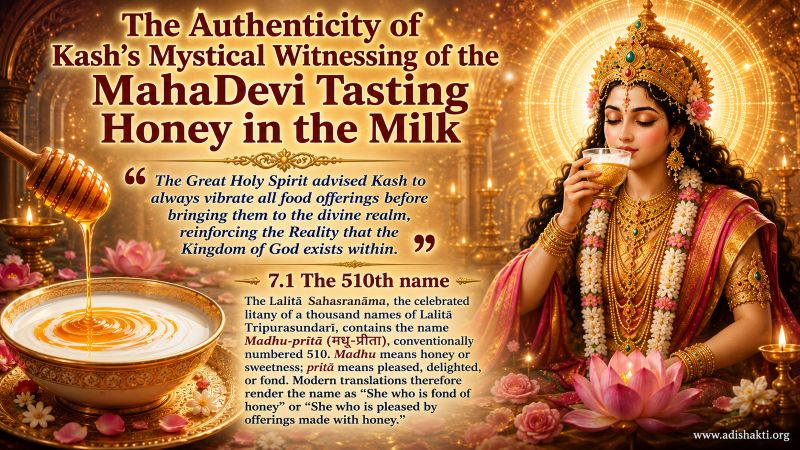
In April 1994, Kashwinder offered milk to Shri Mataji during meditation without knowing that his father had added honey. In the spiritual realm (Sahasrara), Shri Mataji took a sip of the milk and asked Kashwinder: “Is there honey in the milk?” Kashwinder, unaware of the honey addition, spontaneously affirmed it. This demonstrates Shri Mataji’s omniscience as the Adi Shakti (Primordial Mother).
Significance: This example provides concrete, verifiable proof of divine omniscience and the reality of the spiritual realm where offerings are consumed by Divine Beings.
Witnessing the Resurrection of Jesus Christ (April 1, 1994) Contents ↑
Source: The Resurrection of Christ [13]
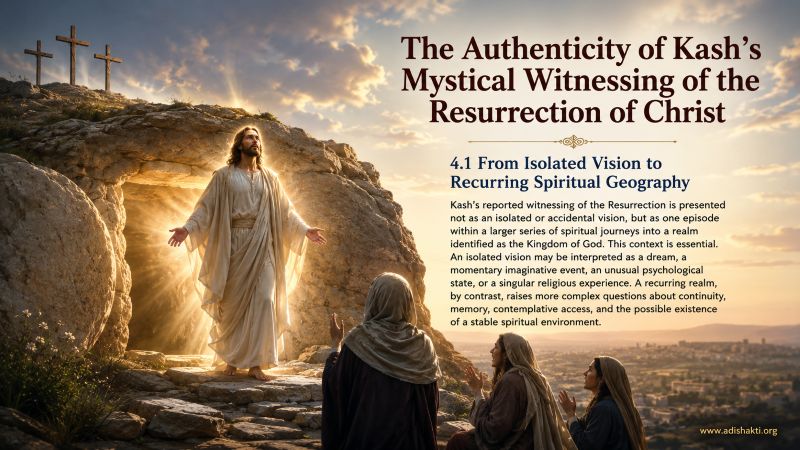
On Good Friday, April 1, 1994, Kashwinder asked Shri Mataji if he could witness the Resurrection of Jesus Christ. Shri Mataji agreed to take him two millenniums back in time! They traveled at super light-year speed back into the past. They came to the exact spot where Jesus lay buried in Golgotha, outside Jerusalem. About 20-25 Divine Incarnations (Lakshmi, Vishnu, Parvati, Shiva, Sita, Rama, Radha, Krishna, Ganesha, Buddha, and others) were sitting in a circle around the tomb.
Suddenly a dazzling ray of Light shone diagonally from the heavens directly on the tomb. Shri Jesus emerged through the rock tomb in deep meditation. The Universal Savior was a Spirit again, just like His Celestial Brethren. Tears of Joy streamed down the cheeks of the Heavenly Hosts as the Divine Unity humbled before the Universal Savior.
Significance: This example provides the most profound verification of Christian theology—the actual witnessing of the Resurrection of Jesus Christ by all Divine Beings, confirming the central truth of Christianity.
Spiritual Vision Corroborated by Historical Evidence (April 1, 1994) Contents ↑
Source: Hole in the Rock Grave [14]

Kashwinder witnessed Jesus’ burial in a “hole in the rock grave” during his spiritual vision on April 1, 1994. He was raised in a Sikh family accustomed to cremation rituals, not burial practices. The concept of a “hole in the rock grave” was alien to his cultural context. On April 17, 1994, his father sent a fax to San Diego, USA describing this vision. On May 28, 1996, this precise mystical description was confirmed through independent research. Dan Costian’s Bible Enlightened (p. 197) confirmed the Gospel accounts describing Jesus’ tomb as “hewn in the rock.”
Significance: This example provides scientific verification of spiritual experiences through independent historical research, proving the accuracy of information received through direct communion with the Divine.
Direct Communion with Jesus Christ (Good Friday, 1994) Contents ↑
Source: Good Friday Greetings [15]

The same evening after witnessing the Resurrection, Kashwinder meditated early, eager to see the Crucified Lord again. Shri Mataji stepped down from the Golden Throne. She held out Her hands and Kashwinder found himself being levitated a few inches. Both traversed across the endless landscape of blue clouds into the universe.
They arrived at their destination and Kashwinder saw Lord Jesus standing and waiting in anticipation. Kashwinder bowed in Namaskar and told Him, “Happy Good Friday.” Shri Jesus took his hands, shook them, hugged him and said, “Son, I am so glad that you came here today.”
Significance: This example fulfills the Christian promise of communion with Jesus Christ, showing that the “Second Coming” is not a future external event, but an immediate internal experience available through the Sahasrara.
Divine Intervention Preventing Suicide (February-March 1996) Contents ↑
Source: MahaDevi’s Miracles: Dual Life-Saving Interventions [16]

Kanggaima was a woman who had suffered through an abusive first marriage in Malaysia and fled to Canada to start anew. She found a new relationship with Telvinder and married in 1994. She worked two jobs, seven days a week to support the family. In February 1996, her husband suddenly left for India, cleared all her bank savings, and abandoned her. She was pregnant at the time and faced complete financial ruin. She became deeply despondent and mentally depressed.
Her friend Mandy, a Muslim and non-Sahaja Yogi, came to stay with her. A very strange thing happened: Mandy heard a voice telling her to bring milk for the Great Divine Mother and Her Son, Shri Ganesha. Mandy did as she was told and put the milk before the altar. This divine intervention occurred to a non-Sahaja Yogi, demonstrating the universal reach of the Adi Shakti’s grace. This prevented Kanggaima from taking her own life.
Significance: This example proves that the Adi Shakti’s grace extends to all humanity, regardless of religion or spiritual practice, and that She actively intervenes to save souls from destruction.
Witnessing Shri Vishnu and Lakshmi on the Cosmic Serpent Contents ↑
Source: A Floating Serpent? Are You Sure? [17]
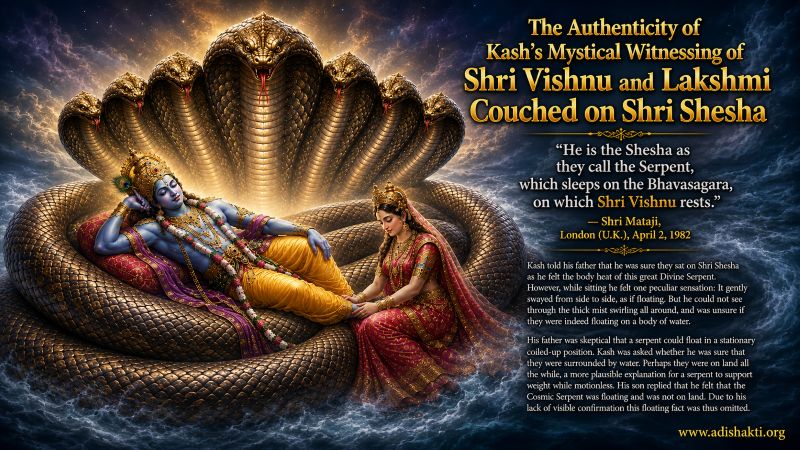
Shri Mataji took Kashwinder to visit Shri Vishnu and Lakshmi as they rested on Shri Sesha, the Primordial Cosmic Serpent. Kashwinder felt the body heat of this great Divine Serpent. While sitting, he felt a peculiar sensation: the serpent gently swayed from side to side, as if floating. He could not see through the thick mist swirling all around, but felt they were floating on a body of water.
His father was initially skeptical that a serpent could float in a stationary coiled-up position. More than a year later, the truth of the child’s inner vision was confirmed. While watching the Ramayana for the first time, the glorious form of Shri Vishnu appeared reclining on Shri Ananta in the vast Milky Ocean! Kashwinder had indeed witnessed this Timeless Vedic Truth. His sensation of being afloat was correct. The Spirit of the Living God, Shri Adhiparasakthi Shri Nirmala Devi, had indeed taken him to the Cosmic Causal Ocean where Shri Vishnu and Shri Lakshmi rested on the floating Shri Sankarsana.
On October 29, 1995, Kashwinder was asked to describe Shri Shesha in detail. He initially said there were 6 heads, but later realized he had not counted the larger middle head. He then stated that Shri Shesha had seven heads, with three smaller heads on either side of the larger middle one. This matches the ancient Vedic description of Shri Shesha with seven heads.
Significance: This example demonstrates that Shri Mataji can transport souls to witness ancient Vedic truths, and that spiritual visions can be verified through independent historical and scriptural sources. The verification of the seven-headed serpent proves the accuracy of information received through direct communion.
Witnessing Shri Rama and Sita in the Heart of Shri Hanuman (April 24, 1994) Contents ↑
Source: The Matchless Devotion of Shri Hanuman [19]
On April 24, 1994, at about 7:00 p.m., Kashwinder asked to visit Shri Hanuman. He meditated and took along a coconut that had a swastika on it. The divine energy of The Mother Kundalini took him through the Sushumna Nadi to the Thousand-Petal Lotus. Kashwinder floated slowly down into his spiritual body that was meditating beside the Great Adi Shakti.
Kashwinder bowed to the Devi and informed Her of his desire to visit Shri Hanuman. Shri Mataji, without any hesitation, agreed and levitated him. They traveled across the universe at a velocity that NASA would find difficult to believe. On the way they visited Shri Ganesha to offer the coconut. The Eternal Child was in meditation, and with His eyes still closed, bowed and thanked Kashwinder.
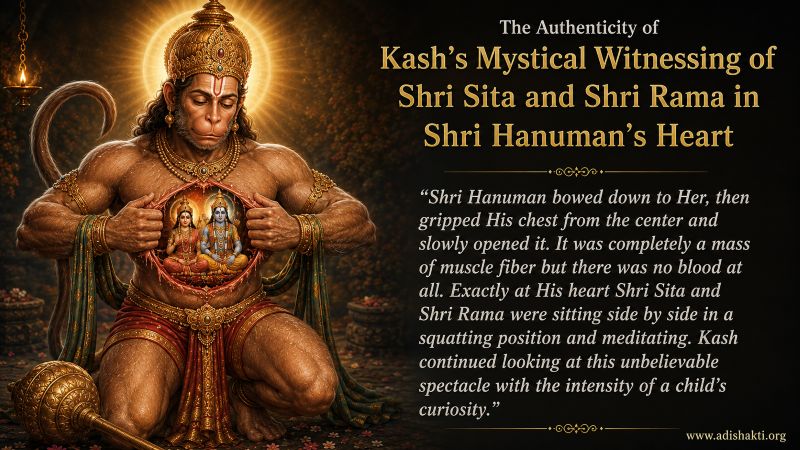
They reached Shri Hanuman’s temple. Both entered by the front open entrance and walked to Shri Hanuman, who was in meditation. Kashwinder bowed to Him and asked the Adi Shakti: “I want to see Shri Rama and Sita in His heart please.” Shri Hanuman opened His eyes as Shri Mataji translated the request into Sanskrit. Shri Hanuman bowed down to Her, then gripped His chest from the center and slowly opened it. It was completely a mass of muscle fiber but there was no blood at all. Exactly at His heart, Shri Sita and Shri Rama were sitting side by side in a squatting position and meditating.
Kashwinder continued looking at this unbelievable spectacle with the intensity of a child’s curiosity. Shri Hanuman then closed His chest again. Kashwinder could not become thoughtless as the unforgettable sight of Shri Sita and Shri Rama meditating in the heart of Shri Hanuman kept whirling in his mind. He had never seen such an incredible spectacle—two Divine Deities in the heart of another Divine Deity! Shri Sita and Shri Rama were really in the heart of Shri Hanuman as the ancient scriptures had proclaimed.
Significance: This example demonstrates that the deepest truths of Hindu scriptures are not metaphorical but literal realities accessible through direct communion with the Adi Shakti. It proves that Shri Hanuman’s devotion to Shri Rama and Sita is so complete that they literally dwell in his heart. This fulfills the ancient Hindu belief and shows that Shri Mataji can reveal the hidden divine realities within the hearts of all Divine Beings.
Conclusion: Realization of the Divine Feminine Through Sahasrara Vision Contents ↑
The central conclusion of this study is that, within the theological and testimonial framework assembled here, realization of the Goddess starts with Sahasrara Vision. The Divine Feminine is not merely an object of devotion standing outside the seeker. Lalitā is identified with the blissful Self; the Goddess is associated with the thousand-petalled lotus; and the awakened Sahasrara becomes the interior sanctuary in which the distinction between scripture read and divinity encountered is radically transformed.
This is why the experiences of Kashwinder, Arwinder, and Lalita are central rather than incidental. Their importance lies in the claimed repeatability, continuity, breadth, and relational character of the experience. Kash’s record alone is described as exceeding 1,300 entries into the Sahasrara, while his siblings provide further testimony to the same sacred interior domain. In the archive’s interpretation, Shri Mataji does not simply reveal one cosmic image. As the Adi Shakti/MahaDevi, She awakens the Kundalini, opens the inner eye, and enables consciousness to enter repeatedly into the Sahasrara.
Krishna’s revelation to Arjuna remains a foundational scriptural paradigm of divine sight: ordinary eyes are insufficient and a divinely granted vision discloses cosmic reality. The MahaDevi-centered Sahasrara corpus makes a different and, in scope, more universal claim: the faculty of inner perception itself can be awakened and made available as an enduring path of realization. The distinction is not a denial of Krishna’s divinity or of the Bhagavad Gita’s authority. It is the paper’s theological argument that the Divine Feminine represents the more all-encompassing principle because Shakti is presented as the power through which realization, revelation, consciousness, and liberation become possible.
The comparative scriptural pattern deepens that conclusion. The Śākta tradition gives the most explicit language of Lalitā and the thousand-petalled lotus. Christianity speaks of the Kingdom that is “within” or “in the midst” of humanity; the Qur’an promises signs in the horizons and within human beings; Sikh scripture speaks of the Dasam Duar opening toward the abode of the transcendent Creator; Buddhist literature preserves the cosmic symbolism of the thousand-petalled lotus. These traditions are not interchangeable, and the historical texts do not all identify their symbols with the Sahasrara. Yet read comparatively they converge upon a profound intuition: ultimate reality is not exhausted by external religious form, and the human interior can become a locus of transcendent disclosure.
The Divine Feminine therefore emerges, in the interpretation advanced by this paper, as a shared sacred secret embedded across the world’s scriptures: named most explicitly as the Goddess in Śākta revelation, yet resonating with the inward Kingdom, the signs within the soul, the Tenth Door, and the thousand-petalled cosmic lotus. Sahasrara Vision becomes correspondingly more than a sectarian experience. It is proposed as a universal grammar of spiritual realization—an awakened vision capable of drawing humanity beyond competing external identities toward a shared encounter with the Divine Feminine as the living power within creation, consciousness, scripture, and the human Self.
Accordingly, the paper’s final thesis is emphatic: the realization of the Divine Feminine through Sahasrara Vision is presented here as more universal and all-encompassing than a single revelation of cosmic form. It is not one vision confined to one prophet, one scripture, one people, or one historical moment. It is a claimed capacity for repeated interior encounter, opened through the Sahasrara and directed toward the Mother who, in this theological reading, is already present—sometimes openly, sometimes symbolically—within humanity’s sacred traditions. The promise of the Goddess is therefore not simply that humanity may believe in Her, but that humanity may awaken the inner vision through which the Divine can be known.
Academic and Comparative References Contents ↑
[2] “Bhagavadgita: 11. The Yoga of Universal Cosmic Vision.” Hinduwebsite.com, www.hinduwebsite.com/gita911.asp. Accessed 29 Sept. 2025.
[3] “Brahman: The ultimate reality in Hindu philosophy.” Fabrizio Musacchio, 2 Jan. 2025, www.fabriziomusacchio.com/weekend_stories/told/2025/2025-01-02-brahman/.
[4] “The Role of the Guru in Hinduism.” Himalayan Academy, www.himalayanacademy.com/readlearn/basics/fourteen-questions/what-is-the-guru-s-role. Accessed 29 Sept. 2025.
[5] “Para and Apara Vidya.” The Vedanta Kesari, vol. 104, no. 5, 2017, pp. 18-22.
[6] “Bhakti Yoga.” Yoga Journal, 28 Aug. 2007, www.yogajournal.com/yoga-101/types-of-yoga/bhakti-yoga/.
[7] “Atman (Hinduism).” Wikipedia, Wikimedia Foundation, 20 Sept. 2025, en.wikipedia.org/wiki/%C4%80tman_(Hinduism).
[8] “Realisation of God starts with Cosmic Vision.” The Times of India, 17 July 2017, timesofindia.indiatimes.com/realisation-of-god-starts-with-cosmic-vision/articleshow/59627693.cms.
[9] “Welcome to Adi Shakti.” Adishakti.org, www.adishakti.org/index.htm. Accessed 29 Sept. 2025.
[10] Śrīmad-Bhāgavatam 10.8.37–39, Mother Yaśodā’s vision of the cosmic manifestation within Krishna’s mouth.
[11] Bhagavad Gita 11.8, 11.13, Krishna grants Arjuna divine sight to behold the universal form.
[12] Bhāvana Upaniṣad 27: “The supreme divinity, Lalita, is one's own blissful Self.”
[13] Lalitā Sahasranāma, śloka 109 / name 528: Sahasradala-padmasthā, the Goddess seated in the thousand-petalled lotus.
[14] Luke 17:20–21: the Kingdom of God rendered as “within you” (KJV) or “in your midst” (NIV).
[15] Qur’an 41:53: divine signs “in the horizons and within themselves”; Yusuf Ali renders the latter “in their own souls.”
[16] The Sikh Encyclopedia, “Dasamdvar”: the Tenth Door in the Guru Granth Sahib and its relation to the abode of the Creator (GG 974; 1036).
[17] Mahāprajñāpāramitāśāstra: a vision of a magnificent thousand-petalled lotus and proliferating Buddhas.
Documentary Sources for the Contemporary Case Studies Contents ↑
[1] Kutta, Pariah. First Permission From The Spirit Of The Living God In The Sahasrara. Adi Shakti.org, accessed December 2025.[2] Kutta, Pariah. Papa, Yesterday I Saw Shri Mataji. Adi Shakti.org, accessed December 2025.
[3] Kutta, Pariah. Shri Mataji — On Whom Do You Meditate? Adi Shakti.org, accessed December 2025.
[4] Kutta, Pariah. The Opening of the Sahasrara Chakra. Adi Shakti.org, accessed December 2025.
[5] Kutta, Pariah. MahaDevi: “Come down to Earth with Me.” Adi Shakti.org, accessed December 2025.
[6] Kutta, Pariah. The Clay Oil Lamps. Adi Shakti.org, accessed December 2025.
[7] Kutta, Pariah. The Celibacy Fallacy. Adi Shakti.org, accessed December 2025.
[8] Kutta, Pariah. The Case of the Double Vision. Adi Shakti.org, accessed December 2025.
[9] Kutta, Pariah. The Case of the Double Mothers. Adi Shakti.org, accessed December 2025.
[10] Kutta, Pariah. The Divine Musicians of Maa. Adi Shakti.org, accessed December 2025.
[11] Kutta, Pariah. The Mighty Messenger: “Join Shri Mataji!” Adi Shakti.org, accessed December 2025.
[12] Kutta, Pariah. Honey in the Milk. Adi Shakti.org, accessed December 2025.
[13] Kutta, Pariah. The Resurrection of Christ. Adi Shakti.org, accessed December 2025.
[14] Kutta, Pariah. Hole in the Rock Grave. Adi Shakti.org, accessed December 2025.
[15] Kutta, Pariah. Good Friday Greetings. Adi Shakti.org, accessed December 2025.
[16] Kutta, Pariah. MahaDevi’s Miracles: Dual Life-Saving Interventions Amid Dual Suicide Attempts. Adi Shakti.org, accessed December 2025.
[17] Kutta, Pariah. A Floating Serpent? Are You Sure? Adi Shakti.org, accessed December 2025.
[19] Kutta, Pariah. The Matchless Devotion of Shri Hanuman. Adi Shakti.org, accessed December 2025.
[20] Yogananda, Paramahamsa. The Undreamed-of Technical Advances in Civilization. Self-Realization Fellowship, teachings on spiritual communion and the fulfillment of prophecy.