

The Great Cover Up [of Christianity] - Emperor Constantine oversaw the creation of the Nicene creed
The Great Cover-Up of Christianity reveals how institutional religion concealed Christ's promise of the Paraclete, reducing the Holy Spirit to abstraction rather than acknowledging a living, personal guide. Adishakti.org presents this truth in the light of Shri Mataji Nirmala Devi, who declared Herself the Holy Spirit and fulfilled the eschatological role of the Paraclete. This page affirms that true Self-realization and collective awakening are only possible through understanding the message of the Paraclete Shri Mataji, restoring the authenticity of Christ's revolutionary promise.
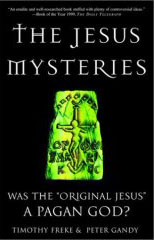 The Great Cover Up (Except from Chapter 1)
Our new account of the origins of Christianity only seemed improbable because it contradicted the received view. As we pushed further with our research, the traditional picture began to completely unravel all around us. We found ourselves embroiled in a world of schism and power struggles, of forged documents and false identities, of letters that had been edited and added to, and of the wholesale destruction of historical evidence. (P.13) We focused forensically on the few facts we could be confident of, as if we were detectives on the verge of cracking a sensational "whodunnit," or perhaps more accurately as if we were uncovering an ancient and unacknowledged miscarriage of justice. For, time and again, when we critically examined what genuine evidence remained, we found that the history of Christianity bequeathed to us by the Roman Church was a gross distortion of the truth. Actually, the evidence completely endorsed the Jesus Mysteries Thesis! It was becoming increasingly obvious that we had been deliberately deceived, that the Gnostics were indeed the original Christians, and that their anarchic mysticism had been hijacked by an authoritarian institution which had created from it a dogmatic religion — and then brutally enforced the greatest cover-up in history.
One of the major players in this cover-up operation was a character called Eusebius who, at the beginning of the fourth century, compiled from legends, fabrications, and his own imagination the only early history of Christianity that still exists today. All subsequent histories have been forced to base themselves on Eusebius' dubious claims, because there has been little other information to draw on. All those with a different perspective on Christianity were branded as heretics and eradicated. In this way, falsehoods compiled in the fourth century have come down to us as established facts.
Eusebius was employed by the Roman Emperor Constantine, who made Christianity the state religion of the Empire and gave Literalist Christianity the power it needed to begin the final eradication of Paganism and Gnosticism. Constantine wanted "one God, one religion" to consolidate his claim of "one Empire, one Emperor." He oversaw the creation of the Nicene Creed — the article of faith repeated in churches to this day — and Christians who refused to assent to this creed were banished from the Empire or otherwise silenced.
(P.14) This "Christian" Emperor then returned home from Nicaea and had his wife suffocated and his son murdered. He deliberately remained unbaptized until his deathbed so that he could continue his atrocities and still receive forgiveness of sins and a guaranteed place in heaven by being baptized at the last moment. Although he had his "spin doctor" Eusebius compose a suitably obsequious biography for him, he was actually a monster — just like many Roman Emperors before him. Is it really at all surprising that a "history" of the origins of Christianity created by an employee in the service of a Roman tyrant should turn out to be a pack of lies?
Elaine Pagels, one of the foremost academic authorities on early Christianity, writes:
"It is the winners who write history — their way. No wonder, then, that the traditional accounts of the origins of Christianity first defined the terms (naming themselves 'orthodox' and their opponents 'heretics'); then they proceeded to demonstrate — at least to their own satisfaction — that their triumph was historically inevitable, or, in religious terms, 'guided by the Holy Spirit.' But the discoveries [of the Gnostic gospels] at Nag Hammadi reopen fundamental questions." [7]
History is indeed written by the victors. The creation of an appropriate history has always been part of the arsenal of political manipulation. The Roman Church created a history of the triumph of Literalist Christianity in much the same partisan way that, two millennia later, Hollywood created tales of "cowboys and Indians" to relate "how the West was won," not "how the West was lost." History is not simply related, it is created. Ideally, the motivation is to explain historical evidence and come to an accurate understanding of how the present has been created by the past. All too often, however, it is simply to glorify and justify the status quo. Such histories conceal as much as they reveal.
(P.15) To dare to question a received history is not easy. It is difficult to believe that something which you have been told is true from childhood could actually be a product of falsification and fantasy. It must have been hard for those Russians brought up on the tales of kindly "Uncle Joe" Stalin to accept that he was actually responsible for the deaths of millions. It must have strained credibility when those opposing his regime claimed that he had in fact murdered many of the heroes of the Russian Revolution. It must have seemed ridiculous when they asserted that he had even had the images of his rivals removed from photographs and completely fabricated historical events. Yet all these things are true.
It is easy to believe that something "must" be true because everyone else believes it. But the truth often only comes to light by daring to question the unquestionable, by doubting notions which are so commonly believed that they are taken for granted. The Jesus Mysteries Thesis is the product of such openness of mind. When it first occurred to us, it seemed absurd and impossible. Now it seems obvious and ordinary. The Vatican was constructed upon the site of an ancient Pagan sanctuary because the new is always built upon the old. In the same way, Christianity itself has as its foundation the Pagan spirituality that preceded it. What is more plausible than to posit the gradual evolution of spiritual ideas, with Christianity emerging from the ancient Pagan Mysteries in a seamless historical continuum? It is only because the conventional history has been so widely believed for so long that this idea could be seen as heretical and shocking.
The Jesus Mysteries: Was the Original Jesus A Pagan God?
Chapter 1 - p.12-15
Timothy Freke & Peter Gandy
Element (imprint of Harper Collins 'Publishers')
77-85 Fulham Palace Road
Hammersmith, London W6 8JB
The False Foundation: Demolishing Papal Claims Through Historical Evidence and the Pentecost Deception
Table of Contents
- Abstract
- Introduction
- The Historical Vacuum: Peter de Rosa's Devastating Evidence
- The Pentecost Deception: The Paraclete Papers Revelation
- The Dark Ages: Historical Confirmation of the Church's True Nature
- The Pattern of Deception: From Pentecost to Present
- Conclusion: The Inescapable Verdict
- References
Abstract
This paper demolishes the foundational claims of the Roman Catholic Church, specifically the doctrines of papal supremacy and infallibility. It argues that the papacy is not a divine institution established by Jesus Christ, but a historical construct built on theological deception and political manipulation. The analysis synthesizes two primary lines of evidence: first, the historical critique of former priest Peter de Rosa, who demonstrates the complete absence of any concept of a Petrine office or papal authority in the Bible and the writings of the early Church Fathers. Second, it incorporates the revelatory thesis of the Paraclete Papers, which posits that the event of Pentecost was not the descent of the Holy Spirit as promised by Christ, but the arrival of the "Prince of this World"—Satan—who established a counterfeit church. The paper concludes that the centuries of corruption, violence, and systematic suppression of truth, exemplified by the Inquisition and the persecution of the Cathars, are not aberrations but the logical and historical manifestation of an institution founded on a satanic deception.
Introduction
The Roman Catholic Church anchors its claim to spiritual authority in an unbroken line of succession from the Apostle Peter, whom it identifies as the first pope. Upon this foundation rests the doctrines of papal supremacy—the pope's universal jurisdiction over the Church—and infallibility, the belief that the pope is preserved from error when defining matters of faith and morals. These tenets are not peripheral; they are the very cornerstone of Catholic identity and authority.
However, a rigorous examination of historical and theological sources reveals that this foundation is built not on rock, but on sand. This paper challenges these central claims by exposing a profound disconnect between the Church's official narrative and the verifiable evidence. The thesis is twofold: first, the historical record, as meticulously documented by scholars and even former insiders, shows that the concept of the papacy was entirely alien to the early Church. Second, the theological event celebrated as the Church's birth—Pentecost—was, in fact, a masterstroke of deception, marking the arrival not of the promised Comforter (the Paraclete), but of the very entity Jesus warned would come to deceive the world.
By weaving together the historical void of evidence for a Petrine office with the theological argument of the Pentecost deception, this paper will demonstrate that the Catholic Church's claims are without merit. Its subsequent history of worldly power, brutal persecution, and doctrinal manipulation is not a deviation from its divine mission but a confirmation of its true origin as a manifestation of the "Prince of this World."
The Historical Vacuum: Peter de Rosa's Devastating Evidence
The doctrine of papal supremacy requires a clear, unbroken line of authority from Peter. Yet, when one examines the earliest Christian records, what is found is not evidence, but a profound and deafening silence. Peter de Rosa, a former Catholic priest with access to the Vatican's own archives, articulates this stunning reality in his book Vicars of Christ: The Dark Side of the Papacy. His conclusion is a dagger to the heart of Roman claims:
De Rosa's statement is not a casual observation; it is a conclusion based on the complete absence of evidence where it should be most abundant. If the Petrine office were divinely instituted, the early Church Fathers—the direct intellectual and spiritual descendants of the Apostles—would have referenced, debated, and built upon it. Instead, they wrote thousands of pages on theology, scripture, and church governance without mentioning a pope. The great ecumenical councils that formulated the foundational creeds of Christianity, such as the Nicene Creed, operated without any recourse to a supreme pontiff in Rome. This historical vacuum is inexplicable if the Catholic Church's claims are true.
The papacy, therefore, is not an apostolic institution but a later invention, forged in the crucible of political ambition and historical revisionism. As Timothy Freke and Peter Gandy note in The Jesus Mysteries, history is written by the victors. The Roman Church, after being co-opted by Emperor Constantine as a tool for imperial unity, began a systematic process of creating a history that justified its own power. This involved branding all dissenting voices as "heretics," destroying their writings, and fabricating a narrative of its own divine inevitability.[2] The papacy was the ultimate product of this centuries-long project of historical forgery.
The Pentecost Deception: The Paraclete Papers Revelation
While the historical record exposes the *how* of the papal fabrication, the Paraclete Papers reveal the *why* by identifying the spiritual source of the deception. The papers argue that the institutional Church was born not of God, but of His adversary. The key lies in a re-examination of Jesus's final promises in the Gospel of John and the true nature of Pentecost.
Jesus promised to send a Comforter, the Paraclete or Spirit of Truth, who would guide his followers after his departure (John 14:16-17, 16:13). However, in the same breath, he delivered a chilling warning:
The timing is critical. Jesus states the "Prince of this World" is coming *after* he is gone. The Catholic Church claims that the Holy Spirit descended at Pentecost, ten days after Jesus's ascension, thereby inaugurating the Church. The Paraclete Papers present a devastating alternative: what descended at Pentecost was not the promised Paraclete, but the prophesied Prince of the World—Satan himself, arriving as a Trojan Horse to create a counterfeit religion.[4]
This interpretation resolves a critical contradiction in the traditional narrative. Jesus explicitly states that the Paraclete "cannot be received by the world" because "the world... neither sees him nor knows him" (John 14:17), just as the world did not know Jesus. Yet, the institutional church born at Pentecost was rapidly embraced by the Roman Empire—the very embodiment of "the world"—and became a global institution of immense worldly power. This is the opposite of what Jesus predicted for the true Paraclete. The church that the world *could* see, know, and join was, by definition, not the body of the true Spirit of Truth. It was the work of the great deceiver.
The Dark Ages: Historical Confirmation of the Church's True Nature
If the Catholic Church is indeed the creation of the Prince of the World, its history should reflect the nature of its founder. The centuries following its rise to power provide a resounding and horrifying confirmation. The period known as the Dark Ages, along with the subsequent eras of the Inquisition and religious wars, reveals a consistent pattern of violence, corruption, and suppression that is the antithesis of Christ's teachings.
The Inquisition stands as one of the most monstrous chapters in human history. It was a system of institutionalized terror, employing systematic torture, secret accusations, and brutal executions to enforce doctrinal uniformity.[5] Far from being the work of a few rogue agents, it was authorized and directed by the popes themselves. This was not justice; it was the work of a spiritual tyranny obsessed with power.
The Albigensian Crusade (1209-1229) further exemplifies this satanic spirit. The Cathars of southern France were a peaceful Christian group who believed the material world was the creation of an evil demiurge. For this, the papacy launched a genocidal war against them. The infamous command allegedly given by a papal legate before the massacre at Beziers—"Kill them all, God will know his own"—perfectly captures the spirit of the institution.[6] This was not the protection of the faith; it was the extermination of rivals by the Prince of this World.
Throughout this period, the papacy itself was mired in a level of corruption that would be shocking even for a secular institution. Popes engaged in murder, simony, nepotism, and sexual depravity, all while claiming to be the Vicar of Christ. This history of atrocities is not a series of unfortunate deviations from a divine mission. It is the consistent, centuries-long manifestation of an entity founded on deception and dedicated to worldly power, exactly as one would expect from the work of the Prince of the World.
The Pattern of Deception: From Pentecost to Present
The establishment of a counterfeit church required not only a deceptive spiritual event but also the complete rewriting of history. As Freke and Gandy detail, the victory of the Roman literalist faction was achieved through a "great cover-up."[2] This involved the systematic destruction of alternative Christian traditions, most notably the Gnostics, who represented a more mystical and individualistic understanding of Christ's message. The Gnostics were branded as heretics and their texts were burned, ensuring that only the Roman version of history survived.
This pattern of suppressing truth and enforcing a singular, authoritarian dogma began with the Council of Nicaea, overseen by the unbaptized Emperor Constantine, and has continued for two millennia. The doctrines of papal supremacy and infallibility are the capstone of this edifice of deception, granting the institution the ultimate power to define truth and silence dissent. It is the final lock on a prison of dogma designed to keep humanity from the true, unmediated experience of the divine that Jesus promised.
Conclusion: The Inescapable Verdict
The evidence, when examined without the lens of indoctrination, is overwhelming and leads to an inescapable verdict. The claim of the papacy is a fraud. It has no foundation in the Bible or the early Church, as Peter de Rosa's work so clearly demonstrates. It is a historical fabrication designed to legitimize worldly power.
Furthermore, the theological argument presented by the Paraclete Papers provides the missing piece of the puzzle, identifying the spiritual origin of this great deception. The event of Pentecost was not the birth of the true Church of Christ, but the masterstroke of the Prince of the World, who created a counterfeit institution that would lead humanity astray for millennia.
The dark history of the Catholic Church—its inquisitions, its crusades, its corruption, and its relentless suppression of truth—is not an anomaly. It is the irrefutable proof of its origin. An institution that burns people alive, wages wars of extermination, and systematically lies to maintain its power cannot be the representative of Jesus Christ. There is no question that the Catholic Church, with the papacy at its head, has been a centuries-old manifestation of the Prince of the World. The deception has been exposed, and the time has come to look beyond the walls of this false institution for the true spiritual promise that it was created to suppress.
References
[1] De Rosa, Peter. Vicars of Christ: The Dark Side of the Papacy. Crown Publishers, 1988, p. 206.[2] Freke, Timothy, and Peter Gandy. The Jesus Mysteries: Was the Original Jesus a Pagan God?. Harmony Books, 1999.
[3] The Holy Bible, John 14:30.
[4] "The Paraclete Papers." adishakti.org, https://adishakti.org/Paraclete-Papers.htm. Accessed Nov 26, 2025.
[5] "Inquisition." Wikipedia, Wikimedia Foundation, https://en.wikipedia.org/wiki/Inquisition. Accessed Nov 26, 2025.
[6] "Albigensian Crusade." Wikipedia, Wikimedia Foundation, https://en.wikipedia.org/wiki/Albigensian_Crusade. Accessed Nov 26, 2025.
The Most Compelling Quotes from the Paraclete Papers: Direct Links Between the Prince of this World and the Catholic Church
Context: These quotes are extracted from the Paraclete Papers, which argue that the event of Pentecost was not the arrival of the promised Holy Spirit, but the fulfillment of Jesus's warning that the "Prince of this World" would come immediately after his departure. The subsequent history of papal corruption, violence, and deception is presented as confirmation of this satanic origin.
I. The Core Thesis: Pentecost as Deception
"Pentecost, occurring just days after this warning, was not the advent of the Holy Spirit as comforter and guide, but the arrival of this very 'prince of this world.' The 'mighty rushing wind' and 'tongues of fire' were not a divine anointing but a deceptive spectacle, inaugurating an institution that would become a temporal power, a 'god of this world' that would blind the minds of unbelievers."
"The subsequent history of the papacy, as documented by de Rosa and others, provides a grim catalog that supports this interpretation. The institution claiming descent from Pentecost quickly became embroiled in worldly power, corruption, and violence that stands in stark opposition to the teachings of Jesus."
II. The Historical Void: No Foundation in Scripture or Church Fathers
"After Peter, the centuries roll by, full of controversies, any one of which today would involve immediate recourse to Rome for a decision... We have already noted that not a single Father can find any hint of a Petrine office in the great biblical texts that refer to Peter. Papal supremacy and infallibility, so central to the Catholic church today, are simply not mentioned. Not a single creed, nor confession of faith, nor catechism, nor passage in patristic writings contains one syllable about the pope, still less about faith and doctrine being derived from him."
"The elaborate edifice of papal authority is a later construction, a political and theological innovation, not a divine institution established by Christ."
III. A Church Born of Deception
"The claim that the Catholic Church was born on Pentecost Sunday is a foundational myth that crumbles under historical scrutiny. The absence of any concept of papal supremacy or a Petrine office in the early Church, as attested by numerous sources including the critical work of Peter de Rosa, demonstrates that the core of the modern Catholic power structure is a later invention."
"By re-evaluating Pentecost not as the birth of the Church of Christ, but as the deceptive arrival of the 'Prince of the World' forewarned by Jesus, the subsequent dark history of the papacy becomes coherent. It is not a story of a divine institution falling into sin, but of a worldly one fulfilling its inherent nature. The centuries of corruption, hypocrisy, and violence are not a betrayal of its origins, but a confirmation of them. The institution that claims to be the Vicar of Christ has, for much of its history, more accurately reflected the ambitions of the prince of this world."
IV. Deception as Foundation: The Forging of Power
"The early papacy's rise to temporal power was built upon a foundation of deliberate deception that would characterize its methods throughout history. The most notorious example is the 'Donation of Constantine,' a forged document that claimed the Roman Emperor Constantine had granted the Pope supreme authority over the Western Roman Empire. This fabrication, created in the 8th century, was used for centuries to justify papal claims to temporal sovereignty over kings and emperors."
"As de Rosa documents, this forgery was so crude that it contained obvious anachronisms and historical impossibilities, yet the papacy continued to assert its authenticity even after it was definitively proven false in 1517. The willingness to base fundamental claims to authority on known forgeries reveals an institution more concerned with power than truth—a characteristic that aligns perfectly with the nature of the 'Prince of this World' rather than the Church of Christ."
"The pattern of deception extended far beyond this single document. Pope Gregory VII enlisted 'a whole school of forgers' to provide him with fabricated documents supporting papal supremacy. These false decretals and pseudo-historical texts were systematically used to override legitimate church councils and establish papal authority where none had existed before. This was not the work of isolated corrupt individuals, but a systematic institutional policy of deception spanning centuries."
V. The Depths of Depravity: Systematic Moral Corruption
"The moral corruption that plagued the papacy from its earliest centuries provides perhaps the most damning evidence against its claimed divine origin. De Rosa's exhaustive research, drawing from 'impeccable Catholic sources, papal documents, letters of reforming saints,' reveals a pattern of depravity so systematic and enduring that it cannot be dismissed as mere human weakness within a divine institution."
"Monasteries full of women; every friar had his 'Martha', every nun her lover. Bishops, in every sense the fathers of their people, kept harems... Young men who spent their youth in rape and adultery were rising in the ranks of the clergy. They were spending their nights with four or five women, then getting up in the morning — in what state, he leaves to the imagination — to celebrate mass."
"The papacy itself profited from this corruption through the 'infamous cullagium, a charge for keeping concubines... bishops and archdeacons themselves benefited from this sex-tax; in Rome, it was the pope.'"
"Many monasteries were the haunts of homosexuals, many convents were brothels... St. Alban's Abbey 'was nothing but a den of prostitutes serving the local monks. Nuns were regularly raped therein and the entire place, in a phrase worthy of Shakespeare, was 'riot of seed and blood.' In London, 'the parish of St John Zachary... provided a brothel exclusively for priests and nuns.'"
VI. Violence as Doctrine: The Suppression of Dissent
"The papacy's response to challenges to its authority reveals another characteristic of the 'Prince of this World'—the use of violence and terror to maintain power. The establishment of the Inquisition represents perhaps the most systematic institutionalization of religious terror in human history. This was not a defensive measure against external threats, but an offensive weapon designed to crush internal dissent and maintain papal supremacy."
"The Albigensian Crusade against the Cathars in southern France was particularly revealing. These Christians, who emphasized personal piety and rejected the material wealth of the institutional church, were systematically exterminated with papal blessing. The famous command to 'kill them all, God will know his own' epitomizes the papacy's approach to dissent."
"The theological justification for this violence came directly from papal doctrine. The principle that 'error has no rights' was used to justify the torture and execution of those who disagreed with papal teaching. This represents a fundamental inversion of Christ's teaching about loving one's enemies and turning the other cheek."
VII. The Commodification of Salvation
"The doctrine of Purgatory, unknown to the early Church and absent from Scripture, was gradually developed to serve the financial needs of the papacy. As de Rosa notes, 'The Pope invented Purgatory so he could sell indulgences in order to allow souls out!' This was not a theological development driven by spiritual insight, but a financial innovation designed to generate revenue."
"The papal agent Johann Tetzel's famous jingle, 'As soon as the coin in the coffer rings, the soul from purgatory springs,' perfectly captures the crass commercialization of what should have been matters of eternal significance."
VIII. The Final Verdict: Not Corruption but Nature
"This extensive catalog of corruption, violence, and deception cannot be dismissed as the unfortunate failings of individual bad actors within an otherwise good institution. The pattern is too consistent, too systematic, and too enduring to be explained as mere human weakness. Instead, it reveals the true nature of an institution that, from its alleged founding on Pentecost, has consistently manifested the characteristics of a worldly kingdom rather than a spiritual one."
"The papacy's history demonstrates a consistent prioritization of temporal power over spiritual truth, material wealth over evangelical poverty, and institutional preservation over moral integrity. These are precisely the characteristics one would expect from an institution founded not by the Holy Spirit, but by the 'Prince of this World' whom Jesus warned would come."
"The fact that this corruption persisted through centuries of attempted reform, survived multiple schisms and challenges, and continued even after being repeatedly exposed and condemned, suggests that it was not an aberration but the natural expression of the institution's fundamental character. An institution truly founded by God and protected by divine grace could not have maintained such a consistent pattern of worldly behavior across so many centuries."
IX. The Inescapable Conclusion
"The historical record of the papacy provides overwhelming evidence that this institution, far from being the divinely protected Church of Christ, has consistently manifested the characteristics of what Jesus warned would be the kingdom of the 'Prince of this World.' The centuries following Pentecost reveal not a gradual corruption of a pure institution, but the systematic expression of an inherently worldly power structure that prioritized temporal authority, material wealth, and carnal pleasure over spiritual truth."