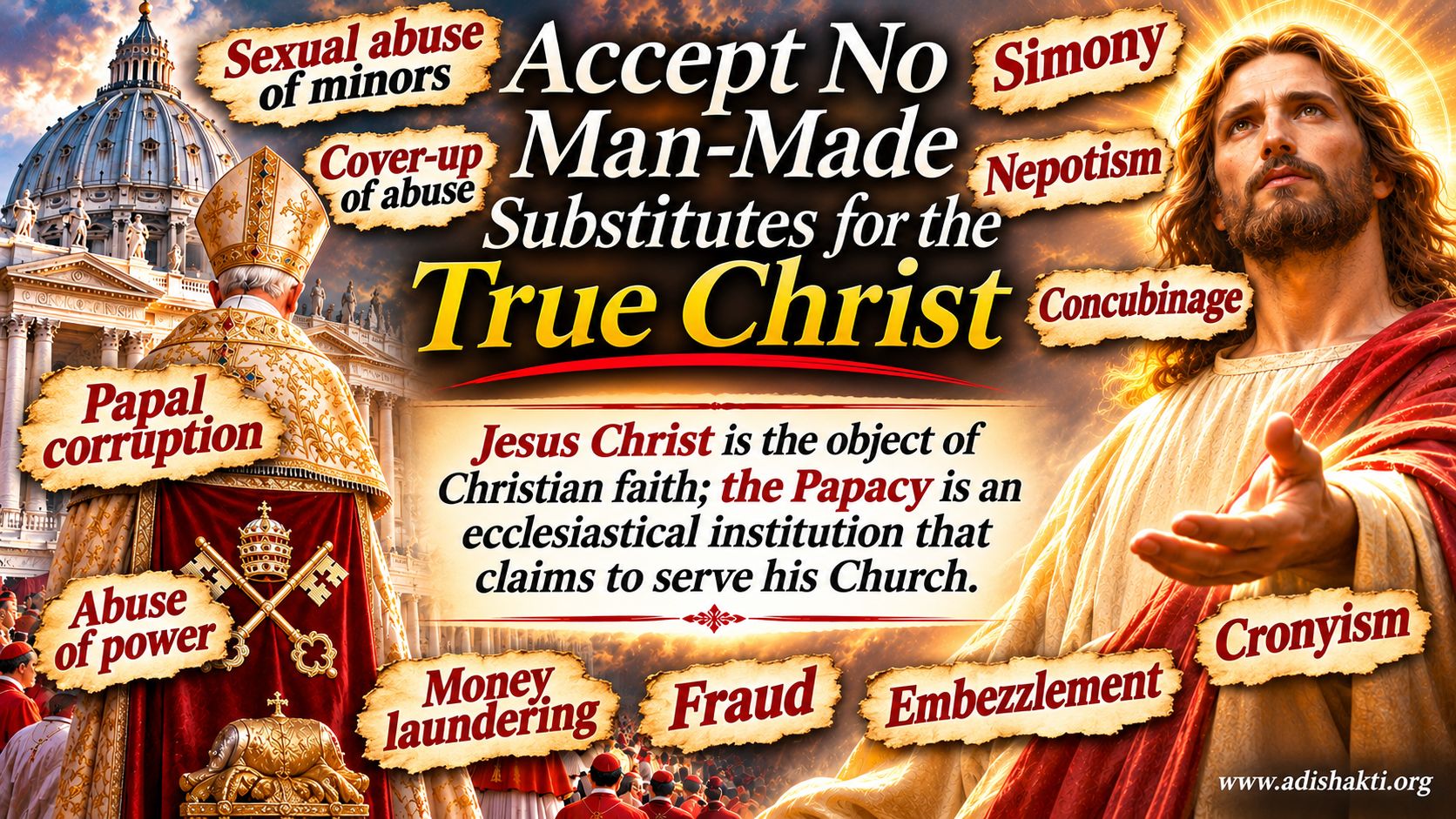
Accept No Man-Made Substitutes for the True Christ
Summary
This study examines the admonition “Accept no man-made substitutes for the true Christ” through the history of the Papacy and the Christian distinction between the authority of Jesus Christ and that of those who claim to represent him. It draws on two supplied texts: a theological essay and an extract attributed to the M+G+R Foundation, The Papacy in Historical Perspective: The Seldom Told History. The latter assembles cases from two especially turbulent periods, 896–1048 and 1455–1555. The cases reveal recurring tensions between pastoral responsibility and aristocratic patronage, money, dynastic ambition, coercion, and warfare. The argument is not that every accusation against every pope has been proved, nor that Catholic doctrine formally equates the pope with God. Rather, it is that the Church’s historical officeholders are fallible human beings, and their actions must not be confused with the person, character, or saving authority of Christ. The final sections assess the eschatological warning about a “False Christ” as a theological interpretation, not a historically demonstrated identification.
This expanded edition also examines global clerical sexual abuse and cover-ups, Vatican financial controversies, coercive religious institutions, the Magdalene laundries, the Avignon Papacy, and the disputed wartime legacy of Pius XII. It distinguishes established facts from accusations, estimates and theological interpretation.
1. The Question: Who Is the Object of Christian Trust?
The starting point is a fundamental theological distinction: Jesus Christ is the object of Christian faith; the Papacy is an ecclesiastical institution that claims to serve his Church. The two cannot simply be exchanged. A Christian may recognize ministries, councils, bishops, or popes without granting them the worship or absolute loyalty owed to God. The danger arises when an institution’s prestige, survival, or pronouncements become practically immune from the moral and spiritual standards by which it claims to live.
This distinction must not be blurred into the claim that Catholics officially worship the pope. They do not. The stronger question is whether particular historical practices—courtly magnificence, coerced allegiance, purchasable offices, or manipulation of spiritual benefits—have sometimes made the institutional hierarchy appear to displace the gospel it professed to protect.
2. What the Papacy Claims—and What It Does Not
Catholic theology regards the bishop of Rome as successor to Peter and visible principle of unity in the Church. The First Vatican Council’s Pastor aeternus (1870) teaches a specifically delimited form of papal infallibility when the pope speaks ex cathedra to define a doctrine of faith or morals to be held by the whole Church. Infallibility is not impeccability: it does not mean a pope is sinless, omniscient, politically infallible, or personally divine. This distinction is indispensable for a historically responsible critique.
The New Testament itself provides a framework for testing leadership: Jesus contrasts domination with service (Mark 10:42–45), condemns religious display divorced from justice (Matthew 23), and is presented as the one mediator between God and humanity (1 Timothy 2:5). Catholic interpreters understand ordained ministry as participation in Christ’s mediation, not competition with it; Protestant and other critics often emphasize the risk of institutional mediation obscuring Christ’s unique place. The disagreement is real, but neither perspective requires denying the documented moral failures of particular popes.
3. The First Crisis: The Papacy, 896–1048
The source extract describes this period as a papal “dark age,” using the polemical term pornocracy for the domination of Roman ecclesiastical affairs by aristocratic factions, particularly the Theophylact family. The word is not a neutral historical classification. It nevertheless points to a serious structural issue: the papal office could become entangled with family power, violent succession, and contested legitimacy.
| Pontiff / period | Historical issue | Assessment and significance |
|---|---|---|
| Boniface VI (896) | Extremely short pontificate; the extract reports prior disciplinary action and disputed eligibility. | The brevity of his reign is secure; details of canonical status require checking against contemporary evidence. |
| Stephen VI (896–897) | The Cadaver Synod: the corpse of Formosus was exhumed and subjected to a posthumous trial. | An extraordinary example of factional conflict and the political weaponization of ecclesiastical judgment. |
| Sergius III (904–911) | The source alleges responsibility for deaths of rivals and a relationship with Marozia. | Political involvement is central to the era; specific murder and paternity claims are contested and should not be presented as judicially established facts. |
| John X (914–928) | The extract alleges involvement in a contested episcopal appointment concerning Reims. | Illustrates how royal politics and ecclesiastical appointments overlapped; the specific narrative needs independent verification. |
| John XII (955–964) | Accounts describe scandalous conduct, conflict with Emperor Otto I, and deposition. | Hostile contemporary testimony is significant but must be weighed for partisan interests. |
| John XIX (1024–1032) | The source alleges bribery in securing office. | Evidence of aristocratic influence is stronger than a definitive reconstruction of every payment. |
| Benedict IX (1032–1040s) | Multiple periods of rule, accusations of misconduct, and a transfer of the papal office for money. | The contested sale or resignation of the office is a major case in the history of simony; sensational sexual allegations require caution. |
| Gregory VI (1045–1046) | Acquired the papacy through a financial arrangement involving Benedict IX; removed at Sutri. | The case demonstrates that even an intended reform could be compromised by the purchase of ecclesiastical office. |
The deeper significance of the tenth-century record
The cumulative argument does not depend on repeating the most lurid stories. Even when hostile chronicles are discounted, a clear institutional pattern remains: election could be shaped by competing families, coercion, and the control of Rome. When succession to spiritual leadership resembles the contest for a hereditary principality, the office risks being evaluated by worldly power rather than fidelity to Christ.
4. The Second Crisis: Renaissance Papacy, 1455–1555
The Renaissance evidence concerns a more elaborate papal monarchy: diplomacy, patronage, armies, great building projects, family advancement, and the commercialization of office. Art and scholarship flourished in this setting, but so did serious abuses. The extract’s individual allegations are not all equally secure; what follows distinguishes widely documented patterns from allegations that require caution.
| Pontiff / period | Historical issue | Assessment and significance |
|---|---|---|
| Callistus III (1455–1458) | Promoted relatives, including Rodrigo Borgia, to positions of power. | A clear example of nepotism as a pathway to later dynastic influence. |
| Pius II (1458–1464) | Humanist literary career and appointments of nephews. | Earlier secular writings do not themselves establish misconduct as pope; nepotism is the more relevant institutional issue. |
| Paul II (1464–1471) | The extract cites a hostile character assessment. | Personal insults are not evidence of specific abuse; institutional decisions should be evaluated separately. |
| Sixtus IV (1471–1484) | Advanced relatives; became entangled in the Pazzi conspiracy and conflict with Florence. | The precise degree of personal complicity in the assassination plot is debated; papal political involvement and nepotism are well attested. |
| Innocent VIII (1484–1492) | Financial expedients, sale of offices, diplomacy involving Prince Cem, and Giovanni de’ Medici’s elevation. | Shows the intersection of papal finance, international bargaining, and elite patronage. |
| Alexander VI (1492–1503) | Borgia family advancement, acknowledged children, political alliances, and allegations of electoral bribery. | Nepotism and dynastic policy are well documented; exact counts and sensational accounts require source-by-source scrutiny. |
| Julius II (1503–1513) | Military campaigns, territorial ambition, construction of the new St Peter’s, and indulgence financing. | The “warrior pope” exposes the tension between pastoral office and temporal sovereignty. |
| Leo X (1513–1521) | Continued the St Peter’s indulgence campaign during Luther’s early challenge. | The 1517 controversy became a catalyst for the Reformation; indulgences were not doctrinally the sale of forgiveness, but abuses of their promotion were consequential. |
| Paul III (1534–1549) | Favored family members while also convening the Council of Trent. | A mixed record: nepotism coexisted with major institutional reform. |
| Julius III (1550–1555) | Advanced Innocenzo del Monte, prompting accusations of favoritism and scandal. | His patronage is documented; sexual insinuations in polemical sources should not be repeated as proven facts. |
5. The Mechanisms of Corruption
Nepotism: treating the Church as a family inheritance
Nepotism is not simply the presence of relatives in public life; it becomes an abuse when access to spiritual office, revenue, or power depends on kinship rather than competence and pastoral responsibility. The recurring promotion of nephews and sons demonstrates how ecclesiastical office could function as a means of securing dynastic continuity. The Callistus III–Alexander VI and Sixtus IV–Julius II connections are especially revealing.
Simony: money and the acquisition of spiritual office
Simony means buying or selling spiritual things or ecclesiastical offices. The source highlights Benedict IX, Gregory VI, and allegations concerning several Renaissance elections. The theological problem is not merely bad administration: when spiritual office becomes a commodity, a ministry meant to serve the faithful becomes a prize acquired through wealth. Allegations about particular conclaves, however, must be distinguished from independently established transactions.
Political violence: the shepherd as prince
The Cadaver Synod, papal territorial wars, and the Pazzi crisis show how sacred office could become entangled with force. The problem is not solved by assuming that every diplomatic or military action was unjust; the issue is the need to judge such acts by moral criteria independent of the prestige of the pope who ordered or supported them.
Indulgences: a spiritual benefit entangled with fundraising
In Catholic doctrine an indulgence concerns remission of temporal punishment for sins already forgiven; it is not formally a license to sin or a purchase of divine forgiveness. Yet fundraising campaigns tied to indulgences could be communicated or experienced as transactions promising spiritual relief for money. This is the historical and pastoral distinction that matters in understanding the challenge of 1517. A doctrine’s formal definition does not erase abuses in how it is marketed or practiced.
6. Julius II, Leo X, and the Reformation
Julius II laid the cornerstone of the new St Peter’s Basilica in 1506 and supported indulgence arrangements connected with its financing. Leo X continued the program. The preaching associated with Johann Tetzel became one immediate focus of Martin Luther’s Ninety-Five Theses in 1517. It would be too simple to claim that one fundraising practice “caused” the Reformation: debates about grace, justification, Scripture, authority, and reform were already profound. Nevertheless, the indulgence controversy exposed the cost of joining spiritual assurance to institutional finance.
The source also notes the dispensation permitting Henry VIII to marry Catherine of Aragon and the later refusal of an annulment, which formed part of the English break with Rome. That sequence was not merely the automatic consequence of Julius II’s original dispensation; dynastic succession, royal policy, and competing legal and theological claims all contributed. This complexity strengthens rather than weakens the central point: the papacy operated within—and could be constrained by—political systems.
7. Papal Election Rules and the Paradox of Simony
The extract draws attention to an apparent paradox. Julius II condemned simoniacal papal elections and sought to invalidate them. Later legislation, including John Paul II’s Universi Dominici Gregis (1996), imposed severe penalties for simony while maintaining the validity of an election even if simony occurred. The difference is juridical, not an endorsement of bribery: one rule seeks to invalidate a tainted election, while another preserves institutional continuity despite punishing the offense. The example shows how ecclesiastical law must balance moral condemnation with the practical problem of disputed succession.
8. How the Evidence Should Be Read
The supplied historical extract cites Richard P. McBrien, Charles A. Coulombe, Eamon Duffy, and Claudio Rendina, but many claims reach us through short quotations and paraphrases rather than reproduced primary documents. It is therefore best treated as a secondary-source compilation with a polemical thesis, not as a complete archival demonstration. Claims of dates, officeholding, family relationships, the Cadaver Synod, and major policy decisions generally have stronger historical foundations than precise numbers of children, alleged motives, private sexual conduct, or responsibility for murders. This edition retains those distinctions explicitly.
A second caution concerns the argument’s scope. Evidence that some popes were corrupt does not logically establish that every pope was corrupt, that the Catholic Church has no legitimate Christian life, or that papal infallibility means papal sinlessness. The historical evidence supports a forceful critique of abuses of power; wider doctrinal judgments require additional theological argument.
9. The True Christ and the Temptation of Institutional Substitution
The theological warning can now be stated more precisely. A church that claims to serve Jesus Christ must remain answerable to the teachings and character of Jesus Christ. The Pope cannot become a second savior, the Vatican cannot become the object of worship, and institutional loyalty cannot be the final test of truth. This standard applies just as much to Protestant pastors, charismatic teachers, spiritual movements, and authors of this paper as it does to Roman Catholic authorities.
The New Testament’s language of service, repentance, humility, and discernment supplies a standard of criticism that is not dependent on the character of a particular officeholder. The measure of Christian authority is not how successfully it protects its own prestige, but whether it directs persons toward Christ and the life he taught.
10. The “False Christ”: Historical Evidence and Eschatological Interpretation
The M+G+R Foundation’s warning that excessive exaltation of the Papacy prepares the way for a “False Christ” belongs to an apocalyptic reading of Christian history. Passages such as Matthew 24:4–5, 24:23–26, and 2 Thessalonians 2 have been interpreted differently across Christian traditions. They can motivate vigilance against deceptive religious authority, but the misconduct of historical popes does not, by itself, identify a present or future Antichrist or prove a prophetic timetable.
This distinction preserves the seriousness of the warning without converting historical criticism into an unsupported prediction. It also avoids treating contemporary Catholics collectively as participants in a conspiracy. The test remains ethical and theological: does any religious authority demand a kind of submission that belongs to God alone?
The Global Clerical Sexual-Abuse Crisis
The modern clerical sexual-abuse crisis is not adequately described as a collection of isolated offenses. Investigations have documented abuse of children, institutional concealment, inadequate responses to complaints, and the transfer or continued ministry of accused clerics. The distinction between individual offending and organizational response is essential: the latter implicates supervision, records, accountability, and the credibility of pastoral authority.
The Boston Globe Spotlight investigation in 2002 exposed a pattern of concealment and reassignment in the Archdiocese of Boston, helping trigger scrutiny far beyond Massachusetts. The John Jay College report commissioned by the U.S. Catholic bishops in 2004 counted 4,392 priests and deacons accused of sexual abuse of minors and 10,667 reported victims for 1950–2002. These are reported allegations in the study, not a count of criminal convictions or proof that every allegation was substantiated.
France’s independent commission on sexual abuse in the Church (CIASE) estimated in 2021 approximately 216,000 people abused as minors by clergy or religious personnel between 1950 and 2020, and approximately 330,000 when other persons associated with the Church were included. These figures are statistical estimates, not individually adjudicated cases, and should not be added to other countries’ counts as if methods were identical.
Investigations in Ireland, Australia, Germany, Chile and elsewhere identified grave failures of safeguarding and institutional response. Ireland’s Ryan and Murphy reports documented abuse in residential institutions and serious failures in the handling of clerical complaints; Australia’s Royal Commission examined Catholic institutional responses alongside those of other organizations. Survivors’ testimony must remain central: administrative reforms are meaningful only when they lead to protection, transparency, fair processes, and remedies.
Theodore McCarrick, formerly a U.S. cardinal, was removed from the clerical state in 2019 after a Vatican canonical process found him guilty of offenses including solicitation and sexual abuse. The Vatican’s 2020 McCarrick Report examined how warnings and institutional decisions were handled over decades. By contrast, Archbishop Carlo Maria Viganò’s 2018 allegations about Pope Francis are claims that require separate evaluation, not a judicial finding of papal culpability. [McCarrick Report]
The theological consequence is exacting: the authority claimed by a religious office cannot exempt its holder from ordinary moral responsibility, civil law, or the duty to protect children. The wrong done to victims is not evidence of their spiritual failure; it is evidence of the abuse of entrusted power.
Beyond the Two Papal Eras: Boniface VIII, Avignon and the Western Schism
Boniface VIII (1294–1303) asserted expansive papal authority in conflicts with secular rulers, notably Philip IV of France. His bull Unam sanctam (1302) is central to debates about papal supremacy; his confrontation with royal agents at Anagni in 1303 dramatized the collision of ecclesiastical and royal power. Accusations advanced by political enemies should not automatically be treated as proven crimes.
The Avignon Papacy (1309–1377) placed successive popes in the southern French city of Avignon. Historians debate the extent of French political influence and the degree of courtly excess; the period should not be reduced to an undifferentiated story of depravity. The subsequent Western Schism (1378–1417), with rival papal claimants, posed a profound problem of authority and legitimacy. The Council of Constance helped end the schism in 1417.
These episodes expose a structural vulnerability: when claims to universal spiritual jurisdiction become entangled with national rivalry, wealth and succession struggles, believers may be asked to defend the institution’s political position as though it were identical to loyalty to Christ.
Vatican Finance: Banco Ambrosiano, VatiLeaks and the London Property Trial
The Institute for the Works of Religion (IOR), often called the Vatican Bank, has been scrutinized for opaque financial relationships. In the 1982 collapse of Banco Ambrosiano, the IOR was connected through business dealings and letters of patronage; it was not simply the majority shareholder, as some popular summaries claim. Banco Ambrosiano chairman Roberto Calvi was found dead beneath London’s Blackfriars Bridge. His death and the bank’s collapse generated complex criminal inquiries and unresolved public controversies. Financial association must be distinguished from a finding that the IOR itself committed each alleged crime.
The 2012 VatiLeaks affair involved the disclosure of confidential papal correspondence and allegations of factional conflict, mismanagement and internal obstruction. It is misleading to treat every later financial controversy, including the misuse of Peter’s Pence, as already proved by those 2012 leaks. Pope Benedict XVI resigned in 2013, citing declining strength; claims that VatiLeaks caused his resignation are interpretations rather than an established fact.
The London property investment concerned a luxury building at 60 Sloane Avenue and transactions involving the Secretariat of State. A Vatican criminal court convicted Cardinal Angelo Becciu and other defendants in December 2023 on various financial charges. The defendants contested aspects of the verdict and appellate proceedings matter when describing the case’s final legal status. The amount invested and the relationship to Peter’s Pence should be reported carefully because funds and transaction stages are described differently in different accounts.
The issue reaches beyond particular sums: donations given in confidence for religious and charitable purposes create a fiduciary obligation of transparency, prudent stewardship and independent oversight. Allegation, prosecution, conviction and final appeal are separate stages, and a serious paper must not collapse them.
The Inquisitions, Crusades and Coercive Religious Power
The medieval inquisitions and the later Spanish and Roman inquisitions were distinct institutions with different jurisdictions, procedures and historical contexts. Some employed coercive interrogation, imprisonment and, in certain settings, torture; condemned persons could be handed to secular authorities for execution. The historical number of victims and the extent of particular abuses remain subjects of scholarship. The central ethical question is whether coercion can legitimately secure religious truth.
The Crusades likewise comprised varied campaigns rather than a single uniform event. The First Crusade began in 1096 after Pope Urban II’s call; the capture of Jerusalem in 1099 included mass killing. Later campaigns included wars within Europe and the catastrophic Fourth Crusade sack of Christian Constantinople in 1204. Religious motives coexisted with political, economic and military interests; neither blanket romanticization nor indiscriminate condemnation substitutes for historical analysis.
In the light of Mark 10:42–45, the contrast is especially stark: Jesus defines greatness through service, not domination. A claim to guard Christian truth does not, by itself, justify violence or suppress the moral evaluation of how power is used.
Indulgences, Reform and the Limits of Ecclesiastical Commerce
An indulgence in Catholic theology is the remission of temporal punishment for sins whose guilt has already been forgiven; it is not formally the purchase of forgiveness or a license to sin. Yet the late-medieval coupling of indulgence preaching with financial contributions invited misunderstanding and abuse. Johann Tetzel’s preaching became a prominent target of Luther’s 1517 protest, though the Reformation had wider doctrinal and political causes.
The Council of Trent affirmed the Church’s authority to grant indulgences while ordering the elimination of improper financial gain. Pope Pius V subsequently prohibited financial transactions connected with indulgences in 1567. This combination of doctrinal defense and disciplinary reform is historically important: it shows both the persistence of an institutional teaching and acknowledgment that its administration had been corrupted.
Magdalene Laundries and the Abuse of Vulnerable Women
In Ireland, Magdalene laundries operated under religious congregations and other arrangements, and many women and girls experienced confinement, unpaid or poorly compensated labor, stigma, and restrictions on their freedom. The last Irish Magdalene laundry closed in 1996. Individual experiences and admission routes varied, and the historical record does not justify treating every resident’s experience as identical.
The Irish government’s 2013 McAleese Report examined state involvement; survivor accounts and subsequent research challenged the adequacy of official recognition and redress. The institutional lesson is not only about historical cruelty but about the danger of treating women’s vulnerability, poverty or social exclusion as grounds for disciplinary confinement rather than dignity and care.
Pius XII, the Holocaust and the Duties of Moral Witness
Pope Pius XII’s wartime conduct remains a significant historical debate. Critics argue that his public denunciations of Nazi persecution were insufficiently explicit; defenders point to diplomacy, humanitarian assistance and efforts to protect Jews. The debate involves the distinction between public statements, private interventions, knowledge available at the time, and the possible consequences of different courses of action.
Newly accessible Vatican archives have enlarged the evidence base, but do not eliminate disagreements over interpretation. Neither a categorical claim that Pius XII did nothing nor an unqualified declaration that all his decisions were vindicated adequately reflects the scholarly debate. The moral question is what a universal religious leader owes threatened human beings when public speech and diplomatic prudence appear to conflict.
Reform, Accountability and the Distinction Between Christ and Institution
The Church has also undertaken reforms: safeguarding policies, independent investigations in some jurisdictions, financial oversight measures, disciplinary procedures, apologies and compensation programs. Their effectiveness differs by country and period; the existence of reforms does not itself demonstrate that every failure has been remedied. Survivors and independent monitors continue to seek access to records, consistent reporting and accountability for senior leadership.
The evidence across centuries supports a rigorous but bounded conclusion: religious authority must be tested against truth, justice, the protection of vulnerable people and the teachings of Jesus—not shielded by its own sacred claims. The Catholic Church includes victims, whistleblowers, reformers, religious communities and believers who have challenged abuses; its members cannot be equated with the wrongdoing of offenders or officials.
The warning “Accept No Man-Made Substitutes for the True Christ” therefore concerns a temptation that can arise in any religious organization: to mistake continuity of office, wealth, charisma or institutional prestige for the living authority of Christ. It is a theological judgment about misplaced trust, not a historical proof that every Catholic ministry is invalid or that a particular pope is the Antichrist.
19. Conclusion: No Office Can Replace the Living Christ
The record of the Papacy in the two periods examined here is sufficiently troubling without exaggeration. The Cadaver Synod, contested successions, simony, dynastic patronage, papal warfare, and indulgence abuses show how deeply a religious institution may become entangled with the pursuits of wealth and power. At the same time, the historical record is uneven and includes reform as well as scandal. The conclusion is therefore both narrower and stronger than indiscriminate condemnation: no human officeholder, however exalted, can be made the equivalent of Jesus Christ.
Accept no man-made substitutes for the true Christ. That imperative is a standard by which all religious authority—including the authority of the critic—must be tested. The true question is not whether a church can claim an ancient succession or command impressive resources, but whether it remains a servant rather than a replacement of the one it professes to follow.
References and Source Notes
CIASE, Independent Commission on Sexual Abuse in the Church, Final Report (2021)
The Boston Globe, Spotlight investigation archive
Australian Royal Commission into Institutional Responses to Child Sexual Abuse, Final Report
The two supplied documents form the principal basis of this revision. The papal chronology and its numbered references come from the supplied M+G+R Foundation extract, The Papacy in Historical Perspective: The Seldom Told History. The theological framing comes from the supplied draft, Accept No Man-Made Substitutes for the True Christ. The source extract itself cites the following works; page references are reproduced from that extract and have not been independently checked against the printed editions.
• Richard P. McBrien, Lives of the Popes (Harper San Francisco, 2000), pp. 143–174, 260–284.
• Charles A. Coulombe, Vicars of Christ (Citadel Press, 2003), pp. 163–204, 322–347.
• Eamon Duffy, Saints and Sinners (Yale University Press, 2001), pp. 104–114, 184–218.
• Claudio Rendina, The Popes: Histories and Secrets (Seven Locks Press, 2002), pp. 210–257, 413–461.
• First Vatican Council, Pastor aeternus (1870); John Paul II, Universi Dominici Gregis (1996), §78.
• Scriptural references: Mark 10:42–45; Matthew 23; Matthew 24:4–5, 23–26; 1 Timothy 2:5; 2 Thessalonians 2.
Further reading: Universi Dominici Gregis; Vatican News on primacy and infallibility; Britannica on Leo X and Luther. These links provide avenues for independent comparison, not verification of every allegation in the supplied extract.