The Gods Within: Kash’s Unprecedented Vision of the Divine Beings in Gurmit Singh
An extraordinary account of more than twenty meditating Divine Beings within a seeker—and the precise correspondences with Shri Mataji Nirmala Devi’s revelations.
Kash was once giving Self-Realization to a new seeker Gurmit Singh seated comfortably on a chair before the photograph of the Great Divine Mother. Gurmit, who lived around Lachine and knew Kash’s father for many years, was brought by his Punjab village friend Bhupinder to have Self-Realization.
After putting himself in bandhan Kash asked the help of the Great Primordial Kundalini to awaken the Kundalini residing within Gurmit. He then used his hands to channel energy into the sacrum bone of the seeker, where the Kundalini had laid dormant for ages. He closed his eyes in concentration and vibrations began flowing profusely from his hands. The Kundalini of Gurmit responded and informed Kash’s Kundalini the condition of the chakras. Kash instantly decoded this vital information on his fingertips and knew precisely which chakra was malfunctioning and the extent of damage. He then proceeded to cleanse these energy centres by invoking the Deities present at those affected chakras.
Every now and then he checked his own Kundalini for any developments. She kept coordinating with him, advising him to work on another chakra whenever a 'blockage' was detected. Sometimes he had to rotate two or three chakras quickly, one after another, as the Kundalini kept scanning the subtle system like a spiritual virus detector. Occasionally he would coax Gurmit’s Kundalini to rise and penetrate the Sahasrara, raising it all the way from the Mooladhara chakra to the top of the head. By checking the top of the Brahmarandhra for the Divine Cool Breeze and finding none, he knew that the Kundalini was still having obstructions. Then again he had to communicate with his Kundalini and continue rotating the energy centers in different combinations, working continuously to open and connect the physical body to the Universal Self.
Kash worked on until the first few strands of the Kundalini pierced the Thousand-Petal Lotus and the Divine Cool Breeze of the Holy Spirit began to blow from the top of the fontanel bone area. It was done. The Great Mother Kundalini within had given second birth to Gurmit. This was the Baptism of God Almighty:
This was the rebirth that the Holy Scriptures had mentioned, a mystery that no religious institution knows about or is able to perform. The baptisms carried out by priests and popes are empty rituals which bestow absolutely no spiritual benefit — This Truth is Absolute.
Then Gurmit's friend Bhupinder, who had also helped Kash to awaken the Kundalini, decided to meditate. Suddenly he got up and began to shake his head in disbelief: he had felt the presence of Guru Nanak very strongly and even caught a fleeting vision of Him. Everyone observed him as he kept on shaking his head in utter amazement, face flushed with emotion. All turned to Kash to see if he could confirm this fact.
Kash, still standing behind Gurmit, closed his eyes momentarily. What he saw with his spiritual eyes was stunning — all the Spirit Beings of the Holy One were seen sitting on every chakra of Gurmit's subtle body! It was the Divine Vision of the Third Eye! He was shown the spiritual body of a human being for the very first and only time. He observed that there were more than 20 Deities, each about an inch in size, sitting on various chakras inside Gurmit. All these Spiritual Beings were in a squatting position and in deep meditation. Kash told his father, Bhupinder and Gurmit was he had just seen inside the latter’s body.
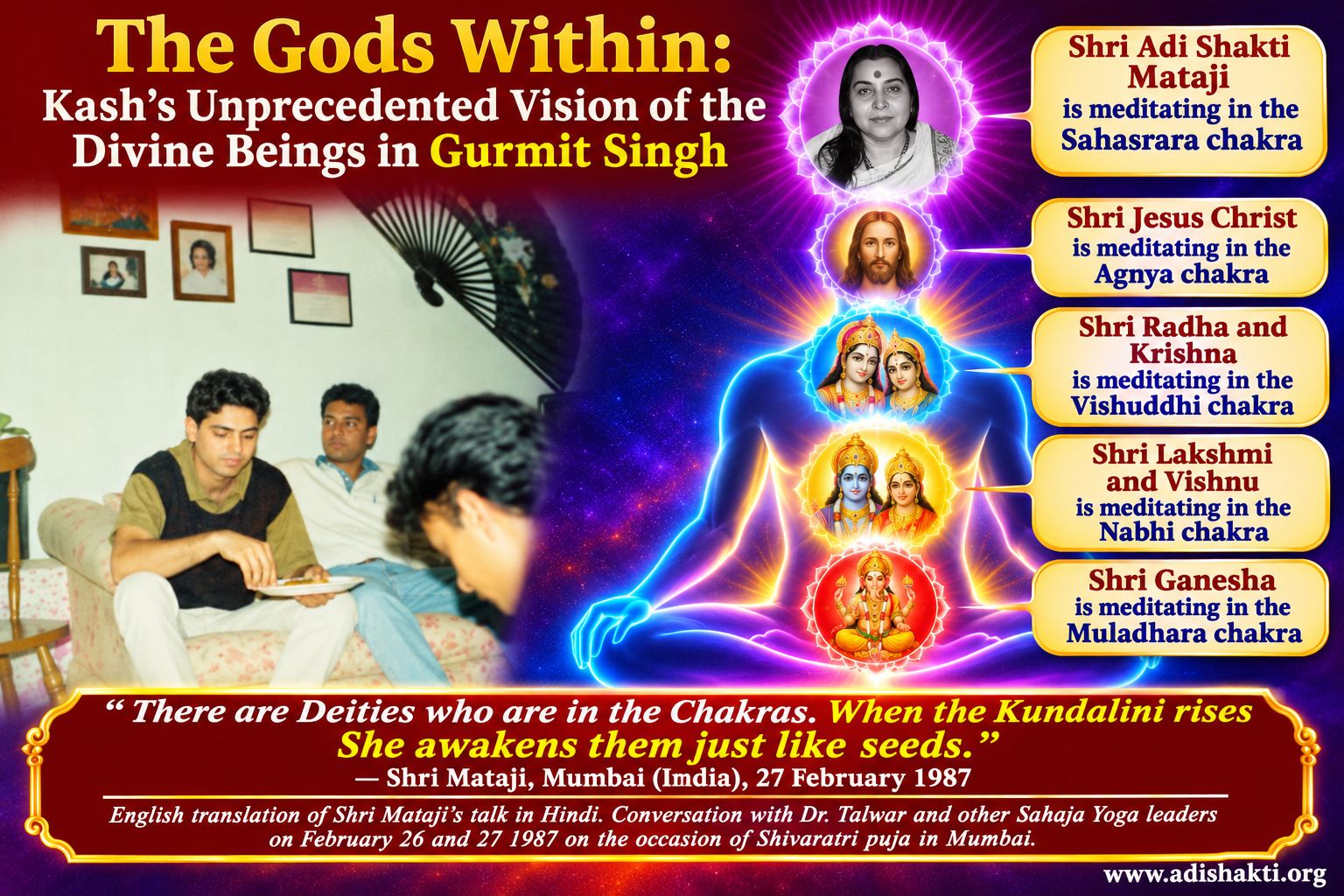
He positively recognized Shri Ganesha above the anus (Mooladhara), Shri Vishnu and Shri Lakshmi at the navel (Nabhi), Shri Krishna and Shri Radha at the throat (Vishuddhi) and Shri Jesus behind and between both eyes (Agnya). Right on the limbic area of the head (Sahasrara) was the Spirit of the Living God Shri Mataji Nirmala Devi, also squatting and meditating.
Bhupinder, Gurmit, and the father looked at each other and then at Kash, unable to believe or understand what they just heard.
Note: It has to be clearly understood that at this time Kash was new to spiritualism and had no knowledge of the subtle human body. The family members did not even know how to recite the great mantra of the Great Adi Shakti, let alone know the various chakras, their locations inside humans, and the presiding Deity. Yet Kash precisely located the positions of the Immortal Beings, matching them exactly to what Shri Mataji Nirmala Devi had told humankind since She opened the Sahasrara on May 5, 1970. This simple fact proved that his spiritual vision was flawless, and the Truth absolute.
The remaining Universal Beings could not be identified because Kash was still new to spiritualism and did not know their names or features. Put simply, although he saw all the Immortal Ones meditating on all the various chakras in Gurmit’s body — Shri Buddha, Muhammad, Mahavira, Lao-tze, Moses, Abraham, Nanak, Confucius and so on — he could not identify any of them. (It is just like meeting a group of strangers and trying to ascertain their identity. The only way to do so would be a formal introduction, i.e., through previous knowledge or photographic recognition.) This inability was compounded not only by their small size and multitude, which made observation and memorization difficult, but also because of the brief period that this Divine Vision was granted to him.
It must be accepted that all the Spirit People are sitting in every human being exactly at the energy points Shri Adhiparasakthi Shri Nirmala Devi has proclaimed. Since Kash has positively identified the positions of the above Deities then it is only logical that the other Divine Beings also exist at precisely at the chakras revealed by the Great Holy Spirit. Those who want to understand this profound Truth have to thoroughly understand the immensity of this spiritual Reality that “inside each of us are primal gods and goddesses.” (Deepak Chopra.) This Knowledge is priceless for all seekers of Truth. It is also the mysterious, subtle Reality vaguely mentioned in the Bible and Qur’an, but explicitly expounded in eastern scriptures.
Again we have to mention that there was just no way Kash could have identified these Universal Beings — absolutely no way! In the first place, how did he know that the Immortal Beings are within the body? No one in the family even knew of this Truth, a fact that took a long time to fathom. Then, how was it possible for him to know exactly where they were sitting? He could have said that Shri Jesus was seen on the Vishuddhi chakra, Shri Lakshmi/Vishnu at the Agnya, and so on. But he did not. He told exactly what he saw and those Divine Beings he identified corresponded exactly to that revealed by the Great Universal Mind. And we must also bear in mind that two non-family members, Gurmit and Bhupinder, witnessed and heard what Kash told them. (Anyone may question them to confirm these facts.) The Revelations, Truth and Divine Drama of the Great Maha Devi is based on Reality and not subject to any contradiction or denial!
Based on this extraordinary mystical experience the following Truths are announced to all seekers of Truth and Spirit:
Shri Ganesha is meditating in the Muladhara chakra — This Revealed Truth is Absolute.
Shri Lakshmi and Vishnu is meditating in the Nabhi chakra — This Revealed Truth is Absolute.
Shri Radha and Krishna is meditating in the Vishuddhi chakra — This Revealed Truth is Absolute.
Shri Jesus Christ is meditating in the Agnya chakra — This Revealed Truth is Absolute.
Shri Adi Shakti Mataji Shri Nirmala Devi is meditating in the Sahasrara — This Revealed Truth is Absolute.
The Immortal Ones are inside all human beings — This Revealed Truth is Absolute.
“There are Deities who are in the Chakras. When the Kundalini rises She awakens them just like seeds. Once they are awakened they start working it out. They know what is their job, what to work out like they have been appointed. Those Deities you have achieved through your evolution at different points. So where ever they are settled they do the job.”
Shri Siva Shri Nirmala Devi
English translation of Shri Mataji’s talk in Hindi. Conversation with Dr. Talwar and other Sahaja Yoga leaders on February 26 and 27 1987 on the occasion of Shivaratri puja in Mumbai.
“But you have your own Gods. You have your own Goddesses. You are the making of your own which are mythical. Face it yourself. You need not believe into anything but you need nor disbelieve also. Just as you go into a college you have to study, not believing into anything or non-believing, but you have to see it for yourself. You have to experiment yourself.”
Shri Goptri Shri Nirmala Devi
Geneva, Switzerland — June 13, 1985
“Innocence is innately built within us. So the first and foremost thing that the Will of God built up was innocence, the auspiciousness. The first thing He did was to create Shri Ganesha, or I would say She, because the Will of God is Adi Shakti. And all this innocence was created first of all to make the whole world very beautiful. All those qualities were also placed within you, all those Deities were placed within you. Specially made human beings were specially made so that they should become saintly people, that they should have their saintly, innate sense. But it happened in the countries which developed, that our brain was bombarded by all kinds of television, all kinds of things, and we became very vulnerable.”
Shri Gudha-gulpha Shri Nirmala Devi
The Will Of God, Sahasrara Puja, Cabella, Italy — May 10, 1992
Jagbir Singh, 1999, p. 695-6
Summary: A Revelation of Extraordinary Specificity
Shri Mataji declared that the Gods and Goddesses reside within humanity. Kash reportedly saw them there—and identified them at the very chakras She had revealed. The central question is not simply whether a child had a mystical vision, but how that vision came to contain multiple specific correspondences with a previously articulated spiritual teaching. During a Self-Realization session for Gurmit Singh, Kash reportedly perceived more than twenty meditating Divine Beings within the seeker’s subtle body. He recognized Shri Ganesha at Mooladhara, Shri Vishnu and Shri Lakshmi at Nabhi, Shri Krishna and Shri Radha at Vishuddhi, Jesus Christ at Agnya, and Shri Mataji at Sahasrara. The testimony maintains that he lacked detailed prior knowledge of these associations. The case deserves to be narrated in its full spiritual magnitude and investigated with equal historical care.
Foundational Declarations: The Gods Within
“When Self-Realization takes place the Deities are awakened and the Chakras are nourished and refreshed . . . as soon as the Deities are awakened, their Powers are also awakened. This is a living process and how it works out you cannot explain”
Shri Brahmarupa Shri Nirmala Devi — Shiva Puja, Bombay, India, February 26, 1987.
“Be careful. Take My warnings always seriously. You all have to come up very well now. It is not only doing My Puja that is going to help you. I can tell you this much. Now you better worship your Self. You have to worship all the Gods within you!”
Shri Samharini Shri Nirmala Devi. Date and location not provided in the supplied quotation.
Terminology: Brahmarupa is a name of the Goddess in the traditional enumeration of the Lalita Sahasranama. The supplied footnote is incomplete; its full wording should be checked against the original book before publication.
1. The Revelation That Challenges Humanity’s Understanding of God
What if the Gods and Goddesses whom humanity has worshipped for millennia were never distant from human beings? What if the Divine Beings revered in sacred traditions were present within the subtle spiritual structure of every person? Shri Mataji Nirmala Devi’s teaching places these questions at the center of Self-Realization. Her declarations about the chakras were not merely invitations to admire sacred images; they described an inner order of spiritual presences and powers.
Against that background, the account of Kash and Gurmit Singh becomes extraordinary. The narrative does not merely say that Kash felt vibrations or saw light. It says that, while assisting another person’s Kundalini awakening, he suddenly perceived more than twenty Divine Beings in meditation within that person. He recognized several and assigned them to the same chakra locations that Shri Mataji had taught. The account further says that he had not studied those correspondences beforehand.
The decisive issue is the conjunction of vision, specificity, and alleged unfamiliarity. Each element alone might invite one kind of interpretation. Together, they form the historical and theological question this paper investigates: was Kash’s experience a direct visionary counterpart to Shri Mataji’s declarations?
2. Shri Mataji’s Declaration: The Gods Are Within
At Shiva Puja in Bombay on February 26, 1987, Shri Mataji described the awakening of the Deities as a living process: when Self-Realization occurs, the chakras are nourished, the Deities awaken, and their powers begin to work. The distinction matters. Her teaching concerns a living spiritual reality, not merely the recollection of mythological names.
In the supplied Geneva statement of June 13, 1985, she encouraged seekers to neither believe blindly nor disbelieve reflexively, but to examine spiritual claims through experience. In the Cabella Sahasrara Puja statement of May 10, 1992, she said that divine qualities and Deities had been placed within human beings. These declarations establish the interpretive framework within which the Kash account is presented.
Her admonition to worship the Gods within shifts the center of religious attention from outward ritual alone to inward transformation. If that teaching is taken seriously, a vision of Divine Beings at the chakras would not be a peripheral curiosity. It would go to the heart of what Self-Realization is claimed to reveal.
3. The Day Kash Gave Gurmit Singh Self-Realization
The preserved narrative begins in an ordinary human setting. Gurmit Singh, an acquaintance of Kash’s father, came with his friend Bhupinder to receive Self-Realization. He sat before a photograph of the Divine Mother while Kash worked with the Kundalini and chakras. The account describes Kash using his hands, observing vibrations, attending to apparent blockages, and repeatedly attempting to raise the Kundalini toward Sahasrara.
The description has an important sequence: the work continued until the account reports a cool breeze above Gurmit’s fontanel area, understood in Sahaja Yoga as a sign of Kundalini awakening. Only after this process did the extraordinary visionary episode unfold. The setting is significant because it is precisely the sort of awakening Shri Mataji associated with the activation of the Deities.
Bhupinder then reportedly experienced a powerful sense of Guru Nanak’s presence, accompanied by a fleeting vision. As those present turned to Kash for confirmation, Kash closed his eyes briefly. The original account says that what followed astonished everyone who heard him describe it.
4. The Moment of Revelation: More Than Twenty Divine Beings
Kash reportedly saw an entire assembly of meditating Divine Beings within Gurmit’s subtle body. The testimony describes more than twenty figures, each approximately an inch in apparent size, seated in meditation at various chakras. This is not the usual form of a solitary devotional apparition. It is presented as a glimpse of a populated inner spiritual order, suddenly visible to a child who had been working to awaken another person’s Kundalini.
The account says that Kash could identify only some of the figures. That detail is important. He did not supply a complete roster of all the Beings he believed he saw. Instead, he named those he recognized and left the remainder unidentified. The distinction between what he reported seeing and what he could name must remain intact. Later interpretations of the unnamed figures cannot be treated as identifications made by Kash himself.
The spectacle described is remarkable in its claimed scope: not one deity, not one chakra, but multiple Divine Beings at multiple spiritual centers in another person. Its full force emerges when those identifications are compared with Shri Mataji’s chakra teachings.
5. Five Chakras and the Specific Correspondences
Mooladhara — Shri Ganesha. Kash reportedly recognized Shri Ganesha at the foundational chakra. Within Shri Mataji’s teaching, Shri Ganesha is associated with innocence and auspiciousness. The account therefore begins with a correspondence between the reported visual identification and the spiritual quality ascribed to that center.
Nabhi — Shri Vishnu and Shri Lakshmi. The testimony places the divine pair at the navel center. This correspondence carries particular significance because it involves two named Beings at a specific location rather than a vague impression of a divine presence.
Vishuddhi — Shri Krishna and Shri Radha. Kash reportedly saw this pair at the throat center. The association is especially important for the argument from specificity: the names and the position are both given, allowing direct comparison with the pre-existing chakra scheme.
Agnya — Jesus Christ. The narrative identifies Jesus behind and between the eyes. In Shri Mataji’s teachings, Christ’s place at Agnya is a repeated and consequential declaration. It connects a Christian figure with the inner spiritual anatomy described in Sahaja Yoga.
Sahasrara — Shri Mataji Nirmala Devi. The testimony culminates in Kash reportedly seeing Shri Mataji at the crown or limbic area. Within the account’s theology, this is not simply another identification; it locates the Divine Mother at the culmination of the Kundalini’s ascent.
Five centers, multiple recognized Beings, and one reported vision. These correspondences form the core of the case. Their strength as historical evidence depends on how securely the timing, wording, and Kash’s prior knowledge can be established. Their theological significance within the testimony is immediate.
6. The Mystery of Kash’s Prior Knowledge
The source insists that Kash was new to spiritualism and had not learned the detailed locations of the chakras or their presiding Deities. If this can be established independently, it becomes the most consequential feature of the account. Knowing that Shri Ganesha exists is not the same as knowing the Mooladhara association; recognizing Jesus is not the same as placing him at Agnya.
The question is therefore not whether Kash could recognize familiar religious figures, but whether he had access—through conversation, books, pictures, instruction, or other exposure—to the particular pattern he reported. A careful investigation would reconstruct what he had heard, read, and seen before the event. It would also seek the earliest recorded version of his words, rather than relying exclusively on later recollection.
This inquiry does not diminish the event. It gives the claim of extraordinary correspondence its strongest possible footing. The more securely the absence of prior instruction is documented, the more challenging the reported identifications become to explain by ordinary learning.
7. Gurmit, Bhupinder and Kash’s Father
The testimony names three people present when Kash described his vision: Gurmit, Bhupinder, and Kash’s father. Their presence matters. They could potentially corroborate the circumstances, the sequence of events, and the words Kash spoke immediately after closing his eyes. Bhupinder’s reported experience of Guru Nanak is a separate element that should be recorded in his own words if possible.
There is also an essential distinction: witnessing Kash make an immediate report is not identical to independently seeing what Kash saw. A compelling paper should say this plainly, then pursue the available corroboration. Dated statements from the participants, if obtainable, would strengthen the historical record considerably.
8. Declarations That Preceded the Vision
The central claim is one of correspondence between a visionary report and Shri Mataji’s previously articulated teaching. For that reason, the chronology of the declarations is essential. The supplied sources identify a Geneva address on June 13, 1985, a Shiva Puja on February 26, 1987, and a Cabella Sahasrara Puja on May 10, 1992. The precise date of Gurmit’s session is not provided in the preserved extract.
A complete historical case requires the date of the vision to be established before asserting that every quoted declaration preceded it. The original book’s publication in 1999 establishes that the testimony circulated by that date, but not the exact day of the event. The paper should preserve the supplied dates without inventing the missing one.
9. Jesus Christ at Agnya: A Challenge to Externalized Religion
Among the recognized figures, the placement of Jesus Christ at Agnya carries far-reaching comparative implications. Shri Mataji repeatedly taught that Christ resides at Agnya. Kash’s reported identification therefore brings a specifically Christian figure into the same inner spiritual map as Shri Ganesha, Shri Vishnu, Shri Lakshmi, Shri Krishna, Shri Radha, and Shri Mataji.
Within this theological interpretation, Christ is not absent from the seeker or confined to distant history: he is understood as present at an inner spiritual threshold. That is a striking claim about the meaning of resurrection, inward transformation, and the Kingdom of God. It is a Sahaja Yoga interpretation, however, and should not be presented as a doctrine shared by all Christian traditions.
The question for readers is nevertheless profound: if a spiritual teacher declares Christ’s inner location and a child subsequently reports seeing him there, how should the relationship between declaration and testimony be evaluated?
10. An Experience Without Known Precedent?
The source presents the vision as the first and only occasion on which Kash saw the entire arrangement of Divine Beings within another person. That is an important and supportable description of the testimony’s own claimed uniqueness. Whether the event was the first of its kind in human history is a separate, much larger historical question.
Religious history includes visionary encounters, subtle-body teachings, and accounts of divine presences within the human person. The particular combination described here—more than twenty meditating figures seen in another person, several specifically named at distinct chakra locations, by a witness reportedly unfamiliar with those correspondences—may be highly unusual. Establishing absolute historical priority would require systematic comparison with earlier visionary literature across traditions.
The most defensible declaration at this stage is also a strong one: the Kash testimony records an exceptionally specific and potentially distinctive visionary claim that merits a serious historical investigation.
11. From External Worship to the Living Gods Within
Shri Mataji’s instruction to worship the Gods within provides the spiritual culmination of the argument. Religious worship often directs attention toward shrines, images, sacred sites, and rituals. Her teaching does not merely add another sacred location; it asks seekers to discover divine reality through their own transformation.
The Gurmit account dramatizes that teaching. A seeker receives Self-Realization; the Kundalini is said to rise; and the child assisting him reportedly glimpses the Divine Beings within. The sanctuary is not elsewhere. In the testimony’s theological vision, the human being is already the dwelling place of the Divine.
For readers who accept the account, this is a summons to experience rather than merely profess belief. For readers who remain uncertain, it is a clear and investigable claim about the relation between spiritual teaching, visionary testimony, and the possibility of inner realization.
12. Conclusion: The Divine Beings Were Never Far Away
For millennia, humanity has raised temples, built altars, preserved scriptures, and undertaken pilgrimages in search of the Divine. Shri Mataji Nirmala Devi proclaimed a truth of breathtaking intimacy: the Gods and Goddesses are already within human beings.
Kash’s reported experience gives that declaration an arresting testimonial form. He did not merely describe a feeling of sacred presence. He reportedly saw numerous meditating Divine Beings within Gurmit Singh and recognized several at the specific chakra locations Shri Mataji had taught. The account insists that he had not previously learned those associations. Others were present to hear his description.
Was Kash permitted to perceive directly the spiritual reality that Shri Mataji had been revealing? For those who accept the testimony, the experience represents a profound confirmation. For historical inquiry, it raises concrete questions about chronology, prior knowledge, immediate reporting, and witness corroboration. These are not reasons to suppress the wonder of the narrative; they are the means by which its extraordinary claims can be examined responsibly.
If the Gods are within, why has humanity spent so many centuries searching only outside itself? That question is the enduring challenge of this testimony. Its final invitation is not to accept a conclusion on command, but to investigate the possibility that the sacred reality humanity seeks may be nearer than it has ever imagined.
Sources and Method
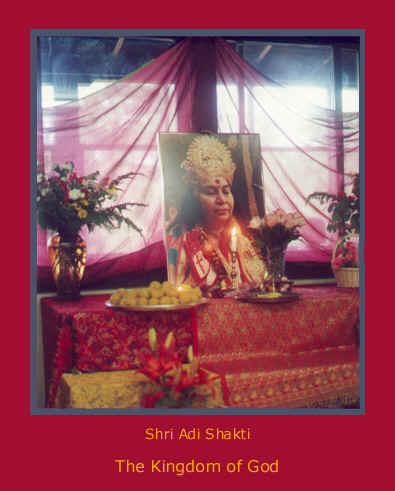
Primary book extract: Jagbir Singh, Shri Adi Shakti: The Kingdom of God (1999), pp. 695–696, as identified in the user-supplied extract; complete supplied text reproduced above with its original book image.
Shri Mataji: Geneva, Switzerland, June 13, 1985; Shiva Puja, Bombay, India, February 26, 1987; Sahasrara Puja, Cabella, Italy, May 10, 1992; and the undated supplied statement about worshipping the Gods within.
Source integrity: Quotations and the primary narrative follow the supplied material. The source’s historical assertions and attributions have not been independently authenticated against recordings or contemporaneous records. The date of Gurmit’s session remains unspecified. This article distinguishes the report, its theological interpretation, and the historical evidence needed to assess it.