
Academic Commentary: Paragraph-by-Paragraph Analysis
The following section returns to the complete post above in sequence. Every numbered commentary entry now reproduces the relevant Jagbir Singh paragraph immediately above its academic analysis, so each discussion can be read independently while the complete original post remains available as a single primary-source document.
Paragraph 2
This opening is confessional comparative theology. The identifications of Shri Mataji with the Johannine Comforter and the Qur’anic Spirit are the author’s theological claims, not identifications explicitly made in Surah 97.
Interpretive significance. The academic strength of the move lies in functional comparison: Jagbir is comparing roles rather than merely matching names. John’s Paraclete teaches, guides and discloses truth, while Surah al-Qadr places “the Spirit” within a divinely authorized descent. Read comparatively, these become two scriptural vocabularies through which he interprets a contemporary revelatory mission.
Paragraph 3
Surah al-Qadr supplies the post’s central vocabulary: revelation, the Night of Power, a thousand months, angels, the Spirit, and peace until dawn. Standard translations read 97:1 as the Qur’an’s descent and commonly interpret the Spirit in 97:4 as Gabriel; Jagbir deliberately gives the passage a further eschatological reading.
Interpretive significance. This passage is therefore not incidental proof-texting but the Qur’anic architecture of the argument. Revelation, Spirit, divine permission, an exceptional sacred time and peace are gathered in one compact text. Jagbir’s resurrection reading asks whether these elements can be read eschatologically and experientially together, making al-Qadr the threshold through which al-Qiyamah is spiritually encountered.
Paragraph 4
The paragraph acknowledges its own polemical language and frames the disagreement as eschatological. Academically, the claim that Muslims have misinterpreted al-Qadr should be treated as Jagbir’s intra-religious critique rather than an established conclusion.
Interpretive significance. The constructive point behind the polemic is a hermeneutical distinction between inherited observance and realized meaning. In academic terms, the useful question is not whether Muslim practice is “petty,” but whether an esoteric reading can recover dimensions of al-Qadr that a primarily ritual or commemorative reading leaves less developed.
Paragraph 5
The ‘thousand months’ becomes an entire human lifetime in Jagbir’s reading. Numerically, one thousand months is about 83 years and 4 months, so the original parenthesis ‘80 years 4 months’ appears mistaken; the resurrection interpretation is an additional esoteric inference rather than the explicit wording of 97:3.
Interpretive significance. The lifetime comparison gives Jagbir a clear theological logic: if the Night is better than an entire lifetime of devotion, its superiority may be qualitative rather than merely quantitative. His proposal is that the decisive quality is transformation—an immediate awakening into the eternal Spirit. That inference is not stated verbatim in 97:3, but it gives a coherent reason for why one sacred Night could surpass decades of pious activity.
Paragraph 6
The Onfray quotation functions as polemic against institutional religion. Because Onfray is an atheist critic of the Abrahamic religions, it documents his critique rather than neutrally describing Muslim intellectual institutions as a whole.
Interpretive significance. Used constructively, the quotation identifies the institutional-versus-experiential tension that Jagbir wants to overcome. Its value for his argument is rhetorical rather than evidentiary: it prepares the reader for the Sufi materials, where inward realization, sincerity and direct apprehension of divine reality become the more relevant categories.
Paragraph 7
This paragraph states the program of the post: al-Qadr and al-Qiyamah are interpreted as the inner core of Islam, and Sufis are identified as the audience most likely to recognize that interpretation. Morgan is then introduced to supply historical context for inward readings.
Interpretive significance. This is the programmatic bridge of the post. Jagbir’s appeal to Sufis is intelligible because Sufi traditions already possess conceptual tools—inner meaning, Divine Light, mystical vision and haqiqa—that can translate his resurrection claim from a purely future event into a present spiritual realization.
Paragraph 8
Morgan’s qualification is important: Sufism has changed across periods and communities. It cautions against treating ‘Sufism’ as a single timeless doctrine and therefore limits any universal claim about what all Sufis believe.
Interpretive significance. The historical variability described here actually helps Jagbir’s case methodologically: it shows that “Sufism” is not reducible to one fixed formulation and that mystical interpretation has repeatedly negotiated its relation to orthodoxy, ritual and philosophy. That history creates conceptual space for a new comparative proposal without making it a universal Sufi doctrine.
Paragraph 9
The exoteric/esoteric distinction gives the post a historical hermeneutical foundation. It supports the existence of Sufi concern with inward significance, but does not itself establish Jagbir’s later identifications of Shri Mataji, the Spirit, and Khatun-i Qiyamat.
Interpretive significance. This exoteric/esoteric distinction is one of the strongest foundations of Jagbir’s reasoning. Once scripture and law are understood as possessing inward significance as well as outward form, his reading of al-Qadr can be evaluated as a proposed haqiqa—an attempt to disclose spiritual meaning beneath the literal wording—rather than dismissed simply because it exceeds a surface reading.
Paragraph 10
Morgan emphasizes disagreements about worship, law, devotion, God, and unity. This supports the proposition that mystical interpretation can produce a distinctive religious epistemology while remaining historically situated within Islamic debates.
Interpretive significance. The importance of these disagreements is positive for the paper: they establish precedent for interpretive plurality inside Islamic intellectual history. Jagbir’s argument belongs to that broader problem of how worship, law, love, unity and direct experience are related, even though his particular synthesis is contemporary.
Paragraph 11
The account of juristic opposition illustrates how unfamiliar mystical language could provoke suspicion. It offers a historical analogy for Jagbir’s own unfamiliar eschatological synthesis, although analogy does not prove that synthesis correct.
Interpretive significance. For Jagbir, this history also supplies an analogy of reception: unfamiliar mystical language can initially appear heterodox precisely because it operates with categories not recognized by dominant interpretive frameworks. The analogy does not prove his claims, but it explains why he expects an experiential message of resurrection to meet resistance.
Paragraph 12
This passage most strongly articulates the post’s contrast between outward form and inward reality. Haqiqa allows religion to be conceived as realized truth, but Morgan’s historical contrast should not be expanded into a blanket claim that non-Sufi Muslims possess only empty forms.
Interpretive significance. This is central to the post’s academic intelligibility. The contrast between form and reality allows Jagbir to argue that resurrection need not be exhausted by a future external event; it may also name an inwardly realized transformation. Ruwaym’s emphasis on “realities” and sincerity gives historical vocabulary to that move.
Paragraph 13
The outward/inward distinction supplies a method for esoteric interpretation of scripture. It makes Jagbir’s spiritual reading intelligible as a hermeneutical move; whether his specific cross-traditional correspondences are warranted remains a separate question.
Interpretive significance. The inward/outward distinction supplies Jagbir with a recognizable hermeneutical method rather than an arbitrary departure from scripture. His claim is that al-Qadr has a batin-like or inward significance whose reality becomes accessible through spiritual experience. The scholarly task is therefore to assess the coherence of that proposal while keeping it distinct from consensus exegesis.
Paragraph 14
Morgan now introduces a crucial restraint: haqiqa does not simply cancel shari‘a. In the orthodox Sufi framework described here, inward realization and outward norm remain related, complicating any equation of spiritual resurrection with unrestricted release from religious law.
Interpretive significance. This qualification strengthens rather than weakens the best form of Jagbir’s case. If haqiqa and shari‘a are complementary, then spiritual realization is not presented as the destruction of religion but as its inward fulfillment. The argument can thus be framed as completion—from observance to realization—rather than simple rejection of Islamic practice.
Paragraph 15
The Ghazalian passage gives mystical vision an epistemic role while rooting it in revelation and divine command. It can support experiential verification, but also implies that inward claims are to be tested rather than accepted merely because they are inward.
Interpretive significance. Ghazali’s formulation gives the paper a particularly important epistemological bridge: haqiqa is “to behold” and to know by mystic vision. Jagbir’s appeal is consequently experiential. He is proposing that claims about resurrection should be tested not only as propositions about a remote future but through the kind of inward perception that Sufi discourse itself recognizes.
Paragraph 16
Morgan’s summary clarifies the element Jagbir appropriates: divine illumination discloses religious meaning inwardly. The subsequent identification of that inner light with Shri Mataji is therefore a further comparative-theological step, not a conclusion supplied by Morgan.
Interpretive significance. This paragraph supplies the clearest positive rationale for Jagbir’s use of personal spiritual experience. If inward illumination can disclose the meaning of religious teaching, then experience becomes interpretively relevant evidence within a mystical epistemology. Academic analysis need not treat that as laboratory proof in order to recognize that it is internally coherent religious reasoning.
Paragraph 17
The genre shifts here from historical exposition to exhortation. Jagbir is no longer merely describing Sufi thought; he is calling Sufis to participate in his interpretation of the Resurrection.
Interpretive significance. The transition is deliberate: Jagbir has assembled a historical vocabulary and now applies it. The exhortation is therefore the practical conclusion of the preceding hermeneutic—if truth can be inwardly disclosed, the reader is invited to seek or witness that disclosure rather than remain at the level of textual argument alone.
Paragraph 18
The sentence condenses the Sufi epistemology invoked throughout the post: religious truth has an inward dimension disclosed by divine light. It remains a general mystical principle and does not identify a particular contemporary bearer of that light.
Interpretive significance. As a thesis sentence, this gives Jagbir’s entire post its method: scripture provides the form, while Divine Light discloses its inner reality. This makes the later identification of resurrection with realized spiritual experience structurally consistent with the Sufi materials he has quoted.
Paragraph 19
This is the theological hinge of the post. Jagbir joins Divine Light, the indwelling Divine Feminine, and Shri Mataji’s mission into one eschatological interpretation. That synthesis is meaningful as comparative theology but requires evidence beyond general Sufi language of illumination if presented as historical Islamic doctrine.
Interpretive significance. Here the argument reaches its synthesis. Jagbir identifies the Divine Light known through mystical vision with the Divine Feminine within and then interprets Shri Mataji’s mission as the historical manifestation of that inward principle. The claim is confessional, but its reasoning is cumulative: scriptural Spirit, mystical illumination, inward realization and a feminine eschatological figure are being brought into a single theological model.
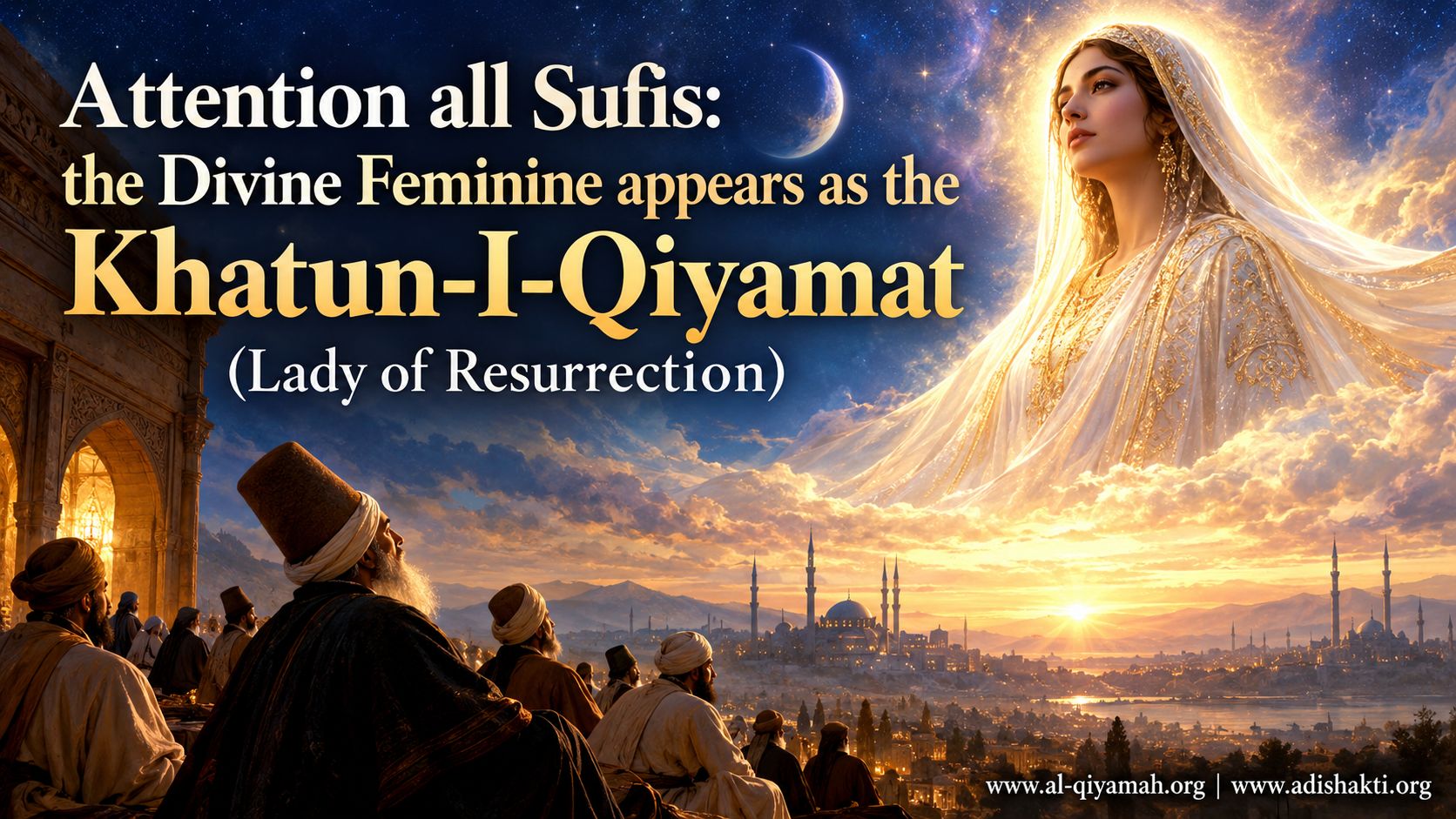
Paragraph 20
The wording ‘The Sufis believe’ is broader than the evidence that follows. The cited material specifically concerns Ghulat/Ahl-i Haqq traditions, so academic precision requires distinguishing that tradition from Sufism or Islam in general.
Interpretive significance. The academically stronger formulation is that some Ahl-i Haqq/Ghulat materials invoked by the post preserve a Khatun-i Qiyamat motif. This precision benefits Jagbir’s thesis: it replaces an unnecessarily universal claim with a concrete historical datum—a Divine Feminine figure explicitly associated with Resurrection—whose comparative significance can then be argued on its own merits.
Paragraph 21
This is the post’s strongest textual evidence for its title. The quotation explicitly names Razbar as Khatun-i Qiyamat and interprets qiyama both as resurrection and spiritual ascent. It demonstrates a feminine resurrection figure in the cited Ahl-i Haqq material, but does not itself identify that figure with Shri Mataji.
Interpretive significance. This is the most important positive external evidence in the post because the title “Khatun-i Qiyamat” is not inferred; it appears explicitly in the cited tradition. The accompanying interpretation of qiyama as rising to a higher spiritual stage also provides a conceptual parallel to Jagbir’s understanding of resurrection as transformation and release into a divine reality.
Paragraph 22
The second narrative reinforces the feminine-helper motif by appointing the Lady of the Resurrection as a helper of human beings. Jagbir’s comparison with the Christian Comforter is understandable at the level of function, but functional similarity alone does not historically prove identity across traditions.
Interpretive significance. The second narrative adds another significant feature: the Lady of Resurrection is appointed as the “helper of human beings.” Jagbir can therefore compare not only feminine and resurrection imagery but function—an eschatological feminine helper—with the Johannine language of the Paraclete/Helper. The traditions remain distinct, yet the functional convergence is precisely what gives comparative theology its explanatory interest.
Paragraph 23
The conclusion reveals the post’s practical aim: recognition and participation, not detached description. The expectation that Sufis will respond first is therefore best classified as theological hope rather than an empirical prediction.
Interpretive significance. The closing appeal follows from that convergence. Sufis are addressed first because the post has argued that their vocabulary of inner reality, Divine Light and mystical vision makes them especially well placed to understand resurrection experientially. This is best read as a reasoned audience-selection within Jagbir’s theology, not as a sociological prediction about all Sufis.
Paragraph 24
The salutation preserves the interpersonal character of the original post. It reminds the reader that the document began as direct religious communication rather than as a formal scholarly article.
Paragraph 25
The signature identifies Jagbir as the speaking voice whose interpretations have been reproduced throughout. Keeping it separate preserves the primary document’s original cadence and authorship.
Paragraph 26
\* Kenneth W. Morgan, Islam—The Striaght Path, pages 168-171
Motilal Banarsidass Pub; 2 edition (February 1, 1998)
\*\* Laurence Galian, The Centrality of the Divine Feminine in Sufism
[25] The Ghulat being customarily judged Islamic (and usually Shi') extremists who go to extremes in exalting a person or persons to the extent of raising him or them above the ranks of ordinary human beings.
[26] Adjarian, H.” Gyoran et Thoumaris.” Translated into French by Frédéric Macler. Revue de L'Histoire des Religion 93, no. 3 (May—June 1926): 294-307.
[27]"Qiyamat-i Qubra in Alamut"
F.I.E.L.D. First Ismaili Electronic Library and Database https://ismaili.net/histoire/history06/history620.html
[28] Tadhkira'i A'la, (Ahl-i Haqq Creation Story) as found in “The Truth-worshipers of Kurdistan: Ahl-i Haqq Texts” edited in the original Persian and analyzed by W. Ivanow, Leiden, Holland: E. J. Brill, 1953.
[29] Tadhkira'i A'la, (Ahl-I Haqq Creation Story) as found in “The Truth-worshipers of Kurdistan: Ahl-i Haqq Texts” edited in the original Persian and analyzed by W. Ivanow, Leiden, Holland: E. J. Brill, 1953.
The notes identify the immediate source chain: Morgan for the exoteric/esoteric discussion and Galian for Khatun-i Qiyamat, with Macler, Ivanow, and Ismaili material behind the latter. Source criticism should distinguish traditional texts, secondary scholarship, modern interpretive essays, and Jagbir’s own synthesis.
Interpretive significance. Taken together, these references show that Jagbir’s synthesis did not arise from a single isolated association. He builds it through several source streams: Qur’anic language, a historical account of Sufi inward interpretation, Ahl-i Haqq/Khatun-i Qiyamat material and comparative reflection on the Divine Feminine. The academic value lies in making that source chain transparent and then distinguishing the historical evidence from the theological synthesis constructed from it.
Paragraph 1
This line is the source label for the preceding Qur’anic quotation. It identifies Surah 97:1–5, al-Qadr, and should be read as bibliographic attribution rather than as a separate theological proposition.