The Second Coming of Jesus Has Taken Place at the Agnya Chakra!
The Second Coming of Jesus Has Taken Place!
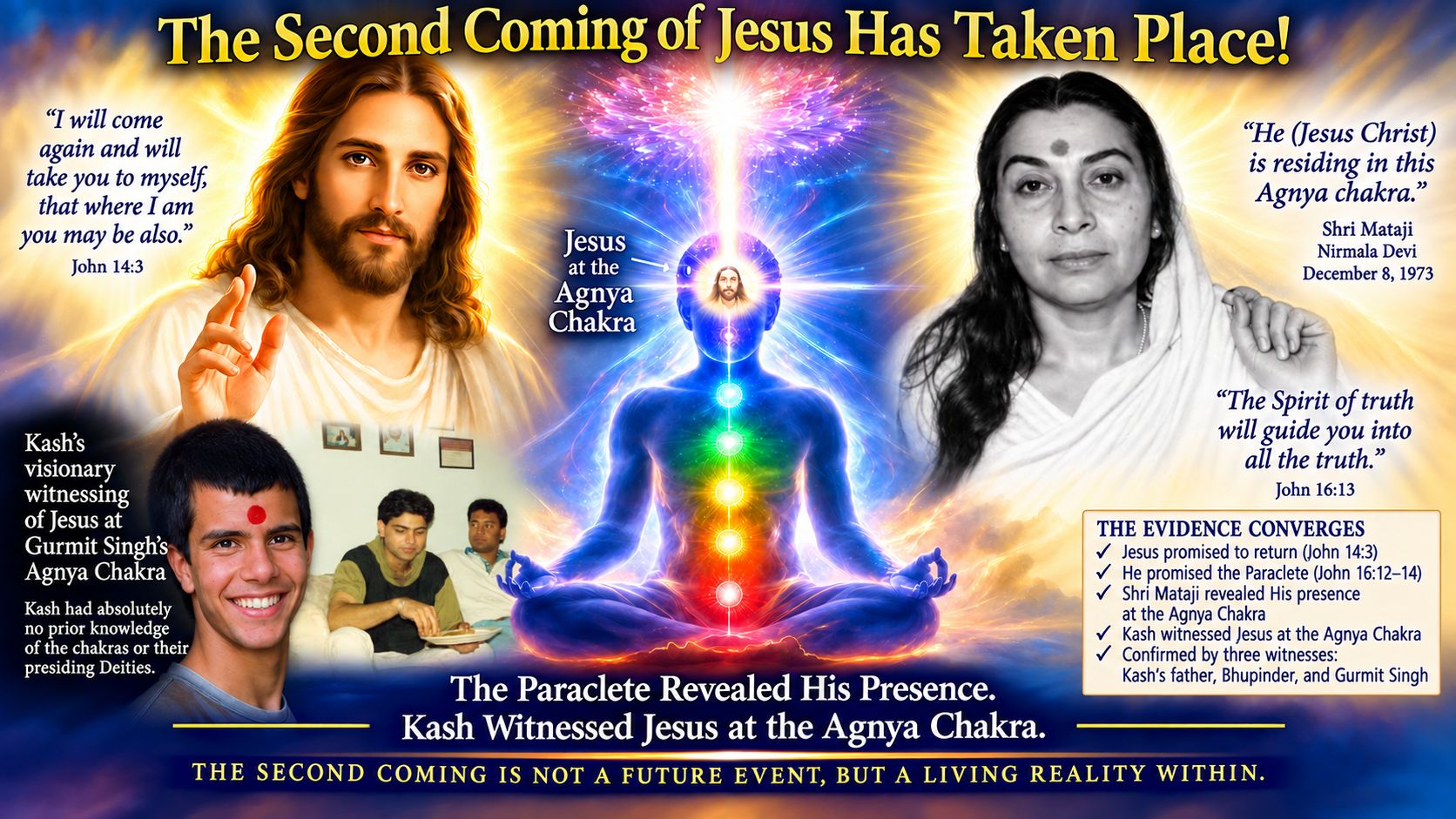
THE SECOND COMING OF JESUS HAS TAKEN PLACE! This is the thesis defended here: Jesus’ promised return is His inward, living manifestation to the disciple—not the requirement that one physical figure sequentially meet billions of resurrected people at the end of history. The decisive scriptural foundation is Jesus’ own promise: “I will come again and will take you to myself, that where I am you may be also” (John 14:3).
Jesus immediately explains the manner of His coming: “I will not leave you orphaned; I am coming to you” (John 14:18); “you in me, and I in you” (John 14:20); and the Father and Son will “come to them and make our home with them” (John 14:23). The inward reading takes these words seriously as an explanation of personal communion, not merely a consolation while an unrelated event remains indefinitely postponed.
Jesus also promised further disclosure. “I still have many things to say to you, but you cannot bear them now” (John 16:12). The Spirit of Truth would guide His disciples into all truth and glorify Him (John 16:13–14). In the Adishakti interpretation, Shri Mataji Nirmala Devi is this Paraclete and revealed Jesus’ presence at the Agnya Chakra. Kash, who according to the original account had absolutely no prior knowledge of the chakras or their presiding Deities, reported seeing Jesus at that precise location within Gurmit Singh. Kash’s father, Bhupinder and Gurmit were present and heard his report.
The challenge to conventional Christian eschatology is direct: an externalized, physicalist picture of graves opening worldwide and billions being individually escorted by Jesus is not established by John 14:3. The numbers expose how strained that imagined scenario becomes; they do not prove that an omnipotent God lacks power. The paper therefore tests the picture against Jesus’ own teaching, the meaning of spiritual rebirth, and the personal nature of His promise.

Kash was once giving Self-Realization to a new seeker Gurmit Singh seated comfortably on a chair before the photograph of the Great Divine Mother. Gurmit, who lived around Lachine and knew Kash’s father for many years, was brought by his Punjab village friend Bhupinder to have Self-Realization.
After putting himself in bandhan Kash asked the help of the Great Primordial Kundalini to awaken the Kundalini residing within Gurmit. He then used his hands to channel energy into the sacrum bone of the seeker, where the Kundalini had laid dormant for ages. He closed his eyes in concentration and vibrations began flowing profusely from his hands. The Kundalini of Gurmit responded and informed Kash’s Kundalini the condition of the chakras. Kash instantly decoded this vital information on his fingertips and knew precisely which chakra was malfunctioning and the extent of damage. He then proceeded to cleanse these energy centres by invoking the Deities present at those affected chakras.
Every now and then he checked his own Kundalini for any developments. She kept coordinating with him, advising him to work on another chakra whenever a 'blockage' was detected. Sometimes he had to rotate two or three chakras quickly, one after another, as the Kundalini kept scanning the subtle system like a spiritual virus detector. Occasionally he would coax Gurmit’s Kundalini to rise and penetrate the Sahasrara, raising it all the way from the Mooladhara chakra to the top of the head. By checking the top of the Brahmarandhra for the Divine Cool Breeze and finding none, he knew that the Kundalini was still having obstructions. Then again he had to communicate with his Kundalini and continue rotating the energy centers in different combinations, working continuously to open and connect the physical body to the Universal Self.
Kash worked on until the first few strands of the Kundalini pierced the Thousand-Petal Lotus and the Divine Cool Breeze of the Holy Spirit began to blow from the top of the fontanel bone area. It was done. The Great Mother Kundalini within had given second birth to Gurmit. This was the Baptism of God Almighty:
This was the rebirth that the Holy Scriptures had mentioned, a mystery that no religious institution knows about or is able to perform. The baptisms carried out by priests and popes are empty rituals which bestow absolutely no spiritual benefit — This Truth is Absolute.
Then Gurmit's friend Bhupinder, who had also helped Kash to awaken the Kundalini, decided to meditate. Suddenly he got up and began to shake his head in disbelief: he had felt the presence of Guru Nanak very strongly and even caught a fleeting vision of Him. Everyone observed him as he kept on shaking his head in utter amazement, face flushed with emotion. All turned to Kash to see if he could confirm this fact.
Kash, still standing behind Gurmit, closed his eyes momentarily. What he saw with his spiritual eyes was stunning — all the Spirit Beings of the Holy One were seen sitting on every chakra of Gurmit's subtle body! It was the Divine Vision of the Third Eye! He was shown the spiritual body of a human being for the very first and only time. He observed that there were more than 20 Deities, each about an inch in size, sitting on various chakras inside Gurmit. All these Spiritual Beings were in a squatting position and in deep meditation. Kash told his father, Bhupinder and Gurmit was he had just seen inside the latter’s body.
He positively recognized Shri Ganesha above the anus (Mooladhara), Shri Vishnu and Shri Lakshmi at the navel (Nabhi), Shri Krishna and Shri Radha at the throat (Vishuddhi) and Shri Jesus behind and between both eyes (Agnya). Right on the limbic area of the head (Sahasrara) was the Spirit of the Living God Shri Mataji Nirmala Devi, also squatting and meditating.
Bhupinder, Gurmit, and the father looked at each other and then at Kash, unable to believe or understand what they just heard.
Note: It has to be clearly understood that at this time Kash was new to spiritualism and had no knowledge of the subtle human body. The family members did not even know how to recite the great mantra of the Great Adi Shakti, let alone know the various chakras, their locations inside humans, and the presiding Deity. Yet Kash precisely located the positions of the Immortal Beings, matching them exactly to what Shri Mataji Nirmala Devi had told humankind since She opened the Sahasrara on May 5, 1970. This simple fact proved that his spiritual vision was flawless, and the Truth absolute.
The remaining Universal Beings could not be identified because Kash was still new to spiritualism and did not know their names or features. Put simply, although he saw all the Immortal Ones meditating on all the various chakras in Gurmit’s body — Shri Buddha, Muhammad, Mahavira, Lao-tze, Moses, Abraham, Nanak, Confucius and so on — he could not identify any of them. (It is just like meeting a group of strangers and trying to ascertain their identity. The only way to do so would be a formal introduction, i.e., through previous knowledge or photographic recognition.) This inability was compounded not only by their small size and multitude, which made observation and memorization difficult, but also because of the brief period that this Divine Vision was granted to him.
It must be accepted that all the Spirit People are sitting in every human being exactly at the energy points Shri Adhiparasakthi Shri Nirmala Devi has proclaimed. Since Kash has positively identified the positions of the above Deities then it is only logical that the other Divine Beings also exist at precisely at the chakras revealed by the Great Holy Spirit. Those who want to understand this profound Truth have to thoroughly understand the immensity of this spiritual Reality that “inside each of us are primal gods and goddesses.” (Deepak Chopra.) This Knowledge is priceless for all seekers of Truth. It is also the mysterious, subtle Reality vaguely mentioned in the Bible and Qur’an, but explicitly expounded in eastern scriptures.
Again we have to mention that there was just no way Kash could have identified these Universal Beings — absolutely no way! In the first place, how did he know that the Immortal Beings are within the body? No one in the family even knew of this Truth, a fact that took a long time to fathom. Then, how was it possible for him to know exactly where they were sitting? He could have said that Shri Jesus was seen on the Vishuddhi chakra, Shri Lakshmi/Vishnu at the Agnya, and so on. But he did not. He told exactly what he saw and those Divine Beings he identified corresponded exactly to that revealed by the Great Universal Mind. And we must also bear in mind that two non-family members, Gurmit and Bhupinder, witnessed and heard what Kash told them. (Anyone may question them to confirm these facts.) The Revelations, Truth and Divine Drama of the Great Maha Devi is based on Reality and not subject to any contradiction or denial!
Based on this extraordinary mystical experience the following Truths are announced to all seekers of Truth and Spirit:
Shri Ganesha is meditating in the Muladhara chakra — This Revealed Truth is Absolute.
Shri Lakshmi and Vishnu is meditating in the Nabhi chakra — This Revealed Truth is Absolute.
Shri Radha and Krishna is meditating in the Vishuddhi chakra — This Revealed Truth is Absolute.
Shri Jesus Christ is meditating in the Agnya chakra — This Revealed Truth is Absolute.
Shri Adi Shakti Mataji Shri Nirmala Devi is meditating in the Sahasrara — This Revealed Truth is Absolute.
The Immortal Ones are inside all human beings — This Revealed Truth is Absolute.
“There are Deities who are in the Chakras. When the Kundalini rises She awakens them just like seeds. Once they are awakened they start working it out. They know what is their job, what to work out like they have been appointed. Those Deities you have achieved through your evolution at different points. So where ever they are settled they do the job.”
Shri Siva Shri Nirmala Devi
English translation of Shri Mataji’s talk in Hindi. Conversation with Dr. Talwar and other Sahaja Yoga leaders on February 26 and 27 1987 on the occasion of Shivaratri puja in Mumbai.
“But you have your own Gods. You have your own Goddesses. You are the making of your own which are mythical. Face it yourself. You need not believe into anything but you need nor disbelieve also. Just as you go into a college you have to study, not believing into anything or non-believing, but you have to see it for yourself. You have to experiment yourself.”
Shri Goptri Shri Nirmala Devi
Geneva, Switzerland — June 13, 1985
“Innocence is innately built within us. So the first and foremost thing that the Will of God built up was innocence, the auspiciousness. The first thing He did was to create Shri Ganesha, or I would say She, because the Will of God is Adi Shakti. And all this innocence was created first of all to make the whole world very beautiful. All those qualities were also placed within you, all those Deities were placed within you. Specially made human beings were specially made so that they should become saintly people, that they should have their saintly, innate sense. But it happened in the countries which developed, that our brain was bombarded by all kinds of television, all kinds of things, and we became very vulnerable.”
Shri Gudha-gulpha Shri Nirmala Devi
The Will Of God, Sahasrara Puja, Cabella, Italy — May 10, 1992
Jagbir Singh, 1999, p. 695-6
Summary
Jesus promises not simply an announcement from a distance, but a personal coming: “I will come again and will take you to myself.” The same chapter speaks of His coming to His disciples, making Himself known to them and dwelling with them. This paper reads those promises together and declares that the inward manifestation of the living Jesus is the Second Coming itself—not merely a consolation while the real fulfillment is postponed.
In the AdiShakti confession, Shri Mataji is the Paraclete promised by Jesus. Her dated teachings place Christ at the Agnya and speak of His awakening within. The account preserved by Jagbir Singh reports that Kash saw Jesus at Gurmit Singh’s Agnya and described his vision in the presence of three others. The Gospel, Shri Mataji’s teaching and Kash’s reported experience are different kinds of evidence. The identification of their convergence with the Second Coming is the theological conclusion this paper proclaims.
Against a picture of graves opening across the earth and Jesus physically escorting each person to the Kingdom, this paper argues that an inward coming alone gives a coherent account of the promised personal meeting. It rejects that elaborate outward picture, while recognizing that not all Christians understand resurrection or Christ’s return in those literal, sequential terms.
1. Jesus’ promise: “I will come again”
Jesus tells His disciples that He is going to prepare a place for them, and promises that He will come again and take them to Himself. His purpose is intimate and unmistakable: “that where I am you may be also.” The destination of the promise is communion with Jesus. He does not merely send directions to His disciples or leave them to find God without Him; the one who promises to come and receive them is Jesus Himself. [2]
The verse does not specify a global queue, an itinerary between cemeteries or the individual transport of bodies into a distant realm. It says that Jesus will come and receive His own. This paper asks what mode of coming best honors that personal promise in the light of His further words in the same discourse.
Its answer is direct: Jesus keeps His promise by making His living presence known within the disciple. This is more than remembering His teachings. It is the presence of the Christ who comes, receives and brings the disciple into the life of God. The claim that this inward manifestation fulfills John 14:3 is the AdiShakti interpretation advanced here, rather than a statement that the verse expressly names an Agnya Chakra.
2. “I in you”: the coming and the dwelling
In John 14:18 Jesus says, “I will not leave you as orphans; I will come to you.” In verse 20 He speaks of “you in me, and I in you.” In verse 21 He promises to manifest Himself to the one who loves Him. When Judas asks how Jesus can manifest Himself to His disciples and not to the world, Jesus speaks in verse 23 of the Father and Son coming and making their home with the person who loves Him and keeps His word. [3]
These words give the promise a personal and inward grammar: Jesus comes to the disciple; the disciple knows Him; Christ dwells in the disciple. The distinction between manifestation to disciples and manifestation to the world is already present in the chapter. The paper therefore reads the promise to “come again” in the light of the coming and mutual indwelling Jesus goes on to describe.
The chapter’s language of dwelling reinforces the connection. The Greek noun monē, rendered “rooms” in verse 2 and “home” in verse 23, links the Father’s house with divine dwelling. Christian writer Mike Raiter likewise reads the chapter’s dwelling language in relation to present communion with God, although he also anticipates a fuller future new creation. The shared word invites the connection; it does not, on its own, prove that every promise in the chapter refers to the same event. [4]
Other Christians understand Jesus’ present indwelling and a future public Second Coming as distinct but compatible. This paper does not deny that their reading exists. It makes the stronger confessional claim that the living inward manifestation is not merely a preliminary: it is the coming by which Jesus fulfills His promise.
3. The Paraclete: the Spirit who testifies to Jesus
Jesus promises the Paraclete, the Spirit of truth. John 15:26 speaks of the Spirit’s testimony to Jesus; John 16:12–14 promises further guidance and says that the Spirit will glorify Him. The promised witness directs attention to Jesus: Her mission, in the understanding of this paper, is to disclose His truth and make His living presence known. [5]
The AdiShakti confession identifies Shri Mataji Nirmala Devi as the Paraclete. Her teaching about Jesus is therefore received here not as a substitute for His promise, but as the Paraclete’s testimony to its inward fulfillment. John’s text does not itself name Shri Mataji or the Agnya; identifying Her as the promised Paraclete and reading Her teaching as its fulfillment are confessional conclusions. [6]
John 7:39 links the giving of the Spirit with Jesus’ glorification. This paper understands Shri Mataji’s Christ-centered teaching over approximately four decades as the Paraclete’s glorification of Jesus and as part of the fulfillment of the Spirit’s promised work. That further identification is the paper’s theological reading; John 7:39 does not itself describe Her ministry or specify its duration. [7]
4. The Paraclete’s proclamation: Christ at the Agnya
Shri Mataji did not speak of Jesus only as a figure of the past. Her teaching identifies a living inward presence. In an English translation of a Hindi public talk dated December 8, 1973, in Mumbai, She states:
The Agnya is a spiritual center in Shri Mataji’s subtle-body teaching, associated with the region between and behind the eyes. Her statement does not merely assert that a person can think about Christ. It places Him within the human being. This is a spiritual teaching; it is not a medically established anatomical finding.
At Caxton Hall, London, on December 10, 1979, Shri Mataji connected Christ’s presence with the promise of being born again:
In Texas on October 4, 1981, She said that “Christ is to be awakened at Agnya Chakra.” Together, these teachings distinguish presence from awakening: the living Christ is proclaimed as present within, while the disciple is invited to become aware of and participate in that presence. The 1979 and 1981 passages do not themselves use the phrase “Second Coming”; this paper makes that identification by reading the teachings together with Jesus’ promise in John 14. [10]
5. Kash’s witness: Jesus within Gurmit Singh
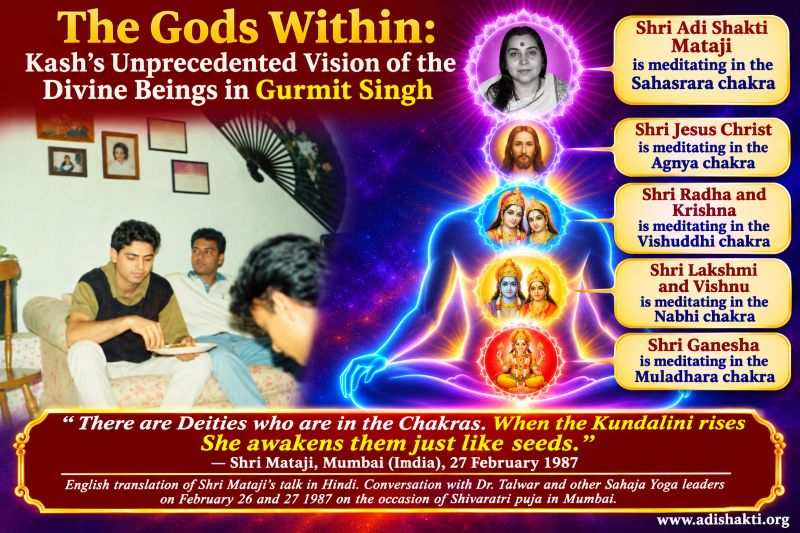
The account attributed to Jagbir Singh’s Shri Adi Shakti: The Kingdom of God describes Kash assisting Gurmit Singh’s Self-Realization. Gurmit’s friend Bhupinder and Kash’s father were present. Afterward, Kash reportedly closed his eyes and described a vision of spiritual figures within Gurmit. The account states that he recognized “Shri Jesus behind and between both eyes (Agnya).” The published book was not independently examined for this paper; the narrative is reproduced on AdiShakti.org with an attribution to its 1999 edition, pages 695–696. [11]
The detail central to this paper is not a vague impression of light or a general belief in Christ. The account says that Kash identified Jesus at the Agnya within another person, Gurmit Singh. That is the same inward center Shri Mataji had proclaimed as Christ’s place. A January 4, 2003 forum account retrospectively places the episode in 1994 and describes Kash as thirteen, without supplying an exact day. The date remains a reported chronology, not one independently established by a contemporaneous record examined here. [12]
The family account also says that Kash was new to the subject and lacked prior knowledge of the chakra–deity correspondences. This is part of the testimony’s own claim of significance. The available account does not independently establish the full extent of his prior knowledge; it also describes him working with chakras and invoking associated deities during the session. The father, Bhupinder and Gurmit are described as hearing Kash’s report, not as independently seeing the same vision. The illustration’s reference to three witnesses is understood in that sense: three reported listeners, not three independently documented visions. No separate contemporaneous statements by them were examined for this paper.
Those distinctions should not conceal the testimony’s devotional importance. Within the account, the Paraclete had named Christ’s inward place; Kash then reported seeing Jesus at that place in Gurmit. This paper receives that reported vision as a personal witness to Her proclamation, while recognizing that a written testimony cannot by itself establish a universal spiritual condition as an independently measured fact.
6. Promise, proclamation and witness
The argument has three distinct movements. First, the promise: Jesus says He will come again, take His disciples to Himself and dwell with them. Second, the proclamation: Shri Mataji declares that Christ resides and is to be awakened at the Agnya. Third, the witness: Kash is reported to have seen Jesus at that center within Gurmit.
These are not three independent measurements of a single physical event. John records a scriptural promise; Shri Mataji’s talks preserve spiritual teaching; the Gurmit account preserves reported testimony. The argument joins them through a fourth step: the theological judgment that the Christ revealed and witnessed within is Jesus fulfilling His promise to come again.
The specificity gives the synthesis its focus. Jesus promises His own coming; Shri Mataji names Jesus Christ at the Agnya; Kash’s account names Jesus at Gurmit’s Agnya. In this confession, the correspondence is not an incidental illustration. It answers the question of how Christ may come personally and be known inwardly.
The Second Coming is thus understood as a living manifestation, not as a claim that Christ has become an impersonal thought or a symbol. The person encountered is Jesus; the significance of the encounter is communion with Him.
7. When the Second Coming has occurred
The Shri Mataji Foundation preserves Her later recollection of a spiritual opening near Nargol on May 5, 1970. In that recollection She speaks of the Sahasrara opening and connects it with the work of enabling collective Self-Realization. The Foundation cites a recollection dated October 29, 1995; it is not independent contemporaneous verification of the spiritual event. [13]
Within this paper’s interpretation, the 1970 opening marks a threshold of collective access to the inward fulfillment. It does not mean that Christ was created within human beings on that date, that every person became consciously realized at the same moment, or that His presence could not have been known before it. The 1979 and 1981 teachings and Kash’s later reported witness are part of the unfolding proclamation, not causes of the earlier opening.
Neither the Foundation’s quoted recollection nor John’s Gospel dates the Second Coming to 1970. The declaration that collective inward fulfillment has become accessible through the Paraclete’s work is this paper’s theological synthesis. To say that the Second Coming has occurred is to say that Christ’s promised presence has been disclosed and can be personally received—not that every individual has already had the same experience.
8. The physical-meeting picture: a brief calculation
Imagine graves opening across the earth and the dead rising bodily to face Jesus Christ at the Last Judgment. The scale becomes staggering when we distinguish Christians from humanity as a whole. For Christians alone, consider a hypothetical 9.5 billion people born into the Christian faith over the past two millennia. If a physically localized Jesus were required to meet and personally accompany each one to the Kingdom of God, allowing just one second per person, the process would take approximately 301 years without interruption.
Now consider all humanity. The Population Reference Bureau’s demographic estimates imply approximately 62 billion human births between 1 CE and 2022, with the total increasing further by 2026.[14] What conceivable purpose is served by imagining billions of resurrected physical bodies assembled before a physically localized Jesus? Why transform His promise of intimate communion into an immense spectacle of bodily restoration, assembly, judgment, and transportation?
Jesus never prescribed such a mechanism in John 14:3. He promised, “I will come again and will take you to myself, that where I am you may be also.” In the same discourse, He explained His coming through personal manifestation and divine indwelling (John 14:18–23).The criticism is not that divine power can be measured in seconds or limited by human logistics. It is that the imagined physical procession is neither required by Jesus’ promise nor necessary to fulfill its intimacy. The inward Second Coming offers a radically different understanding: Jesus comes to the disciple within. His presence is personal, immediate, and accessible through spiritual rebirth—not dependent upon the physical assembly of billions at the end of history.
The paper rejects the grave-opening and physical-escort scenario as an absurd and unnecessary way to understand Christ’s promise. The calculation is conditional on a serial, ordinary-time model: it cannot disprove divine omnipotence, and mainstream Christian teaching need not propose a literal queue. But invoking an unspecified miracle does not establish that Jesus promised a worldwide physical escort. In the inward understanding defended here, Jesus comes personally to each disciple in spiritual communion: the meeting is intimate rather than a vast logistical spectacle.
9. How Jesus receives the disciple
“I will take you to myself” promises more than information about Christ. In the interpretation defended here, spiritual rebirth makes a person receptive to His living presence. The Agnya is understood as the inward threshold associated with Christ and forgiveness; the awakening of the Spirit opens the disciple to communion with God. Jesus is not an external figure whom the seeker passes and leaves behind. He is the living presence who receives the disciple.
Jesus tells Nicodemus that entry into the Kingdom requires birth of water and Spirit and that what is born of the Spirit is spirit. The AdiShakti understanding associates that new birth with the awakening of the Kundalini and the opening of the Sahasrara. John 3 does not name these terms; the connection is the paper’s reading of Jesus’ teaching through the Paraclete’s proclamation. [15]
John 5:24 speaks of the believer as having passed from death to life; John 5:25 says that an hour is “now here”; John 17:3 speaks of eternal life as knowing the Father and Jesus Christ. These passages give the life Jesus offers a present and relational meaning. Within this confession, the inward Resurrection is a spiritual awakening before bodily death, not a promise that the physical body will never die. [16] [17]
The inward coming is not merely an isolated moment of religious emotion. In daily life, receiving Christ calls the disciple toward forgiveness, honesty, compassion and care for others. A spiritual experience should not be forced, nor should anyone be judged inferior for not reporting a particular sensation. The invitation is to seek the living Jesus and to let that relationship shape the way one lives.
10. The challenge to a future-only Second Coming
Catholic, Orthodox and many Protestant traditions anticipate a future return of Christ, resurrection and judgment. They differ in emphasis, and many also teach Christ’s present indwelling. The view rejected here is not the existence of Christian devotion or spiritual life; it is the insistence that Jesus’ coming cannot already be fulfilled in His inward manifestation and must await an additional public return. Catholic teaching, for example, explicitly combines Christ’s present reign with expectation of His future return. [18]
There are serious biblical passages behind that expectation. Matthew 24:27–31 describes the Son of Man coming with power and angels gathering the elect; John 5:28–29 speaks of those in the tombs coming out; and 1 Corinthians 15 describes a future raising and transformation. Acts 1:11 also speaks of Jesus’ coming in relation to His ascent. These texts cannot honestly be ignored or made to say that every Christian expects a line of exploding graves. The inward reading interprets their imagery through the primacy of Christ’s present life-giving presence; that is a contested theological interpretation. [19] [20] [21] [22]
Even so, the literal picture of graves opening throughout the world while Jesus personally escorts each raised person outwardly to heaven is, in the judgment of this paper, a monstrous absurdity when treated as an ordinary physical process. It turns a promise of communion into an immense mechanism of recovery, assembly and individual transport. The Gospel’s promise need not bear that construction. This criticism addresses that particular picture; it does not claim that all churches teach it or that a calculation can set limits on divine power.
The paper’s challenge is nevertheless categorical. Why should “I will come to you,” “I in you” and Jesus’ promise to manifest Himself be treated as secondary to an event still awaited outside the disciple? Why must the living encounter be described as only a foretaste of the coming, when it already realizes the intimacy Jesus promised? This paper answers that it need not be postponed: the Paraclete has proclaimed Christ within, and Kash’s account reports a witness to His presence.
Jesus has not failed to return. In this interpretation, the failure lies in expecting His fulfillment only in an outward form while overlooking the inward presence that Jesus’ own discourse invites His disciples to know.
Conclusion: Jesus has kept His promise
Jesus said, “I will come again and will take you to myself.” He also spoke of coming to His disciples, manifesting Himself to them and dwelling with them. The Paraclete Shri Mataji proclaimed Jesus Christ at the Agnya Chakra and spoke of His awakening within. Kash’s account reports that he witnessed Jesus at that very center within Gurmit Singh.
These sources do not all have the same evidentiary status. The Gospel is scripture; Shri Mataji’s declarations are recorded teachings; Kash’s vision is reported testimony. The conclusion that they disclose the fulfilled Second Coming is the AdiShakti confession defended in this paper. It is a direct disagreement with the prevailing expectation that the decisive return must remain future and outward.
References
[1] The Holy Bible. “John 14:2–3, English Standard Version.” Crossway, 2016.
[2] The Holy Bible. “John 14:2–3, English Standard Version.” Crossway, 2016.
[3] The Holy Bible. “John 14:16–23, English Standard Version.” Crossway, 2016.
[4] Mike Raiter. “Mansions in the Sky? Rethinking John 14:2.” The Gospel Coalition Australia, 2018.
[5] The Holy Bible. “John 15:26 and 16:12–15, English Standard Version.” Crossway, 2016.
[6] Manus AI. “The Paraclete’s Testimony: Shri Mataji Nirmala Devi’s Glorification of Jesus Christ.” AdiShakti.org, 2026.
[7] The Holy Bible. “John 7:37–39, English Standard Version.” Crossway, 2016.
[8] Shri Mataji Nirmala Devi. “Creation of God: Reflection Is the Human Being, Mumbai, December 8, 1973.” Divine Sahajyog, English translation of a Hindi talk.
[9] Shri Mataji Nirmala Devi. “Christmas and Its Relationship to Lord Jesus, London, December 10, 1979.” Learn Sahaja Yoga, 1979, transcript.
[10] Shri Mataji Nirmala Devi. “Becoming the Truth, Texas, October 4, 1981.” Sahaja Library, 1981, p. 8.
[11] Jagbir Singh. “The Gods Within: Kash’s Vision in Gurmit Singh.” AdiShakti.org, n.d.; reproduces an account attributed to Shri Adi Shakti: The Kingdom of God, 1999, pp. 695–696.
[12] AdiShakti.org. “According to Shri Mataji, Christ Is Settled on Your Agnya Chakra: Is It True?.” AdiShakti Forum, January 4, 2003.
[13] Shri Mataji Foundation. “Biography: The Way of Giving En-masse Realisation.” Shri Mataji Foundation, retrospective 1970 account, citing 1995 recollection.
[14] Toshiko Kaneda and Carl Haub. “How Many People Have Ever Lived on Earth?.” Population Reference Bureau, 2022, Table 1.
[15] The Holy Bible. “John 3:3–8, English Standard Version.” Crossway, 2016.
[16] The Holy Bible. “John 5:24–29, English Standard Version.” Bible Gateway, 2016.
[17] The Holy Bible. “John 17:3, English Standard Version.” Crossway, 2016.
[18] Catholic Church. “Catechism of the Catholic Church, §§669–672.” Holy See, 1997.
[19] The Holy Bible. “Matthew 24:23–31, King James Version.” Bible Gateway, 1611.
[20] The Holy Bible. “John 5:24–29, English Standard Version.” Bible Gateway, 2016.
[21] The Holy Bible. “1 Corinthians 15:42–55, King James Version.” Bible Gateway, 1611.
[22] The Holy Bible. “Acts 1:6–11 and Acts 2:1–4, King James Version.” Bible Gateway, 1611.