AUTHENTICITY SERIES — SPIRITUAL BODY AND MYSTICAL TESTIMONY
Authenticity of Kash’s Mystical Witnessing of the Double Bodies
An Evidence-Based Interdisciplinary Assessment of Kash’s Reported Physical and Spiritual Bodies, Including the May 23, 1995 Foot-Soaking Observation
Abstract
This paper investigates “The Case of the Double Bodies,” a recurrent feature of Kash’s mystical testimony in which he distinguished his ordinary physical body on Earth from a second, spiritual or ethereal body encountered in the Sahasrara. The primary narrative reports that Kash’s earthly posture could vary—sitting on a bed, lying down, kneeling, sitting cross-legged, or sitting in a chair—while the spiritual body he encountered remained upright in meditation beside the Throne of the Divine Mother.
The testimony contains several phenomenologically distinctive claims. Kash reports first perceiving the spiritual body from outside it, then entering or merging with it, functioning through it during the Sahasrara experience, and later leaving it while still being able to perceive it meditating. The spiritual form is therefore not described simply as a duplicate seen once during an out-of-body episode. Within the narrative it functions as a stable second locus of embodiment.
A particularly important observation was recorded for May 23, 1995, at 8:30 p.m. Kash meditated while seated on a chair with his physical feet immersed in salted water as part of the Sahaja Yoga foot-soaking practice. He later reported that after entering his spiritual body in the Sahasrara, he lowered its legs into the cloud-like ground and encountered water there as well. This episode links a contemporaneous physical bodily condition to the reported spiritual-body experience.
Contemporary consciousness research establishes that experiences of self-location outside the physical body, seeing one’s body from an extracorporeal perspective, and altered body ownership are genuine human phenomena. A 2025 scoping review covering 87 publications found out-of-body experiences to be highly variable, often strongly reality-like, and subject to competing physiological, psychological, and non-local-consciousness interpretations. Experimental neuroscience also shows that bodily self-location and body ownership can be altered through multisensory manipulation or neurological stimulation.
These findings independently support the phenomenological possibility of experiencing the self as distinct from the ordinary physical body; they do not establish that Kash’s second body objectively existed in a nonphysical realm. The final assessment therefore distinguishes experiential authenticity from ontology: the surviving account strongly supports a stable and unusually elaborate dual-body mystical phenomenology, while the literal existence of an independently persisting spiritual body remains metaphysically open.
Methodological Statement
This investigation distinguishes four questions. Historical: what did Kash actually report, and when? Phenomenological: what structure did the reported second-body experience possess? Comparative: how does it relate to documented out-of-body experiences and religious concepts of a spiritual body or soul? Ontological: did an objectively existing nonmaterial body literally persist in the Sahasrara independently of Kash’s physical body?
The first three can be investigated using testimony, chronology, comparison, and consciousness research. The fourth cannot be established merely by showing that the experience was vivid, consistent, or religiously coherent.
Chapter One
Introduction: What Does “Double Bodies” Mean?
The Double Bodies testimony addresses one of the most fundamental questions raised by Kash’s wider mystical corpus: what exactly was traveling, seeing, speaking, sitting, and interacting in the Sahasrara while his physical body remained in meditation?
The answer supplied by Kash was explicit. His earthly physical body and the form through which he functioned in the Sahasrara were not experienced as identical. Whatever posture the physical body assumed, the second body was reportedly already present in an upright meditative posture beside the Divine Mother.
Central Research Question
Does the Double Bodies narrative represent a stable and distinctive form of altered embodiment, and what evidentiary weight should be assigned to Kash’s repeated claims that he could perceive, enter, inhabit, leave, and continue observing a spiritual body distinct from his physical body?
Chapter Two
Primary Source and Evidentiary Nucleus
Primary Source
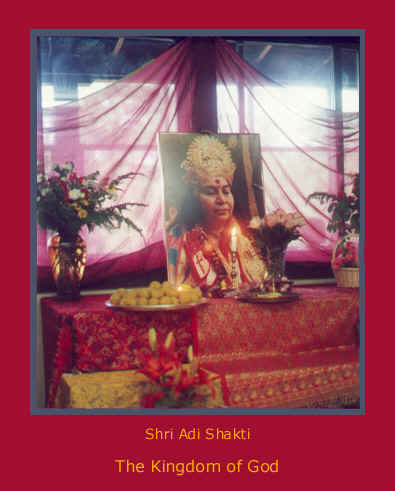
Jagbir Singh, Shri Adi Shakti: The Kingdom of God (1999), p. 552, “The Case of the Double Bodies.” The primary text also cites William S. Hatcher and J. Douglas Martin, The Bahá’í Faith, pp. 100–101, in relation to the nonmaterial soul and the physical body as its vehicle.
The narrative begins with an ordinary observation: Kash was meditating while sitting casually on the edge of a bed rather than using the cross-legged posture followed by the rest of the family. When asked why, he reportedly replied that the earthly posture did not matter because his spiritual body in Sahasrara was always already meditating correctly.
That explanation generated the central Double Bodies claim. Kash said that upon reaching Sahaj Samadhi he would emerge through celestial clouds, see his spiritual body below, descend toward it, and then either float, walk, or sit into it. The two would merge and thereafter function as one.
Evidentiary Nucleus
Physical posture varies; reported spiritual posture does not. Kash perceives the second body before entering it, experiences it as his operative form after entering it, and can reportedly perceive it again after leaving. The claim is therefore one of persistent dual embodiment rather than a momentary floating sensation.
Chapter Three
The Posture Discrepancy
The posture observation is deceptively important. Kash’s physical body could be sitting on the edge of a bed, lying down, slumping, kneeling, sitting cross-legged, or later sitting on a chair. Yet he claimed that the spiritual body remained upright, cross-legged, and meditating in the Sahasrara.
This means the spiritual form was not described as a simple visual copy of the physical body’s instantaneous configuration. If Kash was physically slumped but spiritually upright, the two body representations were functionally dissociated.
Modern bodily-self research demonstrates that self-location, body ownership, agency, and the visually represented body can be experimentally dissociated. That provides a scientific analogue for the experience of two bodily frames, though not proof of a metaphysically independent second body.
Chapter Four
The Reported Sequence of Embodiment
| Stage | Kash’s reported experience | Analytical significance |
|---|
| 1. Physical meditation | Physical body remains on Earth. | Ordinary sensory body is stationary. |
| 2. Transition | Conscious awareness reaches the Sahasrara. | Change of experienced self-location. |
| 3. External observation | Kash sees his spiritual body below him. | Self is initially experienced as distinct from second body. |
| 4. Descent | He floats or moves toward it. | Extracorporeal perspective. |
| 5. Entry | He enters or sits into the spiritual form. | Transfer of experienced embodiment. |
| 6. Merger | Two become one operative body. | Body ownership relocates to spiritual form. |
| 7. Sahasrara activity | He walks, speaks, sees, and interacts. | Second body functions as embodied agent. |
| 8. Departure | He leaves and can still see it meditating. | Reported spiritual body persists after disengagement. |
This sequence is more elaborate than the minimal definition of an OBE. It contains both disembodiment and re-embodiment: awareness first separates from ordinary bodily location and subsequently relocates into a second bodily form.
Chapter Five
The Persistent Spiritual Body
Perhaps the most unusual feature is persistence. Kash does not describe constructing a new spiritual body each time he meditates. He describes arriving to find the same spiritual self already meditating beside the Throne.
This creates an unusual three-stage relation between “I” and “body”: the observing self initially exists apart from the spiritual body; it then enters that body and identifies with it; after meditation it can leave the body and observe it again.
Theologically, the source interprets this as evidence that the spiritual self has an existence not reducible to the physical body. Phenomenologically, the more conservative conclusion is that Kash’s mystical states contained a stable recurring body-schema experienced as independent of ordinary posture and sensory embodiment.
Chapter Six
Clothing, Form, and Body-Mapping
Kash reportedly explained that the ethereal body itself had no intrinsic clothing. Yet when he entered it, the resulting form corresponded precisely to his material body, including whatever clothing he was wearing.
This detail is analytically valuable because clothing is not biologically part of the body, yet ordinary body representation often extends beyond skin to incorporate external objects, tools, garments, and peripersonal space. Contemporary body-ownership research shows that perceived bodily identity is constructed through multisensory integration rather than being a simple readout of anatomy.
Consequently, the clothing correspondence cannot by itself establish a nonmaterial body. It does, however, demonstrate the high-resolution embodied character of Kash’s reported experience: the Sahasrara self was not experienced as a formless point of consciousness.
Chapter Eight
Comparison with Out-of-Body Experience Research
Out-of-body experiences are now a recognized subject of consciousness research. A 2025 scoping review surveyed 87 publications from 1987 through 2024 and concluded that OBEs are highly idiosyncratic but contain recurring phenomenological features. They may occur spontaneously, be self-induced, or arise under several precipitating conditions.
The literature describes experiences ranging from viewing one’s own body from an elevated perspective to traveling through environments or encountering other beings. Reports often carry an unusually strong sense of reality. Proposed explanations include psychological, physiological, neurological, and non-local-consciousness models.
Kash’s report overlaps strongly with this phenomenological class in three respects: extracorporeal self-location, observation of another body identified as one’s own, and apparent movement through an environment while the physical body remains stationary.
Yet his case also departs from the generic pattern. The second body is recurrent, spatially stable, religiously situated, entered deliberately during meditation, and reportedly remains present after Kash disengages from it.
Chapter Nine
Bodily Self-Consciousness and Self-Location
Cognitive neuroscience divides ordinary bodily self-consciousness into components such as body ownership (“this body is mine”), self-location (“I am located here”), and agency (“I am causing this action”). Under normal conditions these components align so closely that their separability is easy to overlook.
Clinical and experimental work shows that they can dissociate. Out-of-body phenomena have been reported in neurological conditions involving temporoparietal regions, and OBE-like illusions can be experimentally induced through multisensory manipulation. Studies of full-body illusion likewise demonstrate that perceived self-location and body ownership can shift toward a virtual or seen body.
This research establishes an important point for the authenticity inquiry: experiencing oneself as located outside the physical body is a genuine alteration of consciousness, not automatically evidence of dishonesty or psychiatric disorder.
The same research simultaneously supplies a non-dualist explanation: a compelling second-body experience can arise through altered construction of bodily self-consciousness without requiring an objectively existing extracorporeal body.
Chapter Ten
Meditation and Altered Embodiment
Meditation is especially relevant because Kash’s experiences were not reported during trauma, anesthesia, or accidental neurological disturbance. They occurred in a repeated contemplative setting.
Research comparing meditation, altered states, and bodily self-consciousness notes that intensive contemplative practice can disrupt the ordinary experience of spatial self-location and bodily boundaries. Some practitioners report loss of bodily location, dissolution of the ordinary self, or radical changes in embodiment.
Kash’s experience differs from complete self-dissolution because it remains highly embodied. He retains a body, location, perspective, movement, and interpersonal interaction—but these functions migrate from the physical body to the reported spiritual body.
This makes the Double Bodies account particularly useful phenomenologically: it is not simply “no body” but replacement embodiment.
Chapter Eleven
Christian Comparison: “Physical Body” and “Spiritual Body”
A striking comparative expression occurs in 1 Corinthians 15:44, where Paul distinguishes a physical body from a spiritual body in the context of resurrection. The passage continues by contrasting the physical and spiritual orders.
The parallel must be bounded carefully. Paul is discussing resurrection and transformation, not describing a child entering a simultaneously existing second body during meditation. Therefore the Pauline text should not be presented as a direct prediction of Kash’s experience.
Nevertheless, it establishes that the conceptual distinction between physical embodiment and spiritual embodiment is deeply embedded within Christian anthropology. Kash’s language is consequently not without cross-traditional analogue.
Chapter Twelve
The Bahá’í Comparison Cited in the Primary Source
The original Double Bodies passage cites William Hatcher and Douglas Martin’s The Bahá’í Faith in support of the proposition that the soul is nonmaterial and does not depend upon the physical body, while the body functions as its vehicle in the physical world.
Related writings by Hatcher describe the human soul as a spiritual entity belonging to a spiritual rather than material order. This comparison is useful because it shows that the primary source did not formulate Kash’s experience in isolation; it interpreted it through an established religious anthropology distinguishing soul from body.
Again, doctrinal correspondence is not empirical proof. A Bahá’í concept of a nonmaterial soul does not verify the Sahasrara body. Its value is comparative and interpretive: it demonstrates a broader religious grammar in which personal consciousness is not exhausted by material embodiment.
Chapter Thirteen
What Is Distinctive About Kash’s Account?
The scientific OBE literature makes the general phenomenon of extracorporeal self-location less anomalous than it once appeared. But Kash’s account contains a combination of features that deserves separate attention:
- the spiritual body is reportedly encountered repeatedly rather than once;
- it occupies a stable sacred location beside the Divine Mother;
- its posture is independent of the physical body’s posture;
- Kash initially sees it from outside;
- he then enters it and acquires embodied agency through it;
- the body permits walking, sitting, bowing, speaking, seeing, and interaction;
- he can later leave and continue to see it;
- physical bodily information can apparently be represented in the spiritual-body experience, as in the foot-soaking episode; and
- the entire pattern recurs within the same Sahasrara geography described throughout his wider testimony.
The cumulative pattern is therefore more specific than the claim “Kash felt outside his body.” The testimony describes a recurrent alternative embodiment system.
Chapter Fourteen
Alternative-Explanation Audit
1. Deliberate fabrication
Assessment: logically possible but not demonstrated. No affirmative evidence of fabrication is contained in the supplied material. Extraordinary content alone does not establish deceit.
2. Imaginative visualization
Assessment: plausible. Repeated meditation can support stable internally generated imagery. The consistency of the spiritual body is compatible with a rehearsed or deeply learned body-schema.
3. Out-of-body experience
Assessment: strongly compatible phenomenologically. Extracorporeal self-location, seeing another body, travel, and strong reality-quality are documented features of OBEs.
4. Multisensory body-model alteration
Assessment: scientifically viable. Experimental evidence shows that self-location and body ownership can shift under manipulated sensory integration. This can explain aspects of the experience without positing a second ontological body.
5. Meditation-induced altered self-consciousness
Assessment: strongly viable. Contemplative states can substantially modify embodiment and spatial self-location.
6. Incorporation of physical sensations
Assessment: especially relevant to the foot-soak. Sensations from physically immersed feet could have been incorporated into the Sahasrara scene as cloud-water.
7. Dreamlike imagery
Assessment: possible but incomplete. OBE research identifies relations with lucid dreaming and sleep-related states, but the primary narrative describes deliberate waking meditation rather than sleep.
8. Persistent spiritual-body schema
Assessment: strongly supported at the phenomenological level. Whatever its origin, the second body appears to have been a recurring and stable feature of Kash’s reported inner world.
9. Non-local consciousness
Assessment: discussed in current OBE literature but not established as scientific consensus. Some researchers consider models in which consciousness is not fully localized to the brain; the evidence remains contested.
10. Literal independent spiritual body
Assessment: consistent with the source theology but not proven by the present evidence. Demonstrating independence would require information obtained through the spiritual body that could not be derived from Kash’s physical sensory system, memory, expectation, or prior knowledge.
Chapter Fifteen
Claim-by-Claim Evidentiary Matrix
| Claim | Evidence status | Academic assessment |
|---|
| Kash reported a body distinct from his physical body. | Explicit primary testimony. | Core historical/phenomenological claim. |
| Physical posture did not determine spiritual posture. | Explicit and recurrent. | Important body-schema dissociation. |
| Kash saw the spiritual body before entering it. | Explicit. | Strong OBE-like feature. |
| He merged with and operated through it. | Explicit. | Re-embodiment rather than simple disembodiment. |
| He could leave and still see it meditating. | Explicit. | Distinctive persistence claim. |
| May 23, 1995 foot-soak was represented in Sahasrara. | Precisely dated in source. | Physical/spiritual sensory coupling; multiple explanations possible. |
| OBEs can involve extracorporeal self-location. | Supported by contemporary research. | Independent phenomenological support. |
| Body ownership and self-location can be experimentally manipulated. | Supported by neuroscience. | Naturalistic explanatory mechanism available. |
| A spiritual body is recognized in religious traditions. | Supported comparatively. | Theological correspondence, not empirical verification. |
| Kash’s spiritual body objectively existed independently of his brain/body. | Metaphysical interpretation. | Not independently established by current evidence. |
| Kash genuinely experienced a recurrent second body. | Strong narrative consistency. | Strongly supportable authenticity judgment. |
Chapter Sixteen
Documentary Limitations and Stronger Tests
The major limitation is that the 1999 publication postdates the 1995 observations. The earliest dated notes should therefore be preserved and reproduced wherever possible.
The Double Bodies hypothesis is also unusually amenable to prospective testing. If a spiritual body can function independently of the physical sensory body, then future tests would ideally place unknown visual or symbolic targets outside the physical participant’s sensory access and ask for descriptions obtained during the reported extracorporeal state.
For the historical case, the strongest archive would include:
- the earliest record of the bed/posture conversation;
- the original May 23, 1995 foot-soaking note;
- records showing whether the foot-soak observation was written immediately after meditation;
- independent family recollections of Kash’s explanation;
- all early descriptions of entering and leaving the spiritual body; and
- failed or contradictory reports, if any, alongside successful ones.
Critical Test of Independence
The strongest evidence for an objectively independent spiritual body would not be vividness alone. It would be accurate acquisition of specific information unavailable to the physical senses and unknown to Kash beforehand, under prospective controlled conditions.
Chapter Seventeen
Consolidated Research Findings
Finding 1 — The Double Bodies testimony is structurally detailed. It specifies separation, observation, entry, merger, agency, departure, and persistence.
Finding 2 — Physical and spiritual postures are explicitly dissociated. The second body is not merely a copy of the earthly pose.
Finding 3 — Kash reports re-embodiment, not only disembodiment. He enters the second body and functions through it.
Finding 4 — The spiritual body is portrayed as recurrent and persistent. This is one of the case’s most distinctive features.
Finding 5 — The May 23, 1995 foot-soak provides a precisely dated body-coupling observation.
Finding 6 — Modern OBE research independently establishes extracorporeal self-location as a genuine human phenomenology.
Finding 7 — Neuroscience demonstrates that body ownership and self-location can dissociate.
Finding 8 — Meditation can substantially alter bodily self-consciousness.
Finding 9 — Christian and Bahá’í traditions supply comparative physical/spiritual-body or body/soul distinctions.
Finding 10 — These religious parallels establish conceptual precedent, not proof of Kash’s ontology.
Finding 11 — No affirmative evidence of fabrication is identified in the supplied record.
Finding 12 — The evidence supports authenticity of the experience more strongly than objective independence of the second body.
Overall Assessment
Kash’s Double Bodies testimony is best classified as a genuine, recurrent and unusually structured mystical experience of alternative embodiment. Contemporary consciousness science makes several core phenomenological components independently intelligible, while leaving open the source tradition’s stronger interpretation that the second body is an objectively existing spiritual vehicle.
Chapter Eighteen
Final Academic Conclusion
The Authenticity Series may uphold Kash’s “Double Bodies” testimony as a genuine and highly structured mystical experience in which ordinary physical embodiment and a recurrent Sahasrara body were experienced as distinct yet functionally connected.
The case is substantially richer than a conventional statement that Kash “left his body.” He reports encountering another body already present in the Sahasrara, seeing it from an external perspective, entering it, merging with it, acting through it, and later leaving it while the form continued to meditate. His physical posture on Earth could change without altering the spiritual body’s posture.
Contemporary research is important because it demonstrates that extracorporeal self-location and altered body ownership are authentic forms of human experience. OBEs are documented across healthy, neurological, sleep-related, and experimentally induced conditions, and modern neuroscience shows that the ordinary unity of self, location, and body can be disrupted.
This evidence removes one simplistic objection: Kash’s report cannot responsibly be dismissed merely on the ground that a person cannot genuinely experience consciousness as existing outside or independently of the physical body. People demonstrably can experience precisely such dissociations. What science does not presently establish is that the apparent extracorporeal location corresponds to an objectively existing nonmaterial body.
The May 23, 1995 foot-soaking observation sharpens the question. The physical feet were in water, and the reported spiritual feet also encountered water. Within the source theology this suggests correspondence between two bodies. Within cognitive neuroscience it could instead represent incorporation of ongoing bodily sensory input into an altered body model. The same datum is therefore compatible with competing ontologies.
The appropriate academic judgment distinguishes experience, interpretation, and objective reality. The first is strongly supported by the coherent testimony. The second is clearly articulated by the source as a soul/spiritual-body model. The third remains open to stronger testing.
Final Judgment
The surviving testimony strongly supports the authenticity of Kash’s mystical witnessing of the Double Bodies as a recurrent experience of a stable second embodiment. Its defining evidentiary features are the independence of spiritual posture from physical posture, the repeated external observation of the spiritual form, entry and merger with that form, continued embodied activity within the Sahasrara, and the claimed persistence of the form after Kash disengaged from it.
Within the theology of Shri Adi Shakti: The Kingdom of God, this is interpreted literally: the physical body is the earthly vehicle while the spiritual self operates through an ethereal body in the Sahasrara. Within a strictly interdisciplinary framework, the case is most securely described as an unusually elaborate and stable altered-embodiment phenomenon whose objective ontological status remains unresolved. A future demonstration of accurate information acquisition through the reported spiritual body under controlled sensory isolation would substantially strengthen the claim that the phenomenon extends beyond internally generated bodily self-consciousness.
References and Source Notes
- Singh, Jagbir. Shri Adi Shakti: The Kingdom of God. 1999, p. 552. “The Case of the Double Bodies.” Primary source.
-
Moix, J., et al. “Out of body experiences: Scoping review.” Explore (2025). Review of 87 publications addressing OBE phenomenology and competing explanatory models.
Source.
-
Campillo-Ferrer, T., et al. “Out-of-body experiences in relation to lucid dreaming and sleep paralysis: A theoretical review and conceptual model.” Neuroscience & Biobehavioral Reviews 163 (2024), 105770.
Source.
-
Frisco, F., Bruno, V., Romano, D., and Tosi, G. “I am where I believe my body is: The interplay between body spatial prediction and body ownership.” PLOS ONE (2024).
Source.
-
“Predicting the bodily self in space and time.” Scientific Reports (2024). Discussion of self-location, body ownership, agency, temporoparietal findings, and experimentally induced full-body illusions.
Source.
-
Millière, R., Carhart-Harris, R. L., Roseman, L., Trautwein, F.-M., and Berkovich-Ohana, A. “Psychedelics, Meditation, and Self-Consciousness.” Frontiers in Psychology (2018). Comparative discussion of meditation, self-location, and OBE-like phenomena.
Source.
-
1 Corinthians 15:42–46, NRSVUE. Paul’s physical-body/spiritual-body distinction occurs specifically in a resurrection context.
Source.
-
Hatcher, William S., and Martin, J. Douglas. The Bahá’í Faith: The Emerging Global Religion. Primary source cites pp. 100–101 concerning the nonmaterial soul and the body as its physical vehicle.
-
Hatcher, William S. “Human Nature and Human Society.” Comparative Bahá’í discussion of the soul as nonphysical, indivisible, and distinct from material composition.
Source.
Primary Source Notes for the Introduction
The analysis preserves the source’s key phenomenological terms and sequence: physical body, spiritual body, Sahasrara, seeing the spiritual self below, floating down, entering it, merging, leaving it, and continuing to see it meditating. The academic terminology of body ownership, self-location, body-schema, disembodiment, and re-embodiment is comparative language added by this investigation.
Recommended Archival Supplement
Reproduce the original May 23, 1995 entry if it survives, together with the earliest record of Kash’s posture explanation. These contemporaneous records would be more evidentially valuable than later recollection and would permit exact comparison between the original wording and the 1999 publication.