"Yes! That Is Jesus!"
In 1994 Kash was shown this work of art in the home of Robert McNeil in Val-David, Quebec, Canada. He instantly agreed it was that of Shri Jesus. There was no hesitation as His physical features matched that in the Kingdom of Heaven.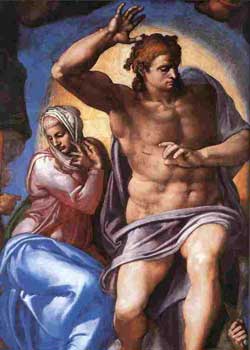
Sistine Chapel. The first impression we have when faced with the
Last Judgment is that of a truly universal event, at the centre of
which stands the powerful figure of Christ. His raised right hand
compels the figures on the left-hand side, who are trying to
ascend, to be plunged down towards Charon and Minos, the
Judge of the Underworld; while his left hand is drawing up the
chosen people on his right in an irresistible current of strength.
It is Michelangelo who accurately portrays the physical features of the Universal Savior in The Last Judgment, devoted to the biblical narration of humanity at the end-times.
Michelangelo Buonarroti was born on March 6, 1475, in the small town of Caprese, which is tucked into a fold of the Apennine mountains in rural Tuscany. His father, Ludovico Buonarroti, was a minor Florentine official and the local governor of the small towns of Caprese and nearby Chiusi. After his six-month term of office, Ludovico moved the family back to Florence, where they owned a good-size farm in the little village of Settignano overlooking Florence. Here, and in the surrounding hills pock-marked with quarries, Michelangelo grew up and was first exposed to stone carving. Appropriately for a son whose family had noble pretensions, Michelangelo attended Latin school. But as so often happens, the boy's aspirations were different from those of his father. Michelangelo was drawn to art rather than to the world of the Florentine banker and merchant.
“In his last frescoes, the Last Judgment (1536-41; Sistine Chapel, Vatican), the Conversion of St. Paul (1542-45; Pauline Chapel, Vatican), and the Crucifixion of Peter (1545-50; Pauline Chapel, Vatican), he replaced the rational compositional unity and beauty of the Sistine ceiling frescoes with a visionary world in which the compression of the figures and the violence of their actions take place in a supremely spiritual world. His human forms are as powerfully modeled as ever, but they are now contorted in physical agonies that imply the necessity of human suffering for the salvation of human souls... . .
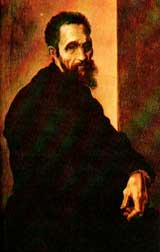
The artist died on February 18, 1564, just two weeks shy of his eighty-ninth birthday. Informing Duke Cosimo in Florence, Michelangelo's doctor wrote to inform Duke Cosimo of Florence: "This afternoon that most excellent and true miracle of nature, Messer Michelangelo Buonarroti passed from this to a better life.”That same year Galileo and William Shakespeare were born.”1
“Christianity, further developing the concept of the Last Judgment, teaches that it will occur at the Parousia (the Second Coming, or Second Advent, of Christ in glory), when all men will stand before a judging God. In early Christian art the scene is one of Christ the judge, the resurrection of the dead, the weighing of souls, the separation of the saved and the damned, and representations of paradise and hell. Romanesque artists produced a more terrible vision of the Last Judgment: Christ is shown as a stern judge, sometimes carrying a sword and surrounded by the four mystical beasts—eagle, lion, ox, and winged man—of the apocalypse; the contrast between paradise and hell is between the awesome and the ferocious. In the gentler, more humanistic art of the Gothic period, a beautiful Christ is shown as the Redeemer, his right side undraped to reveal the wound of the lance, and both wounded hands raised high in a gesture that emphasizes his sacrifice. He is surrounded by the instruments of his Passion—cross, nails, lance, and crown of thorns. The intercessors are restored, and the scene of the Judgment is treated with optimism. In the 16th century, Michelangelo produced a radically different version of the Last Judgment in his fresco in the Sistine Chapel in Rome (1533-41): a vengeful Christ, nude like a pagan god, gestures menacingly toward the damned.”2
“The concept of a final judgment on humankind at the end of history is found in Judaism and Christianity, Islam, and Zoroastrianism. It holds an important place in Judaic tradition, in which God's judgment is regarded as operative both within history and at its end. The consummation of history is called the Day of the Lord, which is a day of judgment upon all who are unfaithful to God.
Christian Eschatology owes much to this Hebrew tradition. The New Testament freely employs the language and imagery of Jewish Apocalyptic Literature. It affirms the expectation that (in the language of the historic creeds) Christ "Will come again with glory to judge both the quick and the dead.” Many different interpretations of the meaning of this affirmation have been offered and, in particular, of the symbolic language employed in the New Testament to describe the indescribable. But there is little doubt that the apostolic writers believed in the Second Coming of Christ and the Great Judgment Day as a manifestation of Christ's eternal victory.”3
In 1994 Kash was shown this work of art in the home of Sahaja Yogi Robert McNeil in Val-David, Quebec, Canada.
1994 at Robert McNeil's home. (Click
to enlarge)
He instantly agreed it was that of Shri Jesus. There was no hesitation as His physical features matched that in the Kingdom of Heaven.
However, it must be emphasized that it is the physical built rather than facial features that Kash is talking about.
Nearly three years later, on January 29, 1997, his father heard an audiotape of Shri Mataji Nirmala Devi's talk in Houston, USA, "The Creation of Christ.” The next day these words of the Comforter Shri Mataji Nirmala Devi were added:
“Now we have to know that Christ has suffered for us absolutely to the brink. We don't have to suffer anymore. These are nonsensical ideas coming from people who are sadistic, whoa have no Joy in themselves. They cannot see you happy. And that's why also they made Christ look like a TB patient I should say. I went to the Sistine Chapel and Michelangelo was a Realized soul, a great person. He had done complete justice to the image of Christ. Huge big thing like, we can say, a Texas fellow. Body was like a lambodar — with a big stomach which is Christ ... Just imagine. It is Michelangelo, is the only person who has really done justice.”The Messiah-Paraclete-Ruh-Devi
The New Age Has Started, Houston, USA — October 6, 1981

The Paraclete Shri Mataji
“Like Michelangelo you can say he is a great personality. He has shown Christ in the real way. If you see the Sistine Chapel that is the Judgment he has shown so well that is happening today! Christ standing like a strong man there and not like bones they show in the Catholic Church. I feel they are sadists always talking about Christ and putting Christ just like a bone structure. I feel like crying when I see all this. Can they carry the Cross, any one of them? Like Christ with that skinny body, would He carry the Cross? He is the One who has died for our sins and miseries and you want to show Him as such a miserable person! ...
How can you judge Christ? You have no powers to judge Him? First become the spirit then you will know what He was. But nobody wants to talk about that....
That's why Christ has said in the second verse of Matthews, He said in the second chapter that," you will be calling Me Christ! Christ! and I will not know you.”These are the people and you don't become one of them. You know Him. You see Him. You will find Him here (see Her pointing at Agnya Chakra) within yourself, awakened, He resides. Be sensible. Be wise.”
The Messiah-Paraclete-Ruh-Devi
Geneva, Switzerland — June 13, 1985
“What was the race of Christ? Was He a fair man? No. Was He a white person? — Not at all! What was His color? He was brown like Indians.”
The Messiah-Paraclete-Ruh-Devi
Christmas Puja, Ganapatipule, India — December 25, 1996
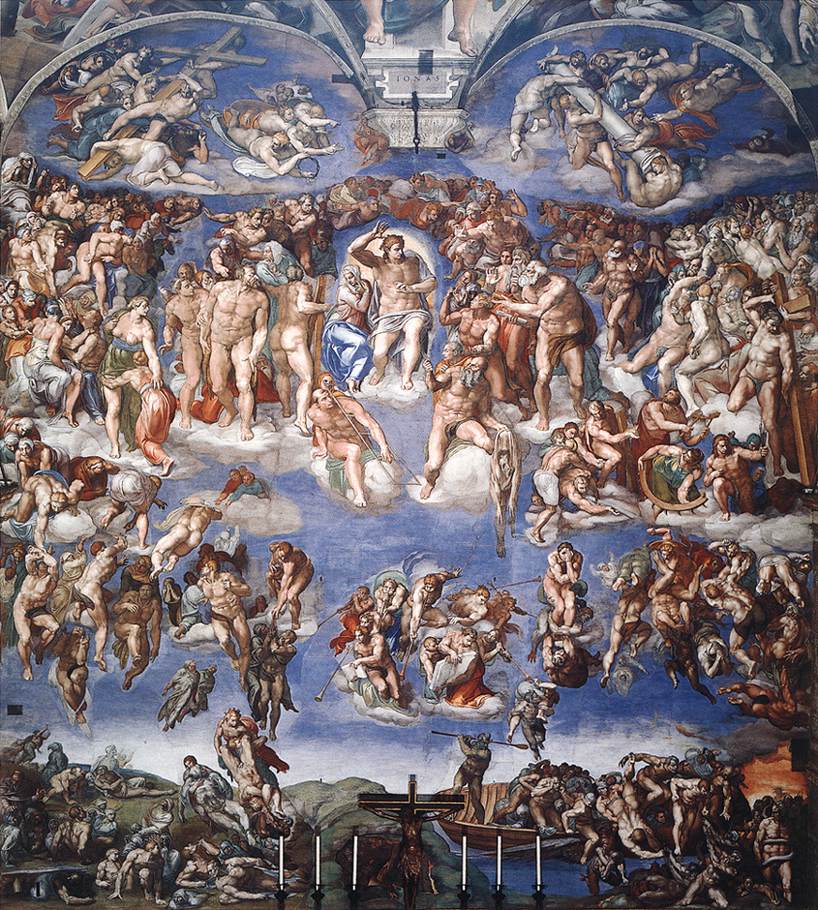
Michelangelo's Last Judgment
"This fresco was commissioned by Pope Clement VII (1523-1534) shortly before his death. His successor, Paul III Farnese (1534-1549), forced Michelangelo to a rapid execution of this work, the largest single fresco of the century.
The first impression we have when faced with the Last Judgment is that of a truly universal event, at the centre of which stands the powerful figure of Christ. His raised right hand compels the figures on the lefthand side, who are trying to ascend, to be plunged down towards Charon and Minos, the Judge of the Underworld; while his left hand is drawing up the chosen people on his right in an irresistible current of strength. Together with the planets and the sun, the saints surround the Judge, confined into vast spacial orbits around Him. For this work Michelangelo did not choose one set point from which it should be viewed. The proportions of the figures and the size of the groups are determined, as in the Middle Ages, by their single absolute importance and not by their relative significance. For this reason, each figure preserves its own individuality and both the single figures arid the groups need their own background.
The figures who, in the depths of the scene, are rising from their graves could well be part of the prophet Ezechiel's vision. Naked skeletons are covered with new flesh, men dead for immemorable lengths of time help each other to rise from the earth. For the representation of the place of eternal damnation, Michelangelo was clearly inspired by the lines of the Divine Comedy: Charon the demon, with eyes of glowing coal/Beckoning them, collects them all,/Smites with his oar whoever lingers.
According to Vasari, the artist gave Minos, the Judge of the Souls, the semblance of the Pope's Master of Ceremonies, Biagio da Cesena, who had often complained to the Pope about the nudity of the painted figures. We know that many other figures, as well, are portraits of Michelangelo's contemporaries. The artist's self-portrait appears twice: in the flayed skin which Saint Bartholomew is carrying in his left-hand, and in the figure in the lower left hand corner, who is looking encouragingly at those rising from their graves. The artist could not have left us clearer evidence of his feeling towards life and of his highest ideals.
The painting is a turning point in the history of art. Vasari predicted the phenomenal impact of the work: 'This sublime painting', he wrote, 'should serve as a model for our art. Divine Providence has bestowed it upon the world to show how much intelligence she can deal out to certain men on earth. The most expert draftsman trembles as he contemplates these bold outlines and marvellous foreshortenings. In the presence of this celestial work, the senses are paralysed, and one can only wonder at the works that came before and the works that shall come after'.”
Web Gallery of Art
http://www.wga.hu/html_m/m/michelan/3sistina/lastjudg/0lastjud.html (Retrieved 2016-12-03)
1. www.island-of-freedom.com
2. Britannica Online (1994-1998 Encyclopaedia Britannica, Inc.)
3. Charles W. Ranson
Disclaimer: Our material may be copied, printed and distributed by referring to this site. This site also contains copyrighted material the use of which has not always been specifically authorized by the copyright owner. We are making such material available to our readers under the education and research provisions of "fair use" in an effort to advance freedom of inquiry for a better understanding of religious, spiritual and inter-faith issues. The material on this site is distributed without profit. If you wish to use copyrighted material for purposes other than "fair use" you must request permission from the copyright owner.

 YES! THAT IS JESUS!