The Logical Impossibility of Sequential Messianic Arrivals
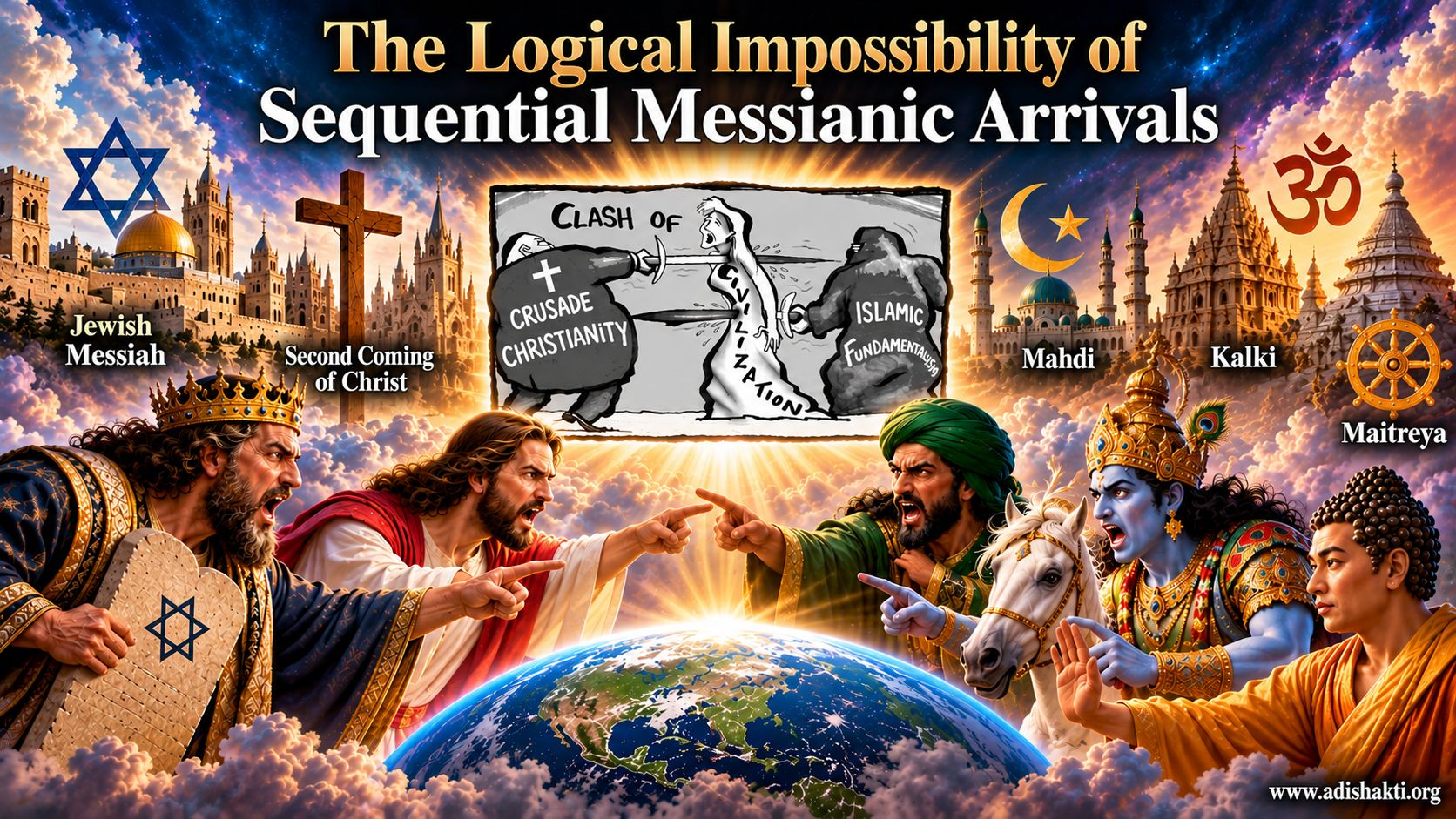
Malachi Martin — Complete Supplied Archival Extract
The following reproduces the entire extract supplied for this paper, including the jacket summary, the comparative formulations attributed to The Encounter, and the extended passages cited from pages 217–218 and 329–332. The jacket description is distinct from Martin’s book text. The transcription and page references have not been independently verified against the printed edition; its polemical generalizations represent the source’s argument, not this paper’s factual endorsement.
Jacket-cover summary — The Encounter
“For almost two thousand years, three major religions, Christianity, Judaism, and Islam, have enjoyed a popularity and exercised a profound influence on millions of human beings. Each, from the very beginning of its existence, claimed to have the ultimate answers to the supreme questions that confront man in every age. Each claimed, on the basis of absolute exclusivity, to be a chosen people. Each claimed to be able to provide its adherents with the truth about man, his origin and his destiny, and further to provide him with a world outlook according to which he could explain everything in human life.
As Dr. Martin shows in The Encounter, each of the three religions at one early moment in its history made a choice according to which all its later history was determined. Christianity restricted itself essentially to the West; it attempted, with minimal success, to convert the peoples of Africa and Asia; it set up from its beginnings an official opposition and hate for Judaism; at one time it dreamed of supervising and controlling the secular and political life of man. Judaism set itself in opposition to Christianity; it became, for almost 1,800 years, the professional underdog of the West; in modern times, it has been polarized beyond repair. Islam tied its fortunes to certain geographical areas, to one concept of civil government, to a way of life totally incompatible with that of mankind generally today, and to an irredentism unacceptable to modern man.
Each of these religions had a limited success over a certain period of human history. That period is now over. It is Dr. Martin's thesis that, as a result, all religions are in a state of crisis. They are not able to provide modern man with answers to his ethical problems. They cannot unite man today. Their very formulations of doctrine and solutions to human problems are unintelligible today. In short, they have failed modern man.” (summary on jacket cover)
Jacket-cover summary, as supplied
The Torah — “The Jews says”
The Jews says:
I believe that there is but one God, YHWH, Eternal, Immutable, All-Perfect, who dwells in Paradise; that He created the skies, the earth, and all things visible and invisible; that He created the angels and spirits, among which is Satan, the Evil One, who was originally an angel, but who fell from favour by disobedience; ● that He created Adam and Eve, the first man and woman, each with a body and immortal soul; that they sinned against Him, and were expelled from Paradise; that He later revealed the true religion to Abraham who thus is the father of all true believers; ● that after Abraham's death Moses was the chief of these and that he led the Israelites out of Egypt at the Exodus to the Land of Promise; that he founded the law by which the true Community of Believers might be saved and so be YHWH's Chosen People living according to His Spirit and awaiting His Messiah; that the Christians corrupted the original teachings of Moses by following the teachings of Jesus of Nazareth; that the Muslims corrupted the true belief of Abraham and Moses further by following the teachings of Mohammad; ● that Jerusalem is the holy center of the world; that YHWH's revelation is only contained in the Jewish Bible; that henceforth men are divided into the Chosen People and the Gentiles; that YHWH's salvation is only with the Jewish People; ● that there will be a Last Day in the history of the world; that all men of the past will rise from the dead for a Last Judgment by God; that only the Jews can receive the final reward of Paradise; that on that day YHWH will admit the Chosen People to eternals in Paradise, and severely judge the others; that the sinful and the unbelieving will be punished forever in Hell.
Malachi Martin, The Encounter (1970), pp. 182–185, as transcribed
The Bible — “The Christians says”
The Christians says:
I believe ● that there is but one God, Eternal, Immutable, All-Perfect, who dwells in Paradise; that He created the skies, the earth, and all things visible and invisible; that He created the angels and spirits, among which is Devil, the Evil One, who was originally an angel, but who fell from favour by disobedience; ● that He created Adam and Eve, the first man and woman, each with a body and immortal soul; that they sinned against Him, and were expelled from Paradise; that He later revealed the true religion to Abraham who thus is the father of all true believers; that after Abraham's death, He sent a number of prophets to revive the true religion of Abraham; ● that Moses was the chief of these, and that he founded the law by which the true community of Believers might be saved; that the Jews corrupted the Law; that finally God sent Jesus of Nazareth, His Son, to be the Messiah; that Jesus taught men the true doctrine and founded the Church to perpetuate these beliefs so that all Christians could live according to His Spirit; that Jesus saved all men from sin by His death on the Cross and resurrection; that Mohammad and the Muslims corrupted both Jewish and the Faith of Jesus; ● that Jerusalem used to be the holy center of the world, then alter it was Rome, then still later various places in the world; that God's revelation is only contained in the Christian Bible; that henceforth men are divided into the Church of believers and the non-believers; that God's salvation is only to be found in the Church; ● that there will be a Last Day in the history of the world; that all men of the past will rise from the dead for a Last Judgment by God; that only the Christians can receive the final reward of Paradise; that on that day God will admit Christians to eternal in Paradise, and severely judge the others; that the sinful and the unbelieving will be punished forever in Hell.
Malachi Martin, The Encounter (1970), pp. 182–185, as transcribed
The Koran — “The Muslims says”
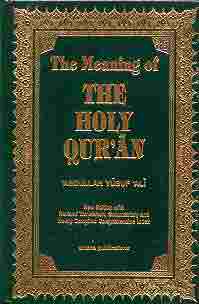
The Muslims says:
I believe ● that there is but one God, Allah, Eternal, Immutable, All-Perfect, who dwells in Paradise; that He created the skies, the earth, and all things visible and invisible; that He created the angels and spirits, among which is Iblis, the Evil One, who was originally an angel, but who fell from favour by disobedience; ● that He created Adam and Eve, the first man and woman, each with a body and immortal soul; that they sinned against Him, and were expelled from Paradise; that He later revealed the true religion to Abraham who thus is the father of all true believers; ● that after Abraham's death, He sent a number of prophets to revive the true religion of Abraham; ● that Moses was the chief of these and that he founded the law by which the true community of believers might be saved; that the Christians corrupted his Gospel; that Allah finally sent Mohammad who left all he possessed at the Hegira in order to establish successfully the true Community of Muslims who could live according to His Spirit; ● that Mecca is the holy center of the world; that Allah's revelation is contained only in the Koran; that henceforth men are divided into Muslims and unbelievers; that Allah's salvation is only with the Muslims; ● that there will be a Last Day in the history of the world; that all men of the past will rise from the dead for a Last Judgment by Allah; that only Muslims can receive the final reward of Paradise; that on that day Allah will admit the Muslims to eternal rewards in Paradise, and severely judge the others; that the sinful and the unbelieving will be punished forever in Gehenna.;
Malachi Martin, The Encounter (1970), pp. 182–185, as transcribed
Exclusivity and the dominance-trait
"It is certain that exclusivity is an essential note of these religions. If tomorrow, Judaism, Christianity, and Islam conceded that any one of the others was as good as or better than itself, they would fall apart as we know them. Their entire history would be negated.”
"Is the dominance-trait an essential characteristic or basic element of these religions? If they lacked or got rid of it, would they be identically the same in their essence as they are now? Are they viable as religions without the dominance trait? Is the dominance-trait non-essential, a historical accretion due to mere historical development or, at least, is it an element due to human limitations and not issuing necessarily from the religions themselves? After all, these religions claim to be divine in origin, to be messages of salvation received by fallible men from a god who is deemed to be illimitable, eternal, faultless, perfection itself. Perhaps the message itself is free from the dominance-trait; only the recipients suffer from this limitation? Perhaps all three religions adopted physical modes at the priceless moments of their history, and these modes imply a purely human dominance-trait?
This question has a burning importance today when a deep crisis appears to be shaking these religions at their very foundations: one of the aspects of all three religions that seems incompatible with the mind of modern man is this dominance-trait of Judaism, Christianity, and Islam. Certainly the prejudice, bigotry, cruelty, the massacres and progroms and persecutions, the suffering and the oppression to which this dominance-trait has given rise, have shaken modern man's belief in the authenticity of their absolutist claims.
It is certain that exclusivity is an essential note of these religions. If tomorrow, Judaism, Christianity, and Islam conceded that any one of the others was as good as or better than itself, they would fall apart as we know them. Their entire history would be negated. The Jews would cease to be the Chosen People. Jesus would cease to be God and Savior. Mohammad and his Koran could be pushed aside as historical accidents. Each of the three must singly and for itself claim to have exclusive possession of the one and absolute truth, to exclude the other two and all others besides. The most any one of them could concede is that the others have a fragment or a portion of the truth, that in virtue of good faith and good works, Yahweh (or God or Allah) will have mercy on them.
The pathos of their locked position is sharply focused by their professed belief in one god. There can only be one god, all three maintain obstinately. And this one god can have only one truth. Embedded in each religion, however, are mutually exclusive proportions about that one god: Jews and Muslims reject the divinity of Jesus; Christians and Jews reject the supremacy and final authority of the Koran as the last words of this one god to men; Christians and Muslims reject the Jewish Torah as the ultimate word of this one god; Christians and Muslims believe in the virginity of Mary which the Jews reject; Jews and Muslims reject the idea that the blood of Jesus wiped out all men's sins. The list is endless.” (pp. 217-8)
Malachi Martin, The Encounter (1970), pp. 217–218, as transcribed
Religion, violence, and the Last Day
Christianity within its own borders has specialized in self-crucifixion, at first to quite a minor degree during the first 1500 years of its life, when heretics and dissidents and accused witches and sorcerers were put to death, as Jesus was. Then, with the breakup of its unity in the 16th century, Christians devised for each other one Hell more horrendous and tortuous than another, indulging in a 300-year round of mutual recrimination, accusation, denigration, and relegation by bell, book, and candle, to the filthiest categories of human life. No branch of Christianity can be excused from this, because all Christians have indulged in it.
No body of Christians ever answered the insults of other Christians with Christ's answer: 'Forgive them, Father, for they know not what they do?' They all developed special vocabularies replete with violent words such as 'heresy,' 'heretic,' 'extirpation,' 'condemnation,' 'excommunication,' 'outcasts,' 'unclean believers,' 'vice-mongers.' Each one devised its special defenses against the other: social ostracism, civil war, discrimination, calumny, legal non-existence. Rome was the Red Lady of the South. Luther was the Pig of Germany. Protestants were the sons of vipers. Jews were the 'race of the devil.' Muslims were 'benighted and error-ridden barbarians.' No body of Christians ever tried to conquer the world with humility and patience and love, and no body of believers ever tried to fan the flames of faith, in the heart of man by being authentically believers.
The Jews, in retaliation for their pain and their sustained exile, contributed to the sea of hate, distrust and, in some cases, deformation of truth. They invented multiform expressions of contempt, condemnation, loathing, and utter rejection of Christians. They even modified some of their traditional beliefs because the Christians had borrowed them in their original form and, in their repugnance from all things Christian, they wanted no resemblance to subsist between their faith and that of the Christians. They returned hate with hate. They, also, cannot be excused and considered totally guiltless. They preached truth and justice, yet they violated both in order to maintain their religion and their Jewishness. Christians preached love but practised officially sanctioned hate, intermingling their loveliest psalms of compassion for their dying Savior with the expressions of extreme disgust for the Jews...
Muslims preached mercy and compassion, but they practised none or very little, assigning both Christians and Jews to the lowest rung in Allah's consideration, and historically meting out to both a treatment which rivals any cruelties of man in known history. Down through the ages, this procession of the crucified one has come: formed, maintained, and augmented by Jews, Christians, and Muslims. Each one has prayed with its armies to its god that the armies of the opponents be destroyed. There is no palliating or explaining away the sin of Judaism, Christianity, and Islam.
The three religions failed in another significant way. None of them attacked slavery or race prejudice or other flagrant inhumanities of man to man from the very beginning of their existence. The Arabs of today sanction slavery as spontaneously as the Popes of the 19th century sanctioned the creation of castrati choirs for Papal masses, as readily and blindly as the Protestant ethic of the white American sanctioned the serfdom and degradation of the Negro race until the second half of the 20th century. Each religion has practiced the art of climbing on the bandwagon: only when lay and secular reformers, sometimes lacking any formal religion whatever, raised such a hue and cry that men's consciences were stirred, did the religions begin to turn their huge resources toward reform. The Catholic Church in Germany and Italy acquiesced in Nazism and Fascism at least in the earlier stages of the ideologies. Russian Orthodoxy acquiesced in the despotism and sadism of Czarist times. Greek Orthodoxy sanctioned the corruption of the Byzantine court and is today bitterly nationalist in Greece's disputes with Turkey. No Protestant Church and no Jewish Synagogue ever officially condemned and attacked the Ku Klux Klan before 1945 in America, though individuals did. Judaism, Christianity, and Islam have practiced the double standard in this matter...
Thus the three religions have not been witnesses to the truth. All, it is true, have developed an exalted vocabulary, and a very impressive manner of announcing their own grandiose claims. All three have excelled and excel in words, as distinct from actions. All three have an impressive ritual and have refined psychological approaches to man. Yet the witness of words, mere words, has never changed men's minds, nor has mere theological subtlety helped men to be better men. The witness of the three religions have been faulty, at times perniciously false and erroneous. The three of them have witnessed to the uses of hate for the love of a god. And all three have disposed of the lives and happiness of millions of human beings without any real feeling for human suffering or any genuine concern for the concrete realities of life.
It is clear, first of all, that today all three religions lack any authoritative note for man. They have, as yet, each one of them, sufficient number of adherents to give the impression of continuing strength, and this glosses over for them and for the outside world at times their terrible weakness. For each of them, when scrutinized closely, is blackened with sufficient failures to prevent any thinking man from believing in them. And, above all, all three persevere in making a claim which cannot possibly be valid and true: that they are, each single one, the true religion.
Each one of them, however, hides from the ultimate test of its validity and truth behind a wall of unknowing and expectation. All three chorus that only on the 'Last Day,' when the 'End' comes, when 'God' decides, will it be clear that the 'other two' and all others besides were false, and it (the claimant) was all along the true community of the one 'God.' "
Malachi Martin, The Encounter (1970), pp. 329–332, as transcribed
Summary
This revised study places the exclusive claims of Judaism, Christianity, and Islam in dialogue with Malachi Martin’s The Encounter (1970), especially its critique of the “dominance-trait”: the conviction that one community alone possesses the complete and final religious truth. It then tests whether the anticipated Jewish Messiah, Christian Second Coming, Islamic Mahdi and return of Jesus, Hindu Kalki, and Buddhist Maitreya could each inaugurate a separate, incompatible, universally final redemption in the same human history. The contradiction arises only under those joint conditions, not from succession itself. Against indefinite waiting, the paper considers the historically documented life and teaching of Shri Mataji Nirmala Devi (1923–2011) and Adishakti.org’s confessional claim that Her mission inaugurated a collective spiritual awakening. The testimony deserves examination; Her divine identity and the promise of eternal life remain theological claims rather than established scientific findings.
The Unanswered Question: Where Are the Promised Deliverers?
Not one of the expected final messianic consummations has been publicly established as completed according to the full traditional criteria of its respective community. Judaism continues to await the Messiah and the promised restoration; mainstream Christianity awaits the visible return of Christ and the final resurrection; Islamic traditions await the Mahdi and, in many interpretations, Jesus' descent; Hindu traditions anticipate Kalki at the appointed close of the age; and Buddhist traditions anticipate the future Buddha Maitreya. These expectations differ significantly, but their uncompleted public horizons invite the same urgent question: When will they come?
This is a claim about the unfulfilled status of the expected final missions , not proof that no claimant has ever appeared or that every tradition teaches precisely the same future timetable. Some traditions understand aspects of fulfilment as already inaugurated; others interpret prophetic figures symbolically. The force of the question does not require denying those distinctions.
For a humanity confronting suffering, division, and mortality, a proposed procession of separate final saviors provides no coherent explanation of how each could independently and exclusively complete the destiny of the same world. If the first arrival finally redeems humanity, what final redemption remains for the second, third, fourth, or fifth? If each leaves humanity awaiting the next, in what sense was the preceding redemption final?
Malachi Martin’s Challenge: Three Exclusive Claims to One Ultimate Truth
The newly supplied archival extract from Malachi Martin’s The Encounter (Farrar, Straus and Giroux, 1970) introduces a second, historically significant argument: Judaism, Christianity, and Islam each speak of one God and final truth, yet their authoritative accounts of revelation, the identity of Jesus, and the means of salvation cannot all be affirmed literally and without qualification. Martin’s criticism is not simply that religions disagree; it is that some communities make the disagreement a test of who alone belongs to the true and ultimately vindicated community.
Martin calls this exclusionary impulse the “dominance-trait.” In the extract supplied, he asks whether this trait is intrinsic to revelation or a historically conditioned product of fallible communities. That question is especially important for this paper. If exclusivism belongs to human interpretation rather than the Divine itself, then religious difference need not imply several competing gods or several successive final redemptions. The alternative becomes a shared ultimate reality interpreted through diverse religious languages.
Martin’s comparative formulations highlight three points of friction: Jewish refusal to identify Jesus as God incarnate; Christian claims concerning Jesus’ unique salvific status and the authority of the New Testament; and Islamic insistence on the Qur’an’s authority and its rejection of Jesus’ divinity. The disagreement is genuine even though Martin’s simplified first-person summaries cannot stand in for the complex doctrines of every Jewish, Christian, or Muslim school.
The source is best read as a polemical theological diagnosis , not a neutral census of what all believers teach. Its claims that every tradition invariably excludes outsiders from salvation, that all religious history has failed, or that no community contributed to moral reform are overgeneralizations. Jewish understandings of the righteous among the nations, Christian debates over salvation beyond the visible Church, and Islamic discussions of divine mercy are more varied than the supplied synopsis admits. A rigorous paper can adopt Martin’s critique of rival absolute claims without adopting his collective accusations against entire peoples or faiths.
Martin’s sharpest point concerns deferral: each claimant may insist that the ultimate verdict will be vindicated only at the Last Day. This produces a dilemma for public adjudication. A promise of future vindication cannot, by itself, establish which present claim is true; and the multiplication of mutually exclusive future verdicts does not provide a coherent common outcome. The question is not whether hope is illegitimate, but whether waiting alone can function as evidence of exclusive truth.
The Competing Last Days: A Comparative Test of Finality
Judaism, Christianity, and Islam do not merely use three different words for an identical eschatological script. The Jewish expectation of messianic restoration concerns Israel, justice, peace, and fidelity to God; the Christian consummation concerns the returning Jesus, resurrection, and the final defeat of death; and Islamic traditions connect judgment and resurrection with the authority of God, while many also anticipate the Mahdi and Jesus’ return. The promises overlap in moral horizon but differ in identity claims and the means by which their authority is recognized.
Suppose, for the sake of argument, that each religious community asserts that its own account will become the sole, permanently authoritative and universally binding outcome for precisely the same humanity. Suppose also that the three outcomes contain genuinely incompatible propositions. Their succession cannot make all three finally true: if the second replaces the first, the first was not permanent; if neither replaces the other, they cannot both be exclusive in the same respect; if each governs only its own adherents, neither is universally final in the asserted sense.
This is the precise logical problem behind the paper’s title. The contradiction does not arise merely because Jews await a Messiah, Christians await Christ’s return, and Muslims anticipate future signs. It arises when each anticipated culmination is promoted into an independent, exclusive, irreversible final settlement for all people , and then all settlements are expected to occur consecutively.
The same test must be applied carefully beyond the Abrahamic traditions. Hindu descriptions of Kalki frequently occur within recurring cosmic ages; Buddhist accounts of Maitreya envision another Buddha teaching when the Dharma has declined. Those frameworks can accommodate successive restorers without logical contradiction. They become relevant to the no-go argument only if one imports the additional premise that each event must replace every other tradition with a permanently exclusive world order.
Exclusivism, Religious Violence, and the Limits of Historical Generalization
The uploaded Martin extract recounts persecution, sectarian warfare, polemics, and religious complicity in social injustice. These histories are relevant because doctrines of unique authority can be mobilized to legitimate coercion and the denial of another community’s dignity. They also reveal a profound gap between professed ideals of mercy, love, and justice and some institutions’ actual conduct.
But a sound historical judgment cannot attribute identical motives or actions to all Jews, Christians, or Muslims across centuries. Their histories include internal dissent, protection of outsiders, reform, interreligious cooperation, anti-slavery work, and resistance to persecution alongside genuine oppression. Some assertions in Martin’s extract—particularly sweeping claims that no religious body opposed particular injustices—would require independent archival verification before being repeated as established fact.
The present argument therefore uses Martin’s critique in a bounded way: exclusive claims can become instruments of domination, but exclusive conviction does not logically entail violence. Nor does the failure of religious institutions prove that their foundational scriptures are false. The more relevant question is whether the promised redemption has produced, or can produce, the moral and spiritual transformation it claims.
Where Are the Deliverers? The Evidentiary Problem of Indefinite Waiting
On the public criteria normally invoked by the traditions surveyed, their ultimate future consummations have not been universally recognized as completed. Judaism has not collectively recognized the final Davidic restoration; Christianity continues to proclaim the future return of Jesus; many Muslim communities still await the Mahdi and the descent of Jesus; Kalki and Maitreya remain future figures in widely held Hindu and Buddhist interpretations. When will they come, and what would count as their having come?
The question is forceful precisely because centuries of waiting have not yielded a common public resolution. Yet it must not be turned into the historically indefensible claim that no religious founder, messianic claimant, reformer, or claimed incarnation has ever appeared. Jesus’ historical life is foundational to Christianity; the debate concerns His expected return and consummation. Similarly, the Mahdi and other figures have been claimed by different movements, without achieving universal recognition.
A promised future event is not logically refuted simply by having not yet occurred. But neither can an indefinitely deferred event verify a community’s exclusive authority in the present. Expectation is a religious posture, not an independently sufficient historical proof. That distinction opens space for assessing claims of an already inaugurated spiritual fulfilment.
From the Dominance-Trait to Collective Fulfilment Through the Divine Mother
Martin’s question—whether exclusionary dominance originates in divine revelation or in fallible historical interpretation—offers a bridge to the paper’s constructive thesis. If one ultimate divine reality can be apprehended under different names, and if salvation is understood as the awakening of spiritual consciousness rather than the victory of one institution over all others, then the conflicting claims need not be arranged as a queue of victorious religions.
Adishakti.org’s interpretation identifies the Supreme Divine Mother, Mahādevī or Ādi Śakti, as the unifying ground of spiritual life. Within that confession, Shri Mataji Nirmala Devi is understood to have inaugurated the accessible awakening of Kundalini and Self-realization, a work read in relation to the Paraclete, the Kingdom within, resurrection, divine guidance, and the restoration of dharma. The thesis is functional and theological : different expectations may describe aspects of one redemptive mission, rather than requiring separate persons to establish mutually exclusive ultimate orders.
There is a decisive historical contrast. Shri Mataji’s life, public teaching, and death in 2011 belong to documented modern history. The identification of Her with the God of all scriptures, the promised Holy Spirit, the Mahdi, Kalki, or Maitreya is not established merely by that history. It depends on interpretation of scripture, testimony of spiritual experience, and acceptance of a theological framework not shared by all the communities being compared.
The resulting confessional challenge is direct: If the Divine Mother has already come, made spiritual awakening available, completed Her earthly teaching mission, and departed, what is humanity still waiting for? This is an argument for recognition and practice within the Adishakti.org worldview, not a demonstration that adherents of other religions must accept that identification.
Equally, the promise of eternal life should not be presented as a medically or scientifically demonstrated consequence of Sahaja Yoga. The claim concerns the meaning of resurrection, spiritual transformation, and ultimate destiny within a religious interpretation. That interpretive distinction strengthens, rather than weakens, the intellectual integrity of the paper.
Source-Critical Note on Malachi Martin’s The Encounter
The supplementary material supplied for this revision attributes its opening jacket summary and extended excerpts to Malachi Martin, The Encounter (New York: Farrar, Straus and Giroux, 1970), especially pp. 182–185, 217–218, and 329–332. These page references and wording have been carried over from the user-supplied transcription; they have not been independently checked against a scanned first edition. The argument here paraphrases the source instead of reproducing its lengthy passages.
The text is used as evidence of a particular twentieth-century critique of religious exclusivity, not as a reliable substitute for primary Jewish, Christian, Islamic, Hindu, or Buddhist sources. Its rhetorical descriptions of whole religious communities require qualification and should not be mistaken for a consensus of historians or scholars of religion.
1. Introduction: One Humanity Cannot Have Five Exclusive Final Histories
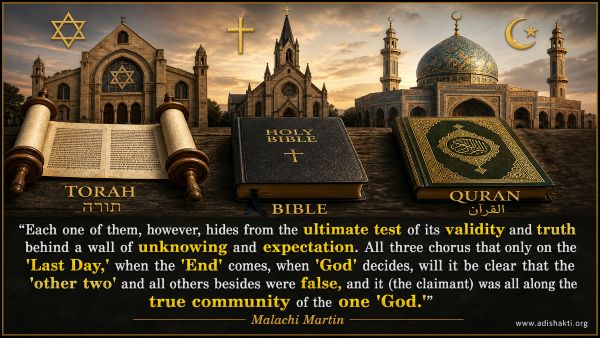
Read source article: Malachi Martin — Competing messianic expectations →
New framework: The critique of religious exclusivity developed by Malachi Martin is now examined before the tradition-by-tradition survey, because the apparent impossibility of successive final saviors rests on mutually exclusive claims to universal authority, not on the number of expected figures.
The problem is not simply that different religions name different expected figures. It is that a certain way of combining their expectations asks one shared human history to reach several mutually exclusive final outcomes. A Jewish restoration, a Christian consummation, an Islamic victory of justice, a Hindu renewal of dharma , and a Buddhist renewal of awakening can be compared. But if each is defined as the uniquely authoritative completion of the destiny of everyone, while each excludes the others, placing them in a chronological queue does not reconcile them. It merely postpones the contradiction.
This paper therefore gives its title a precise meaning. The logical impossibility concerns sequential, mutually exclusive, universally final redemptions—not every sequence of spiritual teachers or eschatological agents. Preparatory figures, cooperating figures, recurrent divine manifestations, and successive Buddhas are not self-contradictory. Indeed, some of the traditions examined below expressly contain such sequences. An academic argument must confront that fact rather than suppress it.
The alternative proposed here is a constructive theology of collective fulfilment. Drawing on The Divine Mother: God of All Scriptures and Antarjami of All , it considers whether differentiated expectations can be understood as religious descriptions of a single transformative divine agency. In the AdiShakti.org interpretation, that agency manifests historically in Shri Mataji Nirmala Devi. The argument is developed affirmatively, but its levels remain distinct: what scriptures say, what historical sources document, what participants report, and what a theological synthesis concludes. The requested source itself makes this distinction between comparative convergence and historical identity. [1]
“Messianic” is used as a comparative umbrella, not as a claim that every religion possesses the Jewish concept of an anointed Davidic ruler. A future Buddha, an avatar of Vishnu, a promised Spirit, an Islamic renewer, and the Jewish Messiah occupy different conceptual worlds. The survey identifies principal figures and significant variants; it does not pretend that five diverse religions have one exhaustive, universally accepted roster.
2. Judaism: Messiah, Precursors, and Divine Presence
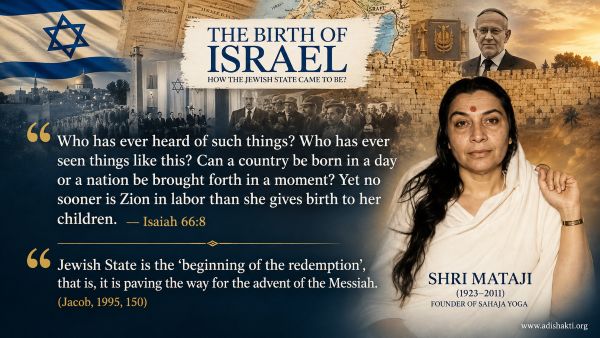
Read source article: Isaiah 66:8 — A nation born in a day →
The principal Jewish expectation is the Mashiaḥ ben David , the Messiah descended from David. Isaiah 11 portrays a ruler associated with Jesse’s line, righteous judgment, peace, knowledge of God, and the gathering of Israel and Judah. In Maimonides’ influential formulation, the messianic king restores Davidic sovereignty, builds the Temple, gathers the dispersed, and restores Torah-governed life. His identification depends on the fulfilment of specified functions rather than on a miracle claim alone. [2] [3]
Judaism also contains differentiated messianic roles. The Babylonian Talmud, Sukkah 52b, identifies the four craftsmen of Zechariah’s vision as Messiah ben David, Messiah ben Yosef , Elijah, and the righteous High Priest. This is an aggadic interpretation, not a universally binding chronology. Messiah ben Joseph, also associated in later traditions with Ephraim, becomes a precursor who gathers, struggles, and in some narratives dies before the Davidic completion. The fuller narrative develops beyond the Talmud’s brief identification and is not accepted in an identical form across Judaism. [4] [5]
Elijah is a reconciler and herald: Malachi 3:23–24, numbered 4:5–6 in many Christian Bibles, places his coming before the great day of God. Maimonides reports the view that Elijah precedes the Messiah but warns that the exact ordering of eschatological details is uncertain and not foundational. The righteous High Priest is a further office in the four-craftsmen interpretation, not a second name for the Davidic king. These sources provide a direct internal example of coordinated, potentially sequential agents. [6] [7]
Shekhinah belongs to another category. It denotes divine dwelling or presence, with a complex history of rabbinic and mystical interpretation. It is not a fifth human Messiah scheduled to arrive after the others. Comparing Shri Mataji with Shekhinah as a claimed manifestation of divine presence is consequently different from identifying Her as a Davidic king. The first is a constructive theological bridge; the second requires the Jewish messianic criteria themselves. [8]
The universal aspiration and the particular covenantal form should both remain visible. Jewish redemption may include the nations without ceasing to concern Israel’s restoration. It would therefore be inaccurate to assume that Jewish expectation is necessarily confined to saving Jews alone. The challenge for an integrative theology is to explain the universal dimension without erasing the particular identity and public tasks specified by the tradition. [3]
3. Christianity: Returning Christ, the Paraclete, and Witnesses
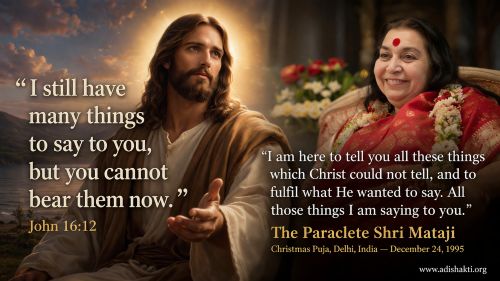
Read source article: Jesus — The promised Spirit of Truth →
The Christian messianic figure is Jesus Christ, expected to return in the Parousia , or Second Coming. Acts 1:11 explicitly identifies the returning figure as “this same Jesus.” Paul links Christ’s coming with the resurrection of those who belong to Him and with the defeat of death. This establishes an identity and a consummatory function; it is not an unrestricted prediction of any later teacher whose work resembles spiritual renewal. [9] [10]
The Johannine Paraclete —Advocate, Helper, or Comforter—is the Spirit of truth. John 14:26 identifies the Advocate with the Holy Spirit, while John 15–16 describes testimony to Jesus, teaching, guidance, and glorification of Christ. In mainstream Christian interpretation, the promised Spirit is already given at Pentecost, as narrated in Acts 2. The identification of Shri Mataji as the Paraclete is therefore a distinctive confessional reinterpretation, not an undisputed Christian expectation of a future female human incarnation. When referring to Her within that proposed identification, this paper uses feminine pronouns without rewriting the original Johannine text. [11] [9]
Revelation 11 introduces two unnamed witnesses who prophesy, are killed, are raised, and ascend. Moses and Elijah are one proposed identification because of the witnesses’ plague-like and drought-related powers; Enoch and Elijah are another traditional proposal. Other readings treat the witnesses corporately or symbolically. None of these identifications is explicitly supplied by Revelation 11, and the witnesses are not called independent universal saviors. [12] [13]
The Antichrist, beast, and false prophet must also be classified correctly. They are adversarial or deceptive figures, not additional messiahs whose arrival ought to be positively fulfilled. The Johannine letters even speak of multiple antichrists. Including opponents in an undifferentiated list of expected redeemers would inflate the apparent absurdity by reversing the texts’ own distinctions. [14] [12]
Christian traditions disagree about the millennium and the relation between present and future fulfilment. Premillennialism, postmillennialism, and amillennialism arrange the relevant events differently. Inaugurated eschatology recognizes an “already” of divine presence alongside a “not yet” of completed renewal. Christianity consequently supplies sequences of incarnation, resurrection, ascension, Spirit, witness, return, and consummation. What it does not automatically supply is a series of different persons, each replacing Jesus as the independently final Messiah. [15]
4. Islam: Mahdi, the Hidden Imam, Returning Jesus, and Signs
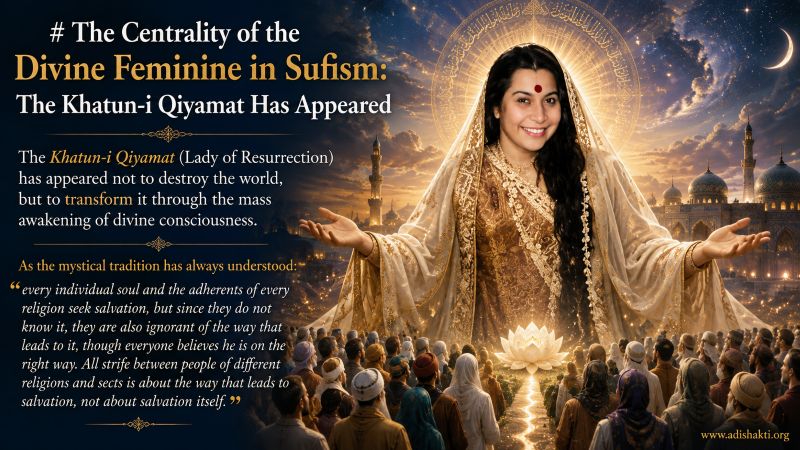
In many Sunni traditions, al-Mahdī is the divinely guided leader expected to restore equity and justice. Sunan Abī Dāwūd 4282 describes a man from the Prophet’s family and preserves variants in the transmitted wording. The Mahdi is not named in the Qur’an; the expectation develops principally through hadith and later interpretation. The Arabic title means “guided” or “divinely guided,” not “Primordial Mother.” Dividing it into “Ma Adi” supplies a devotional wordplay, not an Arabic etymology. [16] [17]
Twelver Shiʿism gives the expectation a specific identity: Muhammad ibn al-Hasan al-ʿAskari, the twelfth Imam, regarded as occulted and destined to reappear. Titles include the Mahdi, Hidden Imam, and al-Qāʾim , the one who rises. This is not simply the generic Sunni expectation under another name. The doctrine identifies a particular Imam and a history of occultation. A claim to fulfil that expectation must confront those particulars. [18] [19]
ʿĪsā ibn Maryam , Jesus son of Mary, is a distinct returning figure. Ṣaḥīḥ Muslim 155a describes His descent as a just judge. Qur’an 43:61 is commonly translated and interpreted in relation to Jesus as a sign or knowledge of the Hour, although the exegetical details are debated. Mahdi traditions and Jesus-return traditions can form a coordinated eschatological scheme. They do not require the logically impossible proposition that two incompatible ultimate gods take turns ruling humanity. [20] [21]
The other expected agents are not additional redeemers. The Dajjāl is the false-messianic adversary. Yaʾjūj and Maʾjūj , Gog and Magog, are associated with corruption and end-time release. The Beast of the Earth in Qur’an 27:82 is an eschatological sign. Such figures occupy different narrative roles from the Mahdi and Jesus. The distinction matters: an expectation of several end-time events is not an expectation of several independently final salvations. [22] [23]
Al-Khiḍr , the later identification of the unnamed wise servant in Qur’an 18, and Ilyās , Elijah, appear in variable accounts of prophecy, saintliness, and extraordinary survival. Neither should be presented as a universally expected Islamic final Messiah. Likewise, Rūḥ and sakīnah concern spirit, divine bestowal, or reassurance; they are not a roster of incarnations. The proposed identification of Shri Mataji with Allah’s Rūḥ is an external comparative theology, especially because mainstream Islamic monotheism does not understand God as becoming a human incarnation. [24] [25] [26]
5. Hindu Traditions: Kalki, Associated Restorers, and Cyclic Time
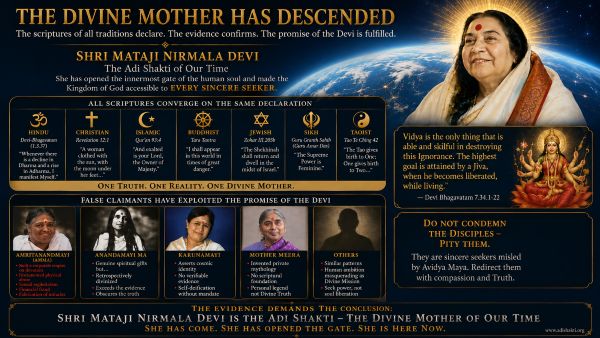
Read source article: The Promise of the Devī →
In influential Vaiṣṇava Purāṇic traditions, Kalki is the expected avatar of Vishnu associated with the end of Kali-yuga and the restoration of dharma , the sustaining moral and cosmic order. Bhāgavata Purāṇa 12.2.18 places His appearance at Śambhala in the home of Viṣṇuyaśas. Verses 19–20 describe the horse Devadatta, a sword, and the destruction of rulers who have become predatory impostors. These are specific narrative predicates, not merely a generic promise of a good spiritual teacher. [27] [28]
The Viṣṇu Purāṇa IV.24 describes restoration followed by the return of Kṛta-yuga , the renewed age of righteousness. It also names Devāpi and Maru, surviving figures associated with the lunar and solar dynasties, who return to regenerate those lines. They are dynastic restorers, not competitors seeking to overthrow Kalki’s own restoration. Their presence provides another internal counterexample to the claim that coordinated redemptive work cannot involve more than one figure. [29]
Later Kalki traditions include further associated persons. Viṣṇuyaśas is Kalki’s father, while Sumati is named as His mother in later retellings. Paraśurāma, or Bhārgava Rāma, appears as a teacher in the later Kalki Purāṇa narrative summarized in R. C. Hazra’s study. These associated figures should not be promoted into independent final messiahs. Nor should later narrative details be attributed without qualification to the shorter Bhāgavata passages. [30]
Śākta traditions offer a different theological emphasis. The Devī Gītā presents the Goddess as supreme consciousness and the ground within which multiple divine forms have their being. That metaphysics is directly relevant to the Divine Mother synthesis, but it is not identical to the Vaiṣṇava Kalki narrative. “Hinduism expects Kalki” is therefore useful shorthand only if one remembers that Hindu traditions contain different sectarian, regional, and philosophical frameworks. [31]
Hindu cyclic time also resists the assumption that a restoration must terminate all possible history. A final intervention within one Kali-to-Kṛta transition need not be the last divine action across all cycles. The cross-religious no-go argument can apply only after a stronger, linear, universally terminal meaning has been imposed. It cannot treat every Hindu renewal as though it were already an irreversible end of history. [29]
6. Buddhism: Maitreya and the Renewal of Awakening
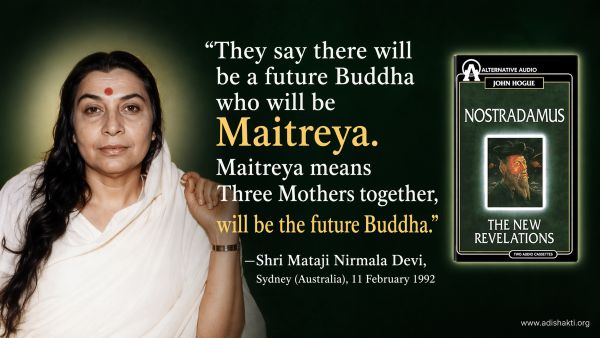
Read source article: Shri Mataji — Buddha and Maitreya →
The principal future-Buddha expectation concerns Maitreya , called Metteyya in Pāli. Dīgha Nikāya 26, the Cakkavatti discourse, names a future fully awakened Buddha who will teach the Dharma and lead a community. The narrative places that appearance within a long sequence of moral decline and renewed human flourishing. It also associates King Saṅkha with that future age and with entering religious life under Metteyya; the king is an attendant ruler and disciple, not another future Buddha. Maitreya is not simply a renamed Jewish king or an avatar of a creator God. [32] [33]
Later traditions elaborate Maitreya’s present residence as a bodhisattva in Tuṣita and His future descent when Gautama’s teaching has decayed. The name is associated with loving friendliness, maitrī . “Mother Threefold” is not its accepted Sanskrit derivation. Such devotional reinterpretation may convey a theology to its own community, but it cannot serve as linguistic evidence that Buddhist scripture predicted Shri Mataji. [34]
The distinction between a future Buddha and other revered figures is essential. Avalokiteśvara expresses compassion and protection; Mañjuśrī personifies wisdom. Tārā is a protective female bodhisattva or saviouress in relevant traditions, while Prajñāpāramitā names the perfection of wisdom and can be personified as the Mother of Buddhas. These maternal and salvific associations are meaningful, but they do not make the figures alternative Maitreya claimants. [35] [36] [37]
Later Buddhist literature also expands accounts of future Buddhas. The scholarly reference consulted records traditions beyond the single Metteyya passage in the Pāli canon, including a Mahāvastu list in which Maitreya stands at the head. Such text-specific extensions should not be turned into a fixed pan-Buddhist roster. More importantly, Śākyamuni followed by Maitreya is itself an explicit succession. An unconditional ban on sequential liberating teachers would contradict rather than explain this Buddhist expectation. [38]
The proposed Divine Mother synthesis encounters a substantive doctrinal boundary here. Buddhist accounts of awakening, rebirth, dependent causation, and non-self do not normally posit one creator God incarnating as a universal Mother. Compassion and wisdom can be compared across traditions, but a comparison cannot convert Buddhist teaching into an unacknowledged creator theology. The Shri Mataji identification must remain an integrative interpretation offered from outside the Buddhist textual identity criteria, not a conclusion that the Buddhist sources themselves require. [39]
7. The No-Go Argument: Why a Queue of Exclusive Consummations Fails
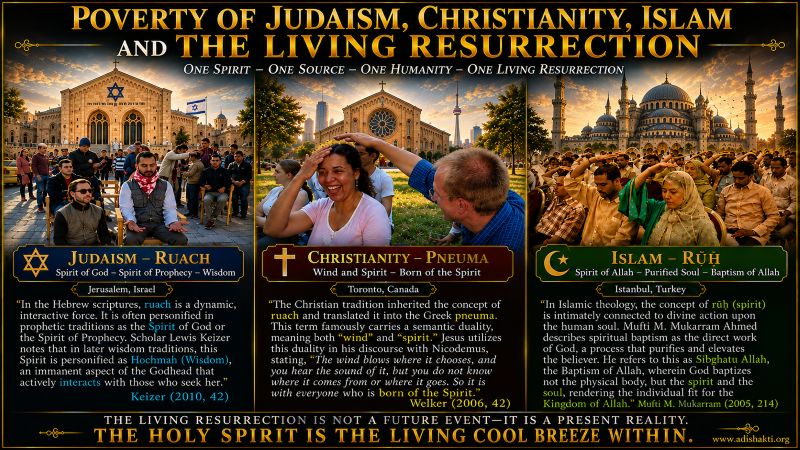
The contradiction stated formally
Premise 1 — Shared subject: the competing universal claims concern the same human history, not disjoint worlds or unrelated communities.
Premise 2 — Finality: each alleged consummation is definitive, such that its redemptive order is not awaiting replacement by another incompatible order.
Premise 3 — Incompatibility: at least two proposed final orders cannot both obtain as final in the same respect.
Premise 4 — Sequential independence: each expected arrival establishes its own universal, independently final order at a different time.
Deduction: when the second incompatible order arrives, it must either displace the first (so the first was not final), coexist with it (contradicting incompatibility), or address a limited domain (so one claim was not universal). Therefore the conjunction of all four premises is inconsistent. Temporal succession cannot make contradictory terminal claims jointly true.
Scope: this result does not exclude multiple messengers, an unfolding revelation, symbolic fulfilments, or one consummation described differently by different traditions. Those possibilities explicitly abandon the independent-finality premise and are therefore not counterexamples.
7.1 The premises that generate an actual contradiction
Let H denote the shared history of humanity, and let Fᵢ denote a proposed fulfilment at time tᵢ . Define a “terminal universal fulfilment” as an event establishing the definitive redeemed order for all humanity, not merely beginning a reform or preparing a later stage. The sequential-exclusivist model then assumes four propositions. First, each Fᵢ is terminal and universal. Second, the terminal orders prescribed by at least two of the traditions are mutually incompatible. Third, all those orders must govern the same humanity in the same history. Fourth, the figures arrive separately at times t₁ < t₂ < … , each inaugurating its own independently final order.
Suppose the first fulfilment establishes its promised final order. The second must then either preserve that order, replace it, or leave part of humanity outside it. If it preserves the order completely, it cannot inaugurate a different incompatible final order. If it replaces the order, the first fulfilment was not terminal. If the first order applied only to one community, it was not universal. Every branch abandons a premise. The contradiction follows from the combination of exclusivity, finality, universality, and a common history. It does not follow from the mere existence of several names.
The proposition is modest enough to be valid and strong enough to expose the problem. A community could consistently believe that only its own expected consummation is true. Another could consistently envisage a coordinated series of events. A third could interpret the same consummation through several names. What cannot be maintained without qualification is that every exclusive final account is literally true in full and that each becomes the independently definitive fate of everyone, one after another.
7.2 The absurdity lies in rival finalities, not in religious diversity
The reductio becomes concrete if one imagines a procession of saviors, each announcing that humanity’s ultimate destiny has now been settled. If the first has truly removed the conditions requiring redemption, what remains for the second to redeem? If the first has not done so, in what sense was the first arrival final? If the second must repudiate the first revelation to fulfil its own, the alleged universal peace becomes another contest over religious supremacy. A third, fourth, and fifth arrival intensify the same dilemma rather than resolving it.
Similarly, a promise that the redeemed world will remain permanently free from the relevant evil cannot coexist with another promise requiring that same world subsequently to return to precisely that evil before a different final deliverer can act. The problem can be avoided by treating the first restoration as temporary, the later event as another cycle, or both as stages of one process. Those are legitimate revisions. They are not the original claim that each event is separately final.
This is the sense in which multiple expectations become absurd: not because the hopes of Jews, Christians, Muslims, Hindus, or Buddhists are beneath respect, but because an unexamined superstructure makes every community’s fulfilment universally exclusive while still demanding that all the incompatible fulfilments occur. The critique is directed at the model, not at its adherents.
7.3 What the argument does not establish
The no-go proposition does not prove that all five religions make identical terminal claims. They do not. Hindu cycles and Buddhist successions require particular caution. Nor does it prove that only one historical person can perform all redemptive functions. Several agents might cooperate within one coherent process. Finally, it cannot identify Shri Mataji by elimination. From the failure of one model it does not follow that one preferred alternative must be true. The case for Her identity requires additional metaphysical premises and positive evidence.
There are therefore several logically available responses: accept one tradition’s literal account and reject incompatible rivals; retain plurality through different histories or cycles; envisage coordinated agents; leave the fulfilment question unresolved; or interpret the traditions as partial descriptions of one divine work. The present paper develops the last option. It is an argument for theological unity, not a claim that logic has eliminated every other possible worldview.
8. The Divine Mother: A Metaphysical Ground for Collective Fulfilment
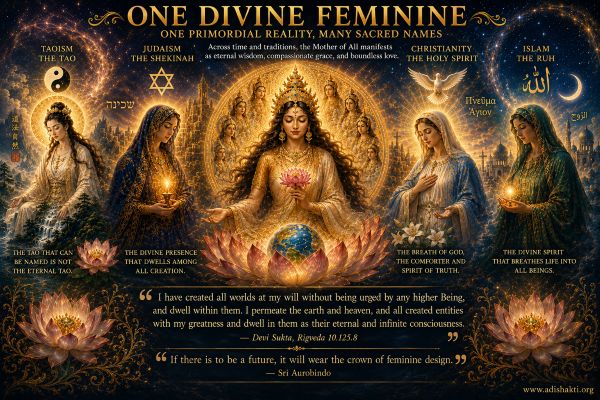
The requested Divine Mother article proposes an underlying structure rather than a dictionary of interchangeable names. The Mother is source, creative power, indwelling presence, revealer, awakener, and liberating ground. Its controlling declaration, attributed to the Devī Gītā 3.3–4, describes the Goddess as creating through Māyā and entering the world She creates. The source’s decisive movement is from divine origination to divine interiority. Because that page does not establish a critical edition for this wording, the passage is treated here as the wording reproduced by AdiShakti.org rather than as an independently collated translation. [1]
Within this Śākta framework, Mahādevī means the Supreme Goddess; Śakti concerns divine power; Antaryāmin concerns the Divine as indwelling ruler or presence. These terms do not designate three competing ultimate beings. The proposed unity precedes their differentiated functions. Accordingly, “God of all scriptures” means the one ultimate Reality interpreted through many revelatory vocabularies, not an additional goddess standing beside independently supreme gods. That is the source’s theological proposition, not an official confession shared by the five religions. [1]
This framework can support collective fulfilment in a way that the sequential-exclusivist model cannot. If ultimate reality is one, if the redemptive functions preserved by different traditions refer to that reality’s work, and if a historical manifestation makes those functions experientially accessible, then several expectations may converge upon one mission. Their fulfilment need not mean five independent cosmic regimes. It may mean one work of transformation recognized through different theological languages.
The third premise is the decisive historical claim. A universal Mother theology does not, by itself, prove that Shri Mataji is its incarnation. Conversely, the existence of a teacher who uses maternal language does not prove that every scripture predicts Her. The metaphysical framework supplies a possible architecture of fulfilment; the documentary and experiential record must supply the argument for a particular embodiment.
The proposed interpretation has its greatest attraction at the level of shared redemptive functions. Teaching truth, overcoming destructive conduct, restoring moral order, giving spiritual life, cultivating compassion, and making divine or liberating presence accessible do not have to be distributed among mutually antagonistic final arrivals. They may be understood as complementary dimensions of one spiritual intervention. That is the positive theological answer to the reductio: unity of salvific work rather than multiplication of rival final sovereignties.
9. Shri Mataji: Historical Record, Declarations, Experience, and Testimony
9.1 A historical life and a distinctive public mission
Nirmala Salve, subsequently known as Shri Mataji Nirmala Devi, was born on March 21, 1923, and died on February 23, 2011. The Shri Mataji Foundation’s biography places the formative Sahaja Yoga event at Nargol on May 5, 1970, and describes Her subsequent public work of giving Self-realization. It also records that She did not charge for Self-realization. As a movement biography, the source is valuable for dates and the movement’s account of its mission, while its supernatural interpretations require separate evaluation. [40]
The historically consequential feature is the provision of an accessible spiritual practice, not merely a prediction that an extraordinary world event would someday occur. In Sahaja Yoga, Kundalini is understood as an individualized maternal spiritual power whose awakening enables Self-realization through the subtle centers and Sahasrara , the crown center. Reports of mental silence and a cool sensation are interpreted by practitioners as signs of that awakening. These are claims about experience and its meaning, not an established anatomical description of a newly discovered physical organ. [26]
9.2 Explicit identity claims
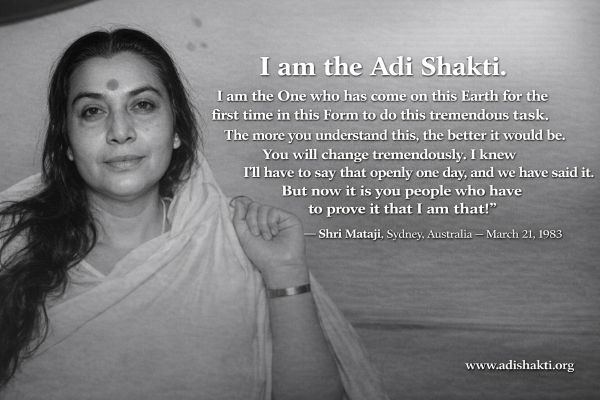
The record is not limited to admirers retrospectively imposing a divine title. AdiShakti.org reproduces a declaration attributed to Shri Mataji in London on December 2, 1979:
A separate public archive lists audio of the December 2, 1979 event at Dollis Hill, London. That listing supports the availability and attribution of a recording; the quoted wording above is cited to the accessible textual reproduction, not represented as a fresh transcription of that audio. The Amruta transcript endpoint required authentication during this research. [42]
The 1983 declaration also includes a demand for scrutiny:
The supplied draft accidentally rendered this as “not people.” Restoring “you people” changes the epistemic force: the sentence places responsibility on the disciples to make the identity claim evidentially inspectable. A declaration establishes that the claim was made. It cannot, without independent support, establish that the claim is true. The strongest response to Her challenge is therefore not to repeat the title “Adi Shakti,” but to relate Her claim to Her teaching, public work, reported experiences, and identifiable sources.
9.3 What independent practice research adds
Empirical research offers a limited but relevant contribution. Tommy Hendriks’s 2018 systematic review included eleven studies and 910 participants. Four studies were randomized controlled trials; two of those were rated high quality and two low quality. The review found that Sahaja Yoga may reduce depression and possibly anxiety, with associations involving well-being, but explicitly withheld definite conclusions because the literature was limited and better randomized studies were needed. [43]
In a 2015 fMRI study, Sergio E. Hernández and colleagues examined nineteen experienced Sahaja Yoga meditators. Reported depth of mental silence was associated with patterns of neural activity, including right inferior frontal activation. This supports investigating mental silence as a reported state with measurable correlates. It does not measure the Adi Shakti, establish an immortal soul, or prove that no other contemplative practice could produce related effects. [44]
These studies matter because they prevent the public practice from being dismissed as nothing but an abstract theological proposition. They do not close the gap between meditation effects and divine identity. The confessional inference is that the spiritual transformation is an expression of the Mother’s redemptive action. That interpretation remains stronger than the empirical findings alone.
9.4 The evidential value and limits of visionary testimony
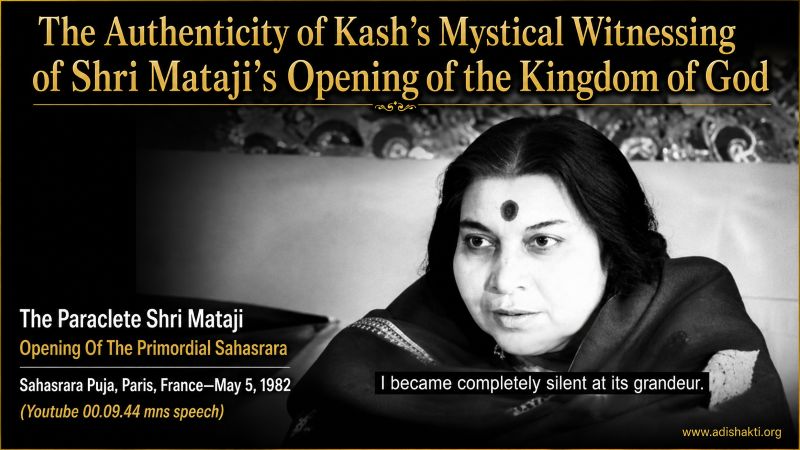
The AdiShakti.org account of Kash’s May 5, 1994 experience describes a reported vision of Shri Mataji’s opening of Sahasrara in 1970. The later analysis emphasizes a specific fire–water sequence and a claimed lack of prior knowledge, comparing the report with Shri Mataji’s earlier account, attributed to Paris, May 5, 1982. Specificity and demonstrable chronology could make such a correspondence more probative than generic reports of peace or light. [45]
However, a retrospective family narrative cannot automatically establish that information was unavailable to the witness. Relevant controls include the earliest dated record, previous exposure to teachings, the exact prompt, independent recording before feedback, and ordinary routes of information transmission. The source-critical article acknowledges that authenticity as testimony is narrower than proof that a transcendent event was literally witnessed. The case should be considered seriously without converting sincerity or a later correspondence into independent verification of incarnation. [45]
The cumulative case thus contains four different kinds of support: a documented movement and public mission; explicit identity declarations; recognizable experiential practices with some empirical research; and unusual testimony requiring source criticism. No single layer proves the entire conclusion. Their theological significance lies in the possibility that they converge upon one historical personality whose proclaimed identity fits the redemptive work being claimed.
10. The Collective-Fulfilment Case: Different Promises, One Transformative Mission
Why collective fulfilment is logically different
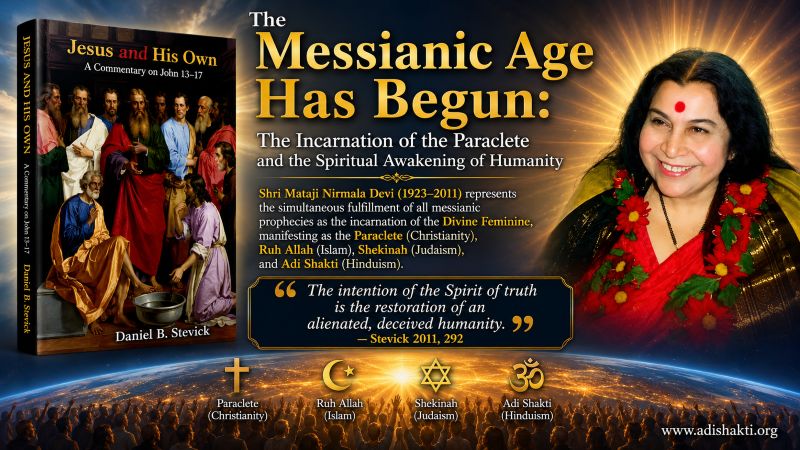
The collective model does not add another claimant to an already impossible queue. It changes the structure of the claim: one underlying redemptive agency may be understood, within Divine Mother theology, to inaugurate a shared spiritual transformation that distinct scriptures describe using different symbols, offices, and hopes. The proposed unity is functional and theological , not an assertion that the Messiah, Paraclete, Mahdi, Kalki, and Maitreya have identical textual definitions.
Shri Mataji’s public mission of Self-realization, her identification with Adi Shakti, and the preserved testimonies supply materials for this interpretation. They support an argument worth examining, but do not independently establish supernatural causation, fulfil every literal criterion in each tradition, or compel assent from adherents of those traditions. The logical critique of rival finalities is stronger than, and must remain distinct from, the historical and theological case for identifying their collective fulfilment with Shri Mataji.
The strongest case for collective fulfilment does not say that every expected person is numerically identical to Shri Mataji. It says that distinct promises can converge upon one transformative mission when their functions are interpreted through the Divine Mother as universal source and indwelling presence. That proposal retains the possibility of different scriptural voices while rejecting the model in which humanity must repeatedly exchange one exclusive final salvation for another. The requested source advances precisely this kind of metaphysical unity without pretending that the vocabularies are interchangeable. [1]
10.1 Jewish restoration and the recovery of divine presence
The Jewish horizon contributes reconciliation, righteous judgment, knowledge of God, and a redeemed common life. Shri Mataji’s invitation to spiritual realization across inherited religious identities can be interpreted as serving the inner conditions of that horizon: reconciliation becomes possible when another person is not spiritually excluded by membership in another community. The Shekhinah comparison adds the language of divine dwelling, which resonates with the Sahaja claim that sacred presence is accessible within the person. [7] [8] [26]
The bridge is functional, not genealogical. It interprets the movement toward God-consciousness as a contribution to restoration. It does not establish Shri Mataji as a Davidic monarch, Elijah, Messiah ben Joseph, or a High Priest, and it does not make a subtle-body description equivalent to the rebuilding of Jerusalem’s Temple. A Jewish reader can therefore recognize a comparative proposal without being told that Judaism already accepts its conclusion.
10.2 The Paraclete’s revelatory and life-giving functions
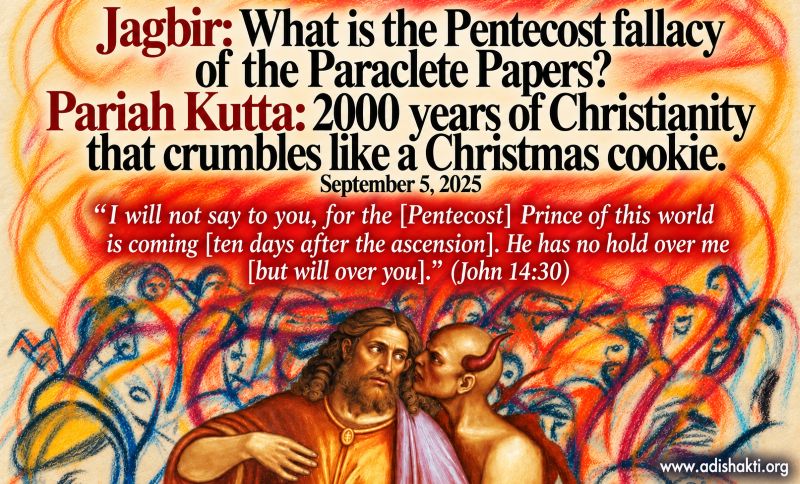
The Christian bridge is more specifically articulated. The Johannine Paraclete teaches, recalls Jesus’ words, bears witness to Him, guides into truth, and glorifies Christ. AdiShakti.org reads Shri Mataji’s spiritual instruction, affirmation of Jesus, and presentation of Self-realization as the functional realization of those promises. The relation is not merely that both traditions use the word “spirit.” It is the claimed continuation of a revelatory and transformative work centered upon spiritual life. [11] [26]
On this interpretation, Her maternal embodiment is not an incidental ornament. It expresses the giver of spiritual birth and the presence that nurtures the seeker. The constructive claim is that the promised agency is recognizable by what it accomplishes: teaching, awakening, and transformative presence. Mainstream Christianity identifies that agency with the Holy Spirit already given to the Church; the proposed incarnation is an additional interpretive commitment. The paper affirms it within the Divine Mother synthesis, rather than disguising it as uncontested Johannine exegesis.
10.3 Islamic guidance, justice, and the awakening of accountability
The Islamic comparison centers on guidance and justice. The Mahdi tradition promises equity where oppression prevailed; the Jesus-return tradition emphasizes just judgment. Shri Mataji’s mission can be placed in dialogue with these aims insofar as spiritual transformation is understood to reshape conduct, reduce destructive egotism, and awaken responsibility. In Her resurrection teaching, the present age becomes a time in which living persons encounter the possibility of realization and must respond to it. [17] [20] [46]
This is a reinterpretation of the redemptive work, not literal identification with the genealogically specified Mahdi or the returning son of Mary. Within AdiShakti.org’s Rūḥ theology, the power of awakening is read as divine spiritual agency. An Islamic reader may regard that move as theologically unacceptable; the comparison remains intelligible without claiming Islamic authorization for incarnation.
10.4 Dharma-restoration and the Goddess as awakening power
The Hindu contribution supplies the clearest indigenous framework for a Divine Mother incarnation. The Devī Gītā places the Goddess at the level of supreme consciousness, not merely among lesser divine helpers. Shri Mataji’s explicit claim to be Adi Shakti therefore has a recognizable Śākta theological context. Her teaching presents awakening as the work of maternal spiritual power already present within humanity. In that framework, restoring dharma can begin through the transformation of awareness rather than through the victory of one community over another. [31] [41] [1]
A functional Kalki comparison interprets the destruction of unrighteousness as overcoming ignorance, exploitative conduct, and spiritually destructive dispositions. It is a spiritualized reading of restorative function, not a demonstration that the Śambhala setting, named family, horse, sword, and cosmic chronology have occurred literally. The claim derives its force from the larger Śākta theology and the realization mission, not from suppressing the particularity of the Kalki texts.
10.5 Maitreya’s horizon of wisdom and compassion
The Buddhist comparison concerns renewed access to awakening and the cultivation of compassionate wisdom. Shri Mataji’s provision of meditation and the reported development of mental silence offer a concrete basis for dialogue with contemplative transformation. Maitreya’s association with friendliness supplies an ethical affinity, while Buddhist wisdom and compassion prevent the comparison from being reduced to a catalogue of divine titles. [32] [34] [44]
The affinity does not establish that She is the future Buddha of Dīgha Nikāya 26 or that Buddhist non-self is secretly the same doctrine as a permanent divine Self. Here collective fulfilment means that an integrative theology interprets awakening-functions as convergent. It does not require Buddhism to endorse a creator-Mother ontology in order for compassion, contemplative discipline, and freedom from ignorance to enter the comparison.
10.6 Why this is a cumulative theological inference
The affirmative argument can now be stated without circularity. The Divine Mother theology proposes one underlying source. The traditions preserve different redemptive functions. Shri Mataji publicly identified Herself as that primordial Mother and offered a practice understood by Her followers as making spiritual rebirth collectively accessible. Reported experiences and limited independent research give the practice an evidential dimension beyond mere assertion. The confessional conclusion is that the identity, work, and spiritual fruits form a convergent pattern appropriately interpreted as collective fulfilment. [1] [26] [43]
The conclusion is coherent if those premises are accepted, but it is not deductively compelled by similarities. Other teachers can guide, meditate, inspire compassion, and attract testimony. Distinctive evidential weight must come from the whole pattern and from its ability to withstand alternative explanations. Moreover, several AdiShakti.org articles drawing on the same testimony are not several independent witnesses. The argument becomes stronger through independent documentation, not through counting repeated formulations of the same claim.
Within this confessional synthesis, Shri Mataji is not five unrelated saviors compressed into one body. She is the incarnation of the one Divine Mother whose redemptive work is apprehended through several religious horizons. This is the precise sense in which the paper speaks of the “God of all scriptures”: a constructive claim about the ultimate ground of those horizons, not the assertion that every tradition already contains that doctrinal sentence.
11. Resurrection, Literal Criteria, and the Strongest Objections
11.1 Resurrection as an awakening of the living
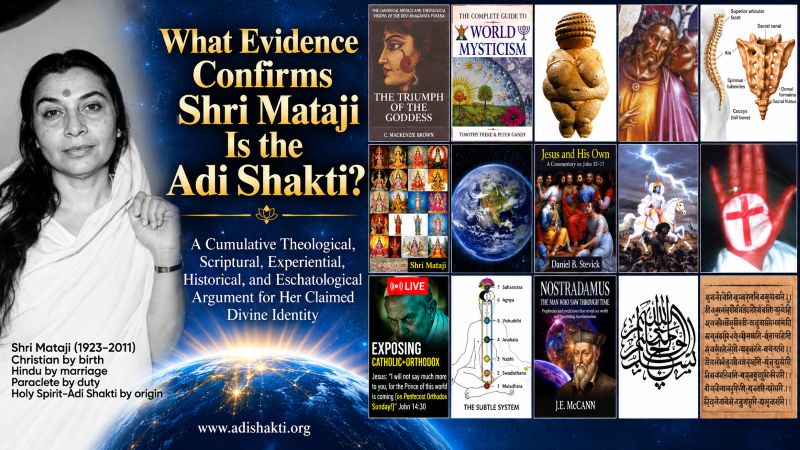
Shri Mataji’s eschatological reinterpretation makes the present opportunity for Self-realization central. In a statement attributed to Moscow, November 12, 1993, She says that the dead souls “will take their birth, take human body and take their Realization in these special times.” This is more than the metaphor that an unhappy person can become happier. It proposes survival beyond bodily death, another human birth, and a spiritual awakening in the period She calls the Blossom Time. [46]
Its internal logic is intelligible: if the soul persists, if it returns in human embodiment, and if liberation is realized through awakening, then resurrection can concern living persons rather than a mechanical reconstruction of ancient corpses. In the collective-fulfilment thesis, the promised age becomes an age in which human beings can participate now. The universal invitation replaces waiting for another community’s savior to finish before one’s own opportunity begins.
But this model should not be presented as the plain meaning of every resurrection passage. Nor does decomposition scientifically disprove every possible act of divine resurrection. A doctrine of transformed embodiment is not equivalent to a proposal that identical atoms must be recovered from every grave. Biological facts about decay cannot establish a logical contradiction in supernatural agency; equally, invoking supernatural power is not empirical evidence that an event occurs. Reincarnation and the survival of a soul also require their own evidential case. The source’s reassessed resurrection paper makes these distinctions explicitly. [46]
11.2 The objection from unfulfilled public outcomes
The strongest objection to collective fulfilment is not that a woman cannot embody divine agency. It is that traditional criteria specify outcomes and identities that cannot simply be replaced without explanation. Rebuilding a Temple is not the same event as opening an inner center. The visible return of the same Jesus is not the same historical assertion as the advent of another teacher. Recognition of a Twelver Imam with a particular genealogy is not established by a broadly similar mission. Renewing dharma at the end of a cosmic epoch and appearing as a future Buddha after the loss of the previous dispensation are not fulfilled merely because a teacher encourages spiritual development.
The paper therefore distinguishes literal completion , functional fulfilment , and inauguration . Literal completion would require the specified identities and public events. Functional fulfilment interprets the underlying promise through corresponding redemptive activities. Inauguration claims that the transforming process has begun without claiming that the world already exhibits its completed results. The defensible Shri Mataji thesis here is primarily functional and inaugurated. It is not a documented demonstration that every inherited criterion has already occurred.
This distinction does not trivialize the theological claim. It locates its strength where the evidence lies: in a historical mission interpreted as opening collective spiritual transformation. It also prevents the continuation of war, injustice, suffering, and religious disagreement from being ignored. If the messianic age is said to have begun, the fruits of its inauguration must be distinguished from the still-unrealized ideal of universal peace.
11.3 Israel, chronology, and unsupported deadlines
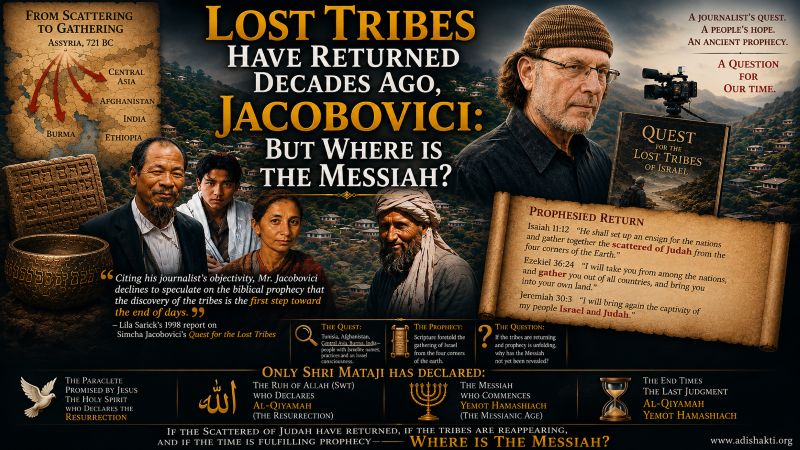
The supplied draft appeals to Israel’s establishment in 1948 as a deadline for all messianic fulfilment. Even granting that some believers interpret that event as a beginning of redemption, the inference does not follow. A sign associated with one interpretive tradition supplies no logical timetable for every other tradition. Nor does the absence of a universally recognized Messiah since that date prove that a preferred claimant must be the Messiah. Such reasoning would be an argument from a disputed deadline plus absence, not positive evidence of identity.
Consequently, this paper does not use 1948 as a universal prophetic clock, unsupported Nāḍī predictions as authenticated forecasts, or devotional divisions of “Mahdi” and “Maitreya” as linguistic proof. A dated text must clearly predate the claimed fulfilment, retain its original context, and specify a distinctive correspondence before it can function as predictive evidence. Broad resemblance is valuable for comparative theology, but it should not be silently promoted into a fulfilled prediction. [26]
11.4 The objection from explanation by ordinary causes
Meditation, expectation, community support, cognitive training, and inherited symbolism can explain at least some reported benefits and experiences without an incarnation hypothesis. The theological case must therefore ask whether the whole pattern explains more than these alternatives, not merely whether the experiences are meaningful. Its best argument is cumulative and abductive—an inference to the interpretation judged most adequate within an accepted theological framework—not a deduction compelling every observer.
The central source offers a useful safeguard: similarity of function is not historical identity. The present argument adds its reciprocal warning: disagreement with the identity claim does not make a person dishonest, spiritually defiant, or incapable of awakening. A universal Mother theology would undermine its own universal scope if it made respectful scrutiny an offense. [1]
The Decisive Contrast: Humanity Is Waiting; Shri Mataji Has Come and Gone
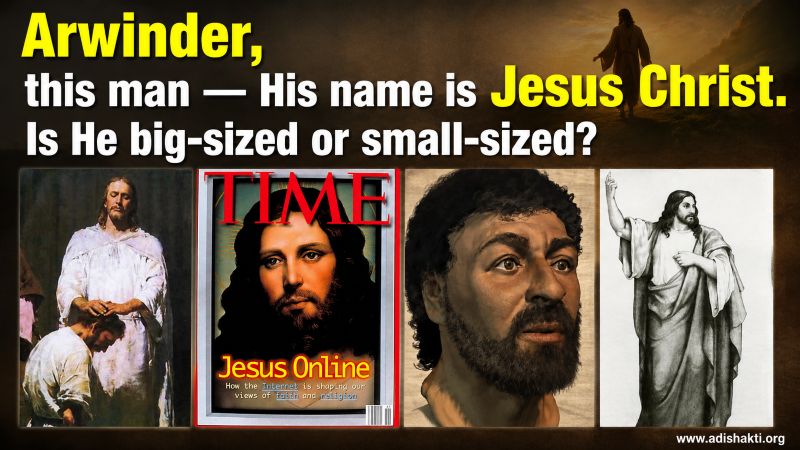
The anticipated final appearances remain future expectations for their respective religious communities. Shri Mataji Nirmala Devi, by contrast, is not a hypothetical future arrival. She was born in 1923, began the public mission associated with Sahaja Yoga and the opening of the Sahasrara in 1970, taught spiritual awakening internationally, and died in 2011. Her historical presence and teaching mission are not dependent on proving supernatural claims.
In the confessional interpretation advanced by Adishakti.org, She came as the Divine Mother anticipated across the scriptures, accomplished Her appointed work by opening a universal path of Self-realization, and departed. The claim is not that every literal Jewish, Christian, Islamic, Hindu, or Buddhist end-time prediction has been independently verified as fulfilled. Rather, the claim is that their deepest transformative functions converge in Her completed earthly mission and the continuing possibility of spiritual awakening.
What, then, is humanity waiting for now? If redemption is understood as the inauguration of shared spiritual awakening, the pertinent response is no longer passive anticipation of a sequence of competing messianic figures, but examination and practice of the transformation said to have been made available. The challenge becomes experiential, ethical, and theological: investigate the teaching, test its practical claims, and assess whether its fruits warrant the interpretation offered.
This conclusion must retain its evidentiary boundaries. The life and public mission of Shri Mataji are historical subjects; accounts of spiritual awakening and visionary witnessing are testimonies requiring interpretation; and the identification of Shri Mataji as the God of all scriptures is a confessional theological judgment, not an established scientific finding or a universally accepted historical fact. Its supporting record merits serious consideration without dissolving that distinction.
12. Conclusion: One Redemptive Work, Many Scriptural Horizons
Martin’s challenge sharpens the conclusion: the three Abrahamic traditions cannot each be exclusively and irreversibly vindicated as the sole universal final order when their defining propositions contradict one another. Their shared appeal to one God does not erase those contradictions, and consigning the verdict to the Last Day does not logically reconcile them. Nor do the different future expectations of Hinduism and Buddhism supply additional independently final world orders merely because they anticipate Kalki and Maitreya.
The positive proposal is therefore not another sectarian victory. Within Adishakti.org’s confessional reading, Shri Mataji’s historical advent signifies the inauguration of a universal spiritual awakening through the Divine Mother. Her public mission has already taken place; the question is whether humanity will investigate and practice what Her followers understand to have been given. The evidence for Her life and teachings is historical; the claim of collective scriptural fulfilment and the promise of eternal life require theological discernment.
The logical result is decisive but conditional. A shared human history cannot contain several independently final, mutually incompatible universal redemptions, each replacing the previous one while all retain their claim to finality. Sequencing does not reconcile contradiction. It moves contradiction into time. The attractive alternative is not the humiliation of religious difference but a recognition that different expectations may illuminate complementary dimensions of redemption.
The comparative result is equally important. Judaism’s Messiah and attendant figures, Christianity’s returning Christ and promised Spirit, Islam’s Mahdi and returning Jesus, Hinduism’s Kalki and associated restorers, and Buddhism’s Maitreya cannot be collapsed into one roster of equivalent saviors. Nor can Shekhinah, Rūḥ, Śakti, and Prajñāpāramitā be mistaken for additional persons waiting in the queue. A coherent synthesis must honor their differences while explaining the proposed unity of their redemptive functions.
Within the constructive theology developed from AdiShakti.org, Shri Mataji is affirmed as the historical manifestation of the Divine Mother, the one divine Reality whose spiritual work gathers these differentiated horizons into a collective fulfilment. This conclusion rests on a specified combination: unity of ultimate source; interpretation of prophecy through transformative function; Her explicit identification as Adi Shakti; Her public Self-realization mission; and the cumulative experiential and testimonial record. It is not the result of etymological wordplay or the invalid inference that because five rival finalities cannot all be true, one particular teacher must therefore be God.
The theological invitation is nevertheless forceful. If the Divine is already the indwelling source of humanity, redemption need not wait for a succession of rival claimants to allocate access to truth by religious identity. The work can be collective because the human need is collective. In this reading, Shri Mataji’s significance is not that She adds a sixth competitor to the messianic procession. It is that Her mission is understood as disclosing the common spiritual ground from which the procession was mistakenly imagined.
Final finding: The logical impossibility is not that religious history could contain many promised figures; it is that one humanity could undergo multiple separate and mutually incompatible final redemptions, each remaining independently final after the next has replaced it. Shri Mataji’s collective fulfilment provides a coherent confessional alternative when redemption is understood as the inauguration of shared spiritual awakening through the Divine Mother. Its supporting record warrants serious consideration; its incarnation claim remains a theological judgment rather than an established scientific or universally accepted historical fact.
References
Primary texts are cited by passage; movement sources document their own teachings and testimony. Online materials accessed October 16, 2026. Repeated citation numbers retain the same source and provide return links to every occurrence.
[1] ↩2 ↩3 ↩4 ↩5 ↩6 ↩7 ChatGPT / AdiShakti.org. “ The Divine Mother: God of All Scriptures and Antarjami of All .” AdiShakti.org , October 5, 2026. Requested source; contemporary constructive theology. Devī Gītā wording cited as reproduced on this page, not as an independently collated translation.
[2] Isaiah; Revised Jewish Publication Society translation. “ Isaiah 11 .” Sefaria / Jewish Publication Society , 2023 translation. Primary biblical text; justice, peace, knowledge and ingathering.
[3] ↩2 Moses Maimonides; translated by Eliyahu Touger. “ Mishneh Torah, Kings and Wars, chapter 11 .” Moznaim Publishing / Sefaria , 12th-century text; online English edition, n.d.. Sections 1–4: Davidic restoration and identification criteria; section divisions vary by edition.
[4] Babylonian Talmud; William Davidson English edition. “ Sukkah 52b: The Four Craftsmen .” Sefaria / Koren-Steinsaltz , Late-antique text; online English edition, n.d.. Aggadic identification of Messiah ben David, Messiah ben Yosef, Elijah and the righteous High Priest.
[5] Jewish Encyclopedia contributors. “ Messiah .” Jewish Encyclopedia , 1906 edition. Historical reference, including the later Messiah ben Joseph traditions; not a description of one uniform modern Jewish doctrine.
[6] Malachi; Revised Jewish Publication Society translation. “ Malachi 3:23–24 .” Sefaria / Jewish Publication Society , 2023 translation. Numbered 4:5–6 in many Christian editions.
[7] ↩2 Moses Maimonides; translated by Eliyahu Touger. “ Mishneh Torah, Kings and Wars, chapter 12 .” Moznaim Publishing / Sefaria , 12th-century text; online English edition, n.d.. Nature, peace, Elijah, disputed eschatological order and knowledge of God.
[8] ↩2 Kaufmann Kohler and Ludwig Blau. “ Shekinah .” Jewish Encyclopedia , 1906 edition. Reference survey of divine indwelling presence and variant rabbinic/philosophical interpretations.
[9] ↩2 Acts of the Apostles; New International Version. “ Acts 1–2: Ascension, Return, and Pentecost .” Bible Gateway; NIV text, Biblica , 2011 NIV edition. Especially 1:9–11; 2:1–4, 17–21, 33.
[10] Paul; New International Version. “ 1 Corinthians 15 .” Bible Gateway; NIV text, Biblica , 2011 NIV edition. Especially 15:20–28 and 42–54: resurrection, sequence and transformed embodiment.
[11] ↩2 Gospel according to John; New International Version. “ John 14–16: The Paraclete Discourses .” Bible Gateway; NIV text, Biblica , 2011 NIV edition. Especially 14:16–17, 26; 15:26; 16:7–15.
[12] ↩2 Revelation; New International Version. “ Revelation 11, 13, and 19–20 .” Bible Gateway; NIV text, Biblica , 2011 NIV edition. Witnesses, beast, false prophet, millennium and judgment.
[13] Ekkehardt Müller. “ The Two Witnesses of Revelation 11 .” Journal of the Adventist Theological Society; Andrews University repository , 2002. pp. 30–45. Confessionally situated scholarly study; surveys personal and symbolic interpretations and favors a scriptural reading.
[14] First Epistle of John; New International Version. “ 1 John 2:18 and 4:1–3 .” Bible Gateway; NIV text, Biblica , 2011 NIV edition. Antichrist and antichrists as opponents/deceivers.
[15] The Gospel Coalition. “ Views of the Millennium .” The Gospel Coalition, theological essay , n.d.. Confessionally situated overview of amillennial, postmillennial and premillennial positions.
[16] John L. Esposito, editor. “ Mahdi .” The Oxford Dictionary of Islam, Oxford University Press / Oxford Reference , 2003. Accessible entry summary consulted; full entry partly restricted. Title means divinely guided one.
[17] ↩2 Abū Dāwūd al-Sijistānī. “ Sunan Abi Dawud 4282: The Promised Deliverer .” Sunnah.com, online Arabic and English edition , 9th-century collection; online edition, n.d.. Primary hadith with transmission variants; page displays al-Albani’s Hasan Sahih grading.
[18] Mohammad Ali Amir-Moezzi. “ Islam in Iran vii. The Concept of Mahdi in Twelver Shiʿism .” Encyclopaedia Iranica , December 15, 2007; updated April 5, 2012. Vol. XIV, fasc. 2, pp. 136–143. Historical development and doctrinal identity of the twelfth Imam.
[19] Payam Mohseni and Mohammad Sagha. “ The Hidden Imam and the End of Time: A Primer on the Mahdi, Islamic Theology, and Global Politics .” Harvard Divinity School, Project on Shiʿism and Global Affairs , 2022. Institutional publication listing and abstract consulted.
[20] ↩2 Muslim ibn al-Ḥajjāj. “ Sahih Muslim 155a: The Descent of Jesus Son of Mary .” Sunnah.com, online Arabic and English edition , 9th-century collection; online edition, n.d.. Primary hadith; Jesus descends as a just judge.
[21] Qur’an; translations presented by Kais Dukes and the Quranic Arabic Corpus. “ Qur’an 43:61: English Translations .” Quranic Arabic Corpus, University of Leeds , Online edition, n.d.. Comparative translation page; interpretation of the pronoun and eschatological significance varies.
[22] Muslim ibn al-Ḥajjāj. “ Sahih Muslim 2937a: Dajjal, the Descent of Jesus, and Gog and Magog .” Sunnah.com, online Arabic and English edition , 9th-century collection; online edition, n.d.. Book 54, hadith 134; primary narrative distinguishing adversaries from Jesus.
[23] Qur’an; Quran.com translation interface. “ Qur’an 27:82: The Beast of the Earth .” Quran Foundation / Quran.com , Online edition, n.d.. Primary Qur’anic eschatological sign, not a messianic office.
[24] Encyclopaedia Britannica Editors. “ Al-Khidr .” Encyclopaedia Britannica , Online edition accessed 2026. Reference survey of the later identification of Qur’an 18’s unnamed servant and variable saintly traditions.
[25] Qur’an; Quran.com translation interface. “ Qur’an 37:123–132: Elijah .” Quran Foundation / Quran.com , Online edition, n.d.. Primary Qur’anic prophetic passage.
[26] ↩2 ↩3 ↩4 ↩5 ↩6 ↩7 Manus AI / AdiShakti.org. “ Fulfilling Shri Mataji’s Request: What Would It Mean to ‘Prove’ the Adi Shakti? .” AdiShakti.org , July 19, 2025; academic reassessment September 15, 2026. Source-critical confessional account; Sydney March 21, 1983 quotation reproduced here.
[27] Bhāgavata Purāṇa; Bhaktivedanta Book Trust English edition. “ Śrīmad-Bhāgavatam 12.2.18 .” Bhaktivedanta Vedabase , Online edition, n.d.. Primary Purāṇic passage: Śambhala and Viṣṇuyaśas.
[28] Bhāgavata Purāṇa; Bhaktivedanta Book Trust English edition. “ Śrīmad-Bhāgavatam 12.2.19–20 .” Bhaktivedanta Vedabase , Online edition, n.d.. Primary Purāṇic passage: Devadatta, sword and destruction of predatory rulers.
[29] ↩2 Viṣṇu Purāṇa; translated by Horace Hayman Wilson. “ Vishnu Purana, Book IV, Chapter XXIV: Dynasty of the Kings of the Kali Age .” Wisdomlib, online edition of Wilson’s translation , 1840 translation; page updated 2019. Kalki, renewal of Kṛta-yuga, and the return of Devāpi and Maru.
[30] R. C. Hazra. “ Studies in the Upapuranas, chapter 4.4: The Kalki-purāṇa .” Wisdomlib, OCR edition of the scholarly study , 1958. Later Kalki narrative; Sumati and Viṣṇuyaśas named as parents; Bhārgava Rāma as teacher. Online OCR carries an unproofread-text warning.
[31] ↩2 Madhu Bazaz Wangu, presenting an English rendering of the Devī Gītā. “ The Devi Gita: Chapter Three .” Madhu Bazaz Wangu website , November 2010. Accessible scriptural rendering; Goddess as the basis of the world and the reality of multiple divine forms. Not a modern-person identity prediction.
[32] ↩2 Dīgha Nikāya; translated by Bhikkhu Sujato. “ DN 26: Cakkavattisutta .” SuttaCentral , Online translation, n.d.. Primary Pāli discourse naming Metteyya, the future Buddha.
[33] Dīgha Nikāya; translated by Ṭhānissaro Bhikkhu. “ DN 26: Cakkavatti Sutta .” Access to Insight , 2013 revision. Independent translation and introduction describing decline, recovery and Metteyya.
[34] ↩2 Encyclopaedia Britannica Editors. “ Maitreya .” Encyclopaedia Britannica , Online edition accessed 2026. Future Buddha, Tuṣita residence and name associated with friendliness.
[35] The Metropolitan Museum of Art. “ Bodhisattvas of Wisdom, Compassion, and Power .” The Metropolitan Museum of Art , 2021–2022 exhibition. Mañjuśrī and Avalokiteśvara as distinct wisdom and compassion figures.
[36] The Metropolitan Museum of Art. “ Tara: Collection Object Record .” The Metropolitan Museum of Art , Online collection edition, n.d.. Distinct protective female Buddhist figure; not the DN 26 future Buddha.
[37] Encyclopedia.com contributors. “ Goddess Images .” Encyclopedia.com, reference edition , Online edition, n.d.. Comparative reference discussing Buddhist wisdom personifications; used only for category distinction.
[38] Lewis Lancaster. “ Maitreya .” Encyclopedia of Buddhism / Encyclopedia.com , Online page updated 2018. Early Pāli mention, later elaborations and future-Buddha traditions.
[39] Mark Siderits. “ Buddha .” Stanford Encyclopedia of Philosophy , 2011; updated online edition. Scholarly overview of Buddhist non-self, liberation, karma and rebirth.
[40] Shri Mataji Foundation. “ Biography .” Shri Mataji Foundation , n.d.. Movement biography; dates, public work, no-charge Self-realization, and retrospective description of Nargol 1970. Not independent verification of supernatural claims.
[41] ↩2 Shri Mataji Nirmala Devi; declaration reproduced by AdiShakti.org. “ Shri Mataji: ‘I Will Tell You All the Secrets’ .” AdiShakti.org , Declaration: December 2, 1979, London; online reproduction, n.d.. Quoted wording verified against the accessible reproduction; original audio not freshly transcribed for this paper.
[42] Sahaja Library. “ 1979-1202 Guru Puja Part 1: Advent Sunday, Shri Mataji’s Declaration .” Sahaja Library / SoundCloud , Recording attributed to December 2, 1979, London. Archive listing inspected, not a new audio transcription. The Amruta transcript endpoint required authentication.
[43] ↩2 Tommy Hendriks. “ The Effects of Sahaja Yoga Meditation on Mental Health: A Systematic Review .” Journal of Complementary and Integrative Medicine , 2018. 15(3), article 20160163. DOI: 10.1515/jcim-2016-0163. Institutional abstract consulted; eleven studies and qualified conclusions.
[44] ↩2 Sergio E. Hernández, José Suero, Katya Rubia, and José L. González-Mora. “ Monitoring the Neural Activity of the State of Mental Silence While Practicing Sahaja Yoga Meditation .” Journal of Alternative and Complementary Medicine , 2015. 21(3), pp. 175–179. DOI: 10.1089/acm.2013.0450. PubMed abstract consulted; nineteen experienced meditators.
[45] ↩2 ChatGPT AI / AdiShakti.org; underlying testimony attributed to Jagbir Singh. “ The Authenticity of Kash’s Mystical Witnessing of Shri Mataji’s Opening of the Kingdom of God (Sahasrara) .” AdiShakti.org , September 20, 2026; underlying narrative: 1999 manuscript, p. 278. Retrospective testimony about May 5, 1994; compared with Shri Mataji’s Paris May 5, 1982 account of the claimed Nargol 1970 event.
[46] ↩2 ↩3 Jagbir Singh / AdiShakti.org. “ Holy Spirit of the Resurrection: Science, Rebirth and Qiyāmah .” AdiShakti.org , n.d.; attributed statements: Moscow November 12, 1993, and Philadelphia October 15, 1993. Source-critical confessional reinterpretation; distinguishes biological decay from a logical disproof of divine resurrection.