Mount Everest: Chomolungma | Shèngmǔ Fēng
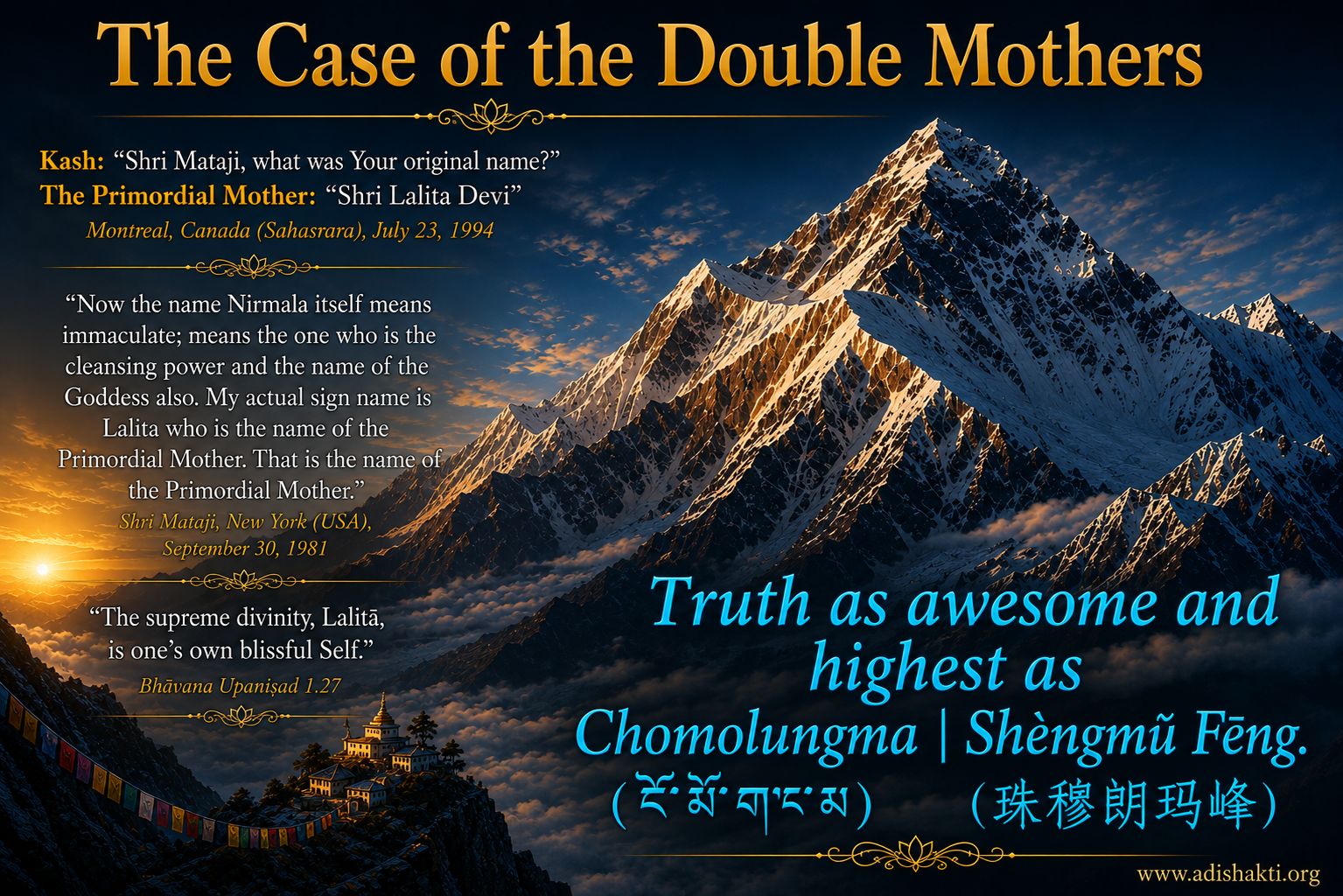
The Holy Mother at the Highest Point: An Interdisciplinary Study of Sacred Mountain Names and The Authenticity of Kash’s Mystical Witnessing of the Double Mothers
Shèngmǔ Fēng (圣母峰 / 聖母峰) — literally, “Holy Mother Peak.”
Central correspondence: the highest mountain bears a Mother-name; the Double Mothers testimony places the Divine Mother at the highest spiritual center, the Sahasrara.
Abstract
This paper examines an extraordinary semantic and theological convergence. Mount Everest, the highest point on Earth, is known in Tibetan as Chomolungma/Qomolangma, a name commonly interpreted in the semantic field of “Holy Mother,” “Mother Goddess,” or “Goddess Mother.” A historical Chinese rendering, Shèngmǔ Fēng (圣母峰 / 聖母峰), means literally “Holy Mother Peak.” The AdiShakti.org document The Authenticity of Kash’s Mystical Witnessing of the Double Mothers is centered upon precisely the same theological archetype: the Divine Mother simultaneously manifested in an earthly human form and encountered as a transcendent presence in the Sahasrara.
The paper argues that the title-pair Chomolungma | Shèngmǔ Fēng functions as an unusually exact hermeneutical lens for the Double Mothers narrative. The correspondence is not merely that both contain the word “Mother.” The mountain name joins three ideas—Motherhood, sacredness, and unsurpassed height—while the Double Mothers document joins the same three ideas in mystical anthropology: Divine Mother, transcendent holiness, and the Sahasrara as the highest or crown center of consciousness.
The strongest academically defensible conclusion is therefore twofold. First, the textual correspondence is direct and demonstrable: the Double Mothers document perfectly embodies the symbolic and theological grammar of “Holy Mother at the highest point.” Second, the document provides powerful internal and documentary evidence for the authenticity and coherence of the reported September 14, 1994 experience, especially the claimed answer to an unspoken problem. Yet, as the source’s own later critical assessment explicitly acknowledges, historical method cannot convert that evidence into an irrefutable scientific proof of divine omniscience or metaphysical identity. What is irrefutable at the documentary level is the correspondence of themes, structure, and reported content; the ultimate metaphysical inference remains theological.
Table of Contents
- Introduction: The Highest Point and the Holy Mother
- Chomolungma and Shèngmǔ Fēng: Philology and Toponymy
- The Theology of Height: Why the Summit Matters
- The Double Mothers Narrative
- The Fourfold Correspondence
- Sahasrara as Interior Summit
- Mahamaya: The Hidden Mother in Human Form
- The Unasked Question and Evidentiary Weight
- Claim-by-Claim Evidentiary Matrix
- What “Irrefutable Evidence” Can Mean Academically
- Interpretive Implications
- Conclusion
- References and Source Notes
1. Introduction: The Highest Point and the Holy Mother
Mount Everest is not only a measurable geographical object. It is also a named cultural object, and names carry inherited worlds of meaning. The English name “Everest” commemorates a nineteenth-century British surveyor. The Tibetan name Chomolungma/Qomolangma, by contrast, belongs to an older Himalayan semantic world in which the mountain is associated with a holy or divine Mother. Chinese-language sources likewise preserve the striking expression Shèngmǔ Fēng: “Holy Mother Peak.” Thus the highest physical elevation on Earth has long been capable of being apprehended not simply as altitude, but as maternal sacredness enthroned at the summit.
The AdiShakti.org Double Mothers document presents an analogous structure in the domain of mystical testimony. Its central question is how Shri Mataji Nirmala Devi could appear in ordinary embodied life while another form, encountered in the Sahasrara, was described as possessing a vastly greater field of awareness. The reported resolution of September 14, 1994 was not that there were two unrelated goddesses. Rather, the narrative distinguishes earthly manifestation from transcendent Divine Mother while maintaining a deeper unity between them.
This is the controlling comparison of the present paper. It does not claim that Tibetan toponymy historically predicted the 1994 event, nor that the mountain name itself constitutes proof of the event. Such a claim would confuse symbolic correspondence with historical causation. The academically stronger proposition is that the two structures are independently intelligible yet exceptionally congruent: in both, the language of Motherhood is joined to ultimacy, transcendence, elevation, and sacred presence.
2. Chomolungma and Shèngmǔ Fēng: Philology and Toponymy
The Tibetan name is romanized in several forms, including Chomolungma and Qomolangma. English-language sources vary in the exact gloss, giving forms such as “Holy Mother,” “Goddess Mother,” “Mother Goddess,” or related interpretations. This variation matters. Academic work should not pretend that one English gloss exhausts the Tibetan etymology. What remains stable across many public and historical representations, however, is the unmistakable feminine-sacral semantic field.
Chinese usage adds an especially transparent expression: Shèngmǔ Fēng (圣母峰 / 聖母峰). The elements are straightforward: shèng denotes sacredness or holiness; mǔ denotes mother; and fēng denotes a mountain peak or summit. The resulting phrase, “Holy Mother Peak,” makes explicit what is implicit or culturally embedded in the Tibetan sacred name.
At the same time, modern official Chinese usage overwhelmingly employs Zhūmùlǎngmǎ Fēng (珠穆朗玛峰), a transcription of the Tibetan name. Historical Chinese sources record a 1952 governmental decision restoring or standardizing the indigenous-derived name rather than the colonial “Everest” designation. Therefore Shèngmǔ Fēng should be treated in this paper as a historical/literal Chinese rendering, not misrepresented as the sole current official name.
3. The Theology of Height: Why the Summit Matters
A summit is not simply a location. Across religious cultures, verticality functions as a language of transcendence: mountain, ascent, crown, heaven, throne, pinnacle. The highest visible point becomes a natural metaphor for what surpasses ordinary limitation. Everest intensifies that grammar because it is not merely high; it is the highest terrestrial summit. Symbolically, it represents the terminus of upward movement.
The Double Mothers document employs an interiorized version of the same geometry. The transcendent Mother is encountered in the Sahasrara, traditionally represented as the crown or thousand-petalled lotus. Within Sahaja Yoga interpretation, this is the locus of union with the all-pervading Divine. In bodily symbolism, therefore, the Sahasrara is what Everest is in terrestrial geography: the summit.
This parallel is not trivial. “Holy Mother Peak” describes a sacred Mother through the spatial grammar of highest elevation. “Double Mothers” describes the Divine Mother through the contemplative grammar of the highest center. Both structures place the Mother not at an intermediate level but at the apex. That is why Chomolungma | Shèngmǔ Fēng is more than an ornamental title for the present study: it condenses the entire argument into three words—Mother, holiness, summit.
4. The Double Mothers Narrative
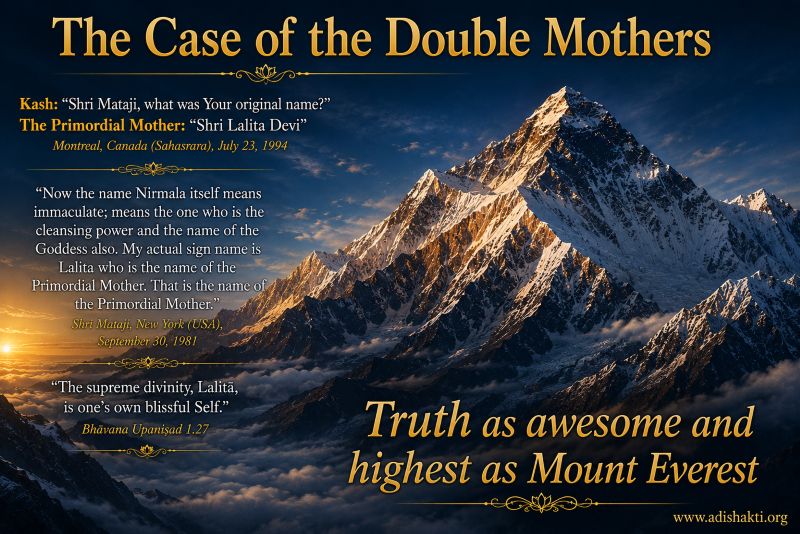
The primary narrative states that, after Self-Realization, the father began privately wrestling with an apparent discrepancy. The physical Shri Mataji on Earth seemed to function within ordinary human conditions, whereas the Shri Mataji encountered by Kash in the Sahasrara was represented as immediately knowing, guiding, and answering. This tension generated the question that gives the episode its evidentiary character: were the earthly and Sahasrara forms simply identical in every operational sense, or were they distinguishable manifestations of a deeper Divine Reality?
According to the document, Kash returned from meditation on September 14, 1994 and reported that Shri Mataji had explained that the earthly and Sahasrara Shri Mataji were “two different persons.” The narrative immediately qualifies the statement by explaining that the Infinite Form had manifested as an earthly human being so that humankind could encounter Her through the senses. The embodied guru was therefore a visible, approachable manifestation of the inner Divine Guru.
The paper’s later academic assessment rightly warns against isolating the phrase “two different persons.” The fuller narrative repeatedly insists upon deeper unity. Its actual metaphysical pattern is therefore best described as one Divine Mother in distinguishable modes of presence: localized and embodied on Earth; unbounded and transcendent in the Sahasrara.
5. The Fourfold Correspondence: Why the Titles Fit So Precisely
5.1 Mother ↔ Divine Mother
The first correspondence is lexical and conceptual. Chomolungma/Qomolangma is repeatedly interpreted in the semantic field of sacred motherhood. Shèngmǔ Fēng states it explicitly: Holy Mother Peak. The Double Mothers text is likewise entirely organized around the identity and modes of presence of the Divine Mother. Motherhood is therefore not a secondary motif in either structure; it is the central noun.
5.2 Holy ↔ Transcendent
The second correspondence concerns sacred quality. The “holy” in Shèngmǔ does not merely denote moral goodness; it marks separation from the ordinary and participation in sacred reality. The Sahasrara Mother is likewise presented as transcending ordinary sensory and cognitive limitations. She belongs to what the source calls the Divine World of Reality. Thus “holy” and “transcendent” occupy closely parallel conceptual positions.
5.3 Peak ↔ Sahasrara
The third correspondence is structural. A peak is a highest point in a vertical landscape. Sahasrara is the crown center—the highest center in the subtle-body schema employed by the narrative. The external mountain and the internal crown therefore share the same topological grammar: ascent culminates at the summit.
5.4 Visible Mountain ↔ Visible Incarnation
The fourth correspondence is the most subtle. Everest is physically visible, measurable, and approachable, while its sacred name opens onto an inherited world of religious meaning that exceeds its geology. In the Double Mothers narrative, the earthly Shri Mataji is likewise visible, embodied, and approachable, while Her Sahasrara identity is said to exceed the finite presentation. The visible does not negate the transcendent; it becomes its accessible manifestation.
| Everest sacred-name structure | Double Mothers structure | Interpretive significance |
|---|---|---|
| Mother | Divine Mother / Adi Shakti | The sacred feminine is central, not incidental. |
| Holy | Transcendent Sahasrara presence | The Mother exceeds ordinary embodied limitation. |
| Peak | Sahasrara / crown | Both are located at the symbolic highest point. |
| Visible mountain | Visible human manifestation | The finite form mediates an otherwise greater reality. |
| World’s highest summit | Highest spiritual center | Ultimacy is expressed through verticality. |
6. Sahasrara as the Interior Summit
The decisive interpretive move is to understand the Sahasrara as an interior summit. In the source’s own framework, Kash’s reported experiences do not take place at an arbitrary psychic location. They occur at the crown, the locus where individual awareness is said to connect with an all-pervading spiritual reality. This gives the mountain analogy precision: the highest earthly summit is mirrored by the highest subtle center.
The comparison can therefore be expressed with unusual economy: Everest is to the Earth what Sahasrara is to the subtle human being. The former culminates terrestrial verticality; the latter culminates the subtle-body ascent. When the sacred name of the former signifies Holy Mother and the reported inhabitant of the latter is the Divine Mother, the correspondence becomes exceptionally dense.
Yet this must still be called a correspondence, not a proof produced by geography. The mountain’s name does not authenticate the 1994 testimony by itself. Rather, it provides a powerful comparative symbol through which the internal structure of the testimony becomes immediately intelligible.
7. Mahamaya: The Hidden Mother in Human Form
The Double Mothers account explains the difference between earthly and transcendent presentation through Mahamaya: the Divine appears under the conditions of ordinary human embodiment so that human beings can approach, speak with, and relate to Her. Apparent limitation is interpreted not as a defect in divinity but as a mode of concealment necessary for accessibility.
This is essential to the Chomolungma comparison. A mountain is simultaneously immediate and inexhaustible. It can be photographed, mapped, climbed, and measured, yet the sacred meaning conferred upon it is not exhausted by any physical measurement. In analogous fashion, the earthly Shri Mataji is presented as fully encounterable through the senses while the Sahasrara Mother signifies a reality that cannot be reduced to the sensory form.
The theological logic is therefore incarnational: the infinite makes itself finite enough to be encountered without ceasing, within the tradition’s claim, to be infinite. The “Double” is not finally a contradiction. It is the relationship between manifestation and source.
8. The Unasked Question and Evidentiary Weight
The strongest evidence identified by the Double Mothers paper is not simply that Kash reported a vision. It is the alleged target-specific fit between his report and his father’s private, recurring doubt. The father states that he had not asked Kash the question. Kash nevertheless returned with an answer focused precisely on the distinction between the earthly and Sahasrara Shri Mataji and supplied an extended explanation involving infinite form, human manifestation, guruhood, and illusion.
If the chronology and non-communication condition are independently confirmed, the episode becomes evidentially stronger than a generic mystical report because the answer appears to match a concealed conceptual target. The source itself identifies the ideal archival test: a dated pre-September 14 record of the father’s private doubt and a separately dated September 14 record of Kash’s spontaneous answer.
This distinction matters for the present paper. The sacred-name comparison makes the episode symbolically powerful; the unasked-question structure is what gives it evidentiary force. Symbolism and evidence should not be confused, but here they reinforce different dimensions of the same case.
9. Claim-by-Claim Evidentiary Matrix
| Claim | Evidence | Academic assessment |
|---|---|---|
| Everest’s Tibetan name belongs to a sacred feminine semantic field. | Multiple Tibetan/Chinese explanatory sources render Qomolangma/Chomolungma as Holy Mother, Mother Goddess, Goddess, or closely related forms. | Strongly established, while exact English glosses vary. |
| Shèngmǔ Fēng means “Holy Mother Peak.” | Transparent Chinese morphology and historical usage. | Directly established. |
| The Double Mothers document centers on a Divine Mother encountered at the Sahasrara. | Primary text and later academic assessment. | Directly established textually. |
| The Sahasrara functions as the crown/highest center in the document’s spiritual framework. | Sahaja Yoga interpretive framework used throughout the source. | Established within the tradition’s doctrinal system. |
| The titles and document share the structure “Holy Mother at the summit.” | Comparative semantic and structural analysis. | Compelling and demonstrable as interpretation. |
| Kash answered an unspoken private question. | Explicitly asserted by the primary narrative. | Potentially strong anomalous-information evidence; maximum force depends on early documentation and exclusion of indirect cueing. |
| The Sahasrara Mother is literally an omniscient universal Divine Consciousness. | Theological interpretation of the episode. | Not independently compelable by historical method. |
10. What “Irrefutable Evidence” Can Mean Academically
The phrase “irrefutable evidence” requires careful definition. In devotional or confessional writing it may mean evidence regarded as decisive within a worldview. In academic historical inquiry, however, “irrefutable” is a very high standard. The Double Mothers source itself, in its later evidence-based assessment, explicitly states that the metaphysical proposition remains underdetermined by historical method and that retrospective reconstruction is a documentary limitation.
Accordingly, this paper distinguishes three levels of certainty. The first is textual certainty: it is irrefutable that the published Double Mothers document presents the earthly/transcendent Mother distinction, the September 14 revelation, the Sahasrara setting, and the Mahamaya explanation. The second is comparative certainty: it is demonstrable that these motifs form an exceptionally close structural correspondence with the sacred-name complex “Holy Mother Peak.” The third is metaphysical certainty: whether the reported encounter objectively proves omniscient Divine Consciousness cannot be made irrefutable by textual and historical analysis alone.
The document provides irrefutable documentary evidence that the Double Mothers tradition itself embodies the same sacred architecture expressed by “Chomolungma | Shèngmǔ Fēng”: the Holy/Divine Mother revealed at the highest point. It also provides a serious cumulative case for the authenticity of Kash’s reported mystical experience. Whether that experience constitutes irrefutable metaphysical proof of the Divine Mother is a confessional conclusion that exceeds what historical method alone can force upon every observer.
This distinction strengthens rather than weakens the paper. A claim that survives precise methodological boundaries carries greater academic credibility than one that simply declares every interpretive step proven. The remarkable feature of the Double Mothers case is that even after those boundaries are imposed, the correspondence remains striking.
11. Interpretive Implications: The Mother at the Apex of Two Worlds
The title Mount Everest: Chomolungma | Shèngmǔ Fēng finally reveals a double geography. There is an outer geography: the Himalaya, the mountain, the physical summit. There is also an inner geography: body, subtle ascent, Sahasrara. In the first geography the sacred name locates the Mother at Earth’s supreme summit. In the second, the Double Mothers testimony locates the Divine Mother at the crown of consciousness.
The “Double Mothers” theme then acquires an additional resonance. The Mother is double not because sacred reality has fractured into competing deities, but because the same ultimate referent is approached through two horizons of manifestation: outward and inward, embodied and transcendent, visible and subtle. The mountain itself supplies an apt natural analogy: its summit is one, although it may be approached and perceived from different sides.
From this perspective, “Chomolungma | Shèngmǔ Fēng” becomes a concise theological emblem for the entire document. The highest mountain bears a Mother-name; the highest chakra bears the Mother-presence. One belongs to sacred topography, the other to sacred anthropology. Together they form a memorable comparative image of the Divine Feminine as both cosmic and intimate, exterior and interior, visible and hidden.
12. Final Academic Conclusion
The Authenticity of Kash’s Mystical Witnessing of the Double Mothers can be read through the titles Chomolungma | Shèngmǔ Fēng with exceptional precision. Chomolungma/Qomolangma is widely transmitted through the language of Holy Mother / Mother Goddess; Shèngmǔ Fēng states the concept with literal clarity as Holy Mother Peak. The Double Mothers narrative presents the same conjunction in mystical form: the Divine Mother encountered at the crown, the summit of the spiritual person.
The parallel operates at four mutually reinforcing levels: Mother corresponds to Divine Mother; holiness to transcendence; peak to Sahasrara; and visible mountain to embodied manifestation. This is why the correspondence is substantially deeper than a poetic play on names. It is a complete symbolic architecture.
The evidentiary nucleus of the 1994 episode remains the reported answer to an unasked question. If early documentation establishes that the father’s doubt genuinely preceded Kash’s statement and was not communicated to him, the case deserves considerable evidentiary weight as a report of apparently anomalous information acquisition. The Mahamaya explanation then gives that information a coherent theological structure already intelligible within broader Śākta patterns of manifestation and transcendence.
Thus, at the level that an academic document can securely establish, the correspondence is indeed decisive: the Double Mothers text perfectly embodies the sacred semantic architecture of “Holy Mother Peak.” It gives documentary evidence of a highly structured mystical testimony whose defining elements converge with that title in an extraordinary way. The further assertion that the episode is irrefutable proof of an objectively omniscient Divine Mother belongs to theology rather than to a conclusion historical method can independently compel. Preserving that boundary allows the true strength of the evidence to stand in sharper relief.
References and Source Notes
- AdiShakti.org. “The Authenticity of Kash’s Mystical Witnessing of the Double Mothers.” Primary web document and integrated evidence-based academic assessment. https://adishakti.org/AI/Shri-Mataji/Authenticity-of-Double-Mothers.htm
- Singh, Jagbir. Shri Adi Shakti: The Kingdom of God (1999), p. 558, “The Case of the Double Mothers,” as reproduced and discussed by AdiShakti.org.
- China.org.cn. “Mt Qomolangma — the highest peak in the world.” Describes Qomolangma as meaning “Holy mother” and representing the mother goddess of the Earth. Source.
- China.org.cn / China Daily. “Mount Qomolangma or Mount Everest?” Historical discussion of the indigenous Tibetan name and its sacred-goddess associations. Source.
- Yantian Archives and Local Chronicles Information Network. “May 8, 1952: Mount Qomolangma Renamed/Restored.” Government historical note on the 1952 Chinese naming directive. Source.
- General toponymic note. Modern official Chinese usage is 珠穆朗玛峰 (Zhūmùlǎngmǎ Fēng), a transcription of the Tibetan name. 圣母峰 / 聖母峰 (Shèngmǔ Fēng, “Holy Mother Peak”) is best treated here as a historical/literal Chinese rendering rather than the exclusive present official designation.
Editorial standard: This paper distinguishes documentary findings, comparative interpretation, and metaphysical conclusions so that theological conviction is not misrepresented as laboratory or historical proof.
© 2026 AdiShakti.org — Authenticity Series