
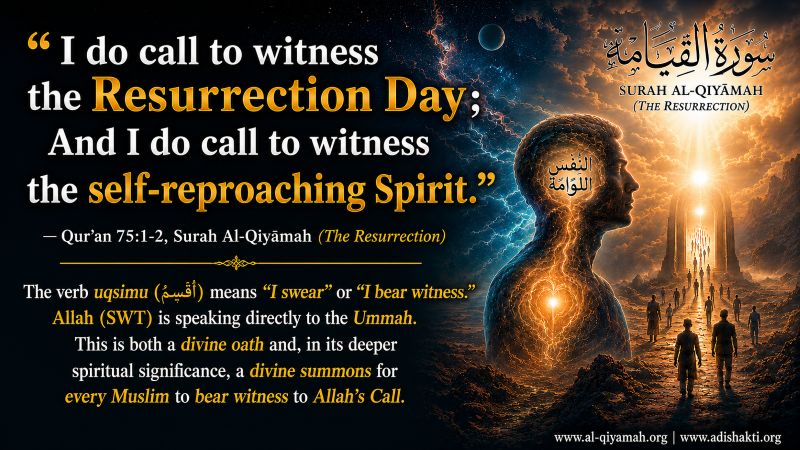
لَا أُقْسِمُ بِيَوْمِ الْقِيَامَةِ وَلَا أُقْسِمُ بِالنَّفْسِ اللَّوَّامَةِ
“I do call to witness the Resurrection Day; and I do call to witness the self-reproaching Spirit.” (Qur'an 75:1–2)
Surah 2:28 Al-Baqarah and the Soul’s Journey

Abstract. Surah 2:28 is best read, within the rebirth framework developed here, not as the description of a single isolated resurrection but as a compressed map of the soul’s passage through successive states: lifelessness, life, death, and renewed life. That recurring pattern does not stand alone. It is echoed and developed across five further Qur’anic passages concerning human formation, the custody and release of the soul, transformed likenesses, staged creation, and repeated death-life transitions. Read cumulatively with Surah 75:3–4 and An-Nabaʾ 78:1–5, these texts suggest a divine mechanism by which personal consciousness can be reconstituted in a new embodied form and thereby become capable of participating in al-Qiyāmah.
Central thesis. The Qur’anic Resurrection cannot be reduced to the future reanimation of a biological corpse. The “assembling of bones” affirms God’s power to restore embodied personal identity; it need not require the reuse of a decomposed corpse as the sole vehicle of that identity. An-Nabaʾ, meanwhile, requires living personalities who can hear the Great News, dispute it, come to know it, recognize its Sure Signs, and either reject or accept them. On this reading, al-Qiyāmah is not merely a one-time event waiting at the end of history; it is an unfolding Age of Resurrection in which conscious human participation is indispensable.
1. Research Question and Method
The controlling question of this paper is not simply, “Does Islam teach reincarnation?” It is more precise: what kind of human subject is required by Qur’anic descriptions of hearing, questioning, disputing, recognizing, witnessing, repenting, choosing, rejecting, and accepting the Resurrection?
Those acts cannot be performed by a biologically inert corpse. They belong to an active human personality—an embodied consciousness capable of language, comparison, memory, self-reproach, moral choice, and recognition. This becomes decisive once al-Qiyāmah is understood not only as a terminal instant of judgment but also as an eschatological age of announcement, signs, recognition, opposition, awakening, and decision.
The argument is cumulative. Surah 2:28 provides the basic sequence. Five corroborating Surahs develop the motifs of repeated death and life, human formation, divine custody of the soul, changed forms, and creation through stages. Surah 75:3–4 then addresses bodily reconstitution, while An-Nabaʾ supplies the indispensable living audience. The result is a coherent rebirth framework rather than an argument resting on a single English phrase.
2. Resurrection, Rebirth, Reincarnation, Nafs and Rūḥ
Resurrection (baʿth, qiyāmah) is divine raising or standing-up into renewed existence, encounter, disclosure, and judgment. Rebirth in this paper means renewed embodied human existence following death. Reincarnation is the stronger formulation: the persistence of a personal subject through death and its embodiment in a new human form.
The Qur’an does not reduce personal identity to the physical atoms of one body. It speaks of the nafs as a morally reflexive self and of souls being taken, withheld, and released by Allah. Thus the central question is not whether the same molecules are reused, but whether God preserves and reconstitutes the identity of the person.
3. Surah 2:28 — Successive States, Not a Single Resurrection

كَيْفَ تَكْفُرُونَ بِٱللَّهِ وَكُنتُمْ أَمْوَٰتًا فَأَحْيَٰكُمْ ۖ ثُمَّ يُمِيتُكُمْ ثُمَّ يُحْيِيكُمْ ثُمَّ إِلَيْهِ تُرْجَعُونَ
“How can ye reject the faith in Allah—seeing that ye were without life, and He gave you life; then will He cause you to die, and will again bring you to life; and again to Him will ye return.”
— Qur’an 2:28
Surah 2:28 describes not a single isolated resurrection but a passage through successive states: lifelessness, life, death, renewed life, and finally return to Allah. Its importance lies in the grammar of transition. The human subject is carried by divine power across more than one boundary between non-life and life. The verse therefore presents existence as a sequence rather than as one uninterrupted earthly biography followed only by a remote final event.
The rebirth reading becomes stronger when 2:28 is not treated in isolation. The same basic pattern—creation, death, custody of the soul, transformation, renewed embodiment, and life through stages—appears across a network of Qur’anic passages. The cumulative picture is of a soul whose existence is governed by divine transitions and whose bodily form is not the final definition of personal identity.
4. The Six Surahs of Rebirth
The Qur’anic case developed in this paper rests on six Surahs of rebirth in total—not seven: Surah 2:28 together with five corroborating passages, 22:5, 23:12–15, 39:42, 56:60–61, and 71:13–14. Surah 75:3–4 and An-Nabaʾ 78:1–5 are treated separately as clarifying texts concerning reconstitution and conscious participation in al-Qiyāmah; they are not counted among the six Surahs of rebirth.
4.1 Surah 2:28 — The Foundational Life–Death–Renewed-Life Sequence
Surah 2:28 supplies the controlling pattern: lifelessness, divine vivification, death, renewed life, and return to Allah. It is the foundational rebirth passage against which the remaining five are read.
4.2 Surah 22:5 — Creation, Dissolution and Human Formation
Surah 22:5 places resurrection alongside the observable stages of human generation. Dust, sperm-drop, clinging form, embryonic development, birth, maturity, and death become evidence of Allah’s power to bring forth embodied personality. Within a rebirth model, the womb is therefore the ordinary divine workshop through which a renewed human form can be constituted.
4.3 Surah 23:12–15 — Formation Followed by Death
Surah 23:12–15 repeats the sequence of human formation, the emergence of “another creation,” and subsequent death. It shows that Qur’anic resurrection theology already reasons from Allah’s production of embodied human life through stages. Reconstitution therefore need not be imagined only as the reopening of an old grave.
4.4 Surah 39:42 — The Soul Taken, Withheld and Released
Surah 39:42 distinguishes the personal self from the body’s ordinary waking condition: Allah takes souls at death and during sleep, withholds some, and releases others until an appointed term. The verse establishes divine custody over the nafs and supports continuity of the personal subject beyond a particular bodily state.
4.5 Surah 56:60–61 — Death and Changed Likenesses
Surah 56:60–61 joins decreed death to Allah’s power to change human likenesses and produce persons in forms they do not know. In the rebirth framework this is crucial: renewed embodiment need not mean restoration of the old physical appearance or reanimation of the former corpse.
4.6 Surah 71:13–14 — Creation in Stages
Surah 71:13–14 speaks of Allah creating humanity “in stages.” Read cumulatively with the other five rebirth Surahs, those stages become part of a larger divine economy in which consciousness can pass through successive conditions of embodiment, experience, moral development, death, and renewed life.
5. An-Nabaʾ and the Living Audience of the Great News
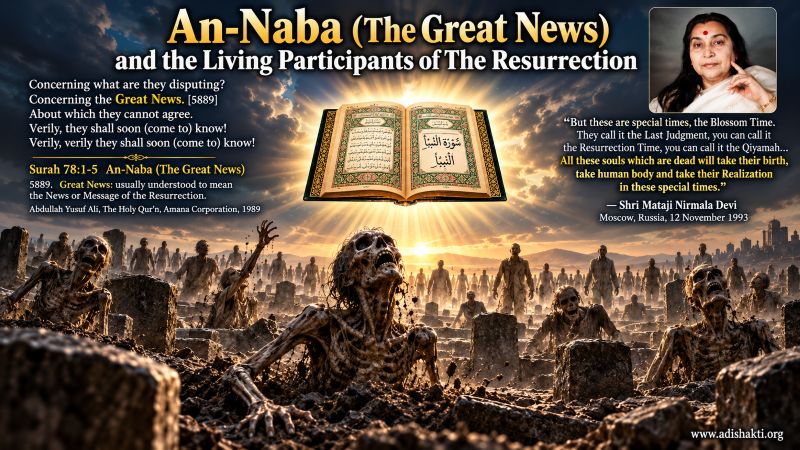
“Concerning what are they disputing?
Concerning the Great News.
About which they cannot agree.
Verily, they shall soon come to know!
Verily, verily they shall soon come to know!”
— Qur’an 78:1–5
An-Nabaʾ begins not with silent corpses but with living people who question one another, disagree, and are warned that they will come to know. The Great News of Resurrection is therefore something that enters human history as an object of discourse. It must be heard, interpreted, disputed, recognized, denied, or accepted.
This is where the rebirth argument moves beyond a theory of post-mortem survival. If souls from earlier centuries are intended to participate in the Age of Resurrection itself, they require human personality in the historical present. They must be capable of encountering the Great News as persons, not merely as remains in graves.
6. The Sure Signs and the Epistemology of Recognition
A Sure Sign has theological meaning because someone can recognize it. Signs are not merely physical occurrences; they call for perception, memory, comparison, conscience, belief, rejection, and testimony. Surah 75 repeatedly addresses precisely such active faculties: the self-reproaching soul, the questioner, the observer, the one informed of deeds, the witness against oneself, and the one who denies and turns away.
For this reason, al-Qiyāmah can be understood as an unfolding process in which humanity is progressively confronted with its signs. The relevant subject is the living personality whose moral and spiritual response reveals whether the sign has been recognized.
7. Embodiment Through Human Formation
Qur’an 23:12–14 describes the route by which a human being becomes embodied: successive developmental stages culminating in “another creation.” In the framework developed here, that passage supplies the biological mechanism through which a preserved personal consciousness can be restored to active human existence.
Rebirth therefore need not mean that a corpse rises from the same grave, atom by atom. It can mean that Allah, who already creates the body through embryological stages, reconstitutes personal consciousness in a newly formed human vehicle. The divine miracle lies not in recycling decayed matter but in preserving identity and restoring embodied agency.
8. Surah 75:3–4 — “Assembling the Bones” Reconsidered
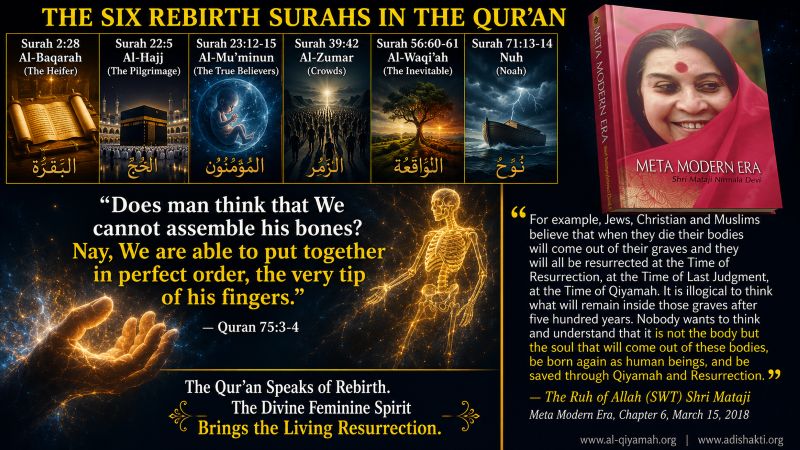
Surah 75:3–4 asks whether man thinks Allah cannot assemble his bones and answers that Allah is able even to perfect his fingertips. The passage is usually taken as a direct affirmation of bodily resurrection. Yet the crucial theological assertion is Allah’s capacity to reconstitute the person with complete particularity.
The text does not require a materialist theory in which numerical personal identity depends upon collecting every atom of the former corpse. Bones and fingertips signify embodied specificity: God can restore the person so completely that even the most individual physical details are within divine power.
Accordingly, “assembling the bones” can be read as the reconstitution of embodied consciousness, not necessarily as the literal reanimation of the same decayed corpse. Read with 23:12–14 and 56:60–61, the Qur’an permits a broader mechanism: the personal subject can be given form again through divine creation, including a changed likeness unknown beforehand.
9. Surah 56:60–61 — Death, Changed Likenesses and Unknown Forms
Qur’an 56:60–61 is especially important because death and transformation are placed together. Allah decrees death and declares His power to change human likenesses and produce human beings in forms they do not know. Within a rebirth framework, this describes precisely the divine freedom required for renewed embodiment: continuity of the person without compulsory continuity of the former bodily appearance.
The verse therefore strengthens the interpretation of 75:3–4. The “assembled” person need not be imagined as a repaired cadaver. Divine reconstitution can preserve identity while altering form.
10. Surah 39:42 — Divine Custody of the Soul
Surah 39:42 portrays Allah as taking the souls at death and during sleep, withholding those for whom death has been decreed and releasing others for a term. The passage establishes a theology of divine custody: the self can be taken from ordinary bodily awareness without ceasing to belong to Allah’s ordering power.
In the present framework, this helps explain how personal continuity can bridge bodily discontinuity. If the nafs is under divine custody, then a change of body does not entail the destruction of the person. The continuity is grounded in Allah, not in the persistence of one organism.
11. Qur’an 23:99–100 and the Question of Return
Qur’an 23:99–100 is the principal objection to a rebirth reading because the dying person asks to be sent back and is refused, with a barzakh until the day of raising. The distinction required here is between a self-requested return after moral disclosure and a divinely ordained process of embodiment belonging to the architecture of al-Qiyāmah itself.
The rejected plea is “send me back so that I may do righteousness”—a request for another chance made when the consequences of the previous life have become evident. That does not necessarily settle whether Allah may, by His own prior decree, return souls to embodied existence as part of the unfolding Resurrection age. The former is an appeal by the judged subject; the latter would be an act of divine governance.
12. Historical Participation in the Age of Resurrection
The decisive issue is historical participation. Millions upon millions of human beings lived and died before the present eschatological age and before any historical manifestation of its Sure Signs. If al-Qiyāmah requires not merely being judged but hearing the Great News, witnessing the signs, recognizing their meaning, and choosing whether to reject or accept them, then conscious participation requires renewed human existence.
This is why rebirth becomes more than a speculative doctrine about the afterlife. It becomes a mechanism of eschatological participation. Souls are restored to active personality so that al-Qiyāmah can be experienced, not merely announced over graves.
On this reading, Qiyāmah is an Age of Resurrection already unfolding in historical time. Its commencement is marked by Sure Signs that necessarily demand witnesses. The human beings who encounter those signs are not passive objects of a future catastrophe; they are participants in the divine disclosure taking place now.
13. The Theological Imperative for Rebirth
The most compelling argument for rebirth in the Qur’an is not found in any single verse. It emerges from the theological implications of the single-life doctrine itself. If Allah is perfectly just, infinitely merciful, and compassionate, a profound problem arises if eternal destiny is made to depend upon one brief earthly existence when vast populations throughout human history had no meaningful opportunity to encounter Islam, understand its claims, or consciously respond to its revelation.
This is not a peripheral difficulty. It reaches directly into the Qur’anic attributes of divine justice and mercy. To maintain that countless human beings could be eternally condemned for an ignorance produced by geography, historical period, language, culture, infancy, isolation, or circumstances entirely outside their control creates what this paper regards as a theological absurdity: punishment for an opportunity that never existed.
Geographic Isolation
For immense periods of history, entire populations lived beyond any realistic contact with the Arabian Peninsula or the communities through which Islam subsequently spread. Peoples in the Americas, Australia, remote islands, and many isolated regions could not simply choose to investigate a revelation of which they had never heard. Their absence of knowledge was not rejection; it was historical non-access.
Technological Barriers
Before modern transportation, printing, broadcasting, and electronic communication, religious knowledge moved only as rapidly as human beings, manuscripts, trade routes, conquest, migration, and oral transmission permitted. Oceans, deserts, mountain ranges, distance, and the hazards of travel placed enormous portions of humanity outside any practical possibility of receiving the same religious information.
Cultural and Linguistic Barriers
Physical contact did not guarantee meaningful understanding. Language, literacy, translation, cultural categories, and the availability of reliable teachers determined whether a person could actually comprehend a theological message. Hearing a distorted fragment of a religion is not equivalent to receiving a genuine opportunity to understand and respond to it.
Political and Historical Isolation
Empires, closed societies, warfare, persecution, political boundaries, social hierarchy, and deliberate isolation could prevent religious ideas from reaching populations for generations. Human beings do not choose the century, civilization, family, language, or information environment into which they are born.
The doctrine of rebirth therefore does more than explain the six-Surah pattern of life, death, renewed embodiment, changed likeness, and stages. It resolves the theological dilemma of unequal access. Instead of an all-or-nothing system in which one historically contingent life determines an eternal destiny, rebirth permits a divine pedagogy extending across successive lives, in which mercy and justice operate through repeated opportunities for spiritual development.
14. The Absurdity of Eternal Condemnation for Ignorance
The single-life doctrine creates an insurmountable moral paradox if it is taken to mean that every human being receives only one earthly opportunity and that failure to possess or accept a particular revelation within that life can result in eternal condemnation. Billions of persons have lived in circumstances in which the relevant knowledge was unavailable, inaccessible, incomprehensible, or never presented to them at all. Such persons did not reject what they understood; many never possessed the opportunity to understand it.
Ignorance caused by historical impossibility is categorically different from conscious rejection. A just judgment must distinguish between the person who hears, understands, recognizes, and refuses, and the person who never receives a genuine opportunity to hear. The very distinction becomes especially important in An-Nabaʾ, where people ask, dispute, and eventually come to know. Accountability presupposes encounter.
Rebirth provides a compassionate resolution to this paradox. The soul can return to embodied existence under different historical and spiritual conditions, repeatedly encountering opportunities for moral growth and divine guidance. No single accident of birth need become an eternal sentence. Each life becomes part of a larger process of education, purification, recognition, and return to Allah.
This also brings the justice argument directly into al-Qiyāmah. If the present Age of Resurrection is marked by Sure Signs and by the Great News that must be heard, witnessed, confirmed, rejected, or accepted, then persons from previous centuries require active human personalities in order to participate in that decisive disclosure. Rebirth simultaneously answers the problem of unequal historical opportunity and provides the mechanism of conscious participation in al-Qiyāmah.
The issue is therefore not merely whether Allah has the power to resurrect. The deeper question is how perfect divine justice gives every soul a genuine opportunity to know, choose, mature, and respond. Within the six-Surah framework developed here, rebirth provides precisely that mechanism.
15. The Deliberative Rebirth Framework
| Principle | Qur’anic basis | Function in the rebirth model |
|---|---|---|
| Successive states | 2:28 | The foundational passage describes lifelessness → life → death → renewed life. |
| Embodied formation | 22:5; 23:12–15 | Allah forms human personality through a new body by developmental stages. |
| Custody of the soul | 39:42 | The self is taken, withheld and released under divine sovereignty. |
| Changed likeness | 56:60–61 | Renewed embodiment need not reproduce the same physical appearance. |
| Creation in stages | 71:13–14 | Human existence belongs to a divinely ordered progression rather than a single static condition. |
| Personal reconstitution | 75:3–4 | Allah restores embodied particularity; “bones” need not entail corpse-reanimation alone. |
| Announcement and recognition | 78:1–5; 75:1–15 | Al-Qiyāmah requires living personalities capable of dispute, recognition, witness and choice. |
Rebirth premise. Allah preserves the identity of the human nafs across death and can assign that identity to renewed human embodiment, enabling the same moral subject to enter the historical field in which the Great News and the Sure Signs of al-Qiyāmah must be consciously encountered.
16. Major Objections and Responses
Objection 1: Surah 2:28 only means non-existence, one earthly life, death, and final resurrection.
Response: That is the dominant classical reading, but it is not the only conceptual possibility generated by the verse’s sequence. The present argument does not depend on 2:28 alone. Its force comes from reading 2:28 through the six-Surah rebirth corpus, the changed-likeness language of 56:60–61, the soul language of 39:42, the reconstitution language of 75:3–4, and the living audience required by An-Nabaʾ.
Objection 2: “Assembling bones” requires resurrection of the same corpse.
Response: It requires God’s power to restore embodied personal identity. Nothing in the verse makes personal identity depend on the uninterrupted survival of the same atoms. The emphasis on fingertips is an assertion of divine precision, not a restriction on the mode of re-creation.
Objection 3: Barzakh prevents any return.
Response: The text denies the dying person’s plea to be sent back for corrective action. The rebirth model distinguishes that rejected appeal from a divinely ordered eschatological process established independently of the person’s request.
Objection 4: An-Nabaʾ was already heard by the Prophet’s contemporaries.
Response: The first historical hearing does not exhaust an eschatological fulfillment. If the Great News announces al-Qiyāmah as an unfolding divine reality, then its definitive recognition may belong to the Age of Resurrection in which its Sure Signs become historically manifest.
17. Evidence Matrix
| Claim | Assessment within this paper |
|---|---|
| Qur’an 2:28 describes lifelessness → life → death → renewed life. | Explicit textual sequence. |
| Five further Surahs corroborate 2:28, making exactly six Surahs of rebirth in total. | Cumulative Qur’anic pattern. |
| 75:3–4 affirms divine reconstitution of embodied identity. | Explicit; mode of material continuity is not specified. |
| An-Nabaʾ 78:1–5 requires people who question, dispute and come to know. | Explicit living-personality grammar. |
| The Sure Signs of al-Qiyāmah require witnesses capable of recognition and rejection. | Strong phenomenological inference. |
| Rebirth supplies a mechanism by which past souls can participate in an historical Age of Resurrection. | Coherent theological synthesis advanced here. |
| Qiyāmah is only a single future instant involving corpse reanimation. | Rejected by the present synthesis as too narrow. |
18. Conclusion — Rebirth as the Mechanism of the Present Age of Resurrection
Surah 2:28 is best understood within this framework as a statement of the soul’s passage through successive states—lifelessness, life, death, and renewed life—rather than as a verse exhausted by the idea of one earthly life followed by one remote resurrection. That pattern is echoed across five further Surahs, making six Surahs of rebirth in total and clarified by the Qur’an’s language of human formation, divine custody of the soul, changed likenesses, repeated deaths and lives, and creation through stages.
Surah 75:3–4 does not overturn this structure. The assembling of bones proclaims Allah’s unlimited ability to reconstitute embodied personal identity. It need not be restricted to the physical repair of the same corpse. Read with 23:12–14 and 56:60–61, the stronger synthesis is that divine resurrection can restore consciousness in a new human form while preserving the identity known perfectly to Allah.
An-Nabaʾ then provides the decisive eschatological criterion. The Great News is heard by persons who question one another, disagree, and later come to know. The Sure Signs of al-Qiyāmah likewise require personalities capable of witnessing, discerning, rejecting, or accepting them. A corpse cannot do this. A living human personality can.
Therefore al-Qiyāmah is not merely a future one-time event waiting beyond history. It is an ongoing process unfolding in the present Age of Resurrection. Its commencement is marked by Sure Signs whose very purpose presupposes conscious human witnesses. Rebirth supplies the divine mechanism by which souls from earlier ages can return to embodied existence, acquire the active human personality required for recognition, and participate in the Great News of Resurrection as it unfolds.
The Qur’anic question is consequently larger than whether Allah can revive a corpse. It is whether the same divine power that gives life, causes death, changes likenesses, forms bodies in stages, takes and releases souls, and assembles embodied identity can restore consciousness wherever and whenever the purposes of al-Qiyāmah require it. The cumulative answer advanced here is yes.
19. References and Primary Text Resources
- Ali, Abdullah Yusuf. The Holy Qur’an: Text, Translation and Commentary. Amana Corporation, 1989.
- Ibn Kathīr, Tafsīr on Qur’an 2:28.
- Maʿārif al-Qurʾān on Qur’an 2:28, 23:99–100 and 75:1–2.
- Qur’anic passages discussed: 2:28; 22:5; 23:12–15; 39:42; 56:60–61; 71:13–14; 75:1–15; 78:1–5.
- Nasr, Seyyed Hossein et al., eds. The Study Quran. HarperOne, 2015.
- Smith, Jane I., and Yvonne Y. Haddad. The Islamic Understanding of Death and Resurrection. SUNY Press, 1981.
- Lange, Christian. Paradise and Hell in Islamic Traditions. Cambridge University Press, 2016.
- Rahman, Fazlur. Major Themes of the Qur’an. University of Chicago Press, 1980.
Compilation, Proclamation, and Exegesis of Surahs Upholding Allah’s (SWT) Command to His Ummah — to Witness and Participate in the Resurrection.
Al-Qiyamah: A Profound Declaration of Al-QiyamahAl-Qiyamah (75:1-2): Oaths of Resurrection
Al-Qiyamah (75:3-4): Reassembling Bones and Fingertips
Al-Qiyamah (75:5-6): Man's Denial of Resurrection
Al-Qiyamah (75:7–10): Sun and Moon 'Joined' At Solar Eclipse
Al-Qiyamah (75:7–10): Solar Eclipse Salat al-Kusuf
Al-Qiyamah (75:11–13): No Refuge, Only Reckoning
Al-Qiyamah (75:14–15): Man: His Own Witness and Judge
Al-Qiyamah (75:16–19): The Usurpation of Allah's Explanation
Al-Qiyamah (75:20–21): Love of The Fleeting World
Al-Qiyamah (75:22–25): Ruh’s Face Brings Either Glory Or Gloom
Al-Qiyamah (75:26–30): Death and Soul's Departure Home
Al-Qiyamah (75:31–35): The Rejection and Arrogance of the Kuffar
Al-Qiyamah (75:36–40): Is Resurrection Beyond Allah, Your Creator?
Al-Qiyamah (75:1-2 and 78:1–5): An Naba and Oaths of Resurrection
Al-Qiyamah (75:1-2 and 78:1–5): The Great News and Resurrection Rebirth
Al-Baqarah (2:138): Baptism of Allah You Were Unaware Of
Al-Baqarah (2:174): Allah Will Not Address Muslims
Al-A'raf (7:16) – Iblis: I Will Lie In Wait and Overpower Them
Al-A'raf (7:146): Allah: I Will Turn Them Away From My Signs
Al-A'raf (7:146): Allah: So Even Though They See All The Signs
Al-Hijr (15:39) – Iblis: I Will Wake (Evil) Fair and Mislead Them
An-Nahl (16:2) – Allah (SWT) Sent Down Angels With His Ruh
Al-Isra (17:85): Muslims Given Little of Allah's (SWT) Ruh
Al-Isra (17:104): Children of Israel Gathered Again (in 1948)
Al-Isra (17:104): Shaykh Palazzi: Children of Israel
Al-Hajj (22:8) – Kitab Al-Munir You Were Unaware Of
Al-Rum (30:56) – The Day of Qiyamah You Were Unaware Of
Fatir (35:9) – Winds of Qiyamah You Were Unaware Of
Yassin (36:63-68) – This Is The Hell You Were Warned Of.
Sad (38:79) – Iblis Allowed to Mislead Muslims And He Did
Fussilat (41:20–21) – Your Hands Will Testify of Qiyamah
Fussilat (41:53) – We Will Show Our Signs Within Your Soul
Az-Zukhruf (43:61): Jesus, Sign of Hour You Were Unaware
Az-Zukhruf (43:62): Satan's Deception of the Muslim Ummah
Az-Jathiya (45:7-14) – Those Who Deny Allah's Revelations
Qaf (50:41) – Listen To The Caller Emerging From Within
Qaf (50:42) – Day They Will Hear of Mighty Blast Witnessed
Qaf (50:45) – By the Caller, My Warning Is Delivered
Al Dhariyat (51:20-22) – Our Signs on Earth and Within
Al-Hadid (57:25) – Allah's (SWT) Iron Has Been Delivered
Al-Mujadilah (58:21) – My Messengers Must Prevail
Al-Saff (61:8–9) – Revelation of Light You Were Unaware
Al-Muddaththir (74:1–2) – My Cloaked One: Deliver Warning
Al-Mursalat (77:1–10): Angels Sent You Were Unaware Of
An-Naba (78:1–5): Concerning What Are They Disputing?
Al-Infitar (82:17–18) – What Will Explain To You? What Will?
Al-Mutaffifin (83:1–6) – Dealers in Fraud You Were Unaware
Al-Tariq (86:1–3) – The Night Visitant You Were Unaware
Al-Qadr (97:1–5) – Blessed Night of Power and Fate Before:
Al-Qariah (101:1–11) – Terrifying Day of Noise and Clamour
Interactive Chat
Explore the paper, compare Qur’anic passages, and examine the rebirth framework.
Open Interactive Chat →