




لَا أُقْسِمُ بِيَوْمِ الْقِيَامَةِ وَلَا أُقْسِمُ بِالنَّفْسِ اللَّوَّامَةِ
“I do call to witness the Resurrection Day; and I do call to witness the self-reproaching Spirit.” (Qur'an 75:1–2)
Jesus is the Sign of the Hour: A Re-examination of Quran 43:61 and the Advent of the Paraclete
Abstract
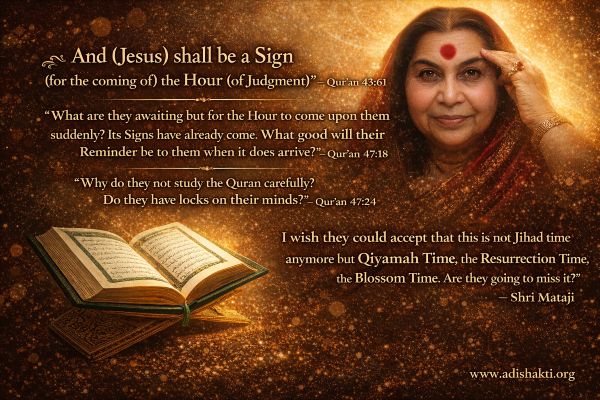
Qur’an 43:61 places Jesus in direct relation to the Hour: “And (Jesus) shall be a Sign (for the coming of) the Hour.” The verse has commonly been read within expectations of Jesus’s eschatological return. This paper re-examines a different possibility developed in the Adishakti.org corpus: that the decisive theological function of Jesus in this verse is not exhausted by a prediction of a future physical descent, but concerns a sign by which the Hour is recognized. The distinction is fundamental. A sign is meaningful only insofar as it communicates, identifies, or makes something knowable.
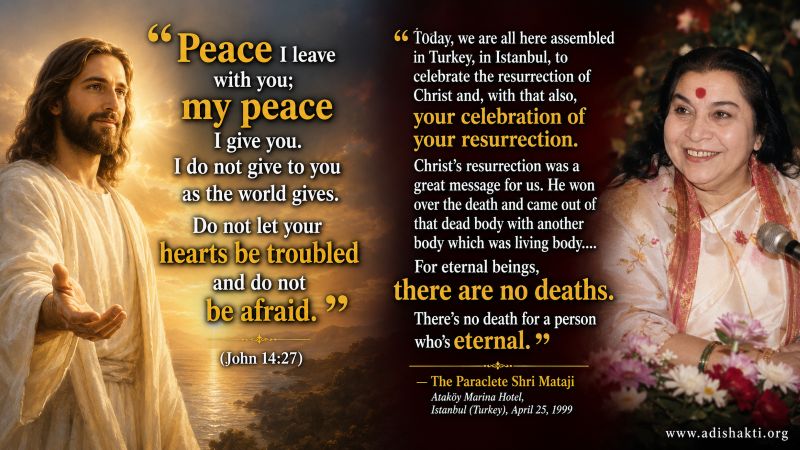
The paper then places Qur’an 43:61 beside the Johannine Paraclete sayings, especially John 16:12–15, where Jesus states that his disciples cannot yet bear everything he has to say and promises the coming Spirit of truth who will guide into “all truth.” Within the interpretive framework examined here, the Sign of Jesus and the promised Paraclete converge: Jesus points beyond his historical ministry toward a later divine agency whose work is recognition, teaching, remembrance, conviction, and interior transformation.
The resulting thesis is deliberately distinguished from a claim about classical Islamic consensus. It is a comparative theological construction. Its force depends on a cumulative argument: Qur’an 43:61 identifies Jesus as a sign; 43:62 immediately warns against satanic hindrance; the Qur’an repeatedly describes divine signs as realities to be perceived and understood; the Gospel of John presents Jesus’s mission as awaiting completion by the Spirit of truth; and the Qur’anic language of al-Qiyāmah and An-Nabaʾ addresses morally responsive human personalities. On this reading, the central eschatological question becomes not merely When will the Hour occur? but How would human beings recognize its divinely appointed Sign if it were already confronting them?
Contents
- The interpretive problem in Qur’an 43:61
- What does it mean to be a “Sign of the Hour”?
- Jesus’s unfinished message and the Paraclete
- Where the Qur’anic and Johannine trajectories converge
- Al-Qiyāmah as an event that must be consciously encountered
- An-Nabaʾ and the necessity of living hearers
- The Shri Mataji claim: what is being asserted?
- Major objections and necessary distinctions
- Conclusion
1. The Interpretive Problem in Qur’an 43:61
The first question is grammatical and theological before it is chronological. The verse does not merely place Jesus near the end of history; it assigns him a sign-function. The Hour is something about which doubt must cease, and Jesus is connected with the evidence by which that certainty becomes possible. The interpretive problem is therefore larger than the mechanics of a return from heaven. It concerns recognition.
The older paper correctly perceived that this point deserves greater weight, but it moved too quickly from “Jesus is a sign” to “therefore the Sign is the Paraclete.” The revised argument proceeds in stages. First, the verse establishes an eschatological relation between Jesus and the Hour. Second, the concept of a sign implies intelligibility: a sign points beyond itself. Third, Jesus’s own discourse in John portrays his historical ministry as incomplete in one important respect—there remains “much more” that his hearers cannot yet bear. Fourth, the promised Spirit of truth is assigned precisely the functions required to complete that unfinished communicative task.
2. What Does It Mean to Be a “Sign of the Hour”?
A sign is not identical with the reality it signifies. Smoke can signify fire; dawn can signify the approaching day; a prophetic act can signify divine judgment. The sign has an epistemic role: it makes another reality recognizable. Applied to Qur’an 43:61, this means that Jesus’s relation to the Hour must be examined not only as an event in a timetable but as a means of disclosure.
This distinction clarifies why the command that follows matters: “therefore have no doubt about the Hour, but follow ye Me.” The verse joins sign, certainty, and following. Eschatology here is not presented as detached speculation. The sign creates a demand for response. If one recognizes the sign, one is expected to orient oneself accordingly.
The next verse intensifies the point:
Read as a literary sequence, 43:61–62 creates a striking pattern: Sign → certainty → following → warning against hindrance. The revised paper treats that sequence as the controlling architecture of the argument. The warning does not by itself prove any particular later fulfillment, but it establishes that failure to respond to the sign is a theological possibility anticipated by the text itself.
3. Jesus’s Unfinished Message and the Paraclete
The Gospel of John contains a cluster of sayings in chapters 14–16 concerning the Paraclete or Advocate. Taken together, these sayings assign the coming figure or presence several functions: abiding with the disciples, teaching, reminding them of Jesus’s words, testifying concerning Jesus, convicting the world, and guiding into truth.
3.1 “I Have Much More to Say to You”
This saying is central because it establishes incompletion without implying failure. Jesus does not say that his message is false or deficient; he says that the present capacity of his hearers imposes a limit. The limitation lies in historical receptivity. The promised Spirit therefore belongs to the logic of continuation: what cannot yet be borne will later be disclosed under different conditions.
3.2 Teaching, Remembering, Testifying, Convicting
John 14:26 says the Paraclete will teach and bring Jesus’s words to remembrance. John 15:26 describes testimony. John 16:8–11 describes conviction. John 16:13 describes guidance into truth. These are not primarily military, political, or catastrophic functions. They are functions of consciousness, understanding, moral discernment, and spiritual recognition.
That observation creates the bridge to the Qur’anic “Sign of the Hour.” If the Hour has a sign that human beings must recognize, and if Jesus promises a later divine agency whose work is to teach, remind, testify, convict, and guide, then a comparative reading may legitimately ask whether the two textual trajectories describe complementary aspects of one eschatological process.
4. Where the Qur’anic and Johannine Trajectories Converge
The convergence proposed here is functional rather than lexical. The Qur’an does not use the Johannine word “Paraclete” in 43:61, and John does not use the Qur’anic expression al-Qiyāmah. The argument therefore cannot rest on word-equivalence. It rests on a pattern of roles.
This pattern is stronger than the older paper’s simple assertion that “the Paraclete is the Sign.” A more precise formulation is: the promised Paraclete can be interpreted as the agency through which the eschatological significance of Jesus becomes intelligible and experientially present in the age of the Hour. That claim is narrower, clearer, and more defensible.
5. Al-Qiyāmah as an Event That Must Be Consciously Encountered
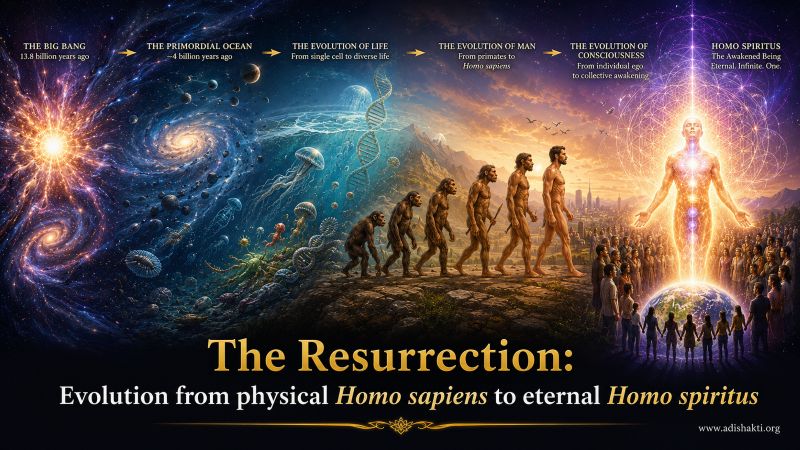
The older paper repeatedly contrasted a “future physical event” with a “living spiritual Resurrection.” That contrast was rhetorically forceful but too absolute. Qur’anic resurrection language includes unmistakably embodied, cosmic, judicial, and eschatological imagery. A stronger thesis does not need to deny those dimensions. It asks whether the Qur’an can also describe an age or process of awakening preceding final judgment.
This distinction between resurrection-process and final consummation is crucial. The first can involve awakening, witnessing, self-knowledge, moral disclosure, and recognition of signs among living people. The second can remain the final divine horizon. The two need not be collapsed into one moment.
Within the Adishakti.org interpretation, al-Qiyāmah is therefore treated as an epoch in which human beings are awakened to the divine reality within themselves and are thereby placed under a form of self-judgment. The language of the “self-reproaching soul” in Qur’an 75:2 becomes significant in this framework because judgment is not imagined solely as an external sentence; conscience itself becomes a witness.
6. An-Nabaʾ and the Necessity of Living Hearers
An-Nabaʾ adds a second dimension: controversy. The Great News is not merely announced; it is disputed. Disputation requires subjects capable of hearing a proposition, understanding enough of it to disagree, and taking a position toward it. This is why the larger Adishakti.org corpus repeatedly emphasizes living human personality.
The logical point can be stated without polemic: a message whose prophetic function includes being heard, disputed, recognized, or rejected presupposes conscious recipients. A corpse cannot deliberate over An-Nabaʾ. A living human being can. This does not by itself prove the entire theology of a living Resurrection, but it supports the claim that the eschatological drama has a communicative and experiential dimension before any final judgment.
7. The Shri Mataji Claim: What Is Being Asserted?
The most consequential step in the paper is the identification of Shri Mataji Nirmala Devi with the promised eschatological agency. This claim must be stated with precision. The argument is not simply that she taught spirituality or spoke about Jesus. It is that her public mission is alleged to correspond to the functions attributed to the Paraclete and to the experiential requirements of a living Resurrection.
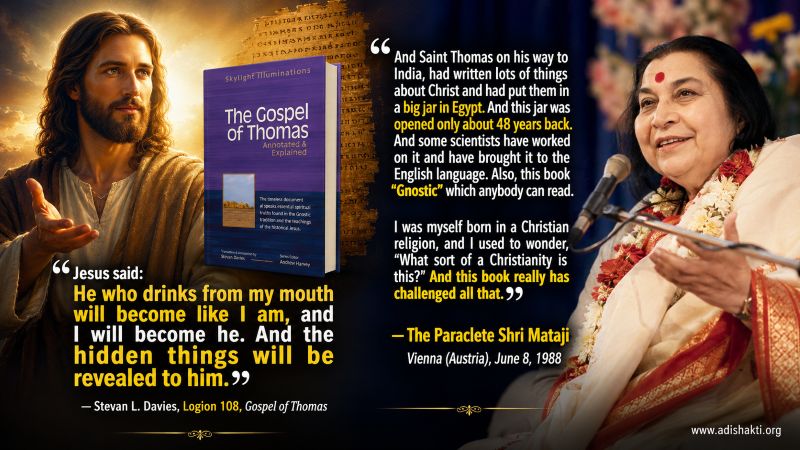
The claim rests on several asserted correspondences: she taught a universal method of Self-realization; described an inner spiritual rebirth; interpreted Jesus within a wider history of revelation; spoke explicitly of the Resurrection Time; emphasized direct verification rather than belief alone; and presented the experience of the “cool breeze” or subtle divine presence as something collectively accessible.
These correspondences are evidence within the proposed framework, not automatic proof of identity. A rigorous case must still ask whether the sayings attributed to Shri Mataji are authentic, whether the experiential claims are reproducible, whether alternative explanations are stronger, and whether the proposed correspondences are specific enough to distinguish fulfillment from retrospective pattern-matching.
8. Major Objections and Necessary Distinctions
8.1 “Qur’an 43:61 simply predicts Jesus’s return.”
That is a major traditional reading and must be acknowledged. The present paper does not erase it by assertion. It argues that even if an eschatological return is accepted, the verse still calls Jesus a sign; therefore the epistemic question—what the sign means and how it is recognized—remains open to investigation.
8.2 “The Paraclete is conventionally identified with the Holy Spirit.”
Christian theology overwhelmingly reads the Paraclete sayings in relation to the Holy Spirit. The Adishakti.org thesis does not become stronger by ignoring this. Its comparative proposal is that the Holy Spirit’s promised activity may become historically manifest through a particular human ministry without reducing Spirit to human personality. That distinction must be argued, not assumed.
8.3 “Spiritual resurrection contradicts bodily resurrection.”
Not necessarily. The revised framework distinguishes an interior awakening or resurrection-process among the living from the final eschatological consummation. The former does not logically require denial of the latter.
8.4 “Similarity is not fulfillment.”
Correct. Similarity becomes evidential only when the correspondences are numerous, specific, independently documented, and resistant to alternative explanation. This is why the historical record, exact quotations, dates, eyewitness testimony, and publicly testable claims are essential to the larger Authenticity Series.
9. Conclusion: From Prediction to Recognition
The deepest contribution of Qur’an 43:61 to this inquiry is the word Sign. It transforms eschatology from a question of chronology alone into a question of recognition. The Hour is not merely awaited; its sign must be understood. The following verse then warns that recognition can be hindered.
John’s Paraclete sayings deepen that problem. Jesus explicitly anticipates a later work of teaching, remembrance, testimony, conviction, and guidance into truth. When these sayings are read alongside Qur’an 43:61–62, a coherent comparative hypothesis emerges: the eschatological Sign of Jesus may be inseparable from the later divine agency that makes his unfinished message intelligible and spiritually operative.
The identification of that agency with Shri Mataji Nirmala Devi remains the paper’s boldest claim and therefore requires the strongest evidence. But the claim is clearer once separated into its component propositions. The issue is not simply whether one accepts an extraordinary title. The issue is whether a documented historical ministry can be shown to fulfill a specific constellation of scriptural functions.
On this reading, the decisive question of the Hour becomes immediate: if divine revelation promised signs, guidance, awakening, and a Spirit of truth, by what criteria would humanity recognize their fulfillment? That is the question the revised paper places before the reader.
References
- Abdullah Yusuf Ali, The Holy Qur’an, Amana Corporation, 1989; especially Qur’an 43:61–62, 75:1–2, and 78:1–5.
- The Holy Bible, Gospel of John 14:16–17, 14:25–26, 15:26–27, 16:7–15.
- Daniel B. Stevick, Jesus and His Own: A Commentary on John 13–17, Eerdmans, 2011, pp. 292–297, as cited in the earlier source paper.
- Adishakti.org, earlier “Jesus is the Sign of the Hour” research paper and related Paraclete/Al-Qiyāmah materials.
Compilation, Proclamation, and Exegesis of Surahs Upholding Allah’s (SWT) Command to His Ummah — to Witness and Participate in the Resurrection.
Al-Qiyamah: A Profound Declaration of Al-QiyamahAl-Qiyamah (75:1-2): Oaths of Resurrection
Al-Qiyamah (75:3-4): Reassembling Bones and Fingertips
Al-Qiyamah (75:5-6): Man's Denial of Resurrection
Al-Qiyamah (75:7–10): Sun and Moon 'Joined' At Solar Eclipse
Al-Qiyamah (75:7–10): Solar Eclipse Salat al-Kusuf
Al-Qiyamah (75:11–13): No Refuge, Only Reckoning
Al-Qiyamah (75:14–15): Man: His Own Witness and Judge
Al-Qiyamah (75:16–19): The Usurpation of Allah's Explanation
Al-Qiyamah (75:20–21): Love of The Fleeting World
Al-Qiyamah (75:22–25): Ruh’s Face Brings Either Glory Or Gloom
Al-Qiyamah (75:26–30): Death and Soul's Departure Home
Al-Qiyamah (75:31–35): The Rejection and Arrogance of the Kuffar
Al-Qiyamah (75:36–40): Is Resurrection Beyond Allah, Your Creator?
Al-Qiyamah (75:1-2 and 78:1–5): An Naba and Oaths of Resurrection
Al-Qiyamah (75:1-2 and 78:1–5): The Great News and Resurrection Rebirth
Al-Baqarah (2:138): Baptism of Allah You Were Unaware Of
Al-Baqarah (2:174): Allah Will Not Address Muslims
Al-A'raf (7:16) – Iblis: I Will Lie In Wait and Overpower Them
Al-A'raf (7:146): Allah: I Will Turn Them Away From My Signs
Al-A'raf (7:146): Allah: So Even Though They See All The Signs
Al-Hijr (15:39) – Iblis: I Will Wake (Evil) Fair and Mislead Them
An-Nahl (16:2) – Allah (SWT) Sent Down Angels With His Ruh
Al-Isra (17:85): Muslims Given Little of Allah's (SWT) Ruh
Al-Isra (17:104): Children of Israel Gathered Again (in 1948)
Al-Isra (17:104): Shaykh Palazzi: Children of Israel
Al-Hajj (22:8) – Kitab Al-Munir You Were Unaware Of
Al-Rum (30:56) – The Day of Qiyamah You Were Unaware Of
Fatir (35:9) – Winds of Qiyamah You Were Unaware Of
Yassin (36:63-68) – This Is The Hell You Were Warned Of.
Sad (38:79) – Iblis Allowed to Mislead Muslims And He Did
Fussilat (41:20–21) – Your Hands Will Testify of Qiyamah
Fussilat (41:53) – We Will Show Our Signs Within Your Soul
Az-Zukhruf (43:61): Jesus, Sign of Hour You Were Unaware
Az-Zukhruf (43:62): Satan's Deception of the Muslim Ummah
Az-Jathiya (45:7-14) – Those Who Deny Allah's Revelations
Qaf (50:41) – Listen To The Caller Emerging From Within
Qaf (50:42) – Day They Will Hear of Mighty Blast Witnessed
Qaf (50:45) – By the Caller, My Warning Is Delivered
Al Dhariyat (51:20-22) – Our Signs on Earth and Within
Al-Hadid (57:25) – Allah's (SWT) Iron Has Been Delivered
Al-Mujadilah (58:21) – My Messengers Must Prevail
Al-Saff (61:8–9) – Revelation of Light You Were Unaware
Al-Muddaththir (74:1–2) – My Cloaked One: Deliver Warning
Al-Mursalat (77:1–10): Angels Sent You Were Unaware Of
An-Naba (78:1–5): Concerning What Are They Disputing?
Al-Infitar (82:17–18) – What Will Explain To You? What Will?
Al-Mutaffifin (83:1–6) – Dealers in Fraud You Were Unaware
Al-Tariq (86:1–3) – The Night Visitant You Were Unaware
Al-Qadr (97:1–5) – Blessed Night of Power and Fate Before:
Al-Qariah (101:1–11) – Terrifying Day of Noise and Clamour
Search Adishakti.org
Explore the scriptural arguments, sources, and comparative theological questions raised by this paper.
Open chat →