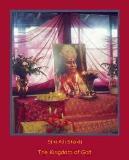
DIVINE FEMININE
The Kingdom Of God

THE MOTHER: Ruach Elohim THE MOTHER: Holy Spirit 
THE MOTHER: Ruh Allah THE MOTHER: Shakti
THE MOTHER: : Tao THE MOTHER: Prajnaparamita
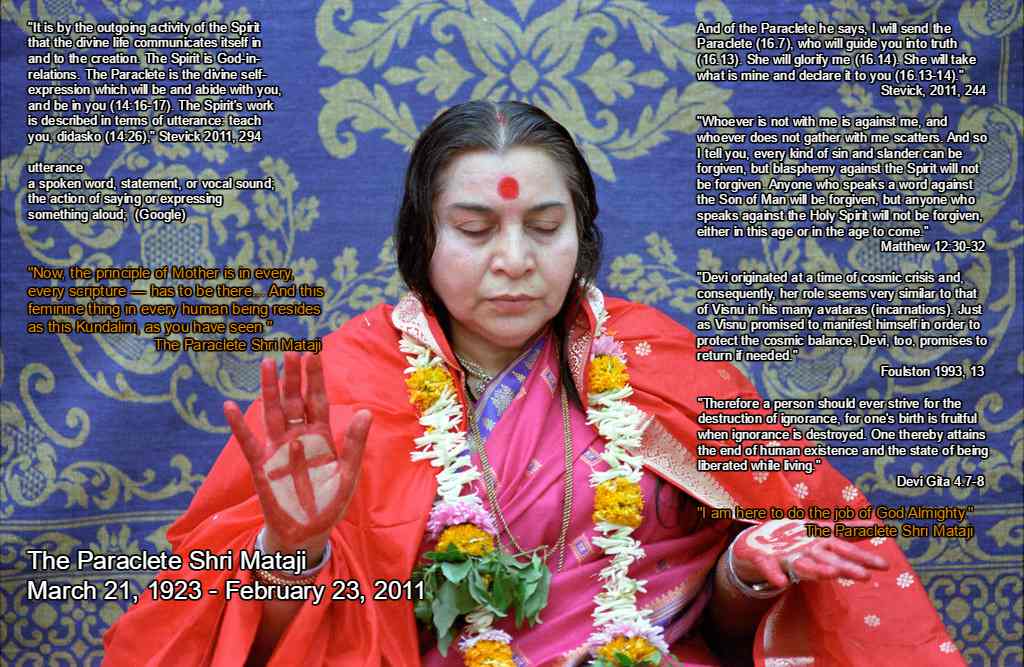
"Now, the principle of Mother is in every,
every scripture - has to be there!"
Shri Mataji, 1 Oct. 1983, Santa Cruz, USA
Since November 1993 the transcendental experiences of children's souls meeting THE MOTHER thousands of times over the years have been recorded. They have identified Shri Mataji as HER incarnation sent to deliver the message and means to participate in the promised Resurrection and evolution into the eternal spirit. Shri Mataji—also the pledged Paraclete—has openly and repeatedly proclaimed the world over the Good News (Al Naba) of the Kingdom of God, specifically pertaining to the eschatology of Jesus, since the 1970s. Only in this age of mass media and literacy is that universality possible, and comprehensible. The common eschatology of the deeply-divisive faiths of Judaism, Christianity and Islam have been harmoniously declared, explained in detail, concluded, and set in motion by the Spirit-Paraclete. As the Divine Feminine entrenched in every scripture, SHE calls upon all to embrace God Almighty's offer and fulfillment of the promise of life eternal in His Kingdom. Mother Prajnaparamita is the Supreme Teacher and Consciousness. In THE MOTHER alone can we find the ultimate source of refuge, reverence, revelation, wisdom, enlightenment, liberation, eternity, and end of all spiritual seeking.

This website is primarily based on the empirical evidence of cosmic visions and mystical experiences of children's souls meditating, meeting, and inquiring from "His Spirit who dwells in you" (Rom. 8:11), and Her answers and revelations to them. Without question it is about encountering the inner Divine Feminine, the Spirit of God.

The DIVINE FEMININE
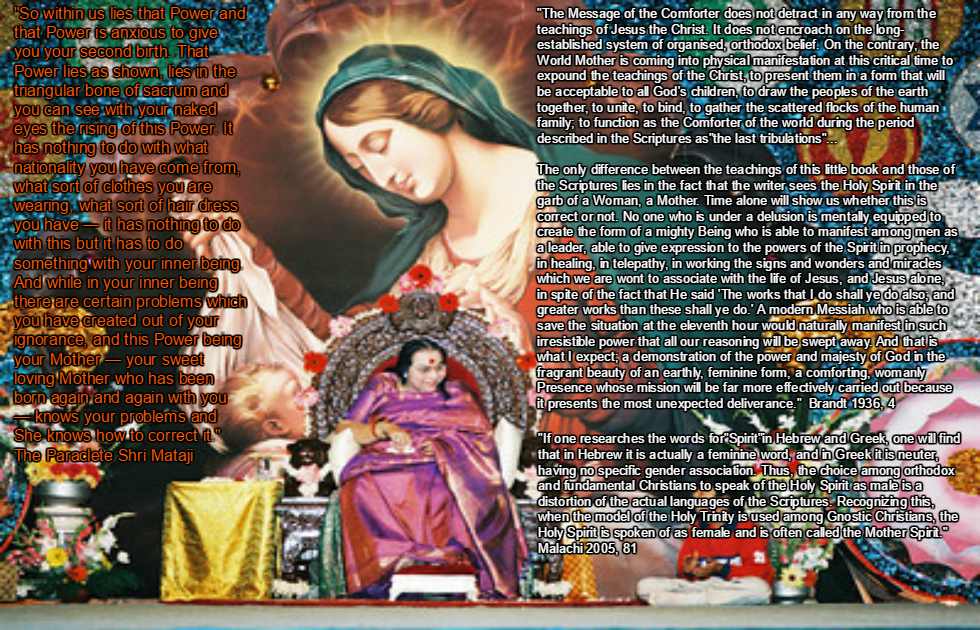
The many forms of THE MOTHER
It also deals with the Divine Message to humanity delivered by the Great Mother's incarnation, Shri Mataji Nirmala Devi. (It is imperative to comprehend that the Divine Feminine—Shakti/Ruach Elohim/
Holy Spirit/Ruh/Tao/Amma/Devi/ Prajnaparamita/Aykaa Mayee—has always been the active, creative aspect of God.) Her Divine Message to humanity is the very foundation of each and every religion, holy scripture and messenger. It embraces all and excludes none, a collective and harmonious triumph unlike anything humanity has learnt from or experienced in organized religion. It is an eschatological message of divine intervention and fulfillment of the promised, long-awaited Age of Resurrection to evolve from the temporary physical body to the eternal, everlasting spirit

The Divine Feminine reveals detailed evidence of this mystical dimension and spiritual sanctuary within human beings never properly understood or explained by organized religions — the Kingdom of God (Christianity), Sahasrara Chakra (Hinduism), Dsam Dwar (Sikhism), 1000 Petal Lotus (Buddhism), "Crystal Palace" (Taoism), Kether (Judaism) or Regions in their Souls (Islam). That it is possible to pursue this inner world beyond everyday physical reality is now backed by incontrovertible evidence.

The Paraclete-Messiah explains how knowledge of this mystical Kingdom of God will eventually awaken, transform and bring about peace and harmony during this Age of the Resurrection and Last Judgment. This unprecedented knowledge and remembrance of Jesus' mystical teachings, to be delivered by the Paraclete, is the final breakthrough in human evolution.

"But, if the Spirit of him who raised Jesus from the dead dwells in you, he who raised from the dead Christ Jesus shall quicken your mortal bodies also through His Spirit who dwells in you." The divine agent, then, is the Holy Spirit, in unity with the human spirit" [1]; "The Messiah will come and the great age of salvation will dawn (for the pious)" [2]; "He (Jesus) is the Sign of the Hour (of Resurrection)" - Surah az-Zukhruf 43:61 [3]. The common eschatology of the deeply-divisive faiths of Judaism, Christianity and Islam have been harmoniously declared, explained in detail, concluded and set in motion by the Paraclete Shri Mataji.
[1] F. J. Lambretch, Resurrection in the New Testament, page 297;
[2] Eric Eve, The Jewish Context of Jesus' Miracles, p. 195;
[3] Al-Qur'an, Surah 43. az-Zukhruf (The Gold Adornment)

In this Golden Age of the Last Judgment and Resurrection humans will break free of centuries-old false religious dogmas, destructive indoctrinations, and absurd ideas about the Divine. The Last Judgment and Resurrection is not the sudden apocalyptic end of the world feared by the divisive religious institutions.

"Though you can understand that Mother's Love makes it very easy for you to get to your Realization and that the whole story of Last Judgment—which looks such a horrifying experience—has been made very beautiful and very tender and delicate, and does not disturb you."

The Paraclete Shri Mataji

On the contrary, humanity awakens to a new dawn of genuine spiritual evolution (Resurrection/birth by the Spirit) and enlightenment (Jesus, the Last Judgment and the Kingdom of God) ushered by the promised Paraclete over a span of four decades. This epic task comprising of thousands of talks, lectures and programs commencing in the 1970s has one central theme - the glorification, defense, completion and final conclusion of the teachings and message of Jesus Christ!


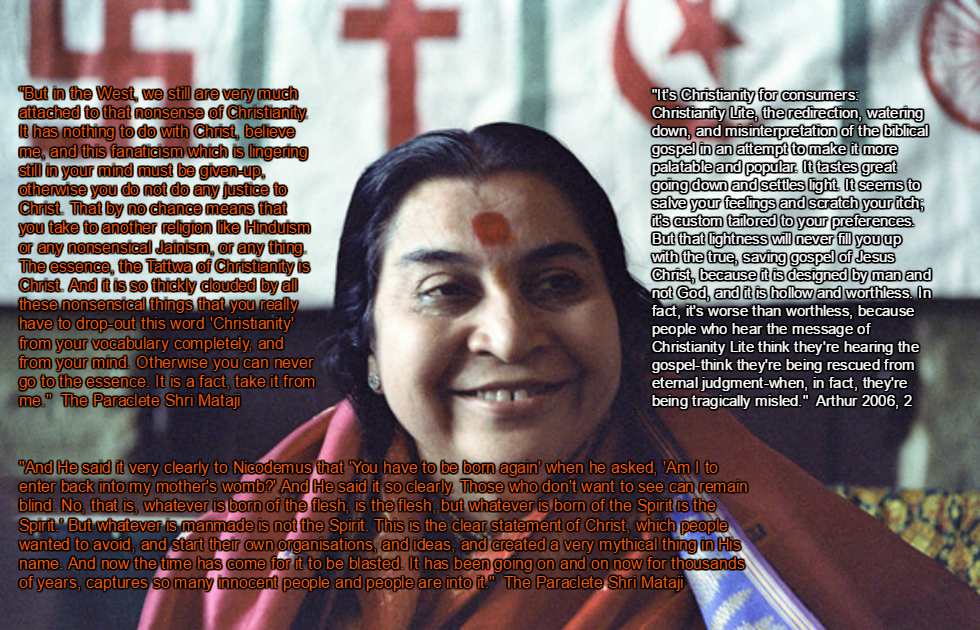
"I am the one about which Christ has talked...They have been telling me, “Mother, you must say that once.” " - The Paraclete Shri Mataji

The Spirit-Paraclete Shri Mataji Nirmala Devi
Shri Mataji Nirmala Devi is
Christian by birth, Hindu by
marriage, and Paraclete by duty
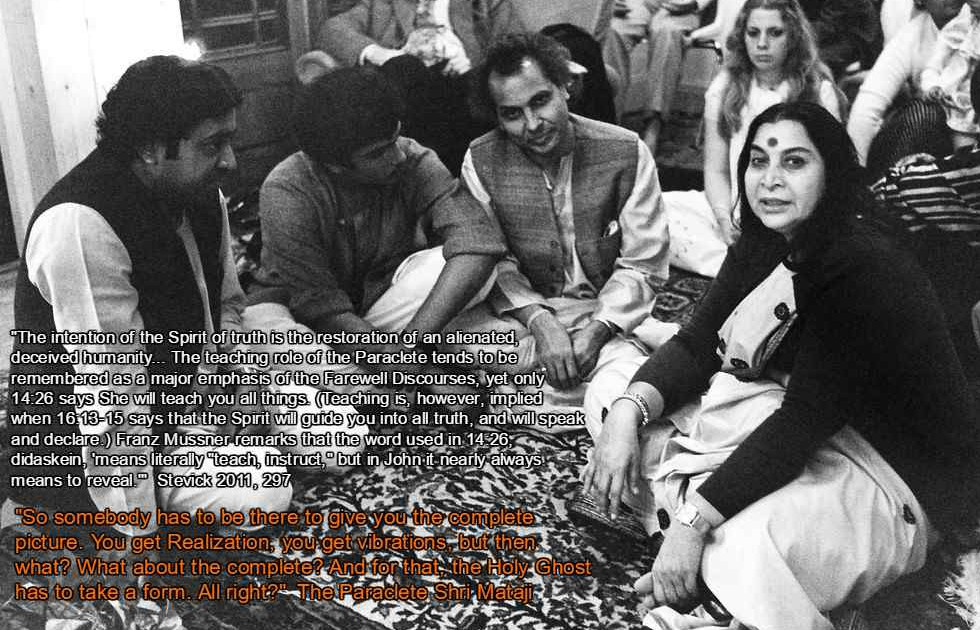
"It’s better that you discover me than I tell you because Christ was crucified, everybody was tortured. I do not want to hamper my work because it makes no difference by telling you anything before Realization. It’s better to tell you after Realization that I am the Holy Ghost – no doubt! I am the one about which Christ has talked.

I have told them (Her 1970's disciples and leaders) I had never said this on from a platform... They have been telling me, “Mother, you must say that once.” I said, “In America I’ll declare it.”

So today I declare that I am the Holy Ghost. I am the Holy Spirit who has incarnated on this Earth for your Realization."

The Paraclete Shri Mataji
New York, USA — September 30, 1981


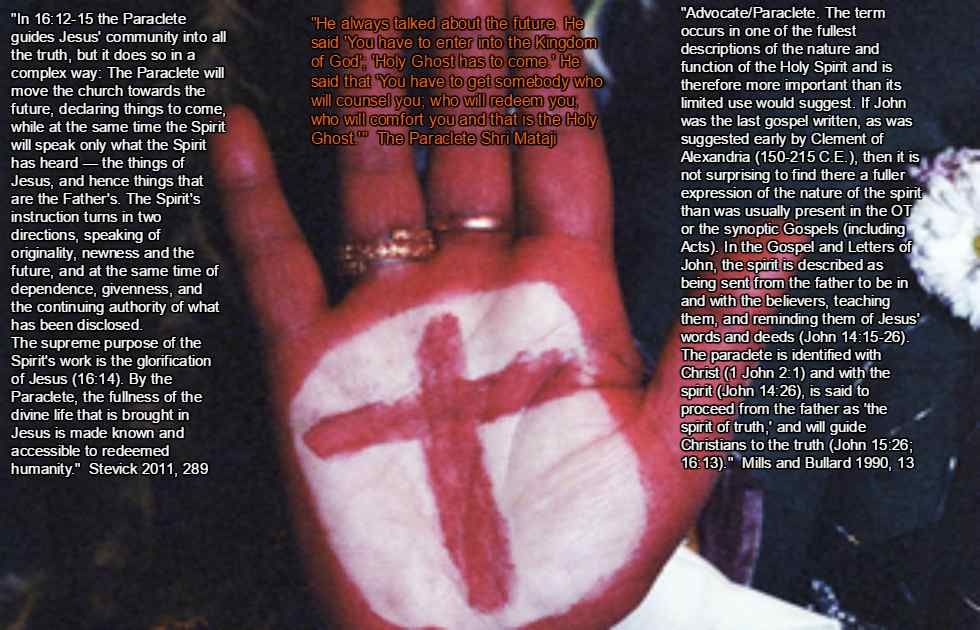
"He always talked about the future. He said “You have to enter into the Kingdom of God”; “Holy Ghost has to come.” He said that “You have to get somebody who will counsel you; who will redeem you; who will comfort you and that is the Holy Ghost.” "

The Paraclete Shri Mataji


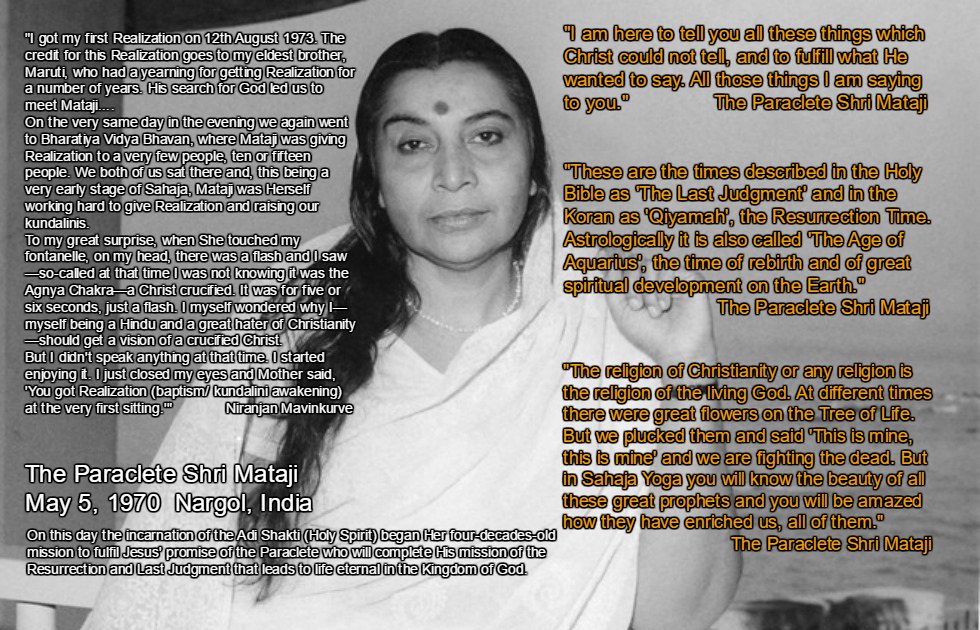
"If we follow Him then we cannot be conditioned by anything because He talked of Spiritum only. Spirit cannot be conditioned, conditioned by anything... I am here to tell you all these things which Christ could not tell, and to fulfill what He wanted to say. All those things I am saying to you."

The Paraclete Shri Mataji
Christmas Puja, Delhi, India — December 24, 1995


"Christ didn't say that, “I am the Destination.” He said, “I'll send you the Holy Ghost”; “I'll send you a Comforter”; “I'll send you a Redeemer”; “I'll send you a Councilor.” He talked about the future."

The Paraclete Shri Mataji


"These days there are people who are going all over the places to find out the truth, the enlightenment. And there are so many books available, so many people who talk about enlightenment. And this is only in this special age, which I call as the Blossom Time, is happening. If they are not seeking the truth, that means they are not yet evolved as this should have been. But this is a special time that we call as the Last Judgment and that time has come. In the Koran it’s called as Qiyamah and described very clearly what will happen at this time. All these have been indicated in all the books which are, I would say, mystical or we can call as religious—whatever you may call it—the mystic part of it. They have all indicated this time. This time, by the end of this century, this should happen."

The Paraclete Shri Mataji
The Blossom Time, Royal Albert Hall, London, UK — July 5, 1998


"What is the essence of religion? The essence of religion is to know God, the Almighty. And one can never know the Almighty unless one knows the Spirit, for it is His reflection in man, and only through it can one know Him."

The Paraclete Shri Mataji


"My vision ... is that all the good people, righteous people, God-loving people will rise above all that is useless, worldly, and reside in the Heavens with all the blessings of God, for ever and ever."

The Paraclete Shri Mataji


"I am here to do the job of God Almighty's."

The Paraclete Shri Mataji
Bordi, India — February 6, 1985


Note: Without question, except for the 40-year span of revelation, guidance, glorification, declaration, advocacy, counseling and comforting by the Paraclete Shri Mataji, the one-day Pentecost Sunday event two millennia ago lasting only a few minutes cannot be attributed to the fulfillment of Jesus' promise because: i)Jesus said that he will send another Comforter just like him i.e., in the form of a human being; ii) there is no evidence whatsoever supporting the advocate, counselor, comforter, and defense attorney accomplishments of the Paraclete to the disciples; iii) there is no witness to the Paraclete bearing witness to Jesus, glorifying him, guiding his followers, and declaring what is coming; iv) there were no Bibles, churches, literacy or means to spread the Paraclete's teachings universally (The Roman persecution of Christians only ended in AD 313 under the reign of Constantine the Great, and the Bible then evolved.); v) there was no closure, conclusion and finality of Jesus' teachings, message of eschatology and Kingdom of God. Each and every Paraclete-specific requirement of i)-v) are completely fulfilled today.
Note: The day called "Pentecost" is named after the Greek word pentekostos, which means "fiftieth" i.e., a week's worth of weeks (7 x 7 = 49). Pentecost grew from what was originally a festival marking the first grain harvest of the Middle Eastern year, marked by a sacrifice to the gods from the “first fruits” of that harvest. In very ancient Palestine, this first-fruit sacrifice was tightly tied into the religions of the gods of power and fertility (both in farming and in sex).


"The functions of the Paraclete spelled out in verses 13-15... are all acts of open and bold speaking in the highest degree." - David Fleer

David Fleer, Preaching John's Gospel: The World It Imagines
"This fifth and final teaching contains themes with which we are now familiar: the time-limitedness of Jesus’ own ministry (v. 12); continuity of the Paraclete’s work with that of God and Jesus’ (vv. 14-15); the Spirit of truth (v. 13). In fact, this last Paraclete teaching is more important for the way it deepens familiar motifs than for introducing new ones. In these verses Jesus makes explicit how the Paraclete will guide the disciples into their own futures...

The promise of the Paraclete is that the Paraclete will carry the promises of Jesus forward into the ever-changing realities that lie in store for people of faith. This means that as life changes, as new sufferings and new hopes emerge, you will receive a fresh promise and word from Jesus, conveyed to the community through the presence and work of the Paraclete. The functions of the Paraclete spelled out in verses 13-15—“guide you into all the truth,” ... “declare to you all things that are to come,” “take what is mine and declare it to you”—are all acts of open and bold speaking in the highest degree. The bold witness of the Paraclete ... carries Jesus’ teachings into the future, will ensure that the disciples do not face the future alone (cf. 14:18), unequipped with the necessary words of Jesus."

David Fleer, Preaching John's Gospel: The World It Imagines
Chalice Press, (May 30, 2008) pages 68-70


"There is a sense in the farewell discourse that while Jesus was still on earth, the disciples’ understanding of him was only inchoate (cf. 14:5, 9; 16:18). Burge correctly notes that the concept of “remembering” in the Gospel is linked to the misunderstanding of the disciples in John. They really do require the new perspective that the Paraclete brings. Indeed, the Paraclete “interprets” the Johannine Jesus-tradition, a concept fully expressed by the extradiegetic narrational voice of John 7:39, and also in the well-known “aside” of 2:22. As “interpreter” of the Jesus tradition, the Paraclete can legitimately be understood as the one who continues the “ongoing revelation of God in the world”. "

The Paraclete and Jesus in the Johannine Farewell Discourses
Ruth Sheridan, Pacifica Theological Studies Association, page 136


"John 16:7-11 constitutes one of the most baffling passages in the fourth gospel. Augustine acknowledged their difficulty; and almost every commentator who has addressed the problem since Augustine has prefaced his interpretation with apposite notice that these verses are not easy to sort out. None of the interpretations offered so far is entirely free from difficulty; and the one about to be presented does not quite escape this curse either."

D. A. Carson, The Function of the Paraclete in John 16:7-11
Journal of Biblical Literature, Vol. 98, No. 4 (Dec., 1979), pp. 547


"The reaction of the world to the Paraclete will be much the same as the world’s reaction was to Jesus." - Berard L. Marthaler

Berard L. Marthaler, The Creed: The Apostolic Faith in Contemporary Theology
"As the Christ, Jesus was at once the fulfillment of prophecy and at the same time the greatest of the prophets. In departing he promised, “I will ask the Father and he will give you another Paraclete—to be with you always...” (Jn 14:16). Jesus spoke several times of the Paraclete in his farewell discourse, and the condition for the coming of this new advocate seems to have been Jesus’ own return to the Father (Jn 16:7). “Paraclete,” a title peculiar to the Johannine writings, is close to the Greek parakletos, which has many meanings. Paraclete suggests a helper, friend, interpreter, consoler, witness for the defense, and advocate. Raymond E. Brown, who compiled a list of all the texts where the word appears in John’s Gospel, concluded that the Paraclete has two basic functions: 1) the Paraclete comes to the disciples and dwells with them, guiding and teaching them about Jesus; and 2) the Paraclete accuses the world and condemns its false values and sin, specifically, for unjustly sentencing Jesus to death.

The portrait of the Paraclete in the Johannine gospel bears a striking resemblance to Jesus. Virtually every quality ascribed to the Paraclete has a parallel in what was said of Jesus. Jesus himself says that the Father will send another Paraclete, thus clearly indicating that his own mission was that of a “paraclete,” with all the complex connotations that this title carries. The Paraclete will come, sent forth by the Father just as Jesus came, sent into the world by the Father. It is said that the disciples will know the Paraclete and the Paraclete will remain with them, much as it was said that the disciples were privileged to know the Son, who will remain with them. The Paraclete will guide the disciples along the way of all truth; Jesus is the way of truth. The Paraclete will bear witness; Jesus bears witness (Jn 8:14). The reaction of the world to the Paraclete will be much the same as the world’s reaction was to Jesus. The world does not know or accept the Paraclete, much as it remained ignorant of Jesus’ true identity and rejected him (5:43; 12:48)."

B. L. Marthaler, The Creed: The Apostolic Faith in Contemporary Theology
Twenty-Third Publications, 2007, page 275


"Christ's teaching is not generally understood in its true, simple, and direct sense even in these days, when the light of the Gospel has penetrated even to the darkest recesses of human consciousness; when, in the words of Christ, that which was spoken in the ear is proclaimed from the housetops; and when the Gospel is influencing every side of human life—domestic, economic, civic, legislative, and international. This lack of true understanding of Christ's words at such a time would be inexplicable, if there were not causes to account for it.

One of these causes is the fact that believers and unbelievers alike are firmly persuaded that they have understood Christ's teaching a long time, and that they understand it so fully, indubitably, and conclusively that it can have no other significance than the one they attribute to it. And the reason of this conviction is that the false interpretation and consequent misapprehension of the Gospel is an error of such long standing. Even the strongest current of water cannot add a drop to a cup which is already full."

Leo Tolstoy, The Kingdom of God is Within You
Bison Books, 1984, page 54


"What has been passing for Christianity during these nineteen centuries is merely a beginning, full of weaknesses and mistakes, not a full-grown Christianity springing from the spirit of Jesus. - Albert Schweitzer

First, I owe a word of explanation to readers. This book is not about one more attempt to prove why it is wrong to be a fundamentalist. Nor is it a book meant to prove that Jesus is not divine-at least in a metaphysical sense-and never walked on water or raised anyone from the dead. Indeed, I could not prove such a thing to anyone who wasn't already inclined to believe it. Instead, it is a book written by a pastor, an invitation that comes bearing the postmark of the church and addressed to those who already accept the Bible as inspired, but not infallible. It is not offered as a scholarly argument against literalism or literalists, nor is it intended to be one more tirade against any form of ignorance or arrogance. Those in glass houses should not throw stones.

Rather, it is a word on behalf of those who have walked away from the church because they recognize intellectual dishonesty as the original sin of orthodoxy. It is a sermon addressed to nonbelievers as well as to those who grew up in the church. It is meant to provide a second opinion for all those who know what they are supposed to believe but refuse to equate miracles with magic or liturgy with history—and yet fall silent when someone reads the Beatitudes or get goosebumps listening to the parable of the prodigal son. It is not an apologetic but a call to reconsider what it means to follow Jesus, instead of arguing over things that the Church has insisted we must all believe about Christ. Doctrines divide by nature. Discipleship brings us together."

Robin R. Meyers, Saving Jesus from the Church
HarperOne (February 24, 2009), Pages 13-14


Bultmann calls the "coming of the Redeemer an “eschatological event,” “the turning-point of the ages”." - George Eldon Ladd

George Ladd, A Theology of the New Testament
"Rudolf Bultmann reinterprets eschatology along existential lines. He calls the coming of the Redeemer an “eschatological event,” “the turning-point of the ages,” from such verses as 3:19; 9:39... The sayings about a future coming of Jesus do not refer to a “coming again” but merely to his coming. Here are to be found the real foundations in the words of Jesus about his coming. But this coming is no second eschatological event but the consummation and fruition of that which is being brought to fulfillment: the coming of Jesus in the Paraclete. The resurrection inaugurates the parousia. Apocalyptic thought later separated these two events and reinterpreted the parousia in terms of Jewish apocalyptic.

Such views of a completely realized eschatology have not persuaded all scholars. They have seen the difference between John and the Synoptics as one of emphasis, and have held that John indeed shares the essentials of primitive Christian eschatology. Kummel answered Bultmann’s interpretation of the eschatology of the Fourth Gospel with an essay in which he argued that a futuristic eschatology is essential to the structure of the Johannine thought. John does not purpose to supplement the Synoptics but to set forth their true meaning. The glory of God was present in Jesus but was recognized only by a few who had faith. The hiddenness of both the Christ and of salvation and the final overcoming of death must await in the future. Jesus came from eternity as the one sent by God in the present. Such a person with a past and a present must also have a future. Therefore the hope of the parousia and an eschatological consummation is an essential element in Johannine thought. John does not express this hope in apocalyptic terms, for his concern is primarily the destiny of the individual, not the destiny of the cosmos."

George Eldon Ladd, A Theology of the New Testament
Wm. B. Eerdmans Publishing Company, 1993, pages 336-7


"The Paraclete equated with the Holy Spirit, is the only mediator of the word of the exalted Christ." - M.E. Boring

In Spirit and Truth, Benny Thettayil
"2.2.2.4. Holy Spirit and the Paraclete

Having seen that pneuma here could only be the Holy Spirit, we proceed to investigate the relationship between the Spirit and the truth. We begin our investigation from the statements of Jesus, which tell the readers that the Paraclete is the Spirit of Truth (14:17; 15:26; 16;13) and that the Paraclete is the Holy Spirit (14:26).

Although the Paraclete theme is complex, a closer look at the declaration of Jesus regarding the sending of the Spirit/Paraclete reveals the relationship between the Holy Spirit and the Paraclete... Making a study on the Paraclete in the Fourth Gospel, in his doctoral dissertation, E. Franck notes that the Paraclete is connected with the Spirit. He holds the idea of the Paraclete as a divine, but abstract power. ‘The Spirit is the power, which renews, giving life and strength (ch. 3:5f; 6:63; 20:22). True worship is done in the Spirit (4:23)’. Regarding the Paraclete, Jesus says: ‘I will pray to the Father and he will give you another Paraclete, that may be with you for ever, the Spirit of truth...’ (14:16-17). It is clear here that the word ‘Paraclete’ is applied to the Holy Spirit/the Spirit of truth. However, John 14:26 does actually identify the Paraclete as the Holy Spirit...

There is a close resemblance between the Paraclete and Jesus in many aspects especially their function. These similarities in function are so striking that they cannot be taken as coincidences. For John these similarities should serve some purpose and logically, his purpose is to show the Paraclete to be the continuing presence of Jesus exercising a ministry that is parallel to that of Jesus himself even after he has gone from the world.”

Benny Thettayil, In Spirit and Truth
Peeters (October 2007), page 139-147

Note: Speaking of the Johannine portrayal of Jesus and the Paraclete, M.E. Boring, “The Influence of the Christian Prophesy on the Johannine Portrayal of the Paraclete and Jesus,’ NTS 25 (1978-79) 114, 120, states regarding the equation of Paraclete and the Holy Spirit: “The Paraclete equated with the Holy Spirit, is the only mediator of the word of the exalted Christ”. Boring would make another equation by saying that Jesus was the first Paraclete and the second Paraclete is the Spirit.

The Paraclete Shri Mataji
"He resurrected himself so that you all could be resurrected, so you have to, today, thank Him for giving you the lead of resurrection and in this lifetime only, you are going to be resurrected and you are going to see, with your own eyes, your resurrection as the disciples saw the resurrection of Christ. This is being all promised and this must happen to all of you."

The Paraclete Shri Mataji
The Meaning of Easter, London, UK
Easter Sunday, April 6, 1980


"Declare to all the nations now that I am the Holy Ghost and I have come for this special time, that is, the Resurrection Time."

The Paraclete Shri Mataji
Sydney, Australia — March 21, 1983


"Another consolation to be attributed to the Holy Spirit (cf. 1 Pet 1:12) is the fulfillment of Jesus' preaching, that is, that “the Gospel of the kingdom will be preached throughout the world as a witness to all nations” (Mt 24:14)". - Pope John Paul II

Pope John Paul II
Pope John Paul II

The Spirit: Another Comforter
Pope Paul, General Audience March 13, 1991

"In his farewell discourse to the apostles during the Last Supper on the night before he died, Jesus promised: “I will ask the Father, and he will give you another Comforter to be with you always” (Jn 14:16). The word “Comforter” here translates the Greek word Parakletos , the name which Jesus gave the Holy Spirit. “Comforter” is one possible meaning of Paraclete. In his discourse in the upper room Jesus suggested this meaning because he promised his disciples the continuing presence of the Spirit as a remedy against the sadness caused by his departure (cf. Jn 16:6-8).

The Holy Spirit, sent by the Father, will be “another Comforter” sent in the name of Christ, whose messianic mission must come to a close with his departure from this world to return to the Father. This departure, which took place through his death and resurrection, was necessary so that “another Comforter” could come. Jesus clearly affirmed this when he said: "If I do not go, the Comforter will not come to you" (Jn 16:7). The Second Vatican Council's Constitution Dei Verbum presents this sending of the "Spirit of truth" as the concluding moment of the revelatory and redemptive process responding to God's eternal plan (cf. n. 4)...

The Comforter whom Isaiah spoke of, seen from the perspective of prophecy, is the one who brings the Good News from God, confirming it with “signs,” that is, “with works containing the salutary good of truth, justice, love and liberation”, the “consolation of Israel.” And when Jesus Christ, after having accomplished his work, left this world to return to the Father, he announced “another Comforter,” that is the Holy Spirit, whom the Father will send in his Son's name (cf. Jn 14:26)...

Another consolation to be attributed to the Holy Spirit (cf. 1 Pet 1:12) is the fulfillment of Jesus' preaching, that is, that "the Gospel of the kingdom will be preached throughout the world as a witness to all nations" (Mt 24:14). Among these nations, covering every era, there are also the people of the contemporary world, who seem so distracted and even led astray by success and the attraction of a too one-sided, material progress. To these people too, and to all of us, the work of the Spirit-Paraclete extends, who does not cease giving consolation and comfort with the Good News of salvation."

www.vatican.va/


"The Messiah will come and the great age of salvation will dawn (for the pious)" - Eric Eve

The Jewish Context of Jesus' Miracles by Eric Eve
"The Messianic Apocalypse (4Q521)

Several fragments of the text of the Messianic Apocalypse survive, but the one that has attracted the most attention is the largest and best preserved, that from column 2, since it appears to look forward to a Messiah who will heal the wounded, revive the dead and bring good news to the poor... Although such phrases are more or less Old Testament quotations (from Isa. 61.1 and Ps. 146.7-8), their association with the coming of the Messiah makes them appear close to Gospel passages such as Lk. 4.18-21 and Mt. 11.4-5. The apparent link is strengthened by the fact that, unlike the biblical passages to which they allude, both 4Q521 and the Gospel passages refer to raising the dead...

This leaves the problem of how God can be said to be about to preach the good news to the poor. Whatever weight is placed on the particular use of דשכ at Isa. 61.1, nowhere in the Old Testament is this verb used with God as its subject, but always of human proclaimers of (mostly good) news. Added to the fact that Isa. 61.1, which appears to be in view here, speaks of one anointed by God’s spirit to perform various actions on God’s behalf, the difficulty appears almost insurmountable. There thus appears to be an exegetical deadlock. Every other consideration points to God being the subject of the verbs in Line 12, and yet the third of these verbs, preaching the good news, stubbornly resists having God as its subject.

At this point one must step back and consider some broader questions about the genre and purpose of this text. It appears that 4Q521 is hymnic in type. In Puech’s view, the different themes evoke the genre of an exhortation on the blessings and punishments that God will bring about in the days of his Messiah. In language that is half-prophetic and half-apocalyptic the author invites the just to persevere in the law and in the orthodox practice of the cult...

In particular, he may not have been greatly concerned to distinguish between what God was going to bring about directly and what God was going to effect through the person of his Messiah. Or he may have considered that the action of a Messiah sent by God was equivalent of God acting himself (on the shaliach principle). In Isa. 61.1-2 the prophetic figure (perhaps reinterpreted as the Messiah by the author of 4Q521) is anointed with God’s spirit to act as God’s agent; on the shaliach principle the acts [the Messiah] performs while carrying out this mission may also be seen as God’s acts: [the Messiah] proclaims the good news on God’s behalf, so that [the Messiah's] words may be regarded as God’s words just as the prophets of old certified their proclamations with ‘Thus says Yahweh.’ Or again, the text may describe what God is going to do quite apart from the Messiah.

Where does this leave the raising of the dead and other miraculous deeds? In the end, one can only say that the text does not make it clear whether these are to be performed through the Messiah or not. This is not a distinction the author was concerned to make: in common with several other authors of intertestamental texts his interest lay not with the person of the Messiah but with what God was going to do in the Messianic age. The Messiah will come and the great age of salvation will dawn (for the pious); that is the author’s message; demarcating a precise division of labour is not his concern."

Eric Eve, The Jewish context of Jesus' Miracles
Sheffield Academic Press (August 2002), pp. 189, 194-6


The Messiah "will bear the signs of that same Jesus who arrived in the past."

"Almost clandestinely, the Roman Catholic Church has in recent weeks taken another step toward reducing Christian animosity toward Judaism - animosity stemming from the theological dispute between the two religions. In a 210-page document published in book form in Rome, the Church states that there is no contradiction between the Jews' anticipation of the Messiah's arrival and the Christians' belief that the Messiah has already arrived, because Christians believe that the Messiah will return at the End of Days. It is significant that the Vatican's new document does not unequivocally or explicitly state that the Messiah destined to return will be Jesus Christ but instead says that the Messiah "will bear the signs of that same Jesus who arrived in the past." The document even adds that the Jews' anticipation of the Messiah's arrival can significantly encourage Christians' belief in the Messiah's return. The new document was written by the Pontifical Biblical Commission, established by Pope John Paul II in 1997. The commission was headed by Cardinal Joseph Ratzinger, prefect of the Congregation of the Doctrine of the Faith and its other members were 20 Bible experts, each of whom received papal authorization to serve on the committee."

Eliahu Salpeter, Waiting for the Messiah - together
www.haaretz.com (23 January 2002


"Move not thy tongue concerning the (Resurrection), to make haste therewith. It is for Us to collect it and to promulgate it: But when We have promulgated it, follow thou its recital: Nay more, it is for Us to explain it (and make it clear)." surah 75:16-19 Al Qiyamah

On 28th February 1990, while on Her way to Australia, Shri Mataji stopped at Changi Airport, Singapore. The Paraclete/Messiah/Ruh informed those who had gathered to meet Her that in Islam there is a complete surah written about Her.

The Holy Qur'an
The chapter in the Qur'an She is referring to is Surah 75 Al-Qiyamah (The Resurrection), explained in depth at www.al-qiyamah.org. A number of Muslim nations, unable to challenge it despite being based entirely on the Qur'an, have instead resorted to blocking the site as it not only reveals that Al Qadr (The Night of Power) precedes Al Qariah (The Day of Noise and Clamor), but also confirms the preordained Sure Signs to back this Great News. Shri Mataji Nirmala Devi has openly challenged and clearly exposed centuries of absolutely misguided Islamic dogma and conditioning regarding Al-Qiyamah, the heart and soul of Islam. Both the Divine Feminine (Ruh/Spirit) and Her incarnation, Shri Mataji, give irrefutable evidence and Sure Signs that the Resurrection is the promised Al Qadr (The Night of Power) that precedes Al Qariah (Day of Noise and Clamour). Shri Mataji has spent four decades spreading the Great News (Al-Naba) by collecting, promulgating, reciting and explaining the message and means to take part in the Resurrection (Al-Qiyamah).

Move not thy tongue concerning the (Resurrection):

Absolutely no human was to start 'moving their tongue' ('wagging their tongue') or rumoring about this particular surah concerning Qiyamah. After all, the entire surah is about Qiyamah and nothing else! Prophet Muhammad was informed that only this Revelation of Qiyamah was never to be speculated upon because humans would have kept demanding answers to numerous questions: "Who is going to explain the Resurrection?" "When will Allah send His Emissary to explain the Resurrection?"  "What proof will His Emissary bring?" (That would have set the stage for hundreds of false prophets claiming to be His emissary sent to explain the Resurrection, bringing chaos and pandemonium. The rest of the Qur'an has no such restrictions.)

To make haste therewith.

Absolutely no human was to be hasty in declaring that the day of Qiyamah had commenced, or will commence, after a particular solar eclipse. Imagine the terror, mayhem and utter social chaos if every solar eclipse had the potential of commencing Qiyamah and, if the interpretation of the Muslim scholars was to be believed, the horrifying End of the world!

It is for Us to collect it and to promulgate it:

Allah made it crystal clear that this extremely important revelation was exclusively for them. Allah and His Ruh (Spirit) will first manifest various Qiyamah-specific Signs and surahs before collecting, promulgating, reciting and explaining them to humankind. Put simply, Allah and His Ruh would be solely responsible for the manifestation, revelation, knowledge and declaration of the Resurrection! Humans were absolutely excluded from any interference whatsoever.

"collect: 1 a : to bring together into one body or place b : to gather or exact from a number of persons or sources c : to gather an accumulation of (objects) especially as a hobby
intransitive verb
1 : to come together in a band, group, or mass : gather
2 : to collect objects"

"promulgate: 1 to publish or make known officially (a decree)
2 a) to make known the terms of (a new or proposed law or statute) b) to put (a law) into effect by publishing its terms
3 to make widespread"

Webster New World Dictionary, Simon & Schuster, Inc. 1988.

But when We have promulgated it, follow thou its recital:

And after Allah and His Ruh have promulgated this Revelation of Qiyamah, humankind must follow Their recital.

"recital: 1 a) a reciting, specifically, a telling of facts, events, etc. in detail b) what is so told; account, story, or description
2 a detailed statement, as of facts or events "

Webster New World Dictionary, Simon & Schuster, Inc. 1988.

Allah and His Ruh would make the Resurrection comprehensible to all humankind by giving a detailed account of facts, descriptions and events relating to Qiyamah!

Nay more, it is for Us to explain it (and make it clear)

And that this Revelation of Qiyamah was, nay more, for Them to explain: i.e. this Revelation of Qiyamah was, nay more, for Them to explain - Allah and His Ruh would clarify it in detail!

"explain: 1 to make clear, plain, or understandable
2 to give the meaning or interpretation of; expound
3 to account for; state reasons for - vi. to give an explanation - explain away to state reasons for so as to justify, often by minimizing, or make understandable - explain implies a making clear or intelligible of something that is not known or understood"

Webster New World Dictionary, Simon & Schuster, Inc. 1988.


The Paraclete Shri Mataji
"But the Muslims do not want to talk about Resurrection at all because they want to frighten people with the Doomsday. They don't want to talk about the Resurrection Time which is going to come, which is the intermediary time (Al Qadr: The Night of Power), because they want to use the time which will frighten people (Al Qariah: Day of Noise and Clamor) by saying that “Now your Doomsday is coming! Now your Doomsday is coming!”"

The Paraclete Shri Mataji


"And even in Koran, Muhammed Sahib says that all the Heavens lie at the Lotus Feet of the Mother. Among them, among Muslims there are Sufis who are realized souls and also accepted in the society. The other day I met something in Paris, a very high person in the Islamic world and he accepted Sahaja Yoga. He said it is described in Koran that there has to be Qiyamah, the Resurrection - we believe in Resurrection.

Also it is for Christians or Hindus, everybody, they have to be resurrected to a higher state. It is just for money and power are some people, who are trying to mislead others, keeping them away from Resurrection. I must say they are committing the greatest sin against the Holy Ghost... There is a very big chapter on Resurrection, but the fundamentalists don't want to look at it. They believe their religion is the best. But what would it has done to anyone? It is so much misinterpreted... so much misinterpreted."

The Paraclete Shri Mataji
Public Program, Brussels, Belgium — 1 July 1993


"Thus we can say, based particularly on Islamic sources but also on the Old Testament and the New Testament, that we are living in the End Times." - Harun Yahya

The Holy Qur'an
"What are they awaiting but for the Hour to come upon them suddenly? Its Signs have already come. What good will their Reminder be to them when it does arrive? (Qur'an, 47:18)

"As the above verse indicates, God has revealed some of Doomsday's signs in the Qur'an. In Surat az-Zukhruf 43:61, God informs us that "He [Jesus] is a Sign of the Hour. Have no doubt about it..." Thus we can say, based particularly on Islamic sources but also on the Old Testament and the New Testament, that we are living in the End Times." - Harun Yahya

"But, it must be pointed out that there are many verses that tell of the Hour, and when we examine them we encounter a great truth. The Qur'an does not indicate the time of the Hour, but it describes those events that will happen prior to it. One verse related that there are several signs of the Hour: What are they awaiting but for the Hour to come upon them suddenly? Its Signs have already come. What good will their Reminder be to them when it does arrive? (Surah Muhammad: 47:18)

From this verse we learn that the Qur'an describes signs that announce the coming of the Last Day. In order to understand the signs of this "great announcement" we must reflect upon these verses. Otherwise, as the verse indicates, our thinking will be of no use when the Last Day is suddenly upon us.

Some of that which was said by the Prophet (saas) which has reached to us deals with the signs of the Hour. In these hadiths of the Prophet (saas), there are both signs of the Hour and detailed information about the period just preceding it. This period, in which the signs of the Hour will occur, is called the "End Times." The matter of the End Times and of the signs of the Hour have attracted much interest throughout the history of Islam; it has been the subject of many works of Islamic scholars and researchers." - Harun Yahya

Only now can this surah (verse) 47:18 be precisely understood as a clear Warning, prior to the appointed Hour:

"What are they awaiting but for the Hour (Al Qariah: The Day of Noise and Clamor) to come upon them suddenly? Its Signs (Al Qadr: The Night of Power) have already come. What good will their Reminder (of Al Qadr: The Night of Power) be to them when it (Al Qariah: The Day of Noise and Clamor) does arrive? (Qur'an, 47:18)

Those Muslims who defy this Divine Decree are assured of the dire consequences of rejecting the message of the Resurrection: "We have indeed revealed this (Message) in the Night of Power: And what will explain to thee what the Night of Power is? The Night of Power is better than a thousand months. Therein come down the angels and the Spirit by Allah's permission, on every errand: Peace!...This until the rise of morn! (Quran 97: 1-5). The Qur'an warns, and Muslims better note, that this Peace of the Night of Power will last only till the rise of the morn that commences the Day of Noise and Clamor!

So in the Hereafter never ever deny that you were not amply warned: "O ye assembly of Jinns and men! came there not unto you messengers from amongst you, setting forth unto you My signs, and warning you of the meeting of this Day of yours?" Qur'an 6.130

Concerning what are they disputing?
Concerning the Great News. [5889]
About which they cannot agree.
Verily, they shall soon (come to) know!
Verily, verily they shall soon (come to) know!

surah 78:1-5 Al Naba' (The Great News)

"5889. Great News: usually understood to mean the News or Message of the Resurrection."

Abdullah Yusuf Ali, The Holy Qur'an, Amana Corporation, 1989.


The Spirit-Paraclete Shri Mataji Nirmala Devi
The Paraclete Shri Mataji
"We have had enough of fights, we have had enough of nonsense... We don't have to challenge any scriptures, we have to see the inner light in all what is described... I hope you have understood what I am saying.

But arguments are not going to give you realisation. It has to happen. It doesn't matter; you may be the crown prince or you may be the king or you may be anything. Makes no difference. It's your individual happening that has to take place. This is your individual mother within you, this is the Ruh I am talking about. Just by ritualism you cannot achieve God. You have to be connected with God.

For all the people of the world who understand and who came, it is important to know that there must be a truth which we can actualize. It has been promised in all the religions and scriptures, and it has to happen!"

The Paraclete Shri Mataji, Confusion: the Subtle Slavery,
Dr. Johnson's house, Birmingham, England — July 9, 1982


"But She—the Spirit, the Paraclete...—will teach you everything." - Danny Mahar

"Where then do we go for direct textual evidence that the Holy Spirit was, in the origins of Christianity, considered feminine? We go to the existing Greek minuscules copied in the early part of the last millennium to find only circumstantial evidence. Likewise, as we go to the earlier copied Greek uncials, the Byzantine copies, the eastern Syriac Peshitta, and the Old Latin we find some peripheral corroboration. Then when we go to the earlier copied Old Syriac that predates the Peshitta we find a pearl of great price. In the most ancient of the rare Old Syriac copies, the Siniatic Palimpsest, from the 4th or 5th century, found in the Covenant of St. Catherine in the Sinia by Mrs. Anes Lewis and transcribed by Syriac Professor R.L. Bensly of Cambridge University in 1892, the words of Jesus in John 14:26 read:

Aramaic Made EZ, Danny Mahar
But She—the Spirit, the Paraclete whom He will send to you, my Father, in my name—She will teach you everything; She will remind you of that which I have told you.

(Translation by Danny Mahar, author of Aramaic Made EZ)

In both the Hebrew and Aramaic language the word spirit is in the feminine gender but in the Greek language it is neuter. It is the Greek neuter word, pnuema, that was employed by the ancient Septuagint translators of the Hebrew Old Testament when they translated the feminine ruach into Greek. The authors who wrote in Greek were limited in expressing the Holy Spirit in the feminine by the constraints of the language...

This concept of the feminine gender of the Holy Spirit is not new or original. The early church had this belief and within the last several decades it has been considered at large with acceptance by individuals of faith in all areas. It may be that this writing is a unique synergism in understandings and that there are some new considerations within what is written here to add to the accumulating evidence. Whatever the case may be there is much more that is written and to be written that patterns the feminine gender of the Holy Spirit through the breadth of scripture...

I offer this presentation so that the revelatory script of the knowing playwright and the intuitions of the wise director may be more fully understood and, in the end, be joined harmoniously together within our souls and within our family to bring to pass the eternal plan of salvation for all humankind through the cross of Christ."

The Feminine Gender of the Holy Spirit
On the Orthodox Revision of the Gender of the Holy Spirit
A Journey Unto Revelation's End, by Steve Santini

Note:"There are some Christian groups who teach that the Holy Spirit is feminine, or has feminine aspects. Most are based on the genders of the verbs in the original Bible languages where the Holy Spirit is the subject. In Hebrew the word for spirit (ruach) is feminine. In Greek the word (pneuma) is neuter, and in Aramaic, the language which is generally considered to have been spoken by Jesus, the word is feminine. This is not thought by most linguists to have significance for the gender of the person given that name. There are biblical cases where the pronoun used for the Holy Spirit is masculine, in contradiction of the gender of the word for spirit (John 16:13). The Syriac language, which was in common use around 300AD, is derived from Aramaic. In documents produced in Syriac by the early Miaphysite church (which later became the Syrian Orthodox Church) the feminine gender of the word for spirit gave rise to a theology in which the Holy Spirit was considered feminine." — Wikipedia


"Grammatical nonsense but evidence of the theological desire to defeminize the Divine." - Lucy Reid

She Changes Everything, Lucy Reid
"Rooted in the Hebrew Scriptures and flourishing in a patriarchal culture, Christianity developed its own negative attitudes towards women and the old religion of the Goddess. At times subtle, at other times brutal, the movement was away from partnership and towards hierarchy, from feminine images of the Divine to strictly masculine ones. Despite Jesus' radical inclusion of women as friends and disciples and his refusal to treat them as second-rate, sinfully sexual, or stupid, his followers quickly established as orthodox an all-male priesthood, a masculine Trinity, and a theologically expressed aversion to women...

And in Syria, where for four hundred years the word Holy Spirit was ruha, a feminine word derived from the Hebrew ruach, and where the Holy Spirit was described as Mother, complementing the parental imagery of Father and Son in the Trinity, the association of feminine language with heresy led authors to assign masculine gender to the word—grammatical nonsense but evidence of the theological desire to defeminize the Divine."

Lucy Reid, She Changes Everything
Continuum, 2005, pages 32-33


The Source of Life: The Holy Spirit and the Theology of Life, Jergen Moltmann
"If the experiences of the Holy Spirit are grasped as being a ‘rebirth’ or a ‘being born anew’, this suggests an image for the Holy Spirit which was quite familiar in the early years of Christianity, especially in Syria, but got lost in the patriarchal empire of Rome: the image of the mother. If believers are ‘born’ of the Holy Spirit, then we have to think of the Spirit as the ‘mother’ of believers, and in this sense as a feminine Spirit. If the Holy Spirit is the Comforter, as the Gospel of John understands the Paraclete to be, then she comforts ‘as a mother comforts’ [cf.. John 14.26 with Isa 66.13). In this case the Spirit is the motherly comforter of her children. Linguistically this brings out the feminine form of Yahweh’s ruach in Hebrew. Spirit is feminine in Hebrew, neuter in Greek, and masculine in Latin and German.”

J. Moltmann, The Source of Life: The Holy Spirit and the Theology of Life
Fortress Press, 1997, page 35


The unfolding God of Jung and Milton, James P. Driscoll
“Fortunately, contemporary feminist scholarship provides a way to resolve Jung’s difficulties and simultaneously deepen his basic insights. The feminine Wisdom or Shekinah the Old Testament says was with God from the beginning, feminist scholars point out, functions like the Holy Spirit or Paraclete of the New Testament, shares its symbolism of the dove, and is specifically referred to as God’s ‘holy spirit from above’ in Wisdom 9:17-18.

Neglecting the similarity of Wisdom to the Paraclete did not of course begin with Jung. It began with those early Christians who sought to give intellectual respectability to Hebraic-Christian myth by reformulating it in terms of Hellenistic philosophy. The actual denigration of Wisdom, however, commenced before Christianity with Philo-Judaeus and other Alexandrian thinkers who, bowing to the era’s intellectual fashions, concluded that feminine attributes lessened God. God’s dignity, these philosophers insisted, required him to be all male no less than all good and powerful.

Anxious to protect the masculinity of their God, the church fathers declined to meld the Judaic wisdom figure with its natural successor, the Paraclete, which would have made one member of the Godhead feminine.”

James P. Driscoll, The unfolding God of Jung and Milton
University Press of Kentucky, 1992, page 88

Note: If by "gender" is meant grammatical gender, the gender of "Holy Spirit" varies according to the language used. Thus the grammatical gender of the word "Spirit" is masculine in Latin (Spiritus) and in Latin-derived languages such as English (Spirit) or German (Geist). In the Semitic languages such as Hebrew (Ruah), Arabic (Ruh, Rooh, Ruh-ul-Qudus), Aramaic (Ruha, Ruho) and its descendant Syriac (Ruha), it is feminine. In Greek it is neuter (Pneuma). When grammatical gender in a particular language is confused with physical gender, the Holy Spirit is thought of, within that language, as male, female or neither.


"Parakletos ... the Isaian portrayal of God as a mother who comforts her children." - Carol Frances Jegen

"John's gospel draws significant parallels between the sending of the Spirit and the sending of the disciples. The functions assigned to the Paraclete are precisely the functions assigned by the gospel to the disciples. We have no exact synonym for the term Parakletos as used by John. The word really has no Hebrew equivalent, although both John and Luke are clearly influenced by the Isaian portrayal of God as a mother who comforts her children. The Greek term common to John's milieu had a variety of distinct meanings, all of which John probably intended to evoke. Helpful insight can be gained by examining briefly key passages in the Farewell Discourses of the fourth gospel, which contains five Paraclete sayings (14:15-17; 14:25-26; 15:26-27; 16:7-11; 16:12-14). The Johannine Paraclete is described as Advocate/ Counselor, Intercessor/Mediator, Comforter/Consoler, and Exhorter/ Stimulator/Life-Giver.

Advocate/Counselor

In ancient Israel a judge, sometimes the king, used to act as an attorney endeavouring to bring justice to the oppressed. In Isaiah, we saw Yahweh as Advocate for Israel; in John, the Paraclete takes on that role in two ways. First, the Paraclete pleads Jesus' case, defending him and acting as a witness at his trial (John 14:16). The defense's task is to testify that Jesus is the true victor. The Paraclete also serves as a prosecuting attorney who puts the world on trial, convicting it of sin (16:7-11).

During Jesus' life, his very presence had highlighted the contrast between his words and deeds and the dismal reality of a sinful world. When he leaves, the Paraclete will continue the critical ministry of convicting the world of its sin, its self-righteousness, and its unbelief or, as John puts it, "sin, righteousness, and judgment"—three basic motifs of prophetic proclamation.

Intercessor/Mediator

This Paraclete saying deals with Jesus' approaching death and the passing on of his teaching mission through the Paraclete:

These things I have spoken to you, while abiding with you.
But the paraclete, the holy spirit, whom the father will send
in my name, will teach you all things, and bring your
remembrance all that I have said to you.
(14:25-26)

Because the Paraclete will pass on to them the message of Jesus and explain to them what Jesus meant, his disciples will be able to perceive more than was possible for Jesus' contemporaries. Indeed, the Paraclete will empower disciples faithfully to carry on their own ministry as true witness/prophets (15:26-27).

The Paraclete will also disclose to them what is to come, another prophetic aspect of the Paraclete's role. Jesus' spirit engages in no rote passing on of Jesus' message, however. Rather, the nature of prophecy compels the Paraclete to alter, amend, and even authorize "new words of Jesus for new and unprecedented times." This is strong scriptural reassurance, backing the quest of today's feminist theologians for "new words of Jesus" for our times.

Comforter/Consoler

During the Farewell Discourse, Jesus told his disciples that he was leaving them, that they must witness to him, and that they also would be persecuted. Small wonder they were discouraged. But Jesus reassures them; he will send a comforter to strengthen them. The Paraclete will take his place in their lives, will live in them, and will help carry out their mission of witnessing to and confronting an imperfect world. As should be quite clear by now, this promise of comfort never implies an end to the suffering inherent in the prophetic task. Rather, the comfort is that the disciples are not left alone; the Spirit-Paraclete will be working within and through them, enabling them to know all truth and empowering them to do far greater works than even Jesus did (John 14:12). This promise of the disciple being able to outshine the leader is particularly characteristic of the Johannine gospel...

Exhorter/Stimulator/Encourager/Life-Giver

John concludes his gospel with a dynamic outward impulse: the young Christian community is not to look backward but to move into the future. In a certain sense, the community is living in God's future even now. Jesus himself was sent to reveal God—the Comforter-God who cares for the poor and sends forth prophets to carry on God's mission. In John's gospel, Jesus too sends forth disciples. Now disciples are sent to continue God's mission of bestowing comfort/salvation to all in the name of Jesus Christ.

The community's stance toward the world, then, is one of outreach and responsibility. The Spirit-Comforter is present as stimulator and encourager, acting as source of life to energize the community to perform this mission. The Spirit, through whom Jesus is present in the community, abides with all disciples, bringing peace, joy, a sense of unity, reconciliation, understanding of the truth, and prophetic challenge to the world. Because of this life-giving presence, the Spirit-Paraclete is creative of community. Because of the presence of the comforter, the entire community—and each person within the community—is capable of greater things than they ever dared hope or imagine. And because of the presence of the Comforter—the strengthening, enlivening, animating presence of the Comforter—the community, and each member of the community, is called to bring that vision of new possibilities to life within a greater world."

Carol Frances Jegen, Mary according to Women
Novalis (Jun 27 2002), Pages 57-60


"The remembrance is to relive and re-enact the Christ event, to bring about new eschatological decision in time and space." - Daniel Rathnakara Sadananda

The Johannine Exegesis of God: an exploration into the Johannine understanding of God, D. R. Sadananda
"But the Paraclete passage does not speak of human attempts to remember. It emphatically speaks of the Paraclete bringing into remembrance all that Jesus has said to the disciples. [The Paraclete] will not just stimulate the disciple’s minds by merely recalling the data, or just intensify the disciples’ capacity to recall Jesus’ words in their entirety, rather will direct, guide the process of ‘remembering’, will make the ‘words’ so effectual as to determine the disciples’ thought and action! Revelation is not mechanistic, so as to reprocess the historical data in advance for present contextual interpretation! The remembrance is to relive and re-enact the Christ event, to bring about new eschatological decision in time and space. Therefore the Paraclete passage affirms through the sending of the Paraclete, that God Himself teaches the community. The Paraclete ‘bringing into remembrance’ God’s historical theophany means God Himself authenticating the community’s Theology—the community’s understanding of God. [The Paraclete] gives new direction, new perspectives, new insights so that the community may encounter God anew. In His act of reminding through the Paraclete, God continues to reveal as He has revealed in Jesus. In making the community remember He will challenge it and transform it to relive and re-enact the Christ event anew in order to call the world to a faith decision...

The Paraclete’s guidance along the way of all truth involves a way of life in conformity with Jesus’ teaching. Barrett expresses it as guidance in the whole sphere of truth, which keeps the disciples safe from deviation. This mission of the Paraclete does not seem to be the recounting of the words of Jesus, but leading the disciples beyond the point that they have been brought, unfolding new dimensions, depths of significance of the ultimate reality of the truth—God.

The mission of the Paraclete is not only translating the ‘words of Jesus’ in every situation which challenges a new interpretation. It is not even having an interpretive relationship to the ‘figurative’, but to perfectly clarify it, speaking openly. The Paraclete, in order to lead to all truth, needs to indigenise, contextualise and inculturate the revelation! It is in enabling the disciples to see each and every experience from God’s perspective, thereby having a new outlook in their philosophy, that the Paraclete leads to all truth. Even so the revelation continued in the Paraclete’s mission is not something entirely different from that of the historical mission of Jesus."

Daniel Rathnakara Sadananda, The Johannine Exegesis of God
Walter De Gruyter, January 31, 2004, pages 263, 270


"They will be privileged to know the Paraclete, as they have known Jesus (14:7, 9, 17). The Spirit will be within the disciples and will remain with them" - Robert Creech

" “Parakletos,” often printed in English as “Paraclete,” challenges the translator of John's gospel. Major translations render it as “Comforter” (KJV), “Helper” (NASB), “Advocate” (NRSV) and “Counselor” (NIV). The Greek word itself contains all those meanings, describing one who is summoned to the aid of another. “Helper” may be the better translation, allowing the context to describe the specific kind of help being offered (advocacy, comfort or counsel). Some commentators do not translate the word at all, simply bringing it into English as Paraclete, as we do with other Greek words like “baptism” or “deacon.”

In many ways, the role of the Paraclete is to continue the ministry of Jesus to his disciples. Jesus introduces the Spirit as “another” Paraclete, implying he himself had been the first (14:16). As Jesus is the Truth (14:6) and bears witness to the Truth (18:37), the Paraclete is “the Spirit of Truth” (14:17) who testifies as well (15:26-27). Just as Jesus is “the Holy One of God" (6:69), the Spirit is “the Holy Spirit” (14:26).

Jesus has “come into the world” (5:43), and now promises the Paraclete will come as well (16:8). The Spirit “comes forth” from the Father (15:26), just as Jesus has come forth from the Father. The Father gives the Paraclete at Jesus' request (14:16), just as the Father has given his Son (3:16). The Father who sent Jesus (3:17) will send the Spirit as well (14:26). Jesus came in the Father's name (5:43) and the Paraclete comes in Jesus' name (14:26). As Jesus spoke only what the Father told him (14:10), so the Spirit would reveal Jesus' words (16:13). Jesus glorified the Father (14:13; 17:4), and the Paraclete will glorify Jesus (16:14). In many ways, the Paraclete is to Jesus as Jesus is to the Father.

The Paraclete will play a significant role in the lives of Jesus' followers. They will be privileged to know the Paraclete, as they have known Jesus (14:7, 9, 17). The Spirit will be within the disciples and will remain with them, as Jesus remains in and with his friends (14:20, 23; 15:4-5; 17:23, 26). The Spirit will guide the disciples along the way of truth (16:13), even as Jesus is the Way and the Truth (14:6). Jesus has taught those who would listen (6:59; 7:14, 18; 8:20), and now the Paraclete will do the teaching (16:12-15). The Spirit will empower disciples to testify to Jesus (15:26-27; 20:21-23).

The Spirit also has an important role to play in relation to the world. The world that did not accept Jesus will not accept the Paraclete (5:43; 12:48; 14:17). The world that did not recognize Jesus (7:28; 8:14, 19; 14:7; 16:3) will not recognize his Spirit either (14:17). Like Jesus, the Paraclete will bear witness in the context of the world's hatred (7:7; 15:26-27). And the Paraclete ultimately proves the world wrong concerning its verdict on Jesus (16:8-11). Jesus' “advocate” will become the prosecuting attorney bringing the world to trial before the bar of Truth."

Robert Creech
University Baptist Church-Clearlake, Houston

Note:"In the Fourth Gospel, although the belief in a judgment on the 'last day' is retained, its significance is attenuated; for the whole episode of Christ's incarnation, including His passion and death, is shown to be the world's Day of Judgment; and the promise of His return is held to have been fulfilled by His resurrection and the coming of the Paraclete ( John iii. 17-21, ix. 39-41, xii. 31-32, xiv. 15-23)." C. H. Dodd, The Johannine Epistles, page xxxv.


"The Spirit acts in such an international situation as the revealer of 'judgment' on the powers that rule the world." - Michael Welker

God the Spirit, Michael Welker
"Through the Paraclete, Jesus and Jesus’ word are made present in many experiential contexts in an authentic and concentrated manner. Unlike the fleshly-earthly Jesus, this advocate—and through this advocate, Jesus—can be with the disciples ‘in eternity’ (John 14:16-17). If we bear in mind this differentiated structural pattern of Jesus’ diverse yet authentic presence through the Spirit, we will not be disturbed by the observation that with the Paraclete in John 14:16 ‘Jesus himself is also implicitly’ meant, or that with the Paraclete in 1 John 2:1 the exalted Christ is meant. Nor will we be disturbed by the ascertainment of diverse analogous statements about Jesus and ‘the Spirit’ in the Johannine writings. Through the Paraclete Jesus and Jesus’ word become and ‘remain’ present in diverse structural patterns of life and experience—without giving up the concentration and authenticity of Jesus’ palpable proximity. In this way Jesus’ powerful, ‘heavenly’ manner of existence can be present in an earthly way...

The Spirit of God thus generates a force field of love in which people strive so that all things might 'work for good' for their 'neighbors.' In an international situation in which whole countries are politically and judicially neglected, in which the ideology of scarceness triumphs and in which the struggle to prevail economically is the order of the day, this 'Comforter' may appear to be an illusion. Yet in truth the Spirit acts in such an international situation as the revealer of 'judgment' on the powers that rule the world. From the perspective of structural patterns of life plunged into misery, the Spirit bears witness that this international situation has no staying power, no validity, that contrary to all self-righteousness of both the 'pious' and the 'impious,' it is marked by unbelief, distance from Christ, and nothingness, and is dependent on the delivering power of the Spirit."

Michael Welker, God the Spirit,
Fortress Press, 1994, pages 222-227

The Spirit-Paraclete Shri Mataji Nirmala Devi
The Paraclete Shri Mataji
"The Kingdom exists, it will exist and it is eternal. It has created universes and universes, created the human being out of the amoeba, to lead you to your today's position. It brought you here to get what is your ultimate goal. This is what's has been done.

And at this critical moment we are living, at this precious moment where you are about to enter the Kingdom of God, all these forces are organized in order to make you fall. It belongs to your intelligence to understand that these forces are very subtle, full of tricks, and that they are above your comprehension. Even after the Realization, you have been noticing how they manage to make you fall.

If we want to establish fully in the Kingdom of God, we have to fight all the forces that are holding us back. Sahaja Yoga is not for the weak, for the useless people; neither for those who are running after money or material things. The foundations of Sahaja Yoga have to be of great caliber, they have to manifest the deep desire for the human emancipation. They are those who will save the mankind; they are the redeemers, those who will achieve the salvation of this ruined mankind. We don't need to be many, very few are enough to save the world, but they have to be strong and they must absolutely establish in their own comprehension the powers of the Spirit, the powers of their Father who is God Almighty."

The Paraclete Shri Mataji
Public Program, Caxton Hall, London, UK — June 30th, 1980


The Paraclete's "appearance means that sin, righteousness, and judgment will be revealed." - Georg Strecker

Georg Strecker, Theology of the New Testament
"Five separate Paraclete sayings can be distinguished, all in the farewell discourses (1) 14:16-17; (2) 14:26; (3) 15:26-27; (4) 16:4, 6-11; (5) 16:12-15 (cf. 1 John 2:1-2). The brief form of the first two sayings modulates into the more expansive ones that follow. In the process there is also a shift in statements about the sending of the Paraclete: Nos. 1 and 2; the Father (however, No. 2 has the supplement “in my name”); Nos. 3 and 4, “I” (with No. 3 adding “from the Father”).116 The Paraclete is more accurately described as the “Holy Spirit” (No. 2) or as the “Spirit of Truth” (Nos. 1, 3, 5), who stands over against the world. The world cannot recognize it but the Spirit is promised to the disciples as an abiding gift (No. 1). [The Paraclete’s] function is to remind them of the teaching of Christ (No. 2) or the testimony of Christ (No. 3), and especially the anticipation of the final judgment of the world, for [the Paraclete’s] appearance means that sin, righteousness, and judgment will be revealed (No. 4). Such leading “into all the truth” makes present the sending of Christ, for the Paraclete will speak with the authority of the Risen One; [the Paraclete] will also announce future events which [the Paraclete] will hear from the Risen Christ (No. 5)."

Georg Strecker, Theology of the New Testament
Walter de Gruyter & Co, 2000, page 505

The collective signs, prophecies and circumstances ushering in this promised Golden Age for the human race—as according to Christian, Jewish, Islamic, Buddhist and Hindu scripture—is the leitmotiv of this website. Few truths are proclaimed as often or as clearly in the scriptures of all the major religions, than that of the general judgment. The scriptures mention certain events and predictions that foreshadow the eschatological manifestations of the Last Judgment and Resurrection, both of which occur simultaneously and take an entire lifetime, thus giving ample time to be properly understood and perceived by the senses. To keep its manifestation in the minds of believers it must be presented without exciting useless curiosity and vain fears. Belief in the Last Judgment will become common, indeed creedal, because scripture talks about it, tradition asserts it, reason supports it and literature and art proclaim it. Most important of all, the daily experience of the gentle Cool Breeze that is absolutely beyond any human manipulation, and specific to the Resurrection (Al-Qiyamah) only, will eventually manifest universal belief of its commencement!

The eschatology that binds Judaism, Christianity and Islam as one—vis-a-vis the final events in history, Resurrection, fulfillment of a divine plan for humanity, and the immortality of the human soul—is congruously and collectively fulfilled by the Divine Feminine (Adi Shakti). This site is thus also an open book and challenge to all the brokers of religious institutions relied upon by the faithful—priests, pastors, reverends, bishops, popes, rabbis, clerics, imams, mullahs, shaikhs, ulema, ayatollahs, gurus, swamis, pandits, brahmins, acaryas, bhagwans, granthis, gianis, lamas, monks, dalai lamas—to rebut and prove the Paraclete's advent, teachings and message false. Skeptics, atheists or any anti-cult organization, especially those specializing in busting fake gurus and false claims, are most welcome.


"While the Spirit-Paraclete is the true broker, the brokers they rely on are impostors." - Tricia Gates Brown

Tricia Gates Brown, Spirit in the writings of John
“The final Spirit-Paraclete saying of John’s Gospel appears at 16.12-15. Jesus has still many things to say to the disciples that they can presently not bear. But when the Spirit of Truth comes ... Everything that the Spirit-Paraclete will proffer to believers will have its source in Jesus. And as v. 15 suggests, all that Jesus has comes from the father: ‘All that the Father has is mine. For this reason I said that ...[the Spirit of Truth] will take what is mine and declare it to you.’ ... The Spirit-Paraclete brokers truth by providing access to Jesus, the truth. That the Paraclete provides access to Jesus has been a theme all through the Farewell Discourses. Yet the contrast emphasized in 16.12-15 is that between the truth that Jesus’ faithful clients will receive and the falsehoods of the world. In 16.8-11 it was implied that those who remain loyal to the world will not receive the truth. They are led in the way of falsehood. Those who remain loyal to Jesus, on the other hand, will be guided in the way of truth by the Spirit of Truth.

The verb employed in 16.13a, (to guide), bears an affinity to the word used by Jesus in his ‘I am’ statements at 14.6, ‘I am [the way].’ As ‘the way’ Jesus provides believers with access to the Father; and as one who ‘guides’ believers into all truth, the Paraclete provides access to Jesus, who is ‘the truth’, as well as to the words ... from the glorified Jesus. The future tense verbs in these verses reveal that the Paraclete will disclose to the disciples ‘new’ revelations from the glorified Jesus and will not merely recapitulate and explain to them the teachings from Jesus’ earthly ministry. These new revelations will include information about ‘things that are to come.’...

The deep concern of the community centered on whether Jesus could continue to broker access to God when he was no longer on the Earth. This concern seems to be behind the emphatic reassurance of Jesus’ role as the exclusive ‘way’ to the Father (14.6). It is dealt with through the introduction of the Paraclete, who continues Jesus’ work and presence among the disciples. The Spirit-Paraclete and Jesus share a functional unity in that many of the tasks that the Paraclete is said to fulfill are earlier ascribed to Jesus. It becomes clear in the Discourses that the Paraclete does not act independently of Jesus, nor is identical with Jesus in some way. Essentially, the Paraclete perpetuates the presence of Jesus by brokering access to Jesus after he has departed. The Paraclete teaches the disciples by speaking to them what [the Paraclete] hears from Jesus (14.26; 16.12-15), ... reminds the disciples of what Jesus said to them (14.26), ... witnesses on behalf of Jesus in Jesus’ trial before the world (15.26), ... continues Jesus’ work of proving to the disciples the wrongheadedness of the world (16.8-11), ... guides the disciples into all truth by taking ‘what belongs to Jesus’ and declaring it to the disciples (16.12-15), and ... glorifies Jesus by providing the means for Jesus to continue his role as their patron/ broker to the disciples. The Paraclete provides the disciples with access to the glorified Jesus, allowing Jesus to continue his work of revealing God to the disciples, of witnessing alongside them, of exposing the darkness of this world. In other words, the Paraclete makes it possible for Jesus to continue to be ‘the way’ to the father, even when he is out of sight of the believers. [The Paraclete] provides a way for Jesus to continue to be a paraclete...

As the spirit is in the Gospel proper, so the Spirit–Paraclete is a benefit that Jesus will broker to believers. But as with the other benefits that Jesus provides, the source of the Paraclete is with God. The Father sends the Paraclete via Jesus. Ultimately, the Paraclete is sent to perpetuate the availability of access to God’s patronage...

As the true Spirit, the Paraclete stands apart from the false spirits of the world. Consequently, to call the Spirit-Paraclete the truth is to make a competitive claim against those opponents. While the Spirit-Paraclete is the true broker, the brokers they rely on are impostors."

Tricia Gates Brown, Spirit in the writings of John
Continuum International, 2004, pages 231-3


"The pneumatological activity ... of the Paraclete ... may most helpfully be considered in terms of the salvific working of the hidden Spirit." - Michael Welker

Michael Welker, The work of the Spirit: pneumatology and Pentecostalism
"This self-effacing character of the Spirit’s presence finds a kind of verbal reinforcement in scripture due to an ambiguity present in both Hebrew and Greek, where the words ruach and pneuma carry a semantic width that encompasses the range of English words: “wind,” “breath,” “spirit.” In the Priestly account of creation, are we to translate Genesis 1:2b as saying that “the spirit of God was moving over the face of the waters” or would it be better rendered, “a wind of God swept over the face of the waters”? When Jesus says to Nicodemus, “The wind blows where it chooses and you hear the sound of it, but you do not know where it comes from or where it goes. So it is with everyone who is born of the Spirit” (John 3:8), the Greek of the Gospel contains a kind of theological pun in its double use of pneuma.

Taking seriously this veiled presence of the Spirit, expressed in the hidden character of pneumatological action, by no means implies a denial of more manifest activity also. The kind of bivalent working that Kathryn Tanner discusses in her chapter is surely just what one would expect of a divine Person, in contrast to the uniformity of action associated with a mere force such as gravity, unvarying in its characteristics...

According to this understanding, the sanctifying work of the Spirit is a continuing activity that awaits its final completion in the creation of the community of the redeemed, a consummation that will manifest fully only at the eschaton. Of the Persons of the Trinity, we can appropriate most specifically to the Spirit the title of deus absconditus, the hidden God.

We have acknowledged that a veiling of pneumatological activity is not the only thing to be said about the work of the Paraclete, yet recognition of a degree of reticence in the nature of the Spirit’s presence does offer opportunities for the theological understanding of a number of puzzling aspects of the human encounter with divine reality. There is the important and pressing problem posed by the need to understand how the apparently clashing cognitive claims made by the different world faith traditions can be reconciled with the evident presence of authentic spiritual experience within all of them. I have suggested elsewhere that this phenomenon may most helpfully be considered in terms of the salvific working of the hidden Spirit."

Michael Welker, The work of the Spirit: pneumatology and Pentecostalism
Wm. B. Eerdmans Publishing Company, 2006, page 170-1


"The subject and the scope of this study are the role(s) of the Spirit-Paraclete in John 16:4b-15. The methodology applied is socio-rhetorical criticism as developed by Vernon K. Robbins. The fourth Gospel is called the `spiritual Gospel.' Its pneumatic connotations are not only related to its presentation of Christ but also to its frequent references to the Spirit and its cognates. Jesus' Spirit-Paraclete teaching in his Farewell Discourse is a prominent example of this. Its pneumatological content is, however, problematic. This is demonstrated by the various attempts of Johannine scholars. In addition, methodologies, goals and the scope of these studies vary. It was observed that if scholars suggest a role for the Spirit-Paraclete, they usually use `either-or' language, pointing out one role while excluding other possible roles from their conclusions or merely list explicitly mentioned functions of the Spirit-Paraclete. This study is a response to this present situation. It deals with the last two Spirit-Paraclete sayings of Jesus in his farewell address to determine the role(s) of the Spirit-Paraclete, applying the comprehensive reading model which has not been applied to this text before. The hypothesis was that if a more comprehensive methodology is applied to the narrative, a more comprehensive understanding of the text would be gained. We applied multidisciplinary socio-rhetorical criticism which takes into account narrative-rhetorical, intertextual, social-cultural, ideological and sacred aspects of the text while not neglecting contexts in which the story took place, was recorded and is interpreted. Findings were that the roles of the Spirit-Paraclete go beyond mere theological and spiritual significance to touch sociological and psychological aspects of human experience. Thus, the roles of the Spirit-Paraclete are multidimensional. These roles are also integrated with each other. Together they support and point to one major role of the Spirit-Paraclete, which does not, however, downplay [her] other roles. The central role of the Spirit-Paraclete in John 16:4b-15 is to be the divine presence who forms a performing community of the disciples called the people of the Spirit."

The role(s) of the spirit-paraclete in John 16:4b-15
Tuppurainen and Riku Pekka, UNISA, University of South Africa


"This book is my attempt, as a sociologist of religion, to answer the question raised by my friend that day. It is about Sahaja Yoga, the new religious movement (NRM) whose member was responsible for the 'cool breezes' which he felt." - Judith Coney

Judith Coney: Sahaja Yoga
"One spring afternoon in 1992, a Norwegian friend who was living in my village for a year whilst he completed a Master of Business Administration at Bath University dropped over for coffee. After exchanging the usual set of pleasantries about the weather and a few comments about the local primary school, he introduced a new topic into the conversation. Knowing my interest in new religions, he said, was I aware that some people in the next village were 'giving cool breezes'? I confessed my ignorance and pressed him for details. One, a woman called Jane, he continued, had given him a sort of massage and as a result he had felt a cool breeze on the top of his head. "I really did, you know!" he went on, looking slightly uncomfortable, as he did not quite believe it himself. "What's it all about?"

This book is my attempt, as a sociologist of religion, to answer the question raised by my friend that day. It is about Sahaja Yoga, the new religious movement (NRM) whose member was responsible for the 'cool breezes' which he felt."

Judith Coney, Sahaja Yoga (Introduction page)
Publisher: RoutledgeCurzon; 1 edition (May 24 1999)
Judith Coney is a lecturer in the Department of Study of Religions at the School of Oriental and African Studies, University of London.


The joy of feeling the Cool Breeze of the Spirit for the very first time
Feeling the Cool Wind of the Spirit for the very first time!
Since the 1970s hundreds of thousands, like the Bath
University undergraduate, given Self-realization ("born of
the Spirit" or Kundalini awakening) at Sahaja Yoga public
programs have felt the Cool Breeze. This verifiable
experience confirms the spiritual rebirth that Jesus Christ
declared is absolutely required to enter the Kingdom of
God. For those accepting the Good News and taking part
in the Resurrection, this Divine Wind (Rûach, Qi, Prana,
Ruh, Pneuma
) will flow 24/7 for the rest of their lives, and
are empowered to trigger spiritual rebirth in others too!
Jesus answered and said unto him, "Verily, verily I say to you, except a man born be born again, he cannot see the Kingdom of God". Nicodemus said to him, "How can a man be born again when he is old? Can he enter the second time into his mother's womb, and be born?" Jesus answered, "Verily, verily, I say to you, except a man born of water and the Spirit, he cannot enter into the Kingdom of God. That which is born of flesh is flesh and that which is born of Spirit is spirit. Marvel not that I say to you: 'You must be born again.' The wind blows where it pleases, and you hear its sound, but cannot tell where it comes from and where it is going: So it is with everyone born of the Spirit." - John 3:3-8


The Spirit-Paraclete Shri Mataji Nirmala Devi
The Paraclete Shri Mataji
"And He said it very clearly to Nicodemus that “You have to be born again” when he asked, “Am I to enter back into my mother’s womb?” And He said it so clearly. Those who don’t want to see can remain blind. No, that is, whatever is born of the flesh, is the flesh, but whatever is born of the Spirit is the Spirit.

But whatever is manmade is not the Spirit. This is the clear statement of Christ, which people wanted to avoid, and start their own organisations, and ideas, and created a very mythical thing in His name. And now the time has come for it to be blasted. It has been going on and on now for thousands of years, captures so many innocent people and people are into it."

The Paraclete Shri Mataji
London, UK — April 22, 84


"It is a difficult subject to talk about Adi Shakti because it's not easy to understand that Adi Shakti is the power of Sadashiva. Sadashiva is the God Almighty. She is His breath, as they some people call it. Some say She is the desire and some say that She is the entire power of Sadashiva and Sadashiva cannot do anything without Her powers."

The Paraclete Shri Mataji
Adi Shakti Puja, Cabella Italy, May 25, 1997


"The Holy Spirit represents the presence and reality of the salvation event in a way that can be experienced by the senses." - M. Walker

According to the Paraclete Shri Mataji, the Cool Breeze (Ruach) is evidence of 'being born again', the promised evolution of humans into the eternal spirit. In many different traditions the perception of the nature of God has been described by individuals that claimed to have God experiences as being accompanied by a breath-like feeling in ways that seem similar to the cool breeze. Whether it is called Chi (Chinese), Ki (Japanese), Prana (Hindus), Ruach (Hebrew prophets), Ruh (Sufi saints), Pneuma (Greeks), or Spiritus, the latin word from which the English word “Spirit” is derived, this Breath of Life has the same meaning in all these languages and cultures. Chinese, Christian, Arabic, Indian, Greek, and contemporary writings describe the experience of the divine as a mysterious wind. This daily Divine Wind is proof of being born again of the Spirit during the Last Judgment and Resurrection—the promised eschatological salvation which promises both bodily resurrection (kundalini awakening) and spiritual immortality (moksa)—has commenced!

Ruach, breath of God, experienced daily by those taking part in the Resurrection
Ruach, breath of God, experienced daily by
those taking part in the Resurrection (Photo
taken 1st August 2008 in Russia of Ruach
which, though invisible to the naked eye,
can be felt as Cool Breeze flowing from the
hands, head and other parts of the body.
(Click image for uncropped original)
Now that time has come. The Adi Shakti has delivered the Good News of the Last Judgment and the Resurrection (Al-Qiyamah), which is the ultimate test of validity and truth of organized religions. Those who believe and take part in the Great Event ordained for all humanity are promised both bodily resurrection (born of the Spirit/ kundalini awakening) and spiritual immortality (moksa/salvation). They will begin to feel the Cool Breeze of the Spirit (Shakti/Ruh/ Tao/Mother) flowing out of the hands and head upon Self-realization, which over time becomes a daily experience. Sooner or later, this Breath of God (Ruach, Nafas al Rachman, Spiritus) will be felt daily for the rest of your life, a constant reminder to those taking part in the Great Event to live righteously on Earth.

"It is a widespread opinion that the Holy Spirit is the 'unknown God', the most hidden mystery within the Trinity. We place in contrast to this opinion the biblical conviction that the Holy Spirit represents the presence and reality of the salvation event in a way that can be experienced by the senses... This community of those who have themselves become bearers of the Spirit is filled with the power of God. The community bears and reflects this power, let’s it benefit others, and is itself strengthened in return.”

Michael Walker, God the Spirit
Fortress Press, 1994, pages 184-5.

1. Ruach, breath of God experienced daily as cool breeze/wind 1
2. Ruach, breath of God experienced daily as cool breeze/wind 2
3. All-Pervading Power of God felt as cool breeze or vibrations
4. Divine Wind flowing out of those born of the Spirit within
5. I will pour out in those days of My Spirit - Acts 2:18
6.
Ruach is activity of God in connection with messianic expectation
7. The Kingdom of God cannot be understood without the Holy Spirit
8. Gospel of Thomas offers Jesus' secret teachings
9. And the Saviour who sent the Comforter will know ...
10. Christian Comforter has come
11. Comforter (Holy Spirit) would be like a breath, like a wind
12. Kingdom of God realized through Comforter
13. What did Jesus (and the Comforter) ask people to "believe"?
14. Nafas al Rachman - the breath of the Merciful
15. The coming Messiah would inaugurate the age of salvation
16. Gospel of Truth pictures the holy spirit as God's breath
17. "Quran explicitly refers to the return of the Jews to the Land of Israel before the Last Judgment"
18. Regathering of Jews back to Israel "will occur right before the return of the Messiah"


"A new body experienced by the practitioner as divine, infused as it now with the ambrosial nectar"


"Physical embodiment, accordingly, is seen as a prime opportunity for spiritual growth, rather than as an unfortunate predicament requiring withdrawal from, or at least indifference to, the material and sensual realm.

Such an approach to spiritual development is epitomized in the famous Tantric discipline of the Serpentine Yoga (Kundalini Yoga), which utilizes the practitioner’s own body as the prime vehicle for liberation. By concentrating and directing the cosmic and liberating energies that are manifestations of the Coiled Serpent Goddess (Kundalini) within one’s own physical being, guiding her through the mystical centers (chakras) of the central subtle channel lying alongside or within the spine, one leads her to ecstatic union with Shiva in the topmost mystic center at the crown of the head. This ascent of the Coiled Serpent and her union with Shiva involves the successive dissolution of the world elements represented in the different mystic or psychoenergetic centers along the spine. Such dissolution, a reversal of the process of creation, is often seen in yoga texts as the basic paradigm for liberation itself. But the Serpentine Yoga does not end with the ascent. The Coiled Serpent is brought back down to her original home at the base of the spine, recreating a new body experienced by the practitioner as divine, infused as it now with the ambrosial nectar obtained from the union of Shiva and Shakti (the Coiled Serpent)."

The Song of the Goddess
The Devi Gita: Spiritual Counsel Of The Great Goddess
C. Mackenzie Brown, State University of N.Y. Press, 2002, pg. 10-11


"When you follow dao, you become one with it. And it is best to also understand qi, because qi and dao go hand in hand. Qi is a Chinese term that is translated as breath, vapour, and energy."

Tao
Tao
There is a flow in the universe, and it is called dao. Dao flows slowly; however, it is never stagnant and is incredibly powerful and keeps things in the universe balanced and in order. It manifests itself through change of seasons, cycle of life, shifts of power, time, and so forth. Dao has a strong and deep connection with cosmology and the natural world, as the most well-known Daoist philosophers Laozi and Zhuangzi agreed. Dao is the law of Nature. When you follow dao, you become one with it. And it is best to also understand qi, because qi and dao go hand in hand. Qi is a Chinese term that is translated as breath, vapour, and energy. Because qi is the energy that circulates the universe, it can be said that dao is ultimately a flow of chi. Being one with dao brings best outcomes, because in that way things will fall into place as they are meant to be.

Many believe the Tao Te Ching contains universal truths that have been independently recognized in other philosophies, both religious and secular.

"The Tao is called the Great Mother
empty yet inexhaustible,
it gives birth to infinite worlds.
It is always present within you.
- Translated by Stephen Mitchell, Chapter 6


"In religious Taoism the interior of the body is inhabited by the same gods as those of the macrocosm. An adept often searches for his divine teacher in all the holy mountains of China until he finally discovers him in one of the “palaces” inside his head... The affinities of Taoism with other Asian religions are numerous. If one distinguishes between universal religions of salvation, such as Buddhism and Islam, and the older, more culture-bound, such as Japanese Shinto and Hinduism, Taoism undoubtedly belongs to the second category."

Encyclopaedia Britannica


“Confucius has taught the humanity how we can improve our relations with other human beings. But, Lao Tse in China has very beautifully described Tao, meaning the Kundalini. And I have had a voyage through the Yangtze River through which Lao Tse had gone many times. I know he was trying to show that this river, which is the Kundalini, is flowing towards the sea and one should not be tempted by the Nature that is around. The Nature around the Yangtse River is very, very beautiful, no doubt, but one has to go through the river. Also, there are lots of currents which flow and can be quite dangerous and we need a good navigator who should take his ship across to the point where it is nearer the sea. At that stage it becomes very silent and extremely simple in its flow.

This country has been endowed with great philosophers, I would say the greatest was Lao Tse, because humanism was for the preparation of human beings for their ascent about which Lao Tse had spoken. But, because of the subtle subject, it was not described in such a clear-cut manner as I am talking to you. It is such a pleasure for me to talk to this august gathering here. After traveling all over the world, I realize that China is one of the best countries as far as spirituality is concerned.”

The Paraclete Shri Mataji
Beijing, China — 13 September 1995


Q: Is the Kundalini the same force that exists all around us as the Chinese call Qi?

"The Chinese what they have written, it’s correct. But Chinese also don’t know who is Lao-Tse, can you imagine? Lao-Tse is the man who talked about this thing, He’s the one who told them about Kundalini and they don’t know who is Lao-Tse. Especially in America, I don’t know what sort of Chinese live here. It’s such a great source of knowledge, and what they have said is a perfect thing. But everything gets integrated in Sahaja Yoga. All the knowledge, all the scriptures, everything gets integrated. Absolutely integrated because out of light you see the truth in all of them. There is truth in everything, there is truth in every religion. But religion now has become money-oriented, or also power-oriented, so it’s gone off."

The Paraclete Shri Mataji
Public Lecture, New York, USA — 1999


"That you have to be born again ... all these descriptions have come to us from all the great scriptures." - The Paraclete Shri Mataji

The Spirit-Paraclete Shri Mataji Nirmala Devi
The Paraclete Shri Mataji
"That you have to be born again, that you have to be baptized, that you have to become a Pir, that you have to become a Brahmin; all these descriptions have come to us from all the great scriptures. It is very easy to say that we don’t believe in God, we don’t believe in any Incarnation, we don’t believe in Jesus, we don’t believe in any religion, we don’t believe into anything; is very easy to say. Even it is easy to say that we believe in them, we believe in God, we believe in Christ, we believe in Krishna, Rama, all that. Both things are equally the same.

When you believe in God you believe in the darkness and ignorance, and when you do not believe in Him also you are in ignorance. By believing into you close your eyes, accept the faith and go along with it. Of course it shows that you are conscious of some Power which is beyond. Such people have a great chance. But in the case if you go to these extremes in this kind of faith then you start only believing in Christ, only believing in Muhammad, only believing in Krishna—I mean depending on where you are born. How human beings are so narrow-minded?

If you are born in England either you will be a Catholic, or a Protestant, or maybe one of these witchcraft people. You believe into anything because you are localized in a place; there has been some identifications because your mother believed into something, because your father believed into something, or you paid for it. And this faith can become such a blinding effect on people that you develop absurd types of groups which call themselves as Christians, Hindus, Muslims—whatever you may say—and are extremely, extremely exclusive, blind, and fanatic. Today one of the problems of the times of the modern times is fanaticism. Now this fanaticism has been growing. The more people try to get out of this fanaticism, it grows more."

The Paraclete Shri Mataji, Being Born Again
May 12, 1980 — Caxton Hall, London, U.K.


"Such a lot of ignorance. That ignorance is really like a ditch of no return. I have seen people who have read books after books. There are people who do one lakh (100,000) mantras, fasting and reaching nowhere; that are the most hot tempered people, or they have no joy in their heart. They leave their families, come out of it, and think that they have done a great sacrifice. God does not want all this nonsense. Why will God who is your Father, who is so compassionate and loving personality, want you to suffer? Why should you suffer? By suffering how will you gain moksha (liberation, salvation or emancipation of soul) is beyond me ... We are killing ourselves — don’t eat food, don’t do this, do that; all the time after our lives. God has created this world for your comfort and enjoyment. Why did He create this world if you had to go through such hell?"

The Paraclete Shri Mataji
Madras, India — Jan. 17, 1994


"This utopian hope, even when modestly expressed, links Jesus and the prophets to a much wider history of human longing." - H. Cox

Harvey Cox, The Future of Faith
“Moving the focus from Jesus as an individual to his life purpose greatly widens his relevance in a religiously pluralistic world. When the Harvard faculty asked me to teach a course on Jesus to undergraduates in the Moral Reasoning division of the curriculum, I was apprehensive at first about what the Hindu, Buddhist, Muslim, and Jewish students who might sign up would make of it. But I quickly learned that Christianity has no monopoly on Jesus. Hindus understood him as an avatar, Buddhists as a bodhisattva, and both Muslims and Jews as a prophet of God. Even agnostics found something fascinating and admirable in him. They were not all that attracted to Christianity, but they were all drawn to Jesus for his exemplary courage, his compassion for the disinherited, and his willingness to stand up to corrupt political and religious authorities. But what attracted them more than anything else was his emphasis on the possibility of another kind of world where gentleness and equality prevail.

As we have already mentioned, Jesus called this other possible world the “Kingdom of God.” It was the heartbeat of his life, his constant concern and preoccupation. The possibility of “another world” is always the reason many non-Christians give when they ask Christians to “go back to Jesus.” This utopian hope, even when modestly expressed, links Jesus and the prophets to a much wider history of human longing.”

Harvey Cox, The Future of Faith
HarperOne (September 8, 2009), pages 47-8


"Many Hindus are willing to consider Jesus as a legitimate manifestation of the divine... many Buddhists see Jesus as one of humanity’s most enlightened people.... A shared reappraisal of Jesus’ message could provide a unique space or common ground for urgently needed religious dialogue—and it doesn’t seem an exaggeration to say that the future of our planet may depend on such dialogue."

Brian McLaren, The Secret Message of Jesus
Nashville: Thomas Nelson's W Publishing Group, 1006, page 4.


"The religion of Christianity or any religion is the religion of the living God. At different times, there were great flowers on the Tree of Life, but we plucked them and said, “This is mine; this is mine” and we are fighting the dead. But in Sahaja Yoga you will know the beauty of all these great prophets and you will be amazed how they have enriched us, all of them."

The Paraclete Shri Mataji
Vienna, Austria — September 8, 1984


"Because of the presence of the Paraclete in the life of the believer, the blessings of the end-times—the eschaton—are already present" - Robert Kysar

Robert Kysar, John
"While John uses the concept of the Spirit in a way very similar to other NT writers (e.g., 3:5ff.), he advances the Christian view of the Spirit with the concept of the “Paraclete.” In five passages within the section called the farewell discourses (chaps. 14-16) John sketches a creative and original view of the Spirit. The Paraclete is the successor to Jesus who brings the revelation of the Father found in Christ to the believers, reminds them of all that Jesus said, glorifies Christ, and convicts the world of unbelief (14:15-17; 14:26; 15:26-27; 16:7-11, 12-14). It is in these passages that John relates the Spirit to the Father and to the Son (although not in such a sophisticated sense as the later doctrine of the Trinity) and enlivens the way in which the Spirit may be understood as related to the community of faith amid a world of unbelief.

Because of the presence of the Paraclete in the life of the believer, the blessings of the end-times—the eschaton—are already present. At times John speaks as if that final consummation of history is still a future event conceived in terms typical of apocalyptic though, both Jewish and Christian: The end-time will bring the coming of Christ, the resurrection of the dead, judgment, and eternal life for believers (e.g., 14:3, 18, 28; 6:39-40; 12:48, 25). Yet, at other times, all of these are spoken of as present realities in the lives of the believers (e.g., 3:18; 5:21, 24, 26). Moreover, there is also some evidence for the view that believers upon their death are taken directly to a heavenly home where they dwell immediately with God (14:2-3; 17:2-3). It is clear that John’s eschatology is a complex one that bridges the distinctions of time and strongly affirms the present life of the believer. In this twofold (or threefold) eschatology we see a possible hint at how John has combined in his gospel older traditional views (future eschatology) with his own interpretation of those views (present or realized eschatology).

These six themes do little more than hint at the rich and none-too-simple views of the Fourth Gospel. Perhaps, however, they do whet the appetite of the reader for the whole banquet of thought found in this gospel."

Robert Kysar, John
Augsburg Publishing House, 1986, pages 19-20


"They are going, by the Holy Spirit’s power, to be part of the greatest miracle of all, bringing men to salvation." - J. W. Stallings

"Now this Kundalini is the power which is placed in the sacrum bone, nowhere else... And imagine this bone is called sacrum; "sacrum" means "sacred. So they knew there was something in it... This is the primule, is the germinating power within us. Now this fact has been accepted for thousands of years in India and elsewhere. For in the Bible also ... they talk of the Tree of Life. That is the same as this...

Ruach (Cool Breeze) flowing out of humans
They are going, by the Holy
Spirit’s power, to bring
humanity to salvation (Click
image for cropped original)
So this is the thing that is being described in our ancient books, in all the scriptures, even in the Qur'an they are described as Ruh, R,U,H, Ruh. "Ruh" means the "cold breeze", the "cool breeze". The cool breeze of the Holy Ghost is described in the Bible also.

You cannot suddenly start a new idea about something. If it is an evolutionary process, if it is a living process it must have its background, its history, and it must culminate into something fruitful. Like every fruit has a tree behind it... If it is a living fruit it has to come out the tree that have existed for thousands and thousands of years, and out of that this tree has to come. It must have a base and this is traditionally called the kundalini awakening process...

Christ has said very clearly that you have to be born again. I mean the whole message of Christ's life is Realization ... when Christ came on this Earth to show that you have to become the spirit. By His resurrection He showed that, and this is the message of Christ."

The Paraclete Shri Mataji
October 23, 1980 — Hampstead, UK


"Jesus solemnly assures the disciples that they will, in the future, perform even greater miracles than He. By this He means to say that through the power of the Holy Spirit, they will bring about the greatest miracle of all – the salvation of lost souls. He promises them that whatever they ask for, in connection with their ministry of bringing the miracle of salvation to lost men, will be granted them.

The theme of this section is reassurance and encouragement. Jesus gives the disciples three basic reasons they should cease being troubled in their spirits. First, He tells them that, although He is going away, He will return for them so that they may ultimately join Him where He is going (vv. 1-3). Second, He tells them that, though He is going away, He will be the only means by which men may come to God and go to Heaven (vv. 4-11). Third, He tells them that, though He is going away, their ministries are not finished. In fact, the best is still ahead. They are going, by the Holy Spirit’s power, to be part of the greatest miracle of all, bringing men to salvation (vv. 12-14)."

J. W. Stallings, Bible Commentary: The Gospel of John,
Randall House Publications, 1989, page 205


"The Kingdom of God stands as a comprehensive term for all that the messianic salvation included... is something to be sought here and now (Mt. 6:33) and to be received as children receive a gift (Mk. 10:15 = Lk. 18:16-17)." - George Eldon Ladd

George Ladd, A Theology of the New Testament
“The New Age of Salvation

We saw in the last chapter that the meaning of basileia (“kingdom”) cannot be reduced to a single concept but is a complex concept with several facets. Its root meaning is the reign or rule of God. It can designate the eschatological act of God when God acts... It can also be designate the future realm of salvation into which God’s people will be gathered to enjoy the blessings of his reign. As such, it is interchangeable with the Age to Come.

The most distinctive fact in Jesus’ proclamation of the Kingdom was its present inbreaking in history in his own person and mission. We should not be surprised to find basileia tou theou (“Kingdom of God”) used of a new realm of redemptive blessing into which people enter by receiving Jesus’ message about the Kingdom of God...

The Kingdom as a Present Gift

When we ask about the content of this new realm of blessing, we discover that basileia means not only the dynamic reign of God and the realm of salvation; it is also used to designate the gift of life and salvation. Here is another original element in Jesus’ teaching. The Kingdom of God stands as a comprehensive term for all that the messianic salvation included. Dalman recognized that the Kingdom in Jesus’ teaching could be “a good which admits of being striven for, of being bestowed, of being possessed, and of being accepted.

In the eschatological consummation, the Kingdom is something to be freely inherited by the righteous (Mt. 25:34). The word here designates neither the reign of God nor the Age to Come but the blessing of life that is the gift of God’s rule in the coming age (Mt. 24:46). In answer to the young man’s question about inheriting eternal life (Mk. 10:17), Jesus spoke of entering the Kingdom (10:23-24) and receiving eternal life (10:30) as though they were synonymous concepts."

George Eldon Ladd, A Theology of the New Testament
Wm. B. Eerdmans Publishing Company, 1993, pages 68-70

"Ladd's New Testament Theology is a helpful introduction to the Biblical Theology of the New Testament. Ladd's primary contribution to the field of Biblical Theology is the incorporation of the "already" "not yet" eschatological dimension into New Testament theology. In his work he argues that there is a tension between realized and future eschatology throughout the entire New Testament. The future Kingdom of God has broken into the present and has radically shifted the entire redemptive history of the New Testament. While this Kingdom of God has become a present reality the entirety of its reign remains a future hope. This tension exists throughout the entire New Testament." - William E. Turner


Evidence of this promised eschatological bodily resurrection (kundalini awakening) and spiritual immortality (moksa) will be the experience of Divine Wind (Rûach, Qi, Prana, Ruh, Pneuma)

Ruach (Cool Breeze) flowing out of humans
Ruach, breath of God (Click image
for uncropped original)
According to Aaron-Golan in The Illustrated Bible Dictionary, "The coming eschatological salvation is envisaged in transcendent and universal terms.... in the form of both bodily resurrection and of spiritual immortality." Please note that the person in the foreground bending down to hand something or talk with someone has the Divine Wind (Rûach, Ki, Prana, Ruh, Pneuma, Spiritus) and halo still suspended at its original position i.e., when he was still standing straight. The rest of the Divine Wind is trailing off his body and that of the person besides him as they move forward. All who are taking part in the Last Judgment and Resurrection are being purified by this Ruach which is invisible to the naked eye.

"The Kundalini rises through a very thin line of Brahmanadi. In the beginning only a hair like thing rises, it pierces through. In some people, of course, in a big way it rises also. And then it pierces this fontanel bone area which is a real baptism, real. Today only people felt the cool breeze coming out of their heads. Can you do that by jumping, or by paying money? They felt the cool breeze in the hand. It's written in the Bible, even in the Bible very clearly, that it's the cool breeze. Cool breeze is the sign of the Holy Ghost. You start feeling the cool breeze in your hands and you start feeling the cool breeze on your head. This is the actualization.

Of course, you people don't read other books which are very good, like Adi Shankaracharya. People don't even like the mention of his name who has really and clearly said that it is the cool breeze, the chaitanya, is to be felt like cool breeze in the hands. They do not want that you should know the truth. And this is the truth that when you get your Realization, you have to feel the cool breeze in your hands yourself. You have to judge yourself. I'm not going to tell you. It is you who has to see, it is you who has to feel. And then you have to grow and you have to know all and everything - all the secrets of Divine Science. You become the master then, you are the guru.

You are the Spirit, and you should get it. It's your own which is given to you. I have nothing to do about it. I'm just a catalyst."

The Paraclete Shri Mataji
March 22, 1981 — Maccabean Hall, Sydney, Australia


"Today, Sahaja Yoga has reached the state of Mahayoga, which is en-masse evolution manifested through it. It is this day's Yuga Dharma. It is the way the Last Judgment is taking place. Announce it to all the seekers of truth, to all the nations of the world, so that nobody misses the blessings of the Divine to achieve their meaning, their absolute, their spirit."

The Paraclete Shri Mataji


“The main thing that one has to understand is that the time has come for you to get all that is promised in the scriptures, not only in the Bible but all the scriptures of the world. The time has come today that you have to become a Christian, a Brahmin, a Pir, through your Kundalini awakening only. There is no other way. And that your Last Judgment is also now.”

The Paraclete Shri Mataji


"Of course there are some absurd things which grew with misinterpretation and interference from unholy people, which are common in these religions. For example, Jews, Christian and Muslims believe that when they die their bodies will come out of their graves and they will all be resurrected at the Time of Resurrection, at the Time of Last Judgment, at the Time of Qiyamah. It is illogical to think what will remain inside those graves after five hundred years. Nobody wants to think and understand that it is not the body but the soul that will come out of these bodies, be born again as human beings and be saved through Qiyamah and Resurrection."

The Paraclete Shri Mataji
The Message of Christ and the Inherent Dangers of Sustaining the Realization
London, UK December — 10, 1979


"These are the times described in the Holy Bible as the Last Judgment and in the Koran as Qiyamah—the Resurrection Time. Astrologically it also called the Age of Aquarius, the Time of Rebirth and of great spiritual development on the Earth.”

The Paraclete Shri Mataji


Just get the Cool Breeze activated and continue on your own

It must be made clear again that except for quotes and images of Her incarnation Shri Mataji Nirmala Devi this site is almost entirely about the Divine Feminine (Devi/Holy Spirit/Ruh/Tao/Aykaa Mayee/Mother). There is no hidden agenda and this site contains all the knowledge and evidence required to re-establish the faith, belief and conviction in the Divine and the promised Resurrection to evolve into the eternal spirit - 3000 pages and counting. The mystical Kingdom of God (Sahasrara) is within your being. There is thus absolutely no need for any external religious/spiritual organizations, dogmas, rituals, worship of images/ idols, or any human intermediary whatsoever.

There is even no need to join any Sahaja Yoga organization as you can receive Self-realization/ "born again of the Spirit" online, although you may need to do so initially in order to establish the all-important Cool Breeze and learn the technique of triggering it in others. After establishing it you can easily continue on your own or with family, free to even form your own collective or organization based on your religious background and pass on this power to trigger the Cool Breeze of the Holy Spirit (Adi Shakti/Ruh) that verifies the promised spiritual rebirth and resurrection based on the Holy Scriptures. So please just learn how to activate the Cool Breeze and disregard the subtle system advice, rituals and treatments that may be suggested at these Sahaja Yoga centers. This is because organized Sahaja Yoga, after compromising and editing out the Paraclete's advent and message decades ago, is now exclusively based on the petty but more palatable subtle system, stress management and health. Most officially approved Sahaja Yoga sites of 2010 carry claims like "Meditation can be an effective form of stress reduction and has the potential to improve quality of life and decrease health care costs. Meditation involves achieving a state of 'thoughtless awareness' in which the excessive stress producing activity of the mind is neutralized without reducing alertness and effectiveness." (www.freemeditation.com)

In contrast to Shri Mataji's honest and steadfast approach, the Sahaja Yoga organization long abandoned the universally far more important, all-encompassing, scripture-based, eschatologically grounded (but much more difficult and ridicule/rejection prone) General Resurrection that She consistently preached since the 1970s. So just get the Cool Breeze activated at these centers and then continue on your own. This is most important to understand.


The Paraclete Shri Mataji
"But why are there so many thieves, as shown in His life? Only as a contrast were they allowed to get out. Why was this compromise not possible with Christ? Do we also have the same with us today that we compromise ourselves with thieves, who are negative people and we do not mind Christ being crucified?"

The Paraclete Shri Mataji
Easter Puja, London, England — 6 April, 1980


"A person who is standing on truth, he doesn't care for any absurd ideas about religion, even about Sahaja religion. He doesn't care that after all 'this is Sahaja, this is not Sahaja'. He goes beyond, in the sense that he sees a global truth within himself. He sees the truth which is all pervading; not only sees, but he knows and feels he is in the truth. So when Dharma flowers into truth, it's a very beautiful happening. And that should happen to all of you."

The Paraclete Shri Mataji
Sahasrara Puja, Cabella, Italy — May 4, 1997


"Your job is, in a way, greater than the saints and sages. The saints and sages did not give Realization to anyone. They gave lectures, tried to make people understand. Your job is that you have to awaken the Kundalini in people and make them Self-realized and resurrect the whole world. This is an extremely important and divine job, and for this Adi Shakti Herself had to come."

The Paraclete Shri Mataji


It will always be an individual journey of self-salvation from within

This non-profit website—which went online exactly on 1-1-2000, the beginning of the New Millennium—is thus for the human race to examine the revelations, miracles, knowledge, truths and prophecies of the Great Mother and Her incarnation, Shri Mataji Nirmala Devi, about the Kingdom of God, Last Judgment and the Resurrection. Should they be convinced they may get their Self-realization/second birth of the Spirit (Kundalini Awakening/Second Birth/Baptism of Allah) to prepare themselves to continue life eternal in the Spirit World where all liberated souls live. The Shakti (Divine Mother/Spirit) within assures that She will guide and liberate you from earthly existence. That is why there is absolutely no need whatsoever to join any organization. At all times it is, and will always be, an individual journey of self-salvation from within - at all times you must be your own master!

We also wish to inform that this site is continuously updated with research data, cross-referenced and linked across a broad spectrum of religious traditions and spiritual issues in a comprehensible way. This is necessary as the sheer magnitude, profound impact and pervading universality of the Divine Mother and Her incarnation's Divine Message of the Resurrection and Last Judgment, unless presented as a completed whole of a massive and complex spiritual puzzle, may result in adverse reactions from those conditioned by centuries of scriptural half-truths, misinformation and distortion. Given the strenuous, sustained and extremely successful efforts of various religious institutions over the millennia to divide and differ over every issue imaginable, it is not an easy task. Our plea is that visitors come with an open mind to be able to venture deep into the Divine Forest in spite of the countless species of religious trees, sect saplings and atheist undergrowth marring their way. (At present there are more than 3000 web-pages, covering a range of religious and spiritual topics, that can be googled.)


The Paraclete Shri Mataji
"Global unity of mankind can be achieved through this awakening that can occur within each human being, so that transformation takes place within us. By this process a person becomes moral, united, integrated and balanced. One actually gets the experience of the feeling of the all-pervading divine power as cool breeze. 'Know thyself' is the main theme of all the scriptures. It becomes evident and one reaches the absolute understanding of oneself. Thus one becomes peaceful and joyous in life. One becomes collective as a drop falling into the ocean of compassion... Moreover, it is the last breakthrough of our evolution. This is the actualization of such transformation, which is taking place now, worldwide, and has been proved and experienced by hundreds of thousands in over 85 countries."

The Paraclete Shri Mataji


We are evolving and the daily experience of Cool Breeze(Ruach, Prana, Nafas al Rachman, Spiritus, Chi) is evidence of the spiritual evolution i.e., the Resurrection promised and backed by the Holy Scriptures! So get in touch with the truth of your being. Live consciously and mindfully. Release yourself from negative religious conditioning and regain a clearer perspective concerning the spiritual potential of humankind. Meditate on your own everlasting Self within and learn to live conscientiously in the eternal present. The Resurrection is a genuine, verifiable, spiritual rebirth promised by the Divine Feminine.

www.adi-shakti.org/  — Divine Feminine (Hinduism)
www.holyspirit-shekinah.org/  — Divine Feminine (Christianity)
www.ruach-elohim.org/  — Divine Feminine (Judaism)
www.ruh-allah.org/  — Divine Feminine (Islam)
www.tao-mother.org/  — Divine Feminine (Taoism)
www.prajnaaparamita.org/  — Divine Feminine (Buddhism)
www.aykaa-mayee.org/  — Divine Feminine (Sikhism)
www.great-spirit-mother.org/  — Divine Feminine (Native Traditions)

"Now, the principle of Mother is in every, every scripture - has to be there!" The Paraclete, Radio Interview 1983 Oct 1, Santa Cruz, USA

Disclaimer: Our materials may be copied, printed and distributed, by referring to this site. This site also contains copyrighted material the use of which has not always been specifically authorized by the copyright owner. We are making such material available to our readers under the provisions of "fair use" in an effort to advance freedom of inquiry for a better understanding of religious, spiritual and inter-faith issues. The material on this site is distributed without profit. If you wish to use copyrighted material for purposes other than "fair use" you must request permission from the copyright owner.


search www.adishakti.org


DIVINE FEMININE AND GOOD NEWS (AL NABA) OF THE
PROMISED ESCHATOLOGICAL EVOLUTION OF HUMANITY

Home Page
Divine Message
Introduction
New Age Children
Miracle Photo
Meeting His Messengers
Fulfilled Prophecies
Age Of Aquarius
Nostradamus
Mayan End Age 12-21-2012
Our Conscious Earth
Adi Shakti's Descent
Witnessing Her Miracles
Jesus Resurrection
Book Of Revelation
His Human Adversary
Book Of Enlightenment
Al-Qiyamah (The Resurrection)
AL-QIYAMAH  (THE RESURRECTION)
AL-QIYAMAH  (THE RESURRECTION) AYAT 1-2
AL-QIYAMAH  (THE RESURRECTION) AYAT 3-4
AL-QIYAMAH  (THE RESURRECTION) AYAT 5-6
AL-QIYAMAH  (THE RESURRECTION) AYAT 7-10
AL-QIYAMAH  (THE RESURRECTION) AYAT 11-13
AL-QIYAMAH  (THE RESURRECTION) AYAT 14-15
AL-QIYAMAH  (THE RESURRECTION) AYAT 16-19
AL-QIYAMAH  (THE RESURRECTION) AYAT 20-21
AL-QIYAMAH  (THE RESURRECTION) AYAT 22-25
AL-QIYAMAH  (THE RESURRECTION) AYAT 26-30
AL-QIYAMAH  (THE RESURRECTION) AYAT 31-35
AL-QIYAMAH  (THE RESURRECTION) AYAT 36-40
WINDS OF QIYAMAH ARE BLOWING (FATIR)
YOUR HANDS WILL SPEAK (FUSSILAT)
ANGELS SENT HAVE ARRIVED (AL MURSALAT)
SIGNS ON EARTH AND WITHIN SELVES SHOWN (FUSSILAT)
SUN AND MOON JOINED TOGETHER (AL-QIYAMAH)
ALLAH'S IRON HAS BEEN DELIVERED (AL HADID)
REVELATION OF LIGHT COMPLETED (AL SAF)
MIGHTY BLAST ON EARTH ON EARTH ANNOUNCED (QAF)
MIGHTY BLAST IN SKY HAS OCCURED (QAF)
CHILDREN OF ISRAEL GATHERED (AL ISRA)
HIDDEN IMAM MAHDI HAS EMERGED (QAF)
KITAB AL MUNIR IDENTIFIED (AL HAJJ)
RUH (SPIRIT) OF ALLAH (AL ISRA)
THE BAPTISM OF ALLAH (SIBGHATU I'LAH)
ALLAH WILL NOT ADDRESS THEM (AL BAQARAH)
THE DEALERS IN FRAUD (AL MUTAFFUN)
THE DAY YOU WERE NOT AWARE (AL RUM)
WHAT WILL EXPLAIN TO THEE? (AL INFITAR)
MY MESSENGERS MUST PREVAIL (AL MUJADIDAH)
NIGHT OF POWER AND FATE (AL QADR)
EID AL-ADHA OF 1994
EID AL-ADHA OF 1995
MERAJ OF PROPHET MUHAMMAD
— BELIEF IN HIS ANGELS
— HIS SPIRIT (RUH) AND ANGELS
DAY OF NOISE AND CLAMOUR (AL QARIAH)
THE NIGHT VISITANT (AL TARIQ)
JESUS SIGN OF THE HOUR OF RESURRECTION (AL ZUKHRUF)
CALLER FROM WITHIN (QAF)
BLASTS OF TRUTH (QAF)
FEAR MY WARNING (QAF)
DELIVER WARNING (AL MUDDATHTHIR)
CONCLUSION
His Light Within
His Universe Within
His Beings Within
Subtle System
Lectures To Earth
Shri Mataji
Frequently Asked Questions
Self-Realization
Drumbeat Of Death
Table Of Contents
Contact Us
Worldwide Contacts
Declaration of the Paraclete (Adi Shakti/Holy Spirit/Ruh)
The Paraclete opens the Kingdom of God (May 5, 1970)
Cool Breeze of the Resurrection - BBC 1985
The Vision Part One
The Vision Part Two
The Vision Part Three
The Vision Part Four


Download Google Toolbar, with
advanced web page translation


Languages available for translation:

Albanian
Arabic
Bulgarian
Catalan
Chinese
Croatian
Czech
Danish
Dutch
English
Estonian
Filipino
Finnish
French
Galician
German
Greek
Hebrew
Hindi
Hungarian
Indonesian
Italian
Japanese
Korean
Latvian
Lithuanian
Maltese
Norwegian
Persian
Polish
Portuguese
Romanian
Russian
Serbian
Slovak
Slovenian
Spanish
Swedish
Thai
Turkish
Ukrainian
Vietnamese


French Translation